Adapting Your Negotiation Style Across Cultures: A Practical Framework
In 2018, a major American tech firm attempted to close a joint venture with a Japanese conglomerate. The Americans, relying on their hallmark direct, transactional negotiation style, pushed aggressively for terms on the first meeting. The Japanese team, adhering to nemawashi — a consensus-building process involving quiet pre-meeting consultations — perceived this as disrespectful and rushed. The deal collapsed, costing both sides millions and damaging reputations. This scenario is not unique; countless cross-border negotiations falter due to culturally mismatched approaches.
The stakes in cross-cultural negotiation are strategic and profound. Misreading cultural signals can lead to misunderstandings, loss of trust, and failed agreements. Many professionals dangerously assume that negotiation tactics effective in one culture translate universally, ignoring deep-rooted differences in communication, values, and conflict resolution. Without cultural intelligence, even the most skilled negotiators risk costly errors.
This comprehensive guide empowers you to master the art of adapting negotiation style across cultures. You will explore rigorous theoretical frameworks including Hofstede’s six dimensions, Erin Meyer’s Culture Map, Richard Lewis’s classification, and more. We will dissect real-world cases from Asia, Europe, the Middle East, and Latin America, providing actionable step-by-step strategies, exact word-for-word scripts, and detailed cultural do’s and don’ts. Whether you are a global executive, sales director, diplomat, or HR professional, this pillar article equips you to negotiate successfully anywhere in the world.
· Table of Contents
· The Theoretical Foundation: Deep Cultural Frameworks and Data
· Key Frameworks and Models: Comparative Analysis Across Countries
· Step-by-Step Strategy: Six Essential Steps to Adaptation
· Real-World Case Studies: Cross-Cultural Negotiation Successes and Failures
· Country/Region-Specific Insights: Cultural Do’s and Don’ts for 10 Key Markets
· Advanced Strategies: Expert Techniques for Complex Contexts
· Scripts and Templates: Exact Phrases Tailored by Culture
· Frequently Asked Questions: Common Challenges Answered
· Conclusion: Synthesizing Insights and Next Steps
· References: Authoritative Sources for Further Study
The Theoretical Foundation — Deep Dive Into Relevant Cultural Frameworks
Understanding cultural dimensions is essential before adapting negotiation style. Here we examine foundational models with country-specific data illuminating the cultural landscapes negotiators face.
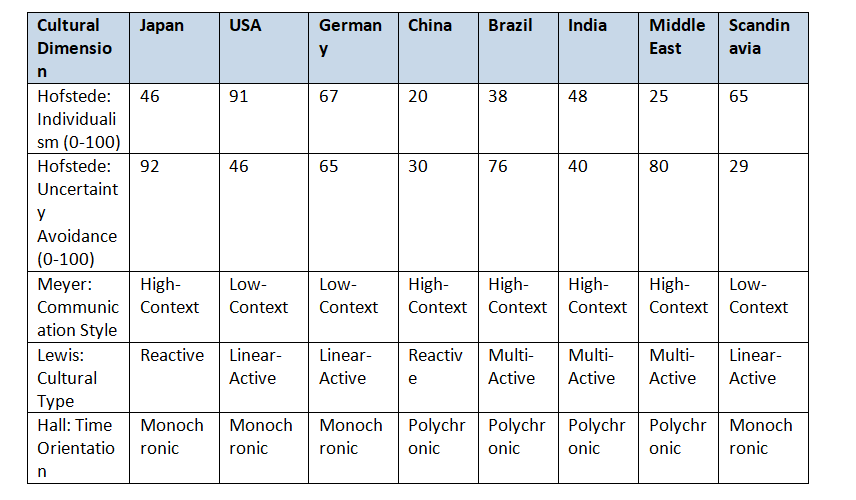
Geert Hofstede’s 6 Dimensions provide quantitative scores enabling comparison. For example, Japan scores high on Uncertainty Avoidance (92) and Collectivism (46 individualism score), reflecting a preference for risk minimization and group harmony, influencing their indirect negotiation style and preference for consensus (ringi). In contrast, the United States scores low on Uncertainty Avoidance (46) but very high on Individualism (91), favoring straightforward, competitive negotiation.
Erin Meyer’s Culture Map extends Hofstede with 8 scales including Communication (Low-Context vs High-Context) and Trust (Task-Based vs Relationship-Based). China’s high-context communication and relationship-based trust (guanxi) contrast sharply with German low-context, task-based interactions, explaining misunderstandings in joint ventures.
Richard Lewis’s triad classifies cultures as Linear-Active (German, Swiss), Multi-Active (Brazilian, Italian), or Reactive (Japanese, Korean). For example, Brazilians’ warmth and flexibility (jeitinho) may clash with the German preference for punctuality and Sachlichkeit (objectivity).
Edward Hall’s concepts of high- vs low-context communication and monochronic vs polychronic time further deepen understanding. Middle Eastern cultures tend to be high-context and polychronic, emphasizing relationships and fluid time, unlike the monochronic, low-context Scandinavian cultures which prize directness and schedules.
Richard Gesteland identifies dimensions such as Deal-Focus vs Relationship-Focus and Expressive vs Reserved. The American style is deal-focused and moderately expressive, whereas Indian negotiation is relationship-focused and often emotionally expressive within hierarchical respect frameworks.
David Livermore’s Cultural Intelligence (CQ) model underscores the need for Drive (motivation), Knowledge, Strategy, and Action to navigate cultural complexity effectively.
Trompenaars & Hampden-Turner’s seven dimensions, including Universalism vs Particularism and Achievement vs Ascription, clarify why French negotiators prize intellectual argumentation (universalism) while many Asian cultures emphasize ascription — respecting status and networks.
This foundational understanding provides a detailed map of cultural terrain, essential for tailoring negotiation approaches.
Key Frameworks and Models — Comparative Analysis of Negotiation Cultures
Three frameworks stand out for practical negotiation adaptation: Hofstede’s Dimensions, Erin Meyer’s Culture Map, and Richard Lewis’s Model. Comparing these across countries clarifies how negotiation styles vary.
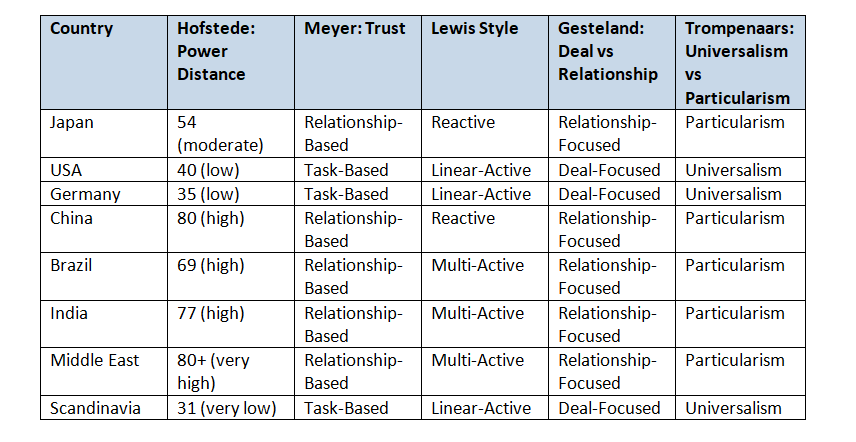
This table reveals, for example, that cultures with high Power Distance and Relationship-Based trust (China, India, Middle East) demand negotiators to first build strong interpersonal bonds, respecting hierarchy and face (mianzi). Conversely, low Power Distance and Task-Based trust cultures like Germany and Scandinavia expect direct, fact-based interactions.
Step-by-Step Strategy — Six Essential Steps to Adapt Your Negotiation Style Across Cultures
Step 1: Conduct Pre-Negotiation Cultural Research and Self-Assessment
Begin by analyzing your counterpart’s cultural profiles using Hofstede, Meyer, and Lewis frameworks. Reflect on your own cultural biases and negotiation habits. Use Livermore’s CQ Drive and Knowledge to prepare mentally.
Tactics:
· Use reliable country cultural profiles before meetings.
· Identify key differences in communication style, time orientation, and trust-building.
· Prepare to modify your natural style rather than impose it.
Step 2: Build Relationship and Trust According to Cultural Norms
In high Power Distance and Relationship-Based cultures (China, India, Middle East), prioritize face-to-face meetings, informal small talk, and gift-giving rituals to build guanxi, wasta, or nunchi sensitivity.
Tactics:
· Allocate time for socializing before business.
· Practice active listening and humility.
· Avoid rushing into contract talks without prior consensus (nemawashi in Japan).
Step 3: Adapt Communication Style — From Direct to Indirect or Vice Versa
When negotiating with reactive or high-context communicators (Japan, Korea, China), employ subtle language, read non-verbal cues, and avoid blunt refusals.
Tactics:
· Use softening phrases like “perhaps we might consider” instead of “no.”
· Confirm understanding with questions rather than statements.
· In low-context cultures, be explicit and precise to avoid ambiguity.
Step 4: Manage Time Expectations and Meeting Protocols
Adjust to monochronic or polychronic time orientation. Germans and Scandinavians expect punctuality and agenda adherence; Middle Eastern and Latin American cultures allow flexible timing.
Tactics:
· Confirm meeting schedules well in advance.
· Allow buffer time in polychronic cultures, avoid pushing strict deadlines.
· Use patience as a negotiation tool in high Uncertainty Avoidance cultures.
Step 5: Address Conflict With Appropriate Styles
Use the Thomas-Kilmann Conflict Mode Instrument adapted by culture:
- In individualistic, low-context cultures (USA, Germany), direct confrontation and compromise may work.
- In collectivist, high-context cultures (Japan, China), avoid open conflict; employ accommodating or avoiding styles initially.
Tactics:
· Use private discussions to resolve conflicts in high-context cultures.
· Frame disagreements as mutual problem-solving, not personal criticism.
Step 6: Close the Deal Respectfully and Confirm Mutual Understanding
Ensure the contract or agreement reflects the negotiation style. In high-context or particularistic cultures (China, Brazil), oral agreements and relationship continuity matter; in universalistic cultures (Germany, USA), detailed written contracts are essential.
Tactics:
· Confirm agreements with written documentation appropriate to culture.
· Use subtle language to confirm consensus in reactive cultures.
· Express gratitude and reaffirm relationship importance.
Real-World Case Studies — Cross-Cultural Negotiation Successes and Failures
Case 1: Japan-American Automotive Joint Venture Failure (2018)
The American team’s aggressive agenda and direct demands clashed with the Japanese preference for ringi, a bottom-up consensus process. The Americans’ disregard for nemawashi led to mistrust and deal failure.
Lesson: Always invest time in informal consensus-building in Japan; rushing erodes trust.
Case 2: German-Brazilian Manufacturing Contract Success (2016)
The German firm adapted their typically rigid-time, deal-focused style by incorporating Brazilian warmth, flexibility, and jeitinho improvisation. They allowed informal negotiations and social events, building relationship capital that smoothed contract complexities.
Lesson: Flexibility and warmth in multi-active cultures enable smoother negotiations.
Case 3: Middle East-European Energy Partnership (2020)
European negotiators initially insisted on detailed written contracts and strict timelines, offending their Middle Eastern partners who prioritized wasta and relational trust. Adjusting with more informal meetings, honoring status, and demonstrating patience led to successful agreement.
Lesson: Recognize the primacy of relationship-building and fluid time in Middle Eastern contexts.
Country/Region-Specific Insights — Cultural Do’s and Don’ts in Negotiation
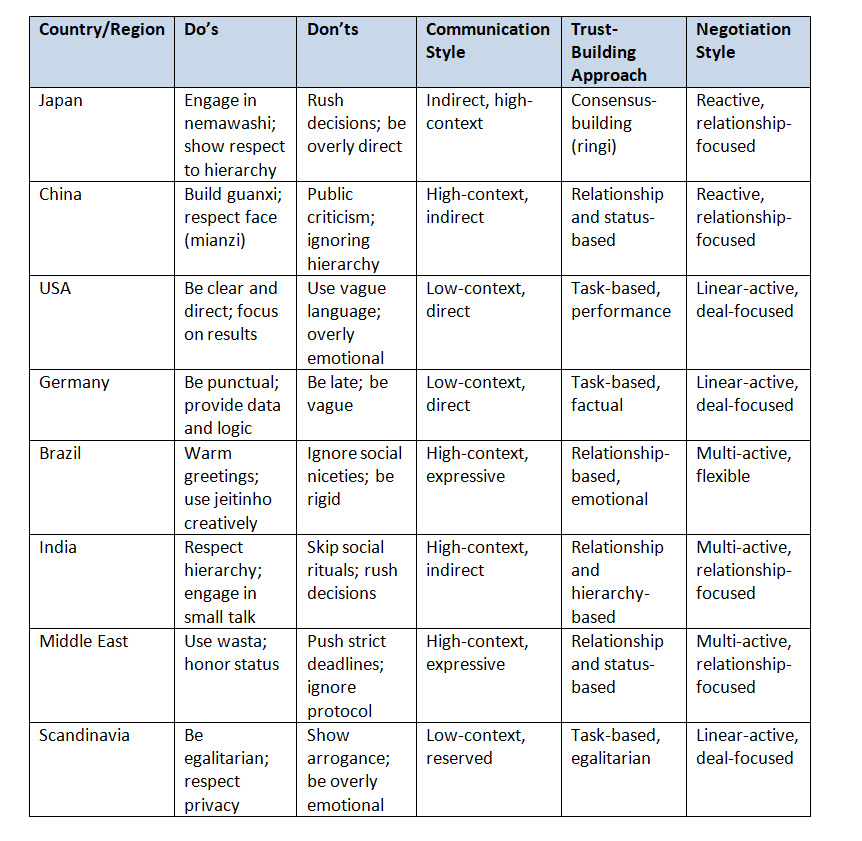
Advanced Strategies — Expert-Level Cross-Cultural Negotiation Techniques
· Employ Dynamic Cultural Intelligence (CQ) by continuously scanning verbal and non-verbal cues and adjusting approach in real time.
· Use “Cultural Bridging” by engaging local cultural intermediaries or cultural brokers who understand both sides’ mental models.
· Implement “Face Management” strategies in high face cultures (China, Japan) to prevent loss of dignity and maintain harmony.
· Leverage “Time Conversion” by negotiating deadlines in culturally sensitive ways, allowing buffer for polychronic partners.
· Apply “Conflict Reframing” techniques to transform criticism into joint problem-solving, especially in high-context cultures.
· Develop “Cultural Scripts” tailored to counterpart culture that embed linguistic politeness, indirectness, and respect signals naturally.
Scripts and Templates — Exact Negotiation Language Adapted by Culture
Script 1: Initiating a Meeting in Japan (Polite, Indirect)
“Thank you very much for taking the time today. We hope to understand your views thoroughly and work together towards a solution beneficial for all parties. Perhaps we might begin by exploring your perspectives at your convenience.”
Script 2: Expressing Concerns in Germany (Direct, Factual)
“We have identified several points in the proposal that require clarification to meet our quality standards. Could we review these sections in detail to ensure mutual understanding and compliance?”
Script 3: Building Rapport in Brazil (Warm, Expressive)
“It is a pleasure to meet you. I have heard wonderful things about your company and look forward to not only doing business but building a strong friendship between our teams.”
Script 4: Handling Disagreement in China (Indirect, Face-Sensitive)
“Your perspective is valuable, and while we see some challenges in this area, we wonder if there might be alternative approaches that could satisfy both sides’ interests.”
Script 5: Closing a Deal in the USA (Direct, Confirmatory)
“Based on our discussions, we agree on the key terms. I will prepare the contract reflecting these points and send it for your review by tomorrow. Please let me know if you have any questions.”
Frequently Asked Questions
Q1: How can I quickly assess the negotiation style of a new cultural counterpart?
A1: Use pre-meeting research leveraging Hofstede and Meyer’s frameworks, observe verbal and non-verbal cues during initial interactions, and ask local contacts about decision-making norms. Livermore’s CQ strategy encourages planning and reflection to adapt in real time.
Q2: What are common pitfalls when negotiating with high-context cultures?
A2: Pitfalls include being overly direct, ignoring non-verbal cues, rushing decisions, and neglecting relationship-building rituals like gift exchange or socializing. These can cause loss of face and trust, derailing negotiations.
Q3: How do I manage conflicting time orientations in international deals?
A3: Clarify expectations early, build flexibility into schedules, and use time respectfully. In polychronic cultures, avoid pushing strict deadlines; in monochronic cultures, communicate scheduling changes promptly.
Q4: How important is hierarchy in cross-cultural negotiations?
A4: Extremely important in high Power Distance cultures like China, India, and the Middle East. Address senior figures respectfully, understand decision-making authority, and avoid bypassing formal channels.
Q5: Can conflict ever be direct in relationship-focused cultures?
A5: Rarely in public or initial stages. Use private, indirect approaches emphasizing harmony and joint problem-solving. Over time, trusted relationships may allow more openness.
Conclusion
Adapting your negotiation style across cultures is not optional but a critical skill in today’s globalized economy. By grounding your approach in well-established cultural frameworks and applying actionable strategies—ranging from relationship-building to communication adaptation—you significantly increase your likelihood of successful outcomes. The complexity and nuance of intercultural negotiation require patience, humility, and cultural intelligence, but mastering these leads to stronger partnerships and sustainable business growth.
This definitive guide equips you with the theoretical foundation, practical step-by-step strategies, real-world examples, and exact scripts to navigate diverse cultural terrains confidently. Begin applying these insights today to transform your cross-border negotiations from risky gambles into repeatable successes.
References
· Hofstede, G. (2001). Culture’s Consequences: Comparing Values, Behaviors, Institutions and Organizations Across Nations.
· Meyer, E. (2014). The Culture Map: Breaking Through the Invisible Boundaries of Global Business.
· Lewis, R. D. (2006). When Cultures Collide: Leading Across Cultures.
· Hall, E. T. (1976). Beyond Culture.
· Livermore, D. (2015). Leading with Cultural Intelligence: The Real Secret to Success.
· Trompenaars, F., & Hampden-Turner, C. (1997). Riding the Waves of Culture: Understanding Diversity in Global Business.