Advanced Negotiation Tactics Used by Elite Dealmakers

Negotiation rooms are battlegrounds where fortunes, careers, and corporate futures are decided in minutes, sometimes seconds. Consider the historic 2011 Apple vs. Samsung patent settlement talks, where months of litigation gave way to a high-stakes negotiation session. Amid mounting pressure, Apple’s legal team deployed calibrated questions and tactical empathy from Chris Voss's "Never Split the Difference" playbook, diffusing tension and extracting favorable concessions. The stakes were astronomical: billions in damages, global market share shifts, and technological dominance. Yet most negotiators facing similarly high-pressure scenarios falter by relying on outdated, positional bargaining or failing to recognize psychological undercurrents driving decisions.
The psychology behind these moments is profound. Behavioral economists like Daniel Kahneman reveal how cognitive biases such as anchoring and loss aversion subconsciously shape offers and counteroffers. Robert Cialdini’s principles of reciprocity and scarcity influence concession patterns. Meanwhile, game theory shows that understanding the opponent’s payoff matrix can transform zero-sum conflicts into value-creating opportunities. Most practitioners misunderstand or overlook these elements, defaulting to win-lose tactics that undermine long-term value and relationships.
This definitive guide equips you to master advanced negotiation tactics employed by elite dealmakers worldwide. You will learn the science underpinning human decision-making in negotiation, dissect cutting-edge frameworks like Voss's Tactical Empathy and Shell’s Bargaining for Advantage, and follow a precise six-step process for structuring negotiations. Real-world case studies from M&A deals, NFL contract disputes, and diplomatic talks reveal how these tactics play out under pressure. You will also gain a comprehensive recognition and counter-response guide for defense against manipulative tactics, expert-level insights beyond the basics, and exact word-for-word scripts for critical scenarios. Whether you lead enterprise sales, legal negotiations, or international diplomacy, you will transform your ability to secure superior agreements with integrity and strategic finesse.
· Table of Contents
· The Psychology and Science Behind Advanced Negotiation Tactics
· Key Frameworks and Models in Elite Negotiations
· Step-by-Step Negotiation Process for Maximum Impact
· Real-World Case Studies of High-Stakes Deals
· Recognition and Counter-Response Guide for Common Tactics
· Advanced Insights Beyond Basic Negotiation
· Scripts and Templates for Elite Negotiators
· Frequently Asked Questions
· Conclusion and Call to Action
· References
The Psychology and Science Behind This Topic
Elite negotiation tactics are deeply rooted in behavioral economics, cognitive psychology, and game theory. Understanding these scientific foundations enables negotiators to anticipate, influence, and guide counterpart behavior with precision.
Daniel Kahneman’s Prospect Theory (1979) demonstrated that people disproportionately weigh losses over equivalent gains, a phenomenon known as loss aversion. This triggers a strong emotional response during negotiation concessions, making framing offers in terms of potential losses versus gains critical. For example, presenting a discount as avoiding a penalty rather than earning a reward taps into loss aversion, increasing acceptance rates.
Anchoring bias, also elucidated by Kahneman and Tversky, occurs when initial offers disproportionately influence subsequent negotiation ranges. Elite negotiators leverage this by setting strong opening anchors, which shift the negotiation zone of possible agreement (ZOPA) favorably. However, they also recognize when to counter-anchor or reframe to neutralize opponent anchors.
Robert Cialdini’s six principles of influence (1984) provide a roadmap for persuasion: reciprocity, scarcity, authority, consistency, liking, and social proof. Reciprocity creates obligation by offering concessions first, scarcity increases urgency, while consistency nudges counterparts to honor previous commitments—each principle strategically deployed by expert negotiators.
Chris Voss’s tactical empathy (2016) extends these psychological insights into actionable techniques: mirroring (repeating the last few words), labeling (naming emotions), calibrated questions (open-ended queries that shape thinking), and the accusation audit (preemptively addressing objections). These foster trust and guide counterparts toward collaboration rather than confrontation.
Game theory, with concepts like the Nash equilibrium and the prisoner's dilemma, explains the strategic interdependence of negotiation decisions. Elite dealmakers identify whether a negotiation is zero-sum or positive-sum and adjust tactics accordingly to unlock integrative solutions, creating value beyond simple concessions.
Finally, power dynamics studied by Machiavelli and Sun Tzu remind negotiators that beyond logic, perception, timing, and psychological dominance influence outcomes. Recognizing when to exert pressure versus when to yield reflects deep strategic acumen.
Together, these scientific insights form the foundation for the advanced tactics detailed in this guide.
Key Frameworks and Models
Several established frameworks and models provide structured approaches to mastering advanced negotiation tactics. Understanding their differences and applications empowers negotiators to select the optimal strategy for each context.
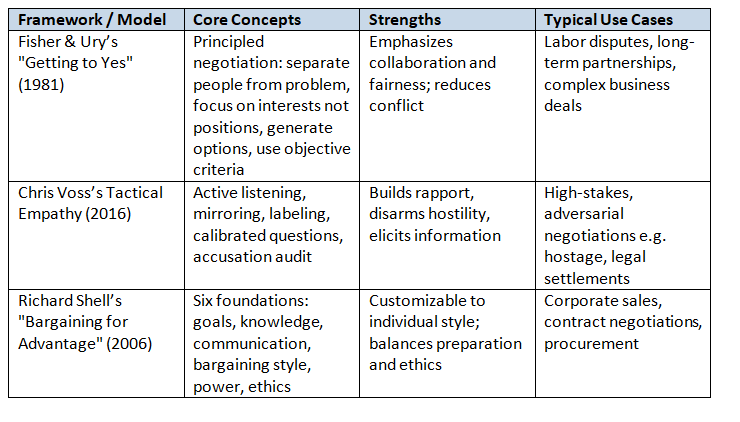
Each framework contributes unique tactical tools:
- "Getting to Yes" introduces interest-based negotiation to overcome positional deadlock.
- Tactical Empathy offers psychological rapport-building for emotional control.
- Bargaining for Advantage integrates self-awareness with situational analysis and ethics.
Elite dealmakers often hybridize these models depending on relational dynamics, stakes, and cultural context.
Step-by-Step Process or Analysis
Mastering advanced negotiation requires a disciplined, phased approach integrating psychological insight, tactical communication, and strategic flexibility. Below is a stepwise framework with detailed guidance.
Step 1: Preparation and Intelligence Gathering
Before negotiation, comprehensive research is essential. Understand counterpart goals, constraints, BATNA (Best Alternative to a Negotiated Agreement), and cultural context. Use open-source intelligence, industry reports, and stakeholder interviews.
Psychologically, preparation reduces uncertainty and enhances confidence, mitigating anxiety-driven errors. Frame your objectives around interests, not rigid positions.
Step 2: Establish Rapport and Tactical Empathy
Open with calibrated questions and empathetic statements to build trust. Use Voss’s mirroring to encourage counterpart elaboration and labeling to acknowledge emotions.
Example: "It sounds like you’re concerned about meeting your deadlines—can you tell me more about that?"
This sets a collaborative tone, lowers defenses, and yields valuable information.
Step 3: Anchor with Strategic Offers
Deploy strong yet justifiable anchors informed by prior research. Use objective criteria (market data, precedents) to legitimize your opening.
Psychology: Anchors influence perception of value and acceptable concessions. Avoid overreaching to prevent loss of credibility.
Step 4: Probe Interests and Use Calibrated Questions
Shift focus from positions to underlying interests by asking open-ended, calibrated questions.
Example: "How can we structure this agreement to ensure both teams meet their key objectives?"
This uncovers integrative possibilities and steers negotiation toward value creation.
Step 5: Manage Concessions with Reciprocity and Scarcity
Concede strategically—small, reciprocal concessions increase counterpart’s sense of obligation. Introduce scarcity to create urgency without coercion.
Example: "We can extend this favorable term if we finalize by next week, as our capacity is limited."
Step 6: Close and Confirm with Objective Criteria and Summaries
Summarize agreed points clearly using objective standards to reduce ambiguity. Use “accusation audit” to preempt final objections.
Example: "I realize this timeline might feel tight, but given market demands, it’s our best option."
Confirm mutual understanding and next steps to solidify agreement.
Real-World Case Studies
Case Study 1: Apple vs. Samsung Patent Litigation Settlement (2011)
Context: Years of costly patent infringement lawsuits culminated in settlement talks.
What Happened: Apple used calibrated questions and labeling to humanize adversaries, breaking deadlock. Anchoring with $2.5 billion damages claim reset Samsung’s expectations. Strategic concessions and reciprocal offers led to a confidential settlement, avoiding prolonged litigation.
Lesson: Tactical empathy and precise anchoring can transform adversarial disputes into negotiated resolutions, saving time and reputational capital.
Case Study 2: NFL Contract Negotiations – Tom Brady’s 2017 Deal
Context: Negotiations between Tom Brady and New England Patriots involved salary cap constraints and player value maximization.
What Happened: Brady’s agent employed framing effects emphasizing loss aversion—highlighting what the Patriots would lose without the player. They used scarcity by signaling limited offers elsewhere. The final deal balanced cap flexibility with guaranteed compensation.
Lesson: Highlighting counterpart’s potential losses and scarcity pressures strategically motivates concessions, even in long-term relationships.
Case Study 3: Diplomatic Talks – Iran Nuclear Agreement (2015)
Context: Multinational negotiations involving complex, high-stakes security issues.
What Happened: Parties utilized mutual interest framing, objective criteria (IAEA verification standards), and tactical patience. Accusation audits addressed mistrust upfront, while calibrated questions opened channels for phased agreements.
Lesson: Integrative negotiation focused on interests and trust-building mechanisms can produce breakthroughs in seemingly intractable disputes.
Recognition and Counter-Response Guide
Elite negotiators must identify tactics deployed by counterparts and counter them effectively. Below is a detailed mapping.
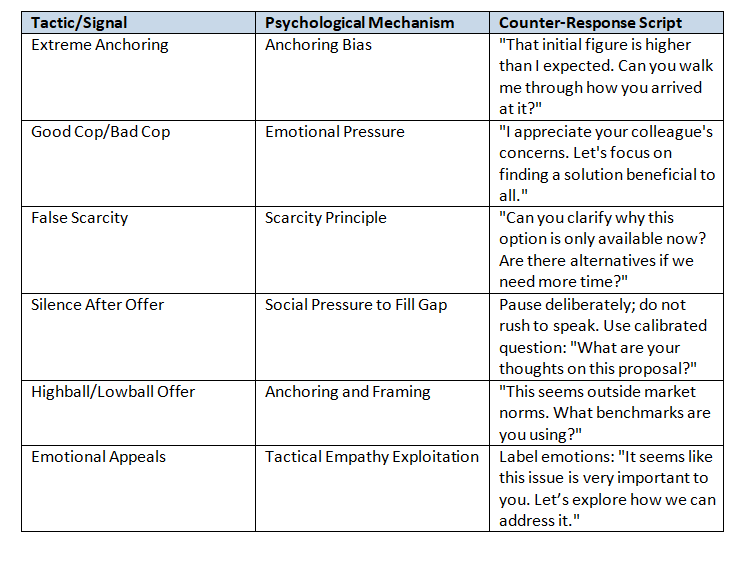
Deploying these counters disarms manipulation and regains control while maintaining rapport.
Advanced Insights
Beyond foundational tactics, elite dealmakers employ nuanced techniques:
- Time as a Weapon: Using controlled delays or deadlines to shift bargaining power, exploiting opponent impatience.
- Multi-Issue Bundling: Packaging several negotiation points to create trade-offs maximizing joint value (logrolling).
- Narrative Framing: Crafting compelling stories aligning your interests with counterpart values, influencing their identity and commitment.
- Shadow Negotiations: Managing informal talks and relationships outside formal negotiation sessions to build consensus.
- Meta-Negotiation: Negotiating the negotiation process itself — rules, agenda, and authority — to shape power dynamics.
These require situational awareness and emotional intelligence to execute without alienating counterparts.
Scripts and Templates
Script 1: Opening with Tactical Empathy
"I understand this project is critical for your team’s success. Can you help me understand the biggest challenges you are facing right now?"
Script 2: Calibrated Question to Uncover Interests
"What’s the most important outcome for you in this agreement?"
Script 3: Counter Extreme Anchor
"That number is quite a surprise. Can you share the data or assumptions behind it so we can evaluate it properly?"
Script 4: Managing Concessions
"We’re willing to adjust the delivery timeline if we can agree on revised payment terms. How does that sound from your side?"
Script 5: Closing with Accusation Audit
"I realize some terms may feel restrictive, but given the market conditions, this is the most sustainable approach. What concerns do you still have?"
Frequently Asked Questions
Q1: How do I identify when a negotiation is zero-sum versus positive-sum?
A1: Analyze whether interests are purely conflicting or if trade-offs exist across issues. Use open-ended questions to uncover integrative possibilities. Positive-sum allows value creation; zero-sum often requires focus on claim-value tactics.
Q2: What if the counterpart refuses to engage in tactical empathy or collaborative approaches?
A2: Maintain professionalism and use calibrated questions to slowly build rapport. If resistance persists, protect your BATNA and consider whether to walk away or shift to positional bargaining.
Q3: How can I prevent anchoring bias from skewing my judgment?
A3: Prepare objective data benchmarks in advance. Deliberately re-anchor by presenting alternative figures and ask for justification of extreme anchors.
Q4: When should I reveal my BATNA during negotiation?
A4: Reveal BATNA strategically when it strengthens your position without giving leverage to the counterpart. Sometimes implicit signaling suffices; other times explicit disclosure is beneficial.
Q5: How do cultural differences affect advanced negotiation tactics?
A5: Cultural norms influence communication style, power distance, and trust-building. Adapt your approach by researching counterpart culture and adjusting language, formality, and pacing accordingly.
Conclusion
Mastering advanced negotiation tactics is not merely about winning isolated battles but creating enduring value while preserving relationships and reputation. By integrating psychological science, robust frameworks, and precise communication strategies, elite dealmakers transform complex, high-stakes negotiations into opportunities for innovation and partnership. Whether navigating billion-dollar M&A deals, contentious legal disputes, or delicate diplomacy, these tactics empower professionals to lead with confidence, empathy, and strategic foresight.
Commit to continuous learning and deliberate practice of these techniques. Begin by applying the six-step negotiation process and scripts in your next negotiation, and use the recognition and counter-response guide to defend against manipulative tactics. Elevate your negotiation mastery today to unlock superior outcomes tomorrow.
References
1. Kahneman, D. (2011). Thinking, Fast and Slow. Farrar, Straus and Giroux.
2. Cialdini, R.B. (1984). Influence: The Psychology of Persuasion. Harper Business.
3. Voss, C., & Raz, T. (2016). Never Split the Difference: Negotiating As If Your Life Depended On It. Harper Business.
4. Fisher, R., Ury, W., & Patton, B. (2011). Getting to Yes: Negotiating Agreement Without Giving In. Penguin Books.
5. Shell, R. (2006). Bargaining for Advantage: Negotiation Strategies for Reasonable People. Penguin Books.
6. Bazerman, M.H., & Neale, M.A. (1992). Negotiating Rationally. Free Press.