Avoiding Margin Erosion: How to Protect Profitability in Procurement Negotiations

In a high-stakes procurement negotiation between a leading automotive OEM and a critical Tier 1 supplier, the buyer faces intense pressure to reduce costs without compromising quality or delivery timelines. The supplier, equally aware of margin constraints, pushes back hard, warning that deeper cuts threaten their sustainability. This scenario plays out daily across industries from aerospace to retail, where procurement teams strive to protect their company’s profitability by avoiding margin erosion while maintaining strong supplier partnerships.
The strategic stakes could not be higher. Margin erosion in procurement not only reduces the bottom line but can also erode competitive advantage, disrupt supply chains, and damage long-term supplier relationships. Procurement leaders must navigate complex frameworks like the Kraljic Matrix, leverage Total Cost of Ownership (TCO) insights, and deploy skilled negotiation tactics grounded in research-backed psychology to safeguard margins effectively.
This comprehensive guide will equip procurement managers, category leaders, and CPOs with advanced frameworks, actionable step-by-step processes, real-world case studies, tactical negotiation scripts, and expert strategies to protect profitability during procurement negotiations. Readers will master how to identify risk areas, engage suppliers constructively, and counteract margin pressures while driving value creation and sustainable cost management.
· Table of Contents
· The Strategic Foundation: Frameworks, Models, and Psychology in Margin Protection
· Key Frameworks and Models: Kraljic Matrix, Total Cost of Ownership, Should-Cost Modeling
· Step-by-Step Process: Mitigating Margin Erosion in Procurement Negotiations
· Real-World Case Studies: Toyota, Apple, NHS Procurement
· Tactics and Counter-Tactics: Negotiation Scripts and Response Frameworks
· Advanced Strategies: Lean Procurement, Value Engineering, and Supplier Segmentation
· Scripts and Templates: Word-for-Word Language for Buyers and Sellers
· Frequently Asked Questions (FAQs)
· Conclusion and Call to Action
· References
The Strategic Foundation - frameworks, models, psychology with named research
Avoiding margin erosion during procurement negotiations requires a strategic foundation built on robust frameworks, economic models, and behavioral psychology. At its core, procurement is a value-creation discipline that balances cost reduction with risk management and supplier relationship stewardship.
The seminal Kraljic Matrix (Kraljic, 1983) remains foundational in segmenting suppliers by supply risk and profit impact, enabling procurement to tailor negotiation strategies that optimize margin preservation. Strategic items with high profit impact but high supply risk demand careful collaboration rather than aggressive price cuts.
Total Cost of Ownership (Ellram, 1995) expands the focus beyond purchase price to include quality, delivery, inventory, and end-of-life costs, helping buyers avoid margin erosion from hidden downstream expenses.
Behavioral economics research by Kahneman and Tversky (1979) on Prospect Theory highlights how loss aversion shapes negotiation dynamics. Buyers and sellers weigh potential losses more heavily than gains, making it crucial to frame proposals in ways that emphasize mutual benefit and minimize perceived threats to supplier margins.
Porter’s Five Forces (Porter, 1979) provides insight into the bargaining power of suppliers and buyers. A strong supplier position can erode buyer margins; thus, advanced procurement requires supplier segmentation and value engineering to rebalance power and preserve profitability.
These strategic pillars underscore that protecting margin is not just about price haggling but involves systemic analysis, supplier collaboration, and psychological insight to achieve sustainable procurement outcomes.
Key Frameworks and Models
This section reviews three critical frameworks essential for understanding and preventing margin erosion in procurement negotiations: Kraljic Matrix, Total Cost of Ownership (TCO), and Should-Cost Modeling.
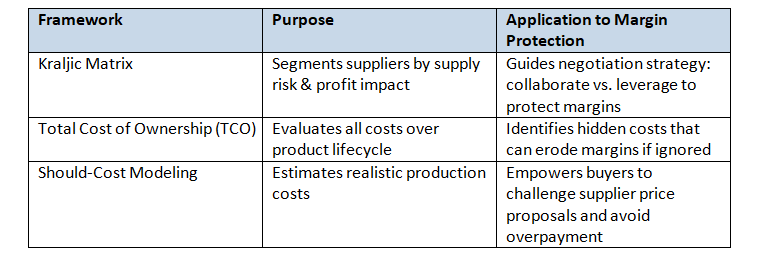
Kraljic Matrix enables procurement managers to prioritize resources and apply differentiated negotiation tactics. For example, Boeing uses Kraljic to classify aerospace suppliers, focusing on strategic partnerships where margin levers are limited and ensuring leverage on routine items.
TCO assessment, pioneered by companies like Walmart, drives a holistic cost view, revealing inventory carrying and quality costs that often cause margin leakage.
Should-Cost Modeling, employed by Apple’s supply chain teams, involves detailed cost breakdowns and benchmarking to identify fair supplier prices and push back on inflated quotes, directly curbing margin erosion.
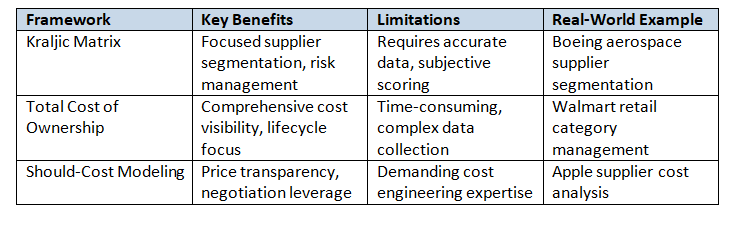
Together, these frameworks provide a robust conceptual and practical toolkit for procurement professionals to defend margins strategically and tactically.
Step-by-Step Process
Avoiding margin erosion is a disciplined process. Below is a detailed six-step approach with specific negotiation tactics and language for procurement managers.
Step 1: Supplier Segmentation Using Kraljic Matrix
Map suppliers on the Kraljic grid by assessing supply risk (availability, complexity) and profit impact (spend volume, margin sensitivity). This identifies which suppliers demand collaboration versus leverage tactics.
Tactic: Use cross-functional workshops to score suppliers objectively.
Language: “Our analysis categorizes you as a strategic supplier, so we aim to build a mutually beneficial partnership rather than focus solely on price.”
Step 2: Conduct a Total Cost of Ownership (TCO) Analysis
Calculate end-to-end costs including logistics, quality, warranty, and obsolescence to uncover hidden margin erosions.
Tactic: Collaborate with finance and operations for comprehensive cost data.
Language: “While your unit price is competitive, we want to understand total costs including delivery and quality to optimize overall value.”
Step 3: Develop a Should-Cost Model
Build a detailed cost estimate based on raw materials, labor rates, overhead, and margins to establish a fair price benchmark.
Tactic: Engage cost engineers and benchmark against industry data.
Language: “Based on our should-cost model, we believe there is room to revisit your price structure to reflect realistic production costs.”
Step 4: Establish Your BATNA and ZOPA
Define your Best Alternative to a Negotiated Agreement (BATNA) and Zone of Possible Agreement (ZOPA) informed by supplier alternatives and market conditions.
Tactic: Research alternative suppliers and market pricing thoroughly.
Language (Buyer): “Our BATNA includes a qualified second-source supplier offering competitive terms.”
Language (Supplier): “We recognize your alternatives but believe our quality and reliability provide superior value.”
Step 5: Execute Value Engineering and Lean Procurement Initiatives
Work with suppliers to redesign products/processes to reduce costs without sacrificing quality or innovation.
Tactic: Use cross-functional teams and continuous improvement workshops.
Language: “Let’s jointly explore design changes that reduce complexity and lower costs to protect margins on both sides.”
Step 6: Negotiate with Data-Driven Transparency and Psychological Insight
Leverage data and behavioral economics principles such as loss aversion, framing, and anchoring to guide discussions.
Tactic: Present data clearly, frame proposals to highlight mutual gains, and manage emotions.
Language: “Reducing costs by 5% enables reinvestment in future innovation, a win-win for both parties.”
This stepwise approach, combining rigorous analysis with skilled negotiation, equips procurement teams to defend margins effectively.
Real-World Case Studies
This section examines how leading organizations avoided margin erosion through procurement excellence.
Toyota’s Tier 1 Supplier Collaboration
Toyota’s renowned lean procurement strategy emphasizes close supplier partnerships and continuous cost reduction through value engineering. Toyota segments suppliers using the Kraljic Matrix and co-invests in process improvements, avoiding margin erosion by prioritizing total cost optimization over aggressive price cuts. This collaborative approach supports steady profitability and supply resilience.
Apple’s Should-Cost and Supply Chain Transparency
Apple employs advanced should-cost modeling and data analytics to benchmark supplier prices rigorously. By understanding true production costs and leveraging global supplier competition, Apple negotiates aggressively but fairly, preserving margins without compromising quality or innovation. Transparency and data-driven discussions prevent margin leaks.
NHS Procurement and Strategic Sourcing
The UK National Health Service (NHS) faced margin erosion risks due to fragmented purchasing and supplier consolidation. Implementing category management frameworks and strategic sourcing processes, NHS procurement centralized spend and used supplier segmentation to negotiate volume discounts and service-level agreements. This systematic approach reduced costs while safeguarding quality critical to patient outcomes.
Lessons Learned
· Collaborative supplier relationships can mitigate margin erosion better than confrontational tactics.
· Data-driven cost transparency is essential to challenge supplier pricing effectively.
· Tailored strategies based on supplier segmentation maximize negotiation impact.
· Continuous improvement and value engineering sustain margins in dynamic markets.
Tactics and Counter-Tactics
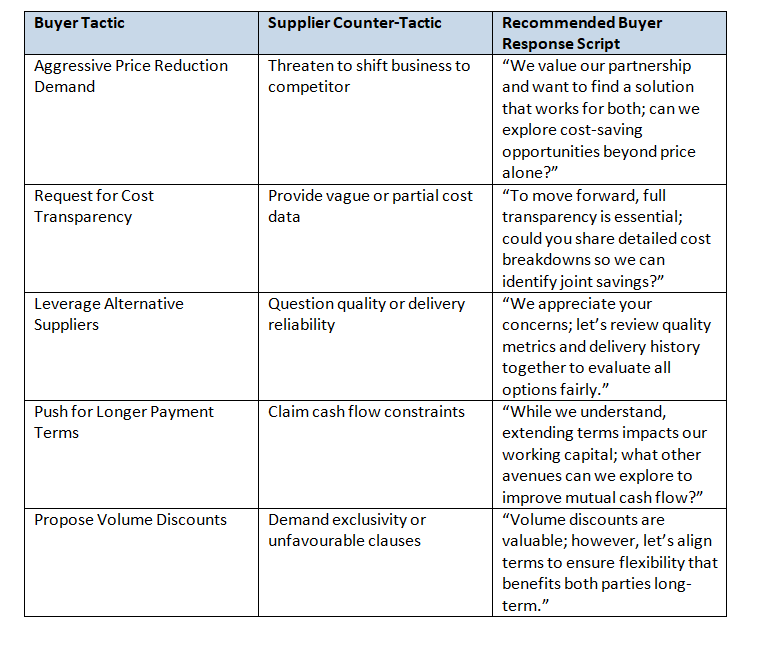
Procurement negotiations are dynamic. Below is a table summarizing common buyer tactics, supplier counter-tactics, and recommended buyer responses to protect margins.
Advanced Strategies - expert-level techniques
Experienced procurement leaders employ advanced strategies to protect margins beyond foundational tactics.
Lean Procurement Integration
Adopting lean principles streamlines procurement processes, reduces waste, and enhances supplier responsiveness. Toyota’s Just-in-Time system embodies this, minimizing inventory costs and margin drag.
Supplier Segmentation with Dynamic Analytics
Using real-time data analytics to continuously update supplier segmentation enables agile negotiation strategies sensitive to market shifts and supplier performance.
Value Engineering Partnerships
Collaborating with suppliers early in product development to redesign for cost efficiency, as practiced by Boeing, prevents margin erosion by embedding cost control upfront.
Multi-Channel Sourcing and Risk Mitigation
Diversifying supplier base strategically prevents overreliance on single suppliers who can pressure margins. Amazon’s supply chain exemplifies this approach with multiple sourcing hubs.
Behavioral Negotiation Mastery
Applying psychological frameworks such as anchoring, framing, and reciprocity enhances negotiation outcomes by managing perceptions and fostering trust.
Scripts and Templates - 4-5 word-for-word scripts
Script 1: Initiating Margin Protection Discussion
“Thank you for your partnership. As we review upcoming contracts, our goal is to ensure sustainable profitability for both parties. We’d like to understand your cost drivers better and explore opportunities for mutual value creation.”
Script 2: Requesting Cost Transparency
“To make informed decisions, could you provide a detailed breakdown of your costs including materials, labor, and overhead? This transparency will help identify areas to optimize together.”
Script 3: Responding to Threats to Shift Business
“We understand the competitive pressures you face. Our preference is to continue this successful partnership, so let’s work collaboratively to address margin concerns rather than consider alternatives.”
Script 4: Proposing Value Engineering Collaboration
“Let’s schedule a joint workshop with your engineering team to explore design modifications that can reduce costs without impacting quality or performance.”
Script 5: Closing with Mutual Gain Emphasis
“Achieving a 5% cost reduction allows us to reinvest in innovation and volume growth, benefiting both our organizations. How can we align to realize this together?”
Frequently Asked Questions - 5 detailed Q&As
Q1: How do I balance aggressive cost reduction with maintaining supplier relationships?
A1: Use supplier segmentation to differentiate strategies. For strategic suppliers, focus on collaboration, transparency, and joint value creation rather than unilateral price cuts. For leverage suppliers, more assertive negotiation is appropriate. Maintaining open communication and fairness prevents relationship damage.
Q2: What role does Total Cost of Ownership play in preventing margin erosion?
A2: TCO reveals hidden costs beyond purchase price such as logistics, inventory, and quality failures. By optimizing these, buyers avoid margin leakage that simple price reductions cannot fix. It provides a holistic cost perspective and stronger negotiation foundation.
Q3: How can I prepare for supplier resistance to cost transparency requests?
A3: Build trust by explaining the mutual benefits of transparency. Use should-cost models to validate requests. If suppliers resist, escalate by presenting alternative sourcing options and highlighting collaboration opportunities for cost reduction.
Q4: What is a BATNA and how does it help protect margins?
A4: BATNA is your best alternative if negotiations fail. Knowing your BATNA strengthens negotiation power and prevents conceding to unfavorable terms that erode margins. Always research alternative suppliers and market rates before negotiations.
Q5: How can behavioral economics improve procurement negotiations?
A5: Understanding concepts like loss aversion and framing helps craft proposals that reduce perceived threats, encouraging supplier cooperation. For example, framing cost reductions as shared gains fosters collaboration rather than confrontation.
Conclusion - 2 paragraphs + CTA
Protecting profitability in procurement negotiations demands a strategic blend of rigorous frameworks, data-driven analysis, and nuanced psychological insight. By applying tools like the Kraljic Matrix, TCO, and should-cost modeling alongside advanced tactics such as value engineering and lean procurement, procurement leaders can effectively guard against margin erosion while fostering sustainable supplier partnerships.
The stakes are significant—margin erosion can undercut competitiveness and financial health if left unchecked. Armed with the processes, case studies, scripts, and strategies outlined here, procurement professionals are well-equipped to navigate complex negotiations and secure enduring profitability. Begin implementing these best practices today to transform your procurement function into a high-value margin protector.
Contact our expert team for tailored guidance on embedding these strategies in your organization and elevating your procurement negotiations to the next level.
Need more knowedge? Visit:
https://www.michalchmielecki.com/procurement-negotiation
References
· Kraljic, P. (1983). Purchasing Must Become Supply Management. Harvard Business Review.
· Ellram, L.M. (1995). Total Cost of Ownership: Elements and Implementation. International Journal of Purchasing and Materials Management.
· Kahneman, D., & Tversky, A. (1979). Prospect Theory: An Analysis of Decision under Risk. Econometrica.
· Porter, M.E. (1979). How Competitive Forces Shape Strategy. Harvard Business Review.
· NHS Procurement Transformation Programme, UK Government Reports.
· Toyota Production System and Lean Procurement Case Studies, Industry Publications.