
Avoiding Price Wars: How to Compete on Value, Not Price

In 2019, a global SaaS company found itself in a brutal price war with a low-cost competitor. Within six months, their average deal size shrank by 35%, margins evaporated, and client churn soared. The sales team was trapped in endless discount requests, and leadership faced a stark choice: slash prices to unsustainable levels or lose market share entirely. This scenario is far from unique. According to a McKinsey report, over 70% of companies that engage in price wars see their profitability decline sharply, and more than half regret initiating aggressive discounting battles.
The stakes could not be higher. Price wars not only erode margins but also damage brand equity, commoditize your offering, and exhaust sales teams. Yet, the psychology of price perception—rooted in cognitive biases and behavioral economics—means that buyers do not always choose the cheapest option; perceived value often trumps sticker price. Understanding how to leverage these psychological principles is critical to shifting conversations from price to value, protecting margins, and closing premium deals.
This definitive guide arms senior sales professionals and business owners with deeply researched insights, proven frameworks, and actionable tactics to avoid destructive price competition. You will master advanced behavioral economics concepts, learn step-by-step value-selling processes, explore real-world case studies from market leaders like Apple and McKinsey, and gain ready-to-use scripts to confidently fend off discount demands. By the end, you will be equipped to transform your pricing strategy and win on value—not price.
· Table of Contents
· The Psychology and Science Behind Avoiding Price Wars
· Key Frameworks and Models for Competing on Value
· Step-by-Step Process to Shift Buyer Focus from Price to Value
· Real-World Case Studies: Apple, McKinsey, Salesforce
· Common Mistakes and How to Avoid Them
· Advanced Tactics for Premium Pricing Success
· Scripts and Templates to Handle Price Objections
· Frequently Asked Questions
· Conclusion and Next Steps
· References
The Psychology and Science Behind This Topic
Avoiding price wars requires deep understanding of how buyers perceive price and value. Behavioral economics research reveals that pricing decisions are far from rational calculations; instead, they are influenced by cognitive biases, heuristics, and social psychology.
At the core lies Kahneman and Tversky’s Prospect Theory (1979), which explains how people evaluate potential losses and gains asymmetrically. Buyers are loss averse: the pain of paying a higher price often feels greater than the pleasure of receiving better quality. However, this does not mean buyers always pick the lowest price—they evaluate perceived value relative to reference points.
Anchoring is a powerful heuristic in pricing. Ariely’s landmark experiments in "Predictably Irrational" show that initial price exposures anchor perceptions, even when arbitrary. For example, presenting a higher-priced “decoy” option can make a mid-tier offering appear more reasonable, nudging buyers toward it. This decoy effect is widely used by luxury brands and SaaS pricing tiers to steer choices.
The price-quality heuristic is another critical factor: consumers often associate higher prices with higher quality, especially in complex B2B purchases where quality is hard to verify directly. This heuristic can backfire if prices are too low, signaling inferior quality.
Robert Cialdini’s principles of influence—particularly scarcity and reciprocity—also impact price perception. Scarcity (limited availability or time-limited offers) increases perceived value, while reciprocity (offering something first) builds goodwill that justifies premium pricing.
Reference pricing, where buyers compare your price to competitors or past prices, can trap sellers in downward spirals. The key is to reset reference points by educating buyers on total cost of ownership, ROI, and unique differentiators.
Understanding these psychological and economic principles enables sales professionals to design pricing and messaging that shifts focus from price competition to value creation—breaking free from destructive price wars.
Key Frameworks and Models
Several established frameworks provide structure for competing on value rather than price. Here are three widely respected models:
1. Value-Based Selling (VBS): Focuses on quantifying and communicating the monetary and strategic value your solution delivers over alternatives, aligning with customer priorities.
2. Challenger Sale Model: Emphasizes teaching, tailoring, and taking control of the sales conversation to reframe buyer thinking toward value and away from price.
3. Jobs-to-be-Done (JTBD) Framework: Identifies the core “job” or outcome customers hire your product for, enabling you to highlight unique capabilities and avoid commoditization.
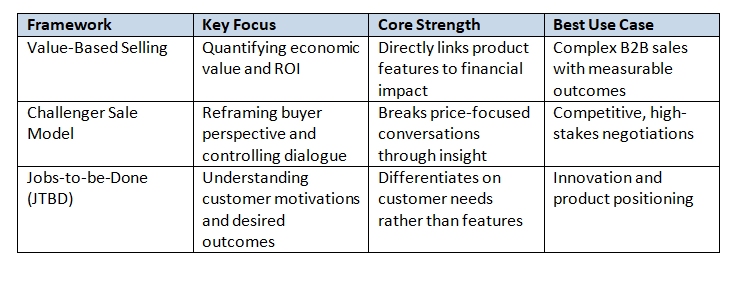
Each model complements the others. Combining value quantification (VBS), conversation control (Challenger), and customer-centric insight (JTBD) creates a powerful toolkit for avoiding price wars.
Step-by-Step Process
Step 1: Diagnose Customer Priorities and Pain Points
Begin by deeply understanding what drives the buyer’s decision beyond price. Use consultative questioning to uncover financial, operational, and strategic pain points. For example:
“What are the most critical challenges your team faces this quarter?”
“How do current solutions fall short in delivering ROI or efficiency?”
Step 2: Quantify Your Unique Value
Translate features and benefits into quantified outcomes—cost savings, revenue gains, risk mitigation, or competitive advantage. Use data, case studies, and benchmarks.
Phrase to use: “Based on our work with [similar client], we estimate this solution can reduce your operational costs by 15%, saving approximately $X annually.”
Step 3: Establish Strong Reference Points
Set the frame of comparison. Present your price alongside clearly articulated total cost of ownership and value delivered, not just sticker price. Avoid competing solely on list price.
Example script: “While our initial investment is higher than some alternatives, when you factor in reduced downtime and faster rollout, the total cost over 3 years is actually lower.”
Step 4: Use Anchoring and Decoy Pricing Strategically
Introduce premium options or bundles that make your core offering appear more attractive. The goal is to shift perception so buyers see your price as reasonable.
Example: Offer three tiers—Basic, Professional, and Enterprise—with the middle tier positioned as the best value.
Step 5: Counter Discount Requests with Value Reinforcement
When buyers push back on price, redirect to value:
“I understand budget is a concern. Let’s revisit how this solution delivers measurable savings and competitive agility that justify the investment.”
If needed, offer conditional value-added services instead of discounts.
Step 6: Build Scarcity and Reciprocity
Create urgency with limited-time offers or exclusive features, and offer small concessions upfront to build goodwill.
Example: “We’re currently offering a complimentary onboarding package for contracts signed this quarter.”
Real-World Case Studies
Apple Inc.: Apple’s premium pricing strategy exemplifies competing on value, not price. Despite higher prices, Apple leverages brand prestige, superior design, ecosystem lock-in, and customer experience to justify price points. Their use of scarcity (limited edition releases) and anchoring (highest-priced flagship models) reinforces perceived quality. This approach protects margins and enables Apple to avoid commoditized price battles common in consumer electronics.
McKinsey & Company: McKinsey charges value-based fees rather than hourly rates. They quantify impact through rigorous business cases and tailor proposals to client-specific outcomes, shifting discussion away from cost per hour to total value delivered. This approach enables McKinsey to command premium prices even in highly competitive consulting markets.
Salesforce: Salesforce uses tiered pricing and the decoy effect by offering multiple subscription levels—from Essentials to Unlimited—guiding customers toward mid-tier packages that balance features and price. Their sales teams are trained in Challenger Sale techniques to educate buyers on transformative CRM benefits, reducing discount pressures.
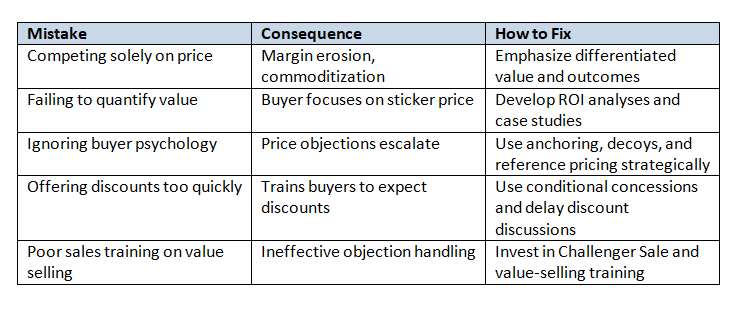
Common Mistakes and How to Avoid Them
Advanced Tactics
- Dynamic Reference Pricing: Monitor competitor pricing in real-time and adjust your value messaging accordingly to maintain favorable reference points without price cuts. Use AI-powered tools for market intelligence.
- Emotional Value Selling: Tap into identity and status motivations (Veblen goods theory) by positioning your product as a symbol of innovation or leadership. This builds intangible value beyond functional benefits.
- Bundling and Unbundling: Create customized packages that isolate high-value features, allowing clients to see where incremental spend delivers disproportionate returns.
- Outcome-Based Contracts: Shift risk to your company by linking fees to achieved results, increasing buyer confidence and reducing price sensitivity.
Scripts and Templates
Script 1: Handling Price Objections
“I appreciate your concern about price. Let’s explore the specific outcomes this investment will deliver, like reducing your operational costs by 20%. When you factor in these savings, the total value exceeds the upfront cost.”
Script 2: Introducing a Decoy Option
“We offer three packages: Basic, Professional, and Enterprise. Most clients find the Professional tier balances cost and features best, delivering 30% more value than Basic with a modest increase in price.”
Email Template: Post-Quote Value Reinforcement
Subject: Maximizing ROI with [Product Name]
Dear [Client],
Thank you for considering [Product]. I wanted to highlight how our solution can save you [X]% in costs and improve [specific KPI]. Let’s schedule a time to discuss how we can tailor deployment for maximum impact.
Best regards,
Script 3: Deflecting Early Discount Requests
“I understand budget constraints. Before we discuss pricing, can we ensure we’ve captured all your key priorities to deliver maximum value? Sometimes, tailoring scope can align better with your budget without compromising outcomes.”
Frequently Asked Questions
Q1: How do I explain premium pricing to price-sensitive buyers?
A1: Focus on the total cost of ownership and long-term ROI rather than upfront price. Use data-driven examples and case studies to show how your solution reduces risk and operational expenses.
Q2: What if competitors keep lowering prices?
A2: Resist matching discounts. Instead, reinforce unique value differentiators, reposition your offering, and if possible, innovate to add features competitors lack.
Q3: Can small businesses apply these value-based pricing strategies?
A3: Absolutely. Even small businesses can quantify value and use consultative selling to shift conversations from price to benefits.
Q4: How do I train my sales team to avoid price wars?
A4: Invest in structured sales training programs like Challenger Sale, role-playing objection handling, and coaching on value quantification techniques.
Q5: When is a discount appropriate without signaling weakness?
A5: Use discounts sparingly as conditional concessions tied to contract terms or volume commitments, and never as a first response to price objections.
Conclusion
Avoiding price wars is not just a pricing tactic—it is a strategic discipline grounded in behavioral economics, rigorous value quantification, and skilled sales execution. By shifting your focus from competing on sticker price to competing on differentiated value, you protect your margins, enhance your brand, and build lasting customer relationships. The frameworks, case studies, and scripts shared here provide a comprehensive roadmap to mastering this critical skill.
Now is the time to implement these insights in your price negotiation strategy. Equip your sales teams with the knowledge and tools to confidently fend off discount pressures and lead conversations that emphasize impact, ROI, and strategic advantage. Start today by auditing your current sales approach against the frameworks in this guide and crafting your first value-based pitch using the scripts provided.
References
1. Kahneman, Daniel & Tversky, Amos. (1979). Prospect Theory: An Analysis of Decision under Risk. Econometrica.
2. Ariely, Dan. (2008). Predictably Irrational: The Hidden Forces That Shape Our Decisions. HarperCollins.
3. Cialdini, Robert. (2006). Influence: The Psychology of Persuasion. Harper Business.
4. McKinsey & Company. (2020). “The Real Price of Price Wars.” McKinsey Quarterly.
5. Dixon, Matthew et al. (2011). The Challenger Sale: Taking Control of the Customer Conversation. Portfolio.
6. Christensen, Clayton et al. (2016). Competing Against Luck: The Story of Innovation and Customer Choice. HarperBusiness.