B2B Negotiation KPIs and Performance Metrics

In today’s hyper-competitive B2B marketplace, negotiation is no longer a simple transactional interaction—it’s a strategic battlefield where measurable outcomes determine the health and profitability of your business. Imagine a multinational tech vendor locked in a high-stakes negotiation with a Fortune 500 company, where every percentage point of margin, delivery timeline, and contract term can mean millions in revenue or loss. Without clear, data-driven KPIs to guide and evaluate these negotiations, teams operate blindly, risking suboptimal agreements that erode profit and damage long-term partnerships.
With the rise of complex procurement processes, multi-stakeholder decision-making, and increased emphasis on value-based selling, understanding and tracking B2B negotiation KPIs and performance metrics has become essential. These metrics not only spotlight negotiation effectiveness but also identify skill gaps, improve strategy adjustments, and enable continuous improvement. Whether you lead a sales team, a procurement department, or act as a negotiation consultant, mastering these KPIs empowers you to drive superior results and align negotiation outcomes with business objectives.
This comprehensive guide will walk you through the most critical KPIs and performance metrics for B2B negotiations, backed by proven frameworks such as BATNA (Best Alternative to a Negotiated Agreement), ZOPA (Zone of Possible Agreement), and anchoring techniques. You will learn how to select, measure, and interpret these metrics, implement actionable strategies, and leverage real-world examples to elevate your negotiation game.
· Table of Contents
· Understanding the Role of KPIs in B2B Negotiations
· Core B2B Negotiation KPIs: Definition and Measurement
· Advanced Metrics: Quality, Efficiency, and Relationship Indicators
· Frameworks and Techniques to Enhance Negotiation Performance
· Implementing a KPI-Driven Negotiation Process: Tools and Scripts
· Analyzing and Acting on Negotiation Data: Continuous Improvement
· Frequently Asked Questions
· Conclusion and Next Steps
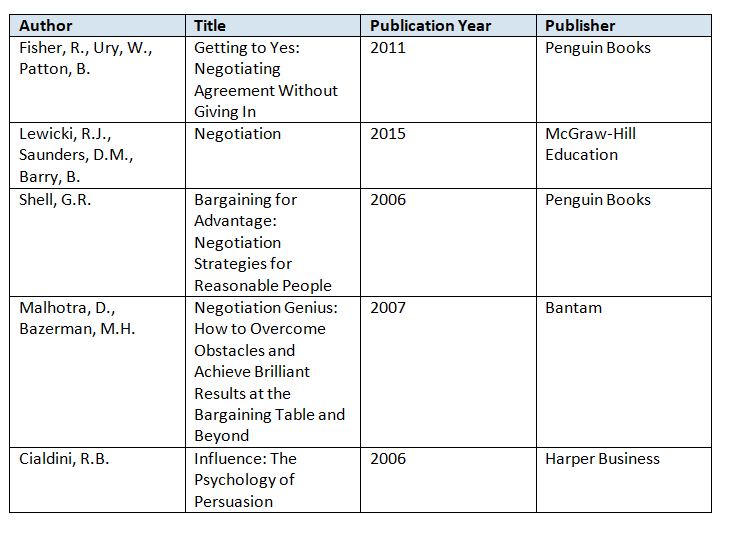
· References
Understanding the Role of KPIs in B2B Negotiations
In B2B negotiation environments, KPIs serve as objective yardsticks that quantify the effectiveness, efficiency, and outcomes of negotiation efforts. Unlike consumer sales, B2B deals often involve multiple decision-makers, longer sales cycles, and more complex contract terms. This complexity makes subjective evaluations unreliable; KPIs provide clarity and focus.
KPIs help organizations:
· Align negotiation goals with overall business strategy (e.g., margin targets, contract length, risk mitigation).
· Benchmark individual and team performance to identify coaching needs.
· Detect negotiation bottlenecks or process inefficiencies.
· Drive accountability and transparency across sales and procurement functions.
For instance, a global manufacturing company tracking the "percentage of deals closed within target margin" can identify which sales units consistently underperform and apply targeted negotiation training or process improvements.
Measuring KPIs also enables scenario planning. The BATNA concept teaches negotiators to quantify their alternatives realistically and understand how KPIs like "walk-away rate" or "agreement acceptance ratio" reflect the strength of their position. Without measurable KPIs, negotiators may fail to recognize when to push harder or concede, resulting in missed value.
Psychological Impact of KPIs in Negotiation
KPIs serve as a motivational tool by providing tangible targets. Drawing from behavioral economics, the goal gradient effect suggests that negotiators increase effort as they perceive themselves nearing KPI goals. This encourages persistence in difficult negotiations rather than settling prematurely.
Moreover, KPIs reduce cognitive bias. For example, anchoring bias often skews negotiators to fixate on an initial offer. By tracking metrics such as "average concession size" or "variance from initial offer," teams can objectively assess whether concessions are reasonable or excessive.
Core B2B Negotiation KPIs: Definition and Measurement
This section details the foundational KPIs every B2B organization should track to evaluate negotiation performance.
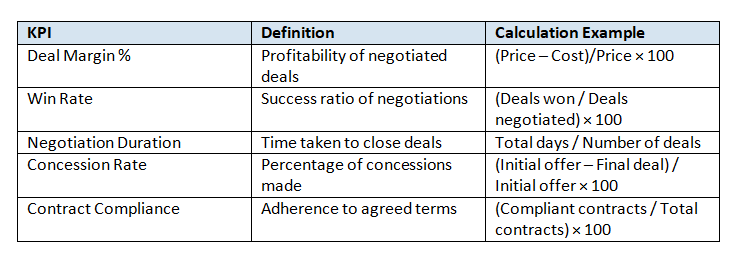
· Deal Margin Percentage
The margin realized on negotiated deals relative to target or list price. This KPI measures how well negotiators protect profitability.
Measurement:
Example: If a software license costs $50,000 and the negotiated price is $75,000, margin % = (75,000 – 50,000) / 75,000 = 33.3%.
· Win Rate
The ratio of successful negotiations to total attempts.
Measurement:
(Number of deals won / Number of deals negotiated) × 100
Example: A procurement team that wins 15 out of 20 contract negotiations has a 75% win rate.
· Average Negotiation Duration
Length of time from negotiation initiation to contract closure.
Measurement:
Sum of negotiation days / Number of negotiations
Shorter durations often indicate efficient processes but should be balanced with deal quality.
· Concession Rate
Percentage of initial offer value conceded during negotiation.
Measurement:
Lower concession rates indicate stronger negotiation positions.
· Contract Compliance Rate
Percentage of contracts executed as negotiated without post-signature disputes or amendments.
Measurement:
(Number of contracts complied with / Total contracts) × 100
High compliance signals alignment and clarity in negotiation outcomes.
Real-World Example: Negotiation KPIs in a SaaS Vendor
A SaaS company implemented these KPIs to track sales negotiation performance:
- Deal Margin %: Targeted 40% margin; under 35% flagged for review.
- Win Rate: Maintained above 70%, with dips triggering pipeline analysis.
- Negotiation Duration: Average 30 days; extended negotiations indicated complex buyer concerns.
- Concession Rate: Kept below 10% to protect pricing integrity.
Tracking these KPIs revealed that deals involving procurement teams had longer duration and higher concession rates, leading to targeted negotiation training focused on value articulation and anchoring techniques.
Advanced Metrics: Quality, Efficiency, and Relationship Indicators
Beyond core KPIs, advanced metrics offer deeper insights into negotiation quality and long-term value creation.
· Value Capture Ratio
Measures the percentage of total potential value captured versus what was initially available or estimated.
Calculation involves comparing final deal terms against best-case scenario benchmarks.
· Negotiation Satisfaction Score (NSS)
A qualitative metric derived from post-negotiation surveys assessing stakeholder satisfaction on fairness, communication, and outcomes.
· Stakeholder Engagement Index
Tracks the number and influence of key decision-makers involved, correlating to negotiation complexity and success rates.
· Renewal and Upsell Rate
Especially relevant in recurring contracts, this KPI measures how often negotiated agreements lead to contract renewals or upsell opportunities.
Efficiency Metrics: Cycle Time Breakdown
Analyzing sub-phases of negotiation through time tracking can uncover inefficiencies:
· Preparation Time
· Initial Offer to Counteroffer
· Contract Review and Legal Approval
· Final Agreement Execution
Reducing bottlenecks in these phases accelerates deal closure without compromising quality.
Relationship Metrics: Trust and Long-Term Collaboration
Leveraging frameworks like Fisher and Ury’s principled negotiation, metrics capturing relational quality include:
· Number of Joint Problem-Solving Sessions
· Frequency of Communication Post-Deal
· Dispute Rate Over Contract Lifecycle
These indicators help organizations balance short-term gains with sustainable partnerships.
Frameworks and Techniques to Enhance Negotiation Performance
Strong KPIs are rooted in robust negotiation frameworks and tactics.
· BATNA (Best Alternative to a Negotiated Agreement)
Assessing BATNA strength helps negotiators understand walk-away options, directly impacting KPIs like Win Rate and Concession Rate.
· ZOPA (Zone of Possible Agreement)
Defining ZOPA boundaries clarifies deal feasibility and guides offer strategies.
· Anchoring
Effective use of anchoring influences concession rates and final deal margins by setting initial offer reference points.
· The Negotiation Funnel
A process model breaking negotiation into stages: Preparation, Opening, Bargaining, Closing, and Implementation—each with corresponding KPIs.
Sample Negotiation Script Using Anchoring and BATNA
Supplier: “Based on market analysis, our starting price is $100,000, reflecting the premium quality and service level.”
Buyer: “Given our budget and alternative suppliers offering $85,000, we are prepared to consider offers up to $90,000.”
Supplier: “We understand your position. Considering your BATNA, we can offer a customized package at $95,000 with additional support.”
This dialogue illustrates anchoring (initial high offer), BATNA awareness (buyer’s alternative price), and movement toward ZOPA.
Implementing a KPI-Driven Negotiation Process: Tools and Scripts
To operationalize KPI tracking and performance improvement, organizations should deploy structured processes supported by technology.
· Negotiation Playbooks
Standardized scripts and tactics aligned with KPIs guide negotiators on when to push, concede, or pivot.
· CRM and Contract Management Systems
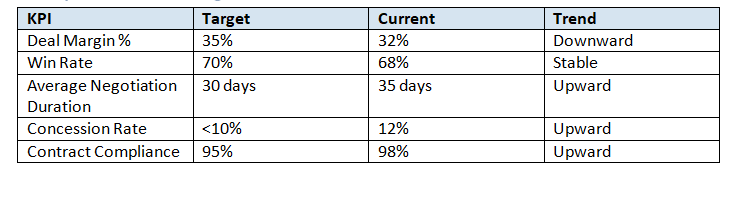
Integrate KPI dashboards that automatically track deal margin, negotiation duration, and compliance.
· Role-Based Scorecards
Individual negotiators receive feedback on KPIs like win rate and concession size, fostering accountability.
Sample KPI Monitoring Dashboard
Negotiation Script Excerpt for Handling Objections
Buyer: “Your price is above our budget.”
Negotiator: “I appreciate your concern. Considering our mutual goal to maximize value, can we explore adjusting the scope or payment terms? Alternatively, what is your BATNA if we cannot reach an agreement today?”
This script aligns objection handling with KPI-oriented outcomes, preserving margin and closing potential.
Analyzing and Acting on Negotiation Data: Continuous Improvement
Effective KPI use requires rigorous data analysis and iterative strategy refinement.
· Root Cause Analysis
When KPIs deviate from targets, conduct detailed reviews—e.g., higher concession rates might stem from poor preparation or misreading buyer priorities.
· Training and Coaching
Use KPI trends to personalize training programs focusing on negotiation techniques like anchoring or emotional intelligence.
· Process Optimization
Identify bottlenecks revealed by duration metrics and streamline contract review or decision-making steps.
· Cross-Functional Collaboration
Encourage feedback loops between sales, legal, and finance teams to enhance negotiation frameworks and compliance rates.
Case Study: Procurement Optimization in an Energy Firm
An energy company noticed negotiation durations averaging 45 days and concession rates above 15%. Post KPI analysis, they implemented standardized playbooks emphasizing BATNA assessment and anchoring, supported by CRM KPI dashboards. Within six months, negotiation duration fell to 30 days, and concession rates dropped to 8%, boosting margin by 5%.
Frequently Asked Questions
1. What are the most important KPIs to track in B2B negotiations?
The foundational KPIs include deal margin percentage, win rate, average negotiation duration, concession rate, and contract compliance. These provide a balanced view of profitability, efficiency, and outcome quality.
2. How can KPIs improve negotiation outcomes?
KPIs create objective benchmarks that highlight strengths and weaknesses, guide strategy adjustments, and foster accountability. They enable data-driven decisions rather than intuition alone.
3. How do psychological negotiation techniques relate to KPIs?
Techniques like anchoring and BATNA influence KPIs such as concession rates and win rates by shaping offer positioning and fallback options. Understanding these principles helps negotiators optimize KPI performance.
4. What tools can help track negotiation KPIs?
CRM platforms with integrated analytics, contract management systems, and negotiation playbooks embedded in sales enablement tools facilitate real-time KPI tracking and reporting.
5. How do you balance speed and quality in negotiation KPIs?
While shorter negotiation durations indicate efficiency, they should not compromise deal quality or margin. Monitoring contract compliance and satisfaction scores alongside duration ensures balanced outcomes.
Conclusion
Mastering B2B negotiation KPIs and performance metrics transforms negotiation from a gut-feel exercise into a strategic, measurable discipline. By tracking core and advanced indicators, leveraging proven frameworks like BATNA and anchoring, and embedding KPI monitoring into daily practice, organizations can significantly enhance profitability, efficiency, and partnership quality. These insights enable negotiators to make informed decisions, minimize costly concessions, and build lasting, value-driven relationships.
If your organization is ready to elevate its negotiation capabilities, start by defining relevant KPIs aligned with your strategic goals, invest in training and technology to track them, and foster a culture of continuous improvement. The measurable gains in margin, win rates, and contract compliance will quickly justify the effort and position you ahead in today’s competitive B2B landscape.