B2B Negotiation Strategies That Increase Margins

In today’s hyper-competitive B2B landscape, procurement teams and sales executives face mounting pressure to optimize deal profitability without sacrificing long-term partnerships. Imagine a global manufacturing firm negotiating a multi-million-dollar supply contract where every percentage point of margin improvement translates into millions of dollars in annual profit. The stakes are high, and the difference between a good deal and a great deal rests on mastering sophisticated negotiation strategies.
As supply chains tighten and budgets shrink, B2B organizations must sharpen their negotiation acumen to protect and increase margins. Conventional negotiation approaches no longer suffice; instead, a blend of psychology, strategic frameworks, and data-driven tactics is required to consistently secure favorable terms. This article will equip you with proven B2B negotiation strategies, from leveraging BATNA and ZOPA to advanced anchoring techniques and value-based selling. You will gain actionable insights, real-world examples, negotiation scripts, and metrics to track success.
Whether you are a sales leader aiming to close higher-margin deals, or a procurement professional seeking cost savings without damaging supplier relationships, this comprehensive guide will serve as your blueprint for negotiation excellence in 2024 and beyond.
· Table of Contents
· Understanding the B2B Negotiation Landscape
· Preparing with BATNA and ZOPA Analysis
· Psychological Principles to Influence Negotiation Outcomes
· Advanced Negotiation Tactics: Anchoring, Framing, and Concessions
· Crafting Effective Negotiation Scripts and Dialogue
· Measuring Success: Metrics and KPIs for Negotiation Performance
· Frequently Asked Questions
· Conclusion and Next Steps
Understanding the B2B Negotiation Landscape
Successful B2B negotiation requires a deep understanding of the unique complexities and stakeholder dynamics inherent in enterprise-level transactions. Unlike B2C, B2B negotiations often involve multiple decision-makers, longer sales cycles, and intricate contractual obligations. Margins are frequently razor-thin, so every negotiation tactic must be executed with precision.
In industries such as manufacturing, technology, and logistics, supplier relationships are critical to operational continuity. Negotiators must balance cost reduction objectives with preserving strategic partnerships. For example, a procurement director at a Fortune 500 company negotiating a cloud services contract must weigh immediate pricing benefits against long-term service reliability and scalability.
The negotiation process typically unfolds over several phases: preparation, opening offers, bargaining, and closing. Each phase offers opportunities to strategically influence the margin outcome. Understanding stakeholder motivations—whether cost savings, innovation, risk mitigation, or service quality—is essential to tailoring the negotiation strategy.
B2B negotiation also requires fluency in legal and compliance considerations. Contracts often include service level agreements (SLAs), penalties, and exclusivity clauses that affect deal economics. Skilled negotiators integrate legal counsel early to avoid margin erosion from unfavorable contract terms.
Preparing with BATNA and ZOPA Analysis
Preparation is the cornerstone of margin-enhancing negotiations. Two foundational frameworks are BATNA (Best Alternative to a Negotiated Agreement) and ZOPA (Zone of Possible Agreement). Mastery of these concepts empowers negotiators to set realistic targets and avoid unfavorable concessions.
· Conduct market research to benchmark pricing and terms
· Identify your BATNA and estimate the counterparty’s BATNA
· Define your reservation price and ideal target price
· Map out the ZOPA boundaries for key deal components
· Develop concessions strategy aligned with margin goals
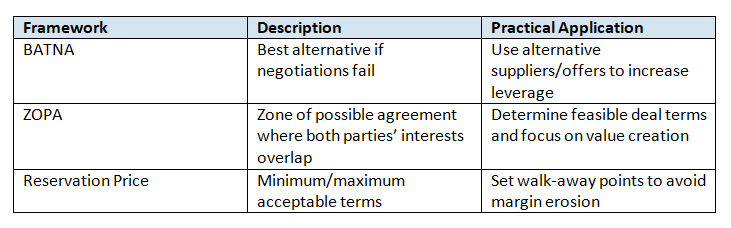
By rigorously applying BATNA and ZOPA analysis, negotiators avoid common pitfalls such as agreeing to unfavorable prices or overestimating counterpart flexibility.
Psychological Principles to Influence Negotiation Outcomes
Negotiation is as much psychological as it is transactional. Understanding cognitive biases and emotional triggers can unlock margin improvements by influencing counterpart behavior.
· Key psychological tactics for margin improvement:
· Use high but credible anchors to set favorable price expectations
· Leverage reciprocity by offering minor concessions strategically
· Frame proposals around value and ROI, not just cost
· Employ social proof by referencing industry benchmarks and competitor pricing
· Manage emotions by maintaining calm and confidence, avoiding reactive concessions
Understanding these psychological levers allows negotiators to shape perceptions and drive agreement terms that maximize profitability.
Advanced Negotiation Tactics: Anchoring, Framing, and Concessions
Building on psychological principles, advanced tactics help negotiators secure superior margins through deliberate strategy.
Anchoring is more than just stating a number. It requires contextualizing the anchor to enhance credibility:
· Start with a high anchor supported by data and market benchmarks
· Use justifications such as increased input costs or enhanced service levels
· Avoid immediate concessions that weaken the anchor’s impact
Framing involves tailoring language and offer structure to influence counterpart perception:
· Frame price increases as investments in quality, compliance, or innovation
· Highlight total cost of ownership (TCO) savings rather than sticker price
· Bundle value-added services to shift focus from price to outcomes
Concessions are inevitable but must be controlled to protect margins:
· Plan concessions in advance and avoid making them without reciprocity
· Use conditional concessions (“If you agree to X, then I can offer Y”)
· Make concessions appear significant but cost minimal to your business
· Track concession patterns to prevent giving away margin unnecessarily
Negotiator A (Buyer): “Your price is above our budget. Can you reduce it by 10%?”
Negotiator B (Seller): “I understand budget constraints. If you can commit to a three-year contract instead of one, we can consider a 10% discount. How does that sound?”
This conditional concession ties price reduction to a longer commitment, protecting seller margins over time.
Crafting Effective Negotiation Scripts and Dialogue
Preparation extends to scripting key negotiation conversations to maintain control and consistency. Scripts help negotiators stay on message, handle objections, and close deals favorably.
· Opening Statement — Set a positive tone while anchoring price/value
· Handling Price Objections — Use value framing and conditional concessions
· Responding to Requests for Discounts — Employ reciprocity and trade-offs
· Closing — Summarize benefits and reinforce deadlines or incentives
“Based on our market research and the enhanced features we’re offering, our proposal reflects a competitive rate aligned with the value your company will gain through improved uptime and support responsiveness.”
Buyer: “The price seems high compared to other vendors.”
Seller: “I appreciate that perspective. Compared to competitors, our solution includes 24/7 support and a 99.9% uptime guarantee, which reduces your operational risks substantially. If budget is a concern, we can explore phased implementation to spread costs.”
· Personalize scripts to industry and client context
· Practice active listening to adapt scripts dynamically
· Use positive language and avoid defensive tones
· Incorporate data points and case studies to support claims
Scripts provide a structured approach to negotiation dialogue, increasing confidence and the likelihood of margin-positive outcomes.
Measuring Success: Metrics and KPIs for Negotiation Performance
Tracking negotiation outcomes quantitatively enables continuous improvement and accountability. Key metrics provide insight into margin impact and process efficiency.
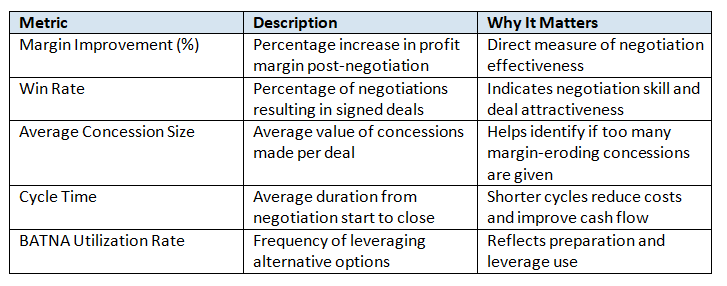
· Integrate negotiation KPIs into CRM or sales enablement platforms
· Conduct post-negotiation reviews focusing on margin impact
· Use scorecards to benchmark negotiators and identify training needs
· Align incentives and compensation to margin improvement metrics
By institutionalizing measurement, organizations foster a culture of disciplined negotiation that drives sustainable margin growth.
Frequently Asked Questions
What is the single most important factor in increasing margins through negotiation?
How can I handle price objections without losing margin?
What role does psychology play in B2B negotiations?
How do I develop a strong BATNA?
What KPIs should I track to ensure negotiation success?
Conclusion
Mastering B2B negotiation strategies that increase margins requires a holistic approach encompassing rigorous preparation, psychological insight, tactical execution, and disciplined measurement. By leveraging frameworks like BATNA and ZOPA, applying psychological principles such as anchoring and reciprocity, and controlling concessions through scripted dialogue, negotiators can consistently achieve superior profitability.
As market pressures intensify, organizations that invest in negotiation training and embed these strategies into their sales and procurement cultures will outperform competitors. Begin today by auditing your current negotiation processes, integrating these proven tactics, and tracking key metrics. The opportunity to boost margins and drive sustainable growth through negotiation mastery has never been greater.
References
· Fisher, Roger, and William Ury. Getting to Yes: Negotiating Agreement Without Giving In. Penguin Books, 2011.
· Malhotra, Deepak, and Max H. Bazerman. Negotiation Genius: How to Overcome Obstacles and Achieve Brilliant Results at the Bargaining Table and Beyond. Bantam, 2007.
· Shell, G. Richard. Bargaining for Advantage: Negotiation Strategies for Reasonable People. Penguin Books, 2006.
· Ury, William. The Power of a Positive No: How to Say No and Still Get to Yes. Bantam, 2007.
· Bazerman, Max H., and Margaret A. Neale. Negotiating Rationally. Free Press, 1992.