BATNA Strategy Explained: How to Build and Use Your Best Alternative

Negotiations often shape the fate of billion-dollar deals, high-stakes contracts, and critical business partnerships. Consider the 2018 Amazon HQ2 bid competition where cities scrambled to become the tech giant’s next hub. Many lost out because they lacked strong alternatives or failed to present credible fallback positions. In contrast, savvy negotiators who understood and leveraged their BATNA—Best Alternative to a Negotiated Agreement—secured advantageous terms or walked away to better opportunities. This concept, while deceptively simple, is the cornerstone of negotiation power.
In today’s volatile and complex business environment, where supply chains, mergers, and global partnerships face disruption, having a clear, actionable BATNA is more vital than ever. Companies that neglect this strategic element risk being cornered into unfavorable deals, eroding value and leverage. Conversely, negotiators who master BATNA wield influence that can redefine outcomes on their terms, protect against manipulation, and optimize deal value.
By the end of this comprehensive guide, you will not only understand the psychological and theoretical foundations of BATNA but also master proven frameworks and a step-by-step process to build and deploy your BATNA effectively. Real-world case studies, expert-level tactics, ready-to-use scripts, and a troubleshooting guide will equip you to transform your negotiation approach and consistently maximize your returns.
· Table of Contents
· The Strategic Foundation: Theory, Psychology, and Research Behind BATNA
· Key Frameworks and Models: Comparing BATNA with Related Negotiation Tools
· Step-by-Step Process: How to Build and Use Your BATNA Effectively
· Real-World Case Studies: BATNA in Action in Top Corporate Deals
· Common Pitfalls and How to Avoid Them: Mistakes That Undermine Your BATNA
· Advanced Tactics: Expert Techniques to Amplify BATNA Power
· Scripts and Templates: Ready-to-Use Dialogue and Documents
· Frequently Asked Questions: Deep Dives on BATNA Challenges and Nuances
· Conclusion: Key Insights and Next Steps
· References: Authoritative Sources and Further Reading
The Strategic Foundation
Understanding BATNA’s power requires grasping its psychological underpinnings and negotiation theory lineage. The concept originates from the seminal work of Roger Fisher and William Ury in their 1981 book *Getting to Yes*. They defined BATNA as the most advantageous course of action a party can take if negotiations fail and an agreement cannot be reached. This shifts negotiation from a gamble to a calculated strategy.
Psychologically, BATNA is deeply linked to Daniel Kahneman and Amos Tversky’s research on loss aversion (1979). Their work shows people disproportionately fear losses relative to gains, which means negotiators with strong alternatives reduce perceived risks. They resist accepting suboptimal deals because their fallback protects against loss—improving confidence and bargaining posture.
Robert Cialdini’s principles of influence reinforce BATNA’s potency. The principle of reciprocity and scarcity become more accessible to negotiators who can credibly walk away, signaling confidence and creating leverage. Shell’s *Bargaining for Advantage* (2010) further emphasizes how BATNA strengthens your reservation point—the minimum acceptable deal—allowing negotiators to avoid pressure tactics.
Max Bazerman and Deepak Malhotra’s *Negotiation Genius* (2007) integrates BATNA into decision science, highlighting how negotiators who prepare alternatives systematically outperform those relying solely on reactive tactics. The authors stress BATNA’s role as an anchor that sets the negotiation’s parameters, shaping expectations and outcomes.
In sum, BATNA is not just a fallback but a strategic asset rooted in behavioral economics, influence psychology, and principled negotiation. Mastering it empowers negotiators to control uncertainty, minimize risks, and create value beyond distributive bargaining’s zero-sum limits.
Key Frameworks and Models
BATNA often overlaps with or complements other negotiation frameworks. Below are three core models that elucidate BATNA’s place within the strategic landscape:
1. Harvard Principled Negotiation (Fisher & Ury)
2. ZOPA (Zone of Possible Agreement) Analysis
3. MESO (Multiple Equivalent Simultaneous Offers)
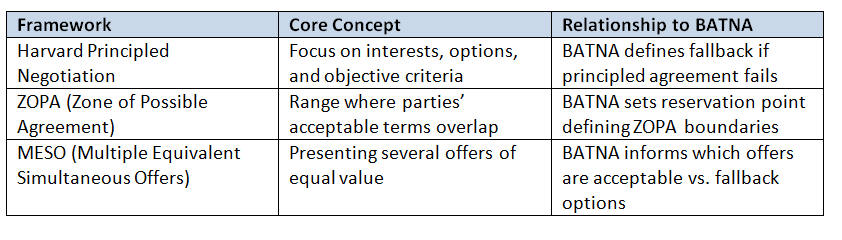
BATNA is foundational across these frameworks. In Harvard Negotiation, it preserves principled bargaining by setting a clear alternative. ZOPA analysis depends on BATNA to identify whether a deal zone exists. MESO offers expand negotiation creativity but rely on knowing your BATNA to avoid accepting inferior options.
Step-by-Step Process
Mastering BATNA requires a rigorous, structured approach. This section details a six-step process to build and employ BATNA effectively.
Step 1: Clarify Your Negotiation Goals and Interests
Before identifying alternatives, articulate your core objectives and underlying interests. This ensures BATNA aligns with what you truly need, not just superficial outcomes.
Step 2: Brainstorm Possible Alternatives
List all realistic options if the current negotiation fails. Include no-deal scenarios, alternative suppliers, different partnerships, or internal solutions.
Step 3: Evaluate Each Alternative’s Value and Feasibility
Assess alternatives against criteria such as cost, time, quality, and strategic fit. Use quantitative scoring and qualitative judgment to rank them.
Step 4: Develop Your Best Alternative (the BATNA)
Select the most viable fallback and refine it. Secure commitments, gather information, or initiate parallel actions to strengthen this alternative’s credibility.
Step 5: Calculate Your Reservation Point
Translate your BATNA into a reservation point—the worst deal you’ll accept. This anchors your negotiation boundaries and informs your minimum acceptable terms.
Step 6: Use BATNA Strategically During Negotiation
Leverage BATNA by signaling your fallback strength without revealing details prematurely. Use it as a psychological shield and a credible walk-away option.
Real-World Case Studies
Examining BATNA in high-profile negotiations highlights its practical impact:
1. **Apple vs. Samsung Patent Licensing (2012-2018)**
Apple’s BATNA in patent litigation was to block Samsung’s market access via injunctions and pursue licensing fees. Samsung’s BATNA involved ramping up design changes and alternative legal strategies. Apple’s strong BATNA enabled them to negotiate a lucrative cross-licensing deal and maintain market dominance. Lesson: A well-prepared BATNA can turn litigation from a zero-sum battle into a strategic lever.
2. **Amazon HQ2 Selection Process (2017-2018)**
Cities competing for Amazon’s second headquarters lacked strong BATNAs; many were desperate and offered concessions below cost. Amazon’s BATNA was to choose no location, leveraging this to extract incentives. Ultimately, Amazon split HQ2 between two locations, using BATNA to maximize political and financial gains. Lesson: Knowing your BATNA—and that of your counterparty—is essential when negotiating with powerful buyers.
3. **IBM’s Enterprise Software Procurement (2015)**
IBM’s procurement team faced a vendor unwilling to lower software licensing fees. IBM’s BATNA was switching to a cloud-based competitor with better terms. By validating and signaling this BATNA, IBM forced the vendor to reduce fees by 15%, saving millions. Lesson: Investing in credible alternatives enhances negotiation outcomes.
Common Pitfalls and How to Avoid Them
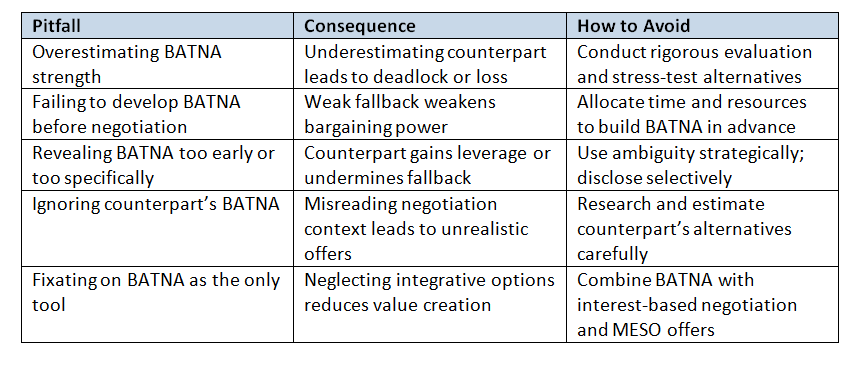
Negotiators often undermine their BATNA through specific errors. The table below summarizes these pitfalls with concrete remedies.
Advanced Tactics
Experienced negotiators can amplify BATNA’s power with sophisticated techniques:
- **Parallel Negotiation Channels**: Simultaneously developing alternatives with multiple parties to strengthen BATNA credibility and flexibility. Used by M&A teams to create competitive tension.
- **Incremental BATNA Improvement**: Gradually enhancing alternatives during negotiation to reset reservation points dynamically. Effective in long-term supplier contracts.
- **BATNA Signaling via Anchoring**: Combining strong BATNA with aggressive opening offers to psychologically anchor counterpart expectations lower. Drawn from anchoring bias research (Tversky & Kahneman).
- **MESO Offers Aligned with BATNA**: Crafting multiple offers calibrated against BATNA thresholds to test counterpart preferences and extract maximum value.
- **Contingency BATNAs**: Preparing tiered alternatives based on scenario planning to adapt swiftly to changing negotiation conditions.
Scripts and Templates
Below are exemplar dialogues and templates for deploying BATNA in negotiation.
**Script Example: Signaling BATNA Without Overdisclosure**
Negotiator A: “We appreciate your proposal, but given our current options and commitments elsewhere, we have alternatives that better align with our timelines and costs. We’re eager to find a path forward, but we also need terms that reflect our market realities.”
Negotiator B: “Can you elaborate on those alternatives?”
Negotiator A: “While I can’t disclose specifics, we’ve vetted them thoroughly, and they provide us a solid fallback if we can’t reach a mutually beneficial agreement here.”
---
**BATNA Evaluation Template**
1. Alternative Description: __________________________
2. Feasibility (1-5): ______
3. Cost Impact ($): _______
4. Time to Implement: _______
5. Strategic Fit (1-5): ______
6. Overall Score: _______
7. Action Plan to Develop Alternative: _______________
Frequently Asked Questions
1. **What exactly does BATNA mean and why is it critical?**
BATNA stands for Best Alternative to a Negotiated Agreement. It represents your fallback option if negotiations fail, providing leverage and clarity on when to walk away.
2. **How do I determine my BATNA in complex deals?**
Identify all possible alternatives, evaluate their feasibility and value systematically, and select the best one. Engage cross-functional teams to assess risk and opportunity comprehensively.
3. **Can BATNA change during negotiation?**
Yes, BATNAs are dynamic. As new information emerges or alternatives improve or deteriorate, reassess and adjust your BATNA and reservation points accordingly.
4. **Should I reveal my BATNA to the counterpart?**
Strategically revealing BATNA can enhance credibility but be cautious not to disclose details that weaken your position. Use ambiguity and timing to maximize impact.
5. **How does BATNA differ from reservation price or ZOPA?**
BATNA underpins the reservation price—the worst deal acceptable. The Zone of Possible Agreement (ZOPA) is the overlap between parties’ reservation prices. BATNA defines your bottom line.
Conclusion
BATNA is more than a theoretical concept; it is the backbone of effective negotiation strategy. By understanding its psychological roots, mastering complementary frameworks, and rigorously developing your best alternative, you transform from a reactive bargainer into a proactive strategist. Real-world examples from giants like Apple, Amazon, and IBM prove that BATNA mastery directly translates into competitive advantage and financial success.
Now is the time to embed BATNA thinking deeply into your negotiation preparation. Use the step-by-step process, avoid common pitfalls, and apply advanced tactics to elevate your outcomes. Start today by auditing your current negotiation approach for BATNA readiness and take concrete steps to build powerful alternatives that secure your success. The leverage you gain from a well-crafted BATNA is not just a fallback—it is your most potent weapon at the bargaining table.
References
- Fisher, R., Ury, W., & Patton, B. (2011). *Getting to Yes: Negotiating Agreement Without Giving In.* Penguin Books.
- Kahneman, D., & Tversky, A. (1979). Prospect Theory: An Analysis of Decision under Risk. *Econometrica*, 47(2), 263-291.
- Cialdini, R. B. (2007). *Influence: The Psychology of Persuasion.* Harper Business.
- Shell, G. R. (2010). *Bargaining for Advantage: Negotiation Strategies for Reasonable People.* Penguin.
- Malhotra, D., & Bazerman, M. H. (2007). *Negotiation Genius: How to Overcome Obstacles and Achieve Brilliant Results at the Bargaining Table and Beyond.* Bantam Books.