Best Negotiation Techniques That Actually Work

Negotiation is an essential skill that affects every aspect of life, from business deals and salary discussions to everyday interactions. Despite its importance, many people enter negotiations unprepared, relying on intuition or outdated tactics that lead to suboptimal outcomes. Understanding and applying proven negotiation techniques can dramatically improve your ability to secure favorable agreements while maintaining strong relationships.
This article explores the best negotiation techniques that actually work, combining psychological principles, real-world examples, and actionable strategies. Whether you’re a seasoned professional or new to negotiation, you’ll gain insights into how to prepare effectively, communicate persuasively, and navigate complex bargaining scenarios with confidence. By the end, you’ll be equipped with a toolkit of powerful methods to enhance your negotiating prowess.
· Table of Contents
· Understanding the Foundations of Successful Negotiation
· Preparing with BATNA and Goal Setting
· Psychological Principles that Influence Negotiation
· Effective Communication and Listening Techniques
· Anchoring and Framing Strategies
· Handling Objections and Deadlocks
· Closing the Deal and Building Long-Term Relationships
· Frequently Asked Questions
Understanding the Foundations of Successful Negotiation
Negotiation is both an art and a science. At its core, negotiation involves two or more parties seeking agreement on matters of mutual interest while managing conflicting objectives. Successful negotiators understand that negotiation is not about winning at all costs but creating value that all parties can share.
One of the fundamental frameworks is the distinction between distributive and integrative negotiation. Distributive negotiation, often called “win-lose,” involves dividing a fixed amount of resources — for example, haggling over price. Integrative negotiation, or “win-win,” focuses on expanding the value pie by addressing underlying interests and generating creative solutions. Skilled negotiators flexibly apply both approaches depending on context.
Another foundational element is trust and rapport. Psychological research shows that negotiators who establish trust and demonstrate empathy tend to achieve better outcomes. Building rapport early can transform adversarial interactions into collaborative problem-solving.
Real-World Example: The Harvard Negotiation Project
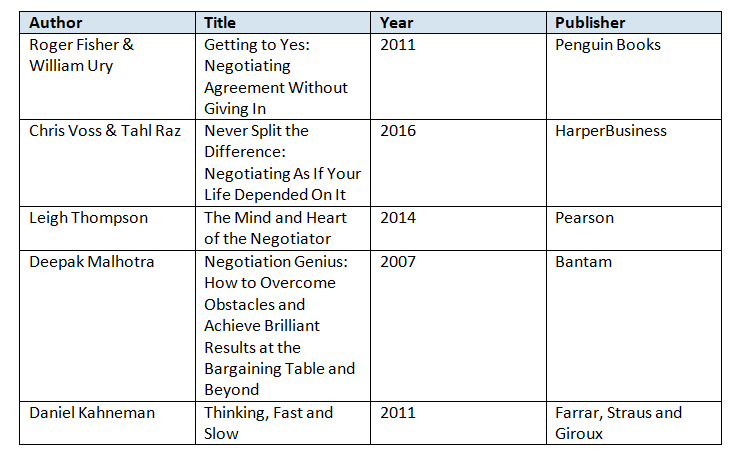
The Harvard Negotiation Project, led by Roger Fisher and William Ury, introduced the concept of “principled negotiation” in their seminal book *Getting to Yes*. Their method emphasizes separating people from the problem, focusing on interests rather than positions, and generating options before deciding. This approach has been adopted worldwide in diplomacy, business, and legal disputes, proving that a principled mindset improves negotiation outcomes.
Preparing with BATNA and Goal Setting
Preparation is the backbone of any successful negotiation. Two critical preparatory steps are identifying your BATNA (Best Alternative to a Negotiated Agreement) and setting clear, realistic goals.
BATNA is your fallback plan if negotiations fail. Knowing your BATNA gives you leverage because it defines your minimum acceptable outcome. The stronger your BATNA, the more power you have at the table.
For example, if you are negotiating a job offer but have another offer in hand, your BATNA is that alternative offer. This knowledge empowers you to negotiate confidently without accepting unfavorable terms.
· List all possible alternatives if the current negotiation fails
· Evaluate the value and feasibility of each alternative
· Select the best alternative as your BATNA
· Calculate your reservation price based on BATNA
Setting goals involves defining your target outcome, your realistic expectations, and your walk-away point. Effective negotiators use SMART criteria — goals that are Specific, Measurable, Achievable, Relevant, and Time-bound.
Template: Goal Setting for Negotiation
· Target Price/Outcome: $X (e.g., $75,000 salary)
· Realistic Range: $65,000 - $80,000
· Walk-away Point: $60,000
· BATNA: Other job offer at $70,000 salary
By preparing your BATNA and goals, you reduce emotional decision-making and enhance your strategic position.
Psychological Principles that Influence Negotiation
Understanding human psychology can unlock powerful leverage in negotiation. Several psychological principles consistently affect how people make decisions and respond to offers.
People feel obliged to return favors or concessions. By making small concessions early, you encourage the other party to reciprocate, fostering cooperation.
The first number put forward in a negotiation heavily influences the final outcome. This cognitive bias means that setting the initial offer strategically can anchor the discussion favorably.
According to prospect theory, people prefer avoiding losses to acquiring equivalent gains. Framing proposals to highlight what the other party stands to lose by not agreeing can motivate acceptance.
People often follow the behavior of others. Demonstrating that your proposal is standard practice or widely accepted can reduce resistance.
Citing expert opinions, company policies, or external benchmarks increases your credibility and persuasive power.
Example: Using Anchoring in Salary Negotiation
Suppose a candidate initiates salary negotiation with a slightly higher number than their target. This high anchor shifts the employer’s expectations upward, often resulting in a higher final offer. However, the anchor should be reasonable to avoid alienating the counterpart.
Effective Communication and Listening Techniques
Negotiation is fundamentally a communication process. Mastering how to articulate your position and actively listen to the other party’s needs is crucial.
Active listening involves fully concentrating, understanding, responding, and remembering what is said. Techniques include paraphrasing, summarizing, and asking open-ended questions. This approach builds trust and uncovers underlying interests.
Popularized by FBI negotiator Chris Voss, mirroring involves repeating the last few words the other party says to encourage elaboration. Labeling verbalizes the other party’s emotions or concerns (e.g., “It seems like you’re concerned about delivery times.”). These techniques validate feelings and reduce defensiveness.
Instead of accusatory language, use “I” statements to express needs without blame. For example, “I feel that the timeline might be tight” rather than “You are delaying the project.”
Script Example: Overcoming Resistance
Counterpart: “Your price is too high.”
Negotiator: “It sounds like budget is a major concern for you. Can you share more about your constraints so we can find a solution that works?”
This approach invites dialogue and fosters problem-solving.
Anchoring and Framing Strategies
Anchoring and framing are cognitive tools that shape the negotiation context and influence decision-making.
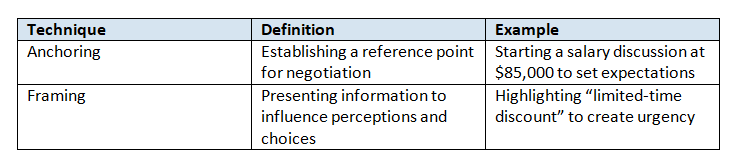
· Set the first offer to establish the reference point
· Use precise numbers rather than rounded figures to appear well-researched (e.g., $49,500 vs. $50,000)
· Counter anchors can be used to reset expectations
Framing involves presenting information in ways that highlight benefits, minimize risks, or appeal to values.
Examples:
· Gain Frame: “By accepting this deal, you will increase your revenue by 20%.”
· Loss Frame: “Rejecting this offer could cost you valuable market share.”
· Time Frame: “This opportunity is available only until the end of the quarter.”
Table: Anchoring vs. Framing in Negotiation
Handling Objections and Deadlocks
Objections and deadlocks are inevitable in negotiation. How you respond can determine whether you reach agreement or impasse.
· Acknowledge the objection without immediate rebuttal to show understanding
· Ask clarifying questions to uncover the root cause
· Reframe objections as opportunities to explore alternatives
· Use “Yes, and…” instead of “No, but…” to maintain positivity
When negotiations stall, consider:
· Introducing new options or creative compromises
· Bringing in a neutral third party or mediator
· Taking a break to cool down emotions
· Revisiting shared goals and mutual interests
Real-World Example: The “Feel, Felt, Found” Method
This classic technique empathizes with objections:
- “I understand how you feel.”
- “Others have felt the same way.”
- “What they found is that this solution actually saved them time and money.”
This script validates concerns, normalizes them, and gently redirects toward benefits.
Closing the Deal and Building Long-Term Relationships
Closing is more than just finalizing terms; it’s about securing commitment and setting the stage for future interactions.
· Summarize agreed terms to confirm mutual understanding
· Use assumptive closes: “When would you like us to start?”
· Offer options to create a sense of control: “Would you prefer delivery next week or the week after?”
· Address final concerns proactively
Successful negotiators invest in relationship management by:
· Following up with thank-you notes or calls
· Delivering on promises consistently
· Seeking feedback and showing willingness to collaborate in the future
Example: Long-Term Partnership in Business Negotiation
A supplier who negotiates fairly and communicates transparently fosters trust, leading to repeat business and referrals. The initial negotiation sets the tone for a partnership rather than a one-time transaction.
Frequently Asked Questions
What is the most effective negotiation technique?
The most effective technique varies by context, but preparing your BATNA and understanding interests are foundational. Combining this with active listening and principled negotiation approaches typically yields the best results.
How can I improve my negotiation skills quickly?
Practice is key. Role-playing scenarios, studying successful negotiators, and seeking feedback accelerate skill development. Additionally, learning psychological principles like anchoring and reciprocity enhances your effectiveness.
What should I do if the other party is aggressive or unreasonable?
Maintain composure and focus on interests rather than positions. Use techniques like mirroring and labeling to defuse tension. If necessary, suggest breaks or involve a neutral mediator to keep negotiations productive.
How important is body language in negotiation?
Body language conveys confidence, openness, and empathy, influencing perceptions. Maintaining eye contact, nodding, and adopting an open posture supports verbal communication and builds rapport.
Can negotiation techniques be applied outside of business?
Absolutely. Negotiation skills are valuable in personal relationships, conflict resolution, and everyday decision-making. Understanding human behavior and communication principles benefits all areas of life.
Conclusion
Mastering negotiation techniques is a transformative skill that empowers you to achieve better outcomes, build stronger relationships, and navigate complex interactions with confidence. By preparing thoroughly, leveraging psychological insights, communicating effectively, and closing strategically, you set yourself apart as a skilled negotiator.
Begin applying these proven techniques today, and watch how your ability to influence and collaborate grows. Remember, negotiation is not about confrontation but about creating value for all parties involved. Take the first step now—practice one technique from this guide in your next negotiation and experience the difference.
Download our free negotiation checklist to start preparing like a pro, and subscribe to our newsletter for ongoing tips and case studies to sharpen your negotiation skills.
Mastering how to negotiate is not about tricks — it's about clarity, positioning, and control. If you want to go deeper into advanced negotiation strategies, negotiation psychology, handling objections, and negotiating under pressure, explore our full library of articles designed for professionals operating in high-stakes business environments.