Bluffing in Negotiation: When It Works, When It Backfires, and How to Detect It

Imagine sitting across the table in a high-stakes merger negotiation. The opposing CEO claims their company has multiple suitors ready to pay a premium, pushing you to up your offer drastically. But behind closed doors, their "multiple suitors" are merely hopeful leads, not solid bids. This classic bluff could either secure a favorable deal or backfire spectacularly if exposed, costing credibility and the deal itself.
Bluffing taps into fundamental psychological and neurological mechanisms — it exploits uncertainty, social proof, and loss aversion. Research in behavioral economics, such as Kahneman’s prospect theory, shows how people’s decisions are skewed by perceived risks and gains. Neuroscience explains how the brain processes trust and deception, often responding to bluff-induced stress with heightened caution or compliance. Understanding these underlying dynamics reveals why bluffing can be a powerful yet risky negotiation tactic.
This definitive guide arms you with deep insights and actionable frameworks: how to deploy bluffing effectively without burning bridges, how to detect when others bluff you using behavioral cues and calibrated questioning, and exact word-for-word scripts to leverage or neutralize bluffing in varied negotiation contexts. By mastering this, you elevate your strategic influence in negotiations to a professional level.
· Table of Contents
· The Science Behind This Tactic
· How This Tactic Works in Practice
· Step-by-Step: How to Deploy This Tactic
· How to Recognize and Counter This Tactic
· Real-World Case Studies
· Common Mistakes When Using This Tactic
· Scripts and Templates
· Frequently Asked Questions
· Conclusion
· References
The Science Behind This Tactic
Bluffing in negotiation is deeply rooted in behavioral economics and psychology, particularly in the way humans process risk, uncertainty, and social signaling. Daniel Kahneman’s prospect theory highlights how individuals weigh potential losses more heavily than equivalent gains — a phenomenon known as loss aversion. A successful bluff leverages this by implying greater loss if the other party does not concede, thus skewing their decision calculus.
From a neurological perspective, bluffing activates the brain’s threat detection and social cognition centers. Studies using fMRI (e.g., by Spence et al., 2001) show that deception engages the prefrontal cortex, responsible for executive function and strategic thinking. The opponent’s brain responds with increased activity in the amygdala and insula, areas linked to anxiety and distrust, which can lead to either compliance or defensive posturing.
Robert Cialdini’s principles of influence also intersect here. Bluffing often employs scarcity (“this offer expires soon”) and social proof (“others are interested”), triggering automatic behavioral responses. Chris Voss’s concept of tactical empathy teaches negotiators to recognize emotional undercurrents and respond effectively — essential when detecting or delivering bluffs.
Game theory provides a formal framework to understand bluffing’s strategic use. The Nash equilibrium in “signaling games” explains how bluffing can be stable when neither party benefits from deviating unilaterally. However, repeated interactions often render bluffing less effective due to reputation effects, as outlined in Roger Fisher and William Ury's “Getting to Yes” and Richard Shell’s “Bargaining for Advantage.”
How This Tactic Works in Practice
Bluffing spans a spectrum from subtle misinformation to outright deception. It can be explicit (“We have a better offer lined up”) or implicit (strategic silence or exaggerated confidence). The effectiveness and risk depend on timing, context, relationship history, and cultural norms.
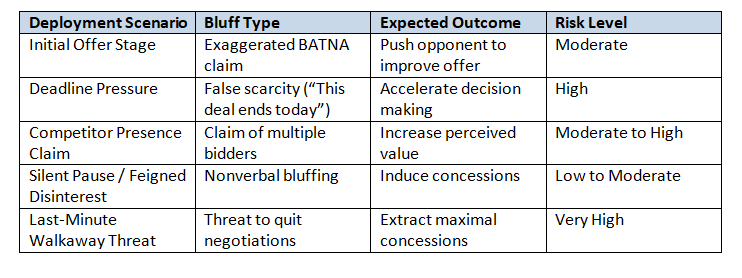
For example, in SaaS enterprise sales, a rep might bluff about competing RFPs to accelerate client commitment. In labor union negotiations, management may bluff a financial inability to pay raises, aiming to soften demands. The bluff’s subtlety and the counterparty’s sophistication dictate success probability.
Step-by-Step: How to Deploy This Tactic
Step 1: Prepare Your Bluff with Accurate Context Assessment
Before bluffing, rigorously analyze your position, alternatives (BATNA), and the opponent’s priorities. A bluff grounded in some factual basis reduces exposure. For instance, “While we don’t have formal offers, several interested parties have expressed strong interest.”
Step 2: Choose the Right Moment in the Negotiation Cycle
Early-stage bluffs can set the tone, but late-stage bluffs wield urgency. Assess the opponent’s readiness and emotional state using tactical empathy. For example, deploying a scarcity bluff near a deadline may pressure quick concessions.
Step 3: Craft Your Message Using Psychological Triggers
Incorporate Cialdini’s principles: scarcity (“This is a limited-time opportunity”), authority (“Our board mandates this decision”), and social proof (“Other major players are onboard”). Use calibrated questions (“How does your team view competing offers?”) to plant seeds without direct claims.
Step 4: Deliver the Bluff with Controlled Confidence and Non-Verbal Cues
Maintain steady eye contact, moderate tone, and open body language. Avoid signs of nervousness that could betray your bluff. Use mirroring techniques to build rapport and increase credibility.
Step 5: Monitor Opponent’s Response and Adjust Accordingly
Watch for verbal and nonverbal signals: hesitation, probing questions, or counters. Apply labeling (“It seems like you’re skeptical about our timeline”) to invite transparency. Be ready to soften or abandon the bluff if risk escalates.
Step 6: Have a Credible Exit Strategy
Plan contingencies if your bluff is called. This might involve partial concessions or shifting negotiation terms. Maintaining long-term relationship equity is crucial; avoid overplaying and causing damage.
How to Recognize and Counter This Tactic
Detecting bluffing requires keen observation and strategic questioning. Behavioral cues include inconsistent stories, microexpressions (brief facial reveals of discomfort), and overcompensation such as excessive detail or vagueness.
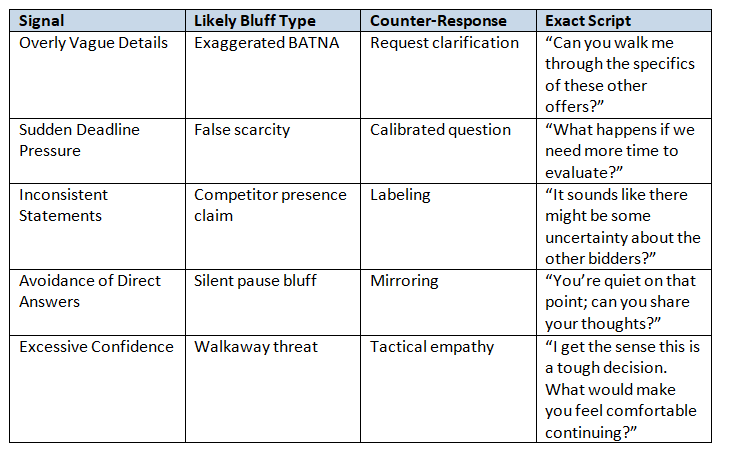
Use Chris Voss’s calibrated questions to invite truthful disclosure, such as “How would you like to proceed if we can’t meet your terms?” or “What’s the biggest concern you have about this deal?” These techniques expose bluffs without direct confrontation.
Real-World Case Studies
Case 1: Apple vs. Samsung Patent Negotiations
During the fierce patent litigation between Apple and Samsung, bluffing played a key role in settlement talks. Apple’s legal team exaggerated the strength of their patent portfolio and the willingness of other manufacturers to litigate aggressively. This bluff pressured Samsung into a multi-billion-dollar settlement. However, when leaks revealed weaknesses in Apple’s claims, Samsung pushed back fiercely in subsequent negotiations, illustrating the risk of bluff exposure.
Case 2: NFL Contract Negotiations - Colin Kaepernick
In the 2017 NFL free agency, Kaepernick’s representatives reportedly bluffed about receiving higher contract offers to leverage better terms. However, teams detected inconsistencies and perceived the bluff as overreach, resulting in no contracts and reputational damage. This case underscores the balance required in bluff credibility.
Case 3: Diplomatic Negotiation - Cuban Missile Crisis
During the Cuban Missile Crisis, U.S. negotiators employed bluffing by implying readiness to escalate military force if demands were unmet, while secretly planning diplomatic backchannels. This calibrated bluff contributed to a peaceful resolution, demonstrating bluffing’s strategic value when combined with credible threats and open communication.
Common Mistakes When Using This Tactic
Bluffing can backfire due to several common errors:
- Overbluffing: Repeated or extreme bluffs erode trust and reputation, reducing future influence.
- Poor Timing: Deploying a bluff when the opponent has strong information or leverage invites exposure.
- Ignoring Opponent Signals: Failure to read skepticism or probing questions leads to escalation rather than concessions.
- Lack of Exit Strategy: Being cornered without options damages relationships and bargaining power.
- Cultural Misalignment: Bluffing styles vary; what works in one culture may be seen as rude or dishonest in another.
Fixes include blending bluffing with transparent communication, practicing tactical empathy to gauge receptivity, and rehearsing contingency plans.
Scripts and Templates
1. Email Template - Subtle Competitive Threat
“Dear [Name],
We appreciate your continued interest. As we progress, I want to be transparent that several other firms have expressed strong interest in similar partnerships. We believe your proposal aligns well with our goals, but we are mindful of timing as these conversations develop rapidly.
Looking forward to your thoughts.
Best,
2. In-Person Script - Deadline Scarcity Bluff
“Our board requires a decision by end of day tomorrow. While we understand this is short notice, delaying further might jeopardize the current terms. How can we work together to meet this deadline?”
3. Phone Script - Feigned Disinterest
“I understand your offer, but to be honest, we’re exploring other avenues that may better align with our priorities. What flexibility do you have to make this more compelling?”
4. Counter-Script - Calibrated Question
“You mentioned other potential offers; can you elaborate on what those look like and your timeline for decisions? That will help us understand how to proceed.”
5. Counter-Script - Labeling Doubt
“It seems like there’s some uncertainty about the options on the table. Can we discuss what concerns you most so we can address them directly?”
Frequently Asked Questions
Q1: Is bluffing ethical in professional negotiations?
Bluffing occupies a gray area ethically. While minor exaggerations and strategic withholding are common, outright deception can breach trust and damage reputations. Ethical bluffing respects boundaries and focuses on creating value rather than manipulation.
Q2: How can I tell if someone is bluffing in a virtual negotiation?
Look for inconsistencies in their statements, evasive answers, and timing of responses. Use calibrated questions to probe deeper. Video calls allow observation of microexpressions and nonverbal cues like eye contact and body language, useful in detecting deception.
Q3: Can bluffing improve negotiation outcomes for inexperienced negotiators?
It can, but with caution. Without experience, bluffing risks exposure and credibility loss. Novices should combine bluffing with solid preparation, tactical empathy, and conservative claims to build skill gradually.
Q4: What role does cultural context play in bluffing effectiveness?
Cultural norms about directness, honor, and face-saving influence bluffing’s reception. For example, high-context cultures may view direct bluffs as rude, while low-context cultures tolerate them more. Understanding cultural nuances is essential.
Q5: How do psychological biases affect susceptibility to bluffs?
Loss aversion and scarcity heuristics increase vulnerability. Confirmation bias may cause negotiators to accept bluffs that fit their expectations. Awareness of these biases helps in maintaining objective evaluation.
Conclusion
Bluffing remains one of the most potent yet perilous tools in a professional negotiator’s arsenal. When wielded with psychological insight, strategic timing, and ethical restraint, it can tip the balance toward favorable outcomes without burning bridges. Conversely, misapplied or poorly timed bluffs risk irreparable damage to credibility and relationships.
By mastering the science, mechanics, and counterstrategies detailed here, negotiators can confidently deploy bluffing tactically and detect it in others with precision. The ability to read subtle signals, ask calibrated questions, and maintain composure under pressure elevates negotiation performance to elite levels. Incorporate these frameworks and scripts into your negotiation playbook today to transform bluffing from a gamble into a calculated advantage.
References
1. Kahneman, D. (2011). Thinking, Fast and Slow. Farrar, Straus and Giroux.
2. Cialdini, R. B. (2009). Influence: Science and Practice (5th ed.). Pearson.
3. Voss, C., & Raz, T. (2016). Never Split the Difference: Negotiating As If Your Life Depended On It. HarperBusiness.
4. Fisher, R., Ury, W., & Patton, B. (2011). Getting to Yes: Negotiating Agreement Without Giving In (3rd ed.). Penguin Books.
5. Shell, R. (2006). Bargaining for Advantage: Negotiation Strategies for Reasonable People (2nd ed.). Penguin.
6. Spence, S. A., et al. (2001). Behavioural and functional anatomical correlates of deception in humans. NeuroReport, 12(13), 2849–2853.