Body Language in Negotiation: Mastering Nonverbal Communication for Better Deals

In today’s hyper-competitive business environment, negotiation skills are more vital than ever. While words and offers matter, the silent language conveyed through body language often speaks louder than any verbal pitch. Understanding and mastering body language in negotiation can provide a critical edge—helping negotiators read counterparts’ true intentions, build trust, and influence outcomes more effectively.
Research by psychologist Albert Mehrabian famously suggests that up to 93% of communication effectiveness can be attributed to nonverbal cues, including body language and tone of voice. This means that even the most carefully crafted arguments can fall flat if your nonverbal signals contradict your message. Conversely, skilled negotiators who align their body language with their verbal communication can create rapport, project confidence, and strategically guide negotiations toward mutually beneficial results.
This comprehensive guide will explore the theory behind body language in negotiation, practical applications, and skill-building exercises. You will learn how to decode common nonverbal signals, use psychological frameworks like mirroring and anchoring through body language, and apply these techniques in real-world negotiation scenarios.
· Table of Contents
· Understanding the Role of Body Language in Negotiation
· Key Nonverbal Cues and Their Meanings
· Psychological Frameworks Enhancing Body Language Use
· Practical Techniques to Improve Your Negotiation Body Language
· Common Pitfalls and How to Avoid Them
· Real-World Examples and Case Studies
· Frequently Asked Questions
· Conclusion
· References
Understanding the Role of Body Language in Negotiation
Nonverbal communication plays a pivotal role in negotiation dynamics. While verbal communication transmits explicit content, body language conveys emotional states, attitudes, and unspoken intentions. According to research by Dr. Paul Ekman, microexpressions—brief, involuntary facial expressions—often reveal concealed emotions that words attempt to mask. Recognizing these subtle cues can alert negotiators to hidden discomfort, deception, or openness.
Moreover, body language impacts not only how others perceive you but also your own psychological state. The concept of embodiment, explored by social psychologist Amy Cuddy, suggests that adopting powerful postures can increase feelings of confidence and reduce stress during negotiations. This interplay between sending and receiving body language signals highlights why mastering this skill is indispensable.
Negotiators who ignore body language risk misunderstanding counterparts, missing opportunities to build rapport, or inadvertently signaling weakness. Conversely, those who develop acute observational skills and intentionally modulate their own nonverbal cues can create a compelling presence that influences negotiation trajectories.
Key Nonverbal Cues and Their Meanings
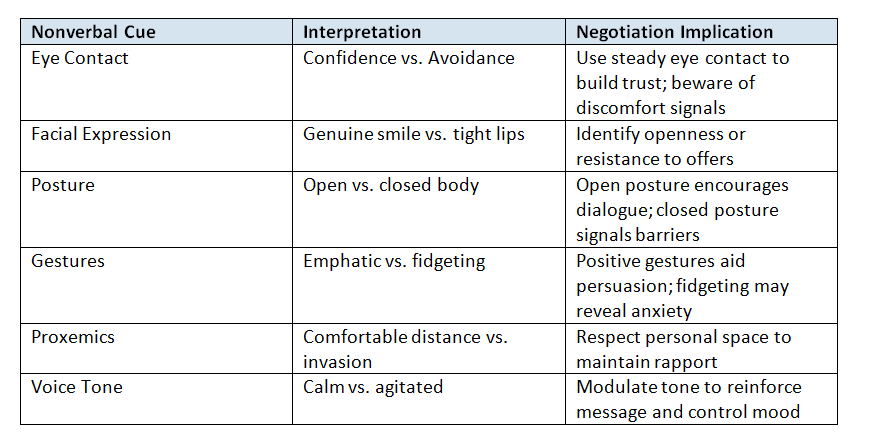
Understanding common nonverbal signals allows negotiators to interpret counterparts’ underlying feelings and adjust strategies accordingly. Below are critical body language cues frequently observed in negotiation settings:
· Eye Contact: Sustained, comfortable eye contact signals confidence and engagement, while avoidance may indicate discomfort, dishonesty, or disinterest. However, prolonged staring can be perceived as aggressive.
· Facial Expressions: Genuine smiles (Duchenne smiles) engage the muscles around the eyes and indicate warmth and sincerity. Raised eyebrows can express surprise or openness, whereas tightened lips often signal tension or resistance.
· Posture: An open posture (uncrossed arms and legs, torso facing the counterpart) conveys receptiveness. Closed postures suggest defensiveness or reluctance. Leaning forward typically indicates interest; leaning back may signal skepticism or disengagement.
· Gestures: Controlled hand movements can emphasize points, while fidgeting or touching the face, neck, or hair may reflect nervousness.
· Proxemics: The physical distance between parties influences comfort levels. Too close can feel invasive; too far may signal detachment.
· Voice Tone and Pace: Although not strictly body language, vocal cues like pitch, volume, and speech rate complement nonverbal signals and affect perception.
Exercise: Nonverbal Observation Drill
Practice observing body language in everyday conversations or meetings. Note at least three nonverbal cues and hypothesize what emotions or intentions they might convey. Over time, refine your interpretations and compare with verbal content for accuracy.
Psychological Frameworks Enhancing Body Language Use
Integrating psychological principles into body language strategies magnifies negotiation effectiveness. Below are key frameworks:
Practical Application: Mirroring Script
During negotiation, observe subtle behaviors such as hand placement or speech tempo. If your counterpart crosses their legs, after a few moments, cross yours similarly. If they speak slowly and softly, adjust your pace and tone to match. This creates subconscious rapport but avoid exact imitation that may seem mocking.
Psychological Insight: Power Posing
Amy Cuddy’s research on power posing shows that adopting expansive postures for two minutes before negotiation can increase testosterone (confidence hormone) and decrease cortisol (stress hormone). Practice “Wonder Woman” or “Superman” poses privately before meetings to boost presence.
Practical Techniques to Improve Your Negotiation Body Language
Mastering body language requires deliberate practice and self-awareness. Below are actionable techniques:
· Maintain Balanced Eye Contact: Aim for 60-70% eye contact to appear interested without intimidating.
· Adopt Open Postures: Keep arms uncrossed, shoulders relaxed, and face counterpart squarely.
· Use Purposeful Gestures: Employ hand movements to emphasize key points but avoid repetitive or distracting gestures.
· Control Your Breathing: Slow, diaphragmatic breathing reduces tension and projects calmness.
· Mirror Subtly: Reflect counterpart’s nonverbal style to build connection.
· Monitor Microexpressions: Train yourself to notice fleeting facial expressions revealing true feelings.
· Manage Distance: Respect proxemics to avoid discomfort.
Exercise: Video Self-Review
Record yourself in a mock negotiation or presentation. Analyze your body language for openness, gestures, eye contact, and posture. Identify areas for improvement and track progress over time.
Scripted Phrases with Accompanying Body Language
When making concessions, soften your tone and nod slightly to show empathy. When asserting a point, lean slightly forward with steady eye contact and use a firm hand gesture to signal confidence.
Common Pitfalls and How to Avoid Them
Even experienced negotiators can misread or misuse body language. Common mistakes include:
· Inconsistent Signals: Saying “yes” while shaking your head “no” creates confusion and erodes trust.
· Over-mirroring: Excessive imitation can appear insincere or mocking.
· Closed Posture During Positive Moments: Crossing arms or legs when agreeing signals reluctance.
· Ignoring Cultural Differences: Nonverbal cues vary across cultures; a gesture positive in one context may offend in another.
· Neglecting Self-Awareness: Failing to monitor your own nervous habits or negative signals undermines credibility.
To avoid these pitfalls, practice mindfulness during negotiations, seek feedback from trusted colleagues, and continually refine your body language skills.
Real-World Examples and Case Studies
During a high-stakes merger discussion, one executive noticed the counterpart’s crossed arms and minimal eye contact while verbally agreeing to terms. Sensing discomfort, the executive paused and invited concerns. This led to uncovering hidden objections that once addressed, facilitated a smoother agreement.
A top sales negotiator used mirroring by matching the prospective client’s relaxed posture and speech cadence. This helped build trust quickly and contributed to closing a $2 million deal. The client later cited the negotiator’s “authenticity and attentiveness” as key factors.
A negotiator opening with a high initial offer stood confidently with an open chest and firm stance, enhancing the perceived strength of the anchor. This nonverbal confidence led to better concessions from the opposing party.
Frequently Asked Questions
Detecting deception involves looking for clusters of inconsistent cues rather than isolated gestures. Signs include avoiding eye contact, increased blinking, touching the face or neck, and microexpressions that contradict spoken words. However, these cues are not definitive proof and should be considered alongside verbal content and context.
Ethical negotiation involves honest communication and respect. Using body language to build rapport and communicate confidence is acceptable. However, deliberately faking emotions or manipulating counterparts to exploit weaknesses crosses ethical boundaries. Aim for authenticity and mutual benefit.
Cultural norms influence gestures, eye contact, personal space, and expressions of emotion. For example, direct eye contact is respectful in Western cultures but can be seen as rude in some Asian contexts. Research cultural expectations before international negotiations to avoid misunderstandings.
Yes, though the range of visible cues is limited, maintaining eye contact via camera, nodding, and using purposeful hand gestures remain important. Pay attention to facial expressions and tone of voice to compensate for reduced physical presence.
Use role-play scenarios with colleagues or a coach, record yourself for self-review, and apply observation exercises in daily interactions. Incorporate power posing and mindfulness techniques before negotiations to enhance confidence and awareness.
Conclusion
Body language is a powerful, often underutilized tool in negotiation that can significantly influence outcomes. By understanding key nonverbal cues, integrating psychological principles like mirroring and anchoring, and practicing deliberate control over your own body language, you can enhance your ability to build rapport, read counterparts, and close better deals. The silent signals you send and receive form a complex dialogue that, when mastered, transforms negotiation from mere exchange into strategic influence.
Developing this skill requires consistent practice, self-awareness, and cultural sensitivity. Start by observing everyday interactions, applying subtle mirroring, and adopting confident postures. Over time, your enhanced nonverbal communication will become an invaluable asset across negotiations in business and beyond. Take the first step today to elevate your negotiation effectiveness through the language your body speaks.
References
· Cuddy, Amy. Presence: Bringing Your Boldest Self to Your Biggest Challenges. Little, Brown, 2015.
· Ekman, Paul. Telling Lies: Clues to Deceit in the Marketplace, Politics, and Marriage. W. W. Norton, 2001.
· Fisher, Roger, William Ury, and Bruce Patton. Getting to Yes: Negotiating Agreement Without Giving In. Penguin Books, 2011.
· Goman, Carol Kinsey. The Nonverbal Advantage: Secrets and Science of Body Language at Work. Berrett-Koehler Publishers, 2008.
· Kahneman, Daniel. Thinking, Fast and Slow. Farrar, Straus and Giroux, 2011.