Case Studies in Negotiation Strategy: Lessons from Real Deals

Negotiation is the invisible engine driving billions in business every day. Consider the landmark 2018 Apple-Foxconn renegotiation that saved Apple $1.5 billion annually by restructuring supply agreements amid tariff pressures. The stakes were massive — a misstep could have rippled into skyrocketing costs and lost market share. Such high-stakes negotiations exemplify why mastering negotiation strategy is not just valuable but essential for today’s business leaders.
In an era defined by rapid globalization, fierce competition, and complex stakeholder webs, negotiation prowess is a strategic imperative. Whether navigating mergers and acquisitions, labor contracts, or international trade deals, the ability to influence outcomes decisively shapes organizational success. Yet many negotiators rely on intuition or one-size-fits-all tactics, missing the deeper psychological levers and strategic frameworks that separate exceptional dealmakers from the rest.
This comprehensive article unpacks the anatomy of successful negotiations through rigorous case studies from industry titans and landmark deals. You will gain a foundational understanding of negotiation psychology and theory, master key frameworks, follow step-by-step processes, and learn advanced tactics from real-world examples. By the end, you will be equipped to execute high-impact negotiations with confidence, precision, and measurable results.
· Table of Contents
· The Strategic Foundation: Psychology and Theory Behind Negotiation
· Key Frameworks and Models: Comparing Harvard, BATNA, and MESO
· Step-by-Step Process: From Preparation to Closing
· Real-World Case Studies: Apple, IBM, and WTO Negotiations
· Common Pitfalls and How to Avoid Them
· Advanced Tactics for Experienced Negotiators
· Scripts and Templates: Exact Dialogue for Winning Deals
· Frequently Asked Questions on Negotiation Strategy
· Conclusion: Synthesizing Lessons and Next Steps
· References: Authoritative Sources for Further Study
The Strategic Foundation — Psychology and Research Behind Negotiation Strategy
Negotiation is fundamentally a human endeavor influenced by cognitive biases, social psychology, and strategic interaction. Understanding these underlying forces equips negotiators to design approaches that anticipate behavior and influence outcomes effectively.
Research by Daniel Kahneman and Amos Tversky (1979) on Prospect Theory revealed the power of loss aversion: people fear losses about twice as intensely as they value gains. This insight explains why framing offers around avoiding losses can be more persuasive than highlighting equivalent gains. For example, in IBM’s 2002 enterprise software sales negotiations, sales teams leveraged loss aversion by illustrating potential productivity losses without IBM’s solutions, thereby increasing customer urgency.
Fisher and Ury’s seminal work Getting to Yes (1981) introduced Principled Negotiation, advocating separating people from problems, focusing on interests rather than positions, generating options for mutual gain, and insisting on objective criteria. This approach underpins many successful deals, such as the 1998 Microsoft antitrust settlement, where both parties moved beyond entrenched positions to negotiate workable remedies.
Robert Cialdini’s Influence (2006) identifies six key principles—reciprocity, commitment, social proof, authority, liking, and scarcity—that negotiators can ethically employ to build rapport and persuade counterparts. For example, Amazon procurement teams consistently use reciprocity by offering small concessions early to encourage reciprocal flexibility from suppliers.
Shell’s Bargaining for Advantage (2006) synthesizes negotiation strategy into preparing your BATNA (Best Alternative to a Negotiated Agreement), understanding the ZOPA (Zone of Possible Agreement), and managing relationships. This framework dovetails with Malhotra and Bazerman’s Negotiation Genius (2007), which emphasizes combining analytical rigor with emotional intelligence to outmaneuver counterparts without damaging long-term relationships.
Together, these theories and models highlight that successful negotiation requires more than tactics—it demands a strategic mindset grounded in behavioral science, preparation, and ethical influence.
Key Frameworks and Models — Comparing Harvard Principled Negotiation, BATNA, and MESO
Navigators of complex negotiations rely on structured frameworks to map strategy and tactics. The three most influential frameworks—Harvard Principled Negotiation, BATNA analysis, and MESO (Multiple Equivalent Simultaneous Offers)—each provide unique lenses and tools.
Harvard Principled Negotiation focuses on interests, options, objective criteria, and relationship management to create integrative solutions.
BATNA analysis centers on developing a strong alternative to improve negotiating power and avoid suboptimal agreements.
MESO encourages presenting multiple comparable offers simultaneously to reveal preferences and expand value creation.
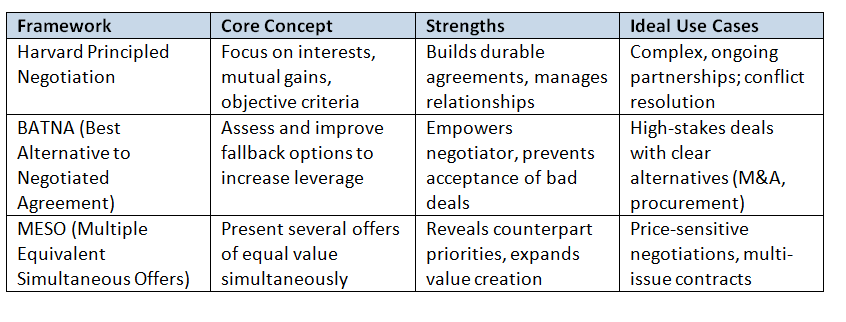
Applying these frameworks is not mutually exclusive; sophisticated negotiators blend elements. For instance, Amazon procurement teams integrate BATNA strength with MESO offers and Harvard’s principled approach to secure favorable supplier contracts without damaging long-term relationships.
Step-by-Step Process — From Preparation to Closing High-Stakes Deals
Mastering negotiation requires following a rigorous, repeatable process. Below are six critical steps to structure any negotiation effectively.
Step 1: Preparation and Research
Preparation is the cornerstone. Gather intelligence on the counterpart’s interests, constraints, BATNA, and cultural context. For example, IBM’s acquisition negotiations involved extensive due diligence on financials and cultural fit to anticipate obstacles.
Step 2: Define Objectives and BATNA
Clarify your goals and establish your BATNA. Knowing your alternative empowers decision-making and prevents settling for unfavorable terms. Create a decision matrix weighing potential outcomes against your BATNA.
Step 3: Build Rapport and Establish Communication
Initiate with rapport-building to create trust. Use Cialdini’s liking principle—find common ground and show genuine interest. For instance, Walmart’s vendor negotiations often begin with informal relationship-building activities.
Step 4: Exchange Information and Uncover Interests
Move beyond positions to explore underlying interests. Ask open-ended questions and actively listen. This aligns with the Harvard framework’s focus on interests instead of fixed demands.
Step 5: Propose Options and Use MESO Offers
Present multiple offers simultaneously, emphasizing equivalence but differing trade-offs. This tactic reveals counterpart priorities, creating value. Apple’s supply chain renegotiations frequently use MESO to balance price, volume, and delivery schedules.
Step 6: Close the Deal and Document Terms
Confirm agreement explicitly, summarize terms, and formalize contracts. Ensure clarity to avoid future disputes. For example, WTO trade negotiations end with detailed protocols that specify commitments and enforcement mechanisms.
Following this structured process enhances control, adaptability, and outcomes.
Real-World Case Studies — Insights from Apple, IBM, and WTO Negotiations
Examining landmark negotiations reveals practical application of theories and frameworks.
Apple-Foxconn 2018 Supply Chain Renegotiation
Context: Amid escalating U.S.-China tariffs, Apple needed to reduce component costs without compromising quality or supply chain stability.
What Happened: Apple deployed BATNA analysis to evaluate alternative suppliers and MESO tactics by offering Foxconn multiple contract structures with varying volume-price trade-offs. They also applied principled negotiation to maintain partnership goodwill.
Lesson: Combining BATNA with MESO and relationship management enabled Apple to save $1.5 billion annually while preserving supply continuity.
IBM-2002 Enterprise Software Sales Negotiation
Context: IBM aimed to close a multimillion-dollar contract with a hesitant client facing budget constraints.
What Happened: IBM’s sales team framed proposals around loss aversion, emphasizing productivity losses if the client delayed adoption. They used open dialogue to uncover hidden interests and tailored MESO offers balancing price and service levels.
Lesson: Leveraging behavioral insights like loss aversion and MESO expanded value and sealed the deal.
WTO Doha Round Trade Negotiations
Context: Complex multilateral talks involving numerous countries with divergent interests over agricultural subsidies and trade barriers.
What Happened: Negotiators utilized principled negotiation to separate people from problems, focusing on objective criteria such as World Bank data. Multiple rounds of MESO offers helped identify overlapping zones of agreement.
Lesson: Even massive, complex negotiations benefit from structured frameworks emphasizing interests, data-driven standards, and creative option generation.
Common Pitfalls and How to Avoid Them
Even experienced negotiators fall prey to predictable mistakes that jeopardize deals.
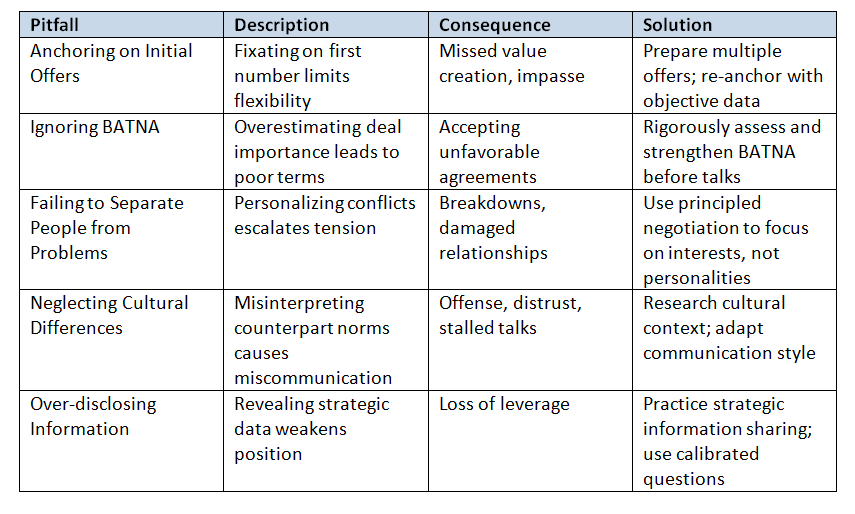
Avoiding these pitfalls requires discipline, preparation, and self-awareness.
Advanced Tactics — Expert-Level Techniques for Seasoned Negotiators
Beyond foundational methods, elite negotiators deploy nuanced strategies.
Anchoring with Strategic Concessions
Rather than bluntly stating an opening offer, expert negotiators embed concessions in initial proposals to psychologically anchor counterparts toward acceptable ranges.
Silence and Strategic Pausing
Using calibrated silence after offers compels counterparts to fill conversational gaps, often revealing valuable information or softening positions.
Framing with Loss Aversion and Gain Framing
Tailoring message framing to emphasize what counterpart stands to lose or gain increases persuasive power depending on their risk tolerance.
Multi-Issue Logrolling
Trading concessions across issues of varying importance to each party maximizes joint gains, especially in complex contracts.
BATNA Enhancement via Coalition Building
Strengthening alternatives by aligning with third parties increases leverage, as seen in labor union negotiations where coalitions shift bargaining power.
Scripts and Templates — Exact Dialogue and Written Formats
Below is a sample dialogue script applying principled negotiation and MESO techniques in a procurement negotiation:
Negotiator A (Buyer): “Thank you for meeting today. We value our partnership and want to explore options that meet both our needs. Could you share the key priorities you have for this contract?”
Negotiator B (Supplier): “We need pricing stability and reasonable volume commitments.”
Negotiator A: “Understood. Based on that, we have prepared three equivalent proposals:
Option 1: Higher volume commitment with a fixed lower price.
Option 2: Moderate volume with flexible pricing tied to market index.
Option 3: Lower volume but higher price with extended payment terms.
Which aligns best with your objectives?”
Negotiator B: “Option 2 seems attractive, but payment terms are a concern.”
Negotiator A: “We can consider extending payment terms in Option 2 to address that. Does that make it more viable?”
This script demonstrates open information exchange, MESO presentation, and principled interest focus.
Template: Negotiation Preparation Checklist
· Define objectives and minimum acceptable terms
· Research counterpart interests and BATNA
· Prepare multiple equivalent offers (MESO)
· Anticipate objections and prepare responses
· Plan rapport-building strategies
· Set clear criteria to evaluate offers
· Decide walk-away points and fallback plans
Frequently Asked Questions
Q1: What is the difference between distributive and integrative negotiation?
A1: Distributive negotiation involves a fixed pie where parties compete over limited resources, emphasizing claiming value. Integrative negotiation focuses on expanding the pie through mutual gains by addressing interests and exploring creative options, leading to win-win outcomes. Using principled negotiation encourages integrative approaches.
Q2: How can I strengthen my BATNA before negotiations?
A2: Strengthen your BATNA by researching alternatives, developing partnerships, or improving internal capabilities that reduce dependence on the current deal. For example, a company negotiating a supplier contract can identify and qualify additional vendors to increase leverage.
Q3: When is MESO most effective?
A3: MESO is effective in multi-issue negotiations where trade-offs are possible, and counterpart preferences are unclear. Presenting multiple equivalent offers simultaneously reveals priorities and uncovers value-creating opportunities.
Q4: How do cultural differences impact negotiation strategy?
A4: Cultural differences affect communication styles, decision-making, power distance, and attitudes toward conflict. Understanding these factors helps tailor approaches, avoid misunderstandings, and build trust. For example, negotiations in East Asia may emphasize indirect communication and consensus.
Q5: What role does emotional intelligence play in negotiation?
A5: Emotional intelligence enables negotiators to recognize and manage their own emotions and those of counterparts. This skill facilitates rapport, defuses conflict, and aids in reading unspoken cues, contributing to more effective influence and problem solving.
Conclusion
Negotiation is both an art and a science, deeply rooted in behavioral psychology and strategic planning. By studying case examples like Apple’s supply chain mastery, IBM’s sales finesse, and WTO’s multilateral diplomacy, negotiators can glean timeless lessons on preparation, framing, and creative problem-solving. Integrating proven frameworks such as Harvard Principled Negotiation, BATNA, and MESO equips professionals to navigate complexity with confidence and influence.
The path to negotiation excellence demands rigorous preparation, awareness of cognitive biases, and an ethical commitment to mutual value creation. We invite you to apply these insights systematically, refine your skills with the provided scripts and templates, and elevate your negotiation outcomes. Start by assessing your next deal through the frameworks explored here — your organization’s success depends on it.
References
· Kahneman, D., & Tversky, A. (1979). Prospect Theory: An Analysis of Decision under Risk. Econometrica.
· Fisher, R., Ury, W., & Patton, B. (1981). Getting to Yes: Negotiating Agreement Without Giving In. Penguin.
· Cialdini, R. B. (2006). Influence: The Psychology of Persuasion. Harper Business.
· Shell, G. R. (2006). Bargaining for Advantage: Negotiation Strategies for Reasonable People. Penguin.
· Malhotra, D., & Bazerman, M. H. (2007). Negotiation Genius: How to Overcome Obstacles and Achieve Brilliant Results at the Bargaining Table and Beyond. Bantam.
· Raiffa, H. (1982). The Art and Science of Negotiation. Harvard University Press.