Case Studies: Negotiation Tactics in Action — Mastering High-Stakes Deals with Proven Strategies

Negotiations often unfold in high-pressure environments where a single tactical misstep can cost millions, reputations, or even lives. Consider the 2013 NFL contract dispute between the Seattle Seahawks and franchise quarterback Russell Wilson. Behind the scenes, the parties leveraged a mix of anchoring, calibrated questions, and tactical empathy to break an impasse that could have derailed the season. Wilson’s camp deftly used social proof and commitment tactics to frame their leverage while the Seahawks countered with scarcity and loss aversion messaging. The result was a record-setting contract that redefined player-team negotiations in professional sports.
This dramatic scenario encapsulates the complex psychological and strategic dynamics too many negotiators overlook. Far from a simplistic win-lose battle, negotiations hinge on understanding cognitive biases such as anchoring (Daniel Kahneman), reciprocity (Robert Cialdini), and tactical empathy (Chris Voss). Negotiators who fail to master these principles often get stuck in positional bargaining, miss critical signals, or suffer from confirmation bias and framing errors. Research spanning behavioral economics, game theory, and social psychology reveals that successful negotiators combine empathy, data-driven framing, and calibrated influence to create positive-sum outcomes.
In this comprehensive guide, you will master the art and science of negotiation tactics in action through real-world case studies and evidence-based frameworks. You will learn: how to identify and deploy key psychological levers; frameworks such as Fisher and Ury’s principled negotiation and Shell’s bargaining advantage; exact scripts for high-stakes moments; and how to counter common manipulative tactics. Whether you negotiate multi-billion dollar M&A deals, labor contracts, or diplomatic agreements, this article arms you with the knowledge and tools to win decisively.
· Table of Contents
Negotiation Psychology and Behavioral Science
Key Frameworks and Models in Negotiation
Step-by-Step Negotiation Process and Analysis
Real-World Case Studies of Negotiation Tactics
Recognition and Counter-Response Guide
Advanced Insights and Expert Techniques
Scripts and Templates for Common Negotiation Scenarios
Frequently Asked Questions on Negotiation Tactics
Conclusion and Call to Action
References
The Psychology and Science Behind This Topic
The foundation of any effective negotiation strategy is a deep understanding of human psychology and behavioral economics. Daniel Kahneman’s seminal work on cognitive biases—anchoring, loss aversion, and framing effects—explains why initial offers anchor the negotiation and why parties irrationally weigh losses more heavily than equivalent gains. For example, in salary negotiations, an initial lowball offer can set a psychological anchor that depresses the counteroffer range even if objectively unreasonable.
Robert Cialdini’s six principles of influence—reciprocity, commitment and consistency, social proof, authority, liking, and scarcity—are core psychological levers in negotiation. His research shows that offering small concessions (reciprocity) or establishing mutual commitments creates a powerful momentum that changes the counterpart’s behavior. Scarcity, in particular, triggers loss aversion and urgency, often shifting outcomes dramatically.
Chris Voss, former FBI hostage negotiator, introduced tactical empathy, mirroring, labeling, and calibrated questions to break deadlocks. These techniques build rapport and allow negotiators to uncover hidden motivations, transforming adversarial dynamics into collaborative problem-solving. His “accusation audit” preempts objections by voicing counterparts’ fears before they do—defusing tension and increasing trust.
Game theory contributes crucial insights into strategic interdependence. Concepts like Nash equilibrium illuminate how rational actors balance cooperation and competition. Positive-sum negotiation strategies, which expand the pie before dividing it, contrast with zero-sum bargaining where one party’s gain is the other’s loss. Understanding when to push for value creation and when to protect against exploitation is essential.
Behavioral economists like Richard Shell synthesize these perspectives, emphasizing that negotiation success depends on preparation, understanding your BATNA (Best Alternative to a Negotiated Agreement), and adapting to counterparts’ behavioral cues. Adam Grant’s research on “Give and Take” reveals how generosity in negotiation often yields better long-term outcomes than purely self-interested tactics.
Key Frameworks and Models
Three foundational frameworks dominate high-stakes negotiation theory and practice.
1. Getting to Yes — Fisher & Ury’s Principled Negotiation: Focuses on separating people from the problem, focusing on interests not positions, generating options for mutual gain, and insisting on objective criteria.
2. Bargaining for Advantage — Richard Shell’s Six Foundations: Includes understanding your bargaining style, preparation, relational dynamics, and framing offers strategically.
3. Voss’s Tactical Empathy Model: Prioritizes emotional intelligence, labeling, calibrated questions, mirroring, and accusation audits to gain psychological leverage.
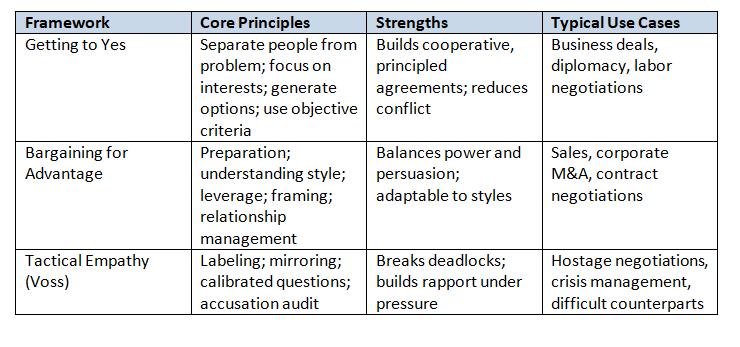
Each framework contributes unique tools. Principled negotiation excels at value creation, Shell’s model helps adapt to power dynamics, and Voss’s tactics are critical when emotions run high. Skilled negotiators integrate all three.
Step-by-Step Process or Analysis
Step 1: Preparation and BATNA Development
Clarify your bottom line and alternatives. Research counterpart’s interests, constraints, and past behaviors. Create a BATNA that is realistic and credible to enhance your leverage. Use Cialdini’s social proof by assembling evidence of your value or alternatives.
Step 2: Opening and Anchoring
Make the first offer when you have informational advantage. Use Kahneman’s anchoring bias to set the negotiation frame. Calibrated questions (“How flexible are you on this point?”) invite dialogue and reduce resistance.
Step 3: Tactical Empathy and Rapport Building
Use mirroring (“It sounds like you’re concerned about timing”), labeling (“It seems you feel this proposal puts you at risk”), and accusation audits to lower defenses and gather emotional data. This step transforms positional standoffs into collaborative conversations.
Step 4: Creating and Exploring Options
Generate multiple options using brainstorming techniques to avoid premature commitment. Frame options with objective criteria (market rates, expert opinions) to reduce bias and increase fairness perceptions.
Step 5: Concessions and Reciprocity
Make small, strategic concessions to trigger reciprocity. Frame concessions as costly to enhance perceived value. Maintain consistency by linking concessions to counterpart’s commitments, reinforcing mutual responsibility.
Step 6: Closing and Agreement Formalization
Summarize agreed points clearly, using labeling (“We’ve both agreed that…”). Use calibrated questions to confirm understanding and commitment. If resistance occurs, return to BATNA to recalibrate expectations.
Real-World Case Studies
Apple vs Samsung Patent Negotiations (2011–2018)
Context: The prolonged legal and licensing dispute involved billions at stake and global market dominance. Apple used anchoring with aggressive initial claims, leveraging objective criteria from patent law. Samsung responded by fragmenting negotiations into smaller licensing deals (value creation). Both employed tactical empathy behind closed doors to avoid stalemate. Lesson: Combining principled negotiation with tactical empathy and strategic anchoring can resolve even bitter IP disputes.
Russell Wilson’s NFL Contract Negotiation (2013)
Context: Wilson’s agent used calibrated questions and social proof of comparable quarterback contracts to push for a record deal. The Seahawks leveraged loss aversion framing, emphasizing the cost of losing Wilson to free agency. Both sides used tactical empathy to maintain rapport and avoid public breakdown. Lesson: Emotional intelligence combined with anchoring and loss aversion framing drives successful sports contracts.
Colombia Peace Process Negotiations (2012–2016)
Context: The Colombian government and FARC guerrillas engaged in complex peace talks involving deep mistrust. The mediators employed principled negotiation to separate personal animosities from substantive issues, using objective criteria for land reform and disarmament. Accusation audits were used to preempt suspicion and build trust. Lesson: In high-stake diplomacy, combining principled negotiation with tactical empathy and framing builds pathways to peace.
Recognition and Counter-Response Guide
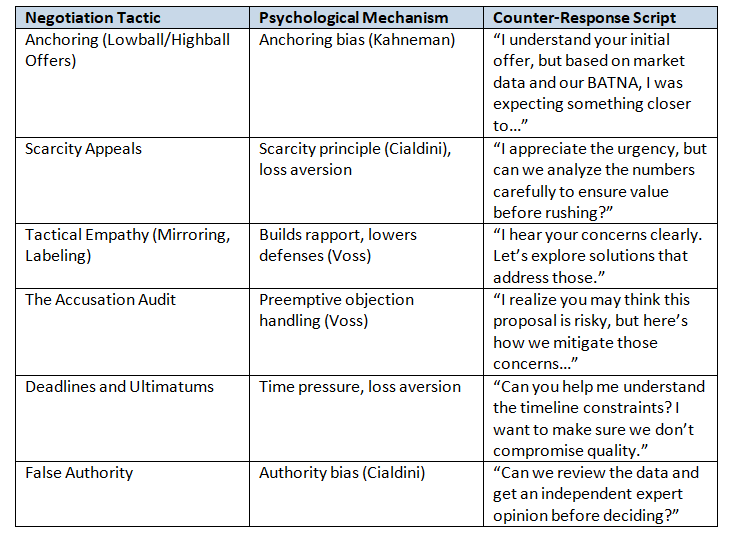
Advanced Insights
Top negotiators recognize the fluidity of power and leverage, adjusting tactics dynamically. For instance, employing "calculated vulnerability" — revealing a genuine constraint or interest — can paradoxically increase trust and reciprocity, as Adam Grant’s research shows.
Another advanced technique is "framing reversal," where negotiators reframe offers to highlight gains rather than losses, overcoming loss aversion. For example, transforming a price increase into a package emphasizing enhanced services or exclusivity activates scarcity and social proof simultaneously.
Game theory advises monitoring counterpart’s payoff matrices and anticipating their best responses to create Nash equilibria favoring cooperation. In multi-party negotiations, coalition dynamics from Machiavelli through modern game theory inform when to form alliances or signal credible threats.
Finally, expert negotiators use "metacommunication"—explicitly discussing the negotiation process—to prevent emotional escalation and clarify intentions. This technique reduces misunderstandings and sets a shared roadmap for resolution.
Scripts and Templates
1. Opening Offer Anchor
“I appreciate the opportunity to discuss terms today. Based on our market research and previous deals, we’re starting with an offer of $X, which reflects the value and scope we bring.”
2. Tactical Empathy Labeling
“It sounds like the timeline is a significant pressure point for you. Let’s explore how we can adjust deliverables to meet your needs without compromising quality.”
3. Accusation Audit Preemptive Statement
“I understand you might feel that our pricing is on the higher side. That’s a fair concern, and here’s how the additional value justifies the cost.”
4. Calibrated Question to Encourage Collaboration
“How can we work together to bridge the gap between our positions while ensuring both sides meet their priorities?”
5. Counter to Scarcity Pressure
“I hear that this offer is only available for a limited time. Before we commit, can we review the full details to ensure it aligns with our strategic goals?”
Frequently Asked Questions
Q1: What is the most effective psychological tactic for breaking deadlocks?
A1: Tactical empathy, especially labeling and mirroring (per Chris Voss), is highly effective for breaking deadlocks by lowering emotional resistance and creating rapport. It helps uncover underlying interests rather than positions.
Q2: How do I prepare my BATNA to maximize negotiation power?
A2: Identify credible alternatives, quantify their value, and develop fallback plans. The stronger and clearer your BATNA, the more leverage you have to reject unfavorable offers or push for better terms (Shell 2006).
Q3: When should I make the first offer in negotiations?
A3: Making the first offer is advantageous when you have superior information or have prepared well, as anchoring strongly influences outcomes (Kahneman 2011). If uncertain, it may be better to invite the other side’s offer to gather information.
Q4: How do I respond to manipulative deadlines or ultimatums?
A4: Use calibrated questions to probe the urgency’s rationale and request reasonable extension. This neutralizes pressure and forces counterpart to justify constraints logically (Voss 2016).
Q5: What ethical considerations should guide negotiation tactics?
A5: Ethical negotiation respects transparency, avoids deception, and seeks mutual benefit (Fisher & Ury 1981). While persuasion tactics are valid, manipulation or coercion harms relationships and long-term value. Use influence responsibly.
Conclusion
Mastering negotiation tactics in action requires integrating psychological insight with strategic frameworks and real-world adaptability. Understanding cognitive biases like anchoring and loss aversion, applying empathy-based techniques, and preparing thoroughly with BATNA and objective criteria position you for success in any negotiation context. The real-world case studies—from Apple’s patent battles to Colombia’s peace process—demonstrate how these principles translate into tangible outcomes.
Whether you lead multi-million dollar deals or navigate complex diplomatic talks, this comprehensive guide equips you with the tools to recognize tactics, anticipate counter-moves, and deploy scripts that close agreements effectively and ethically. Start implementing these techniques today to shift negotiations from zero-sum struggles into opportunities for shared value and lasting partnerships.
References
Fisher, R., & Ury, W. (1981). Getting to Yes: Negotiating Agreement Without Giving In. Penguin Books.
Kahneman, D. (2011). Thinking, Fast and Slow. Farrar, Straus and Giroux.
Cialdini, R. B. (2009). Influence: Science and Practice. Pearson Education.
Voss, C., & Raz, T. (2016). Never Split the Difference: Negotiating As If Your Life Depended On It. Harper Business.
Shell, G. R. (2006). Bargaining for Advantage: Negotiation Strategies for Reasonable People. Penguin.
Grant, A. (2013). Give and Take: Why Helping Others Drives Our Success. Viking.