Case Studies: Price Negotiation — Lessons from Real Deals
Price negotiation is the battleground where companies win or lose critical revenue and margin. Consider this: according to McKinsey research, companies that excel at negotiation achieve up to 15% higher profit margins than their peers. Yet, many sales teams leave money on the table because they underestimate the nuanced psychology underpinning price discussions or rely on weak tactics. Picture a SaaS vendor who offers a 20% discount just to close a deal quickly, only to realize they’ve undermined months of product development investment and set a dangerous precedent for all future clients.
Why is mastering price negotiation so crucial? Because pricing is not just a number; it signals value, quality, and trust — all of which are deeply psychological. Buyers’ perceptions of price fluctuate based on anchoring, reference points, and social proof, often outside conscious awareness. Poor negotiation can erode margins, damage brand positioning, and weaken long-term customer relationships. Conversely, skilled negotiators leverage behavioral economics principles and structured frameworks to secure premium pricing while nurturing loyalty.
This comprehensive guide unlocks the secrets behind successful price negotiations through real-world case studies and actionable techniques. You will master the psychology of price perception, learn proven frameworks like the Value-Based Pricing Model and the Anchoring-Decoy Approach, and gain step-by-step processes to confidently handle objections and close high-value deals. From Apple’s premium pricing tactics to Amazon’s procurement negotiation strategies, this article equips sales leaders and business owners with indispensable tools to protect margins and negotiate with authority.
· Table of Contents
· The Psychology and Science Behind Price Negotiation
· Key Frameworks and Models Compared
· Step-by-Step Price Negotiation Process
· Real-World Case Studies: Apple, McKinsey, Amazon
· Common Mistakes and How to Avoid Them
· Advanced Price Negotiation Tactics
· Scripts and Templates for Price Discussions
· Frequently Asked Questions
· Conclusion and Call to Action
· References
The Psychology and Science Behind This Topic
Price negotiation is much more than a transactional discussion; it is a complex interplay of human psychology and behavioral economics. Nobel laureate Daniel Kahneman’s Prospect Theory reveals that buyers evaluate potential gains and losses asymmetrically — losses (such as paying a higher price) loom larger than gains, making price resistance natural. This loss aversion means that negotiators must frame their pricing to emphasize value and minimize perceived loss.
Ariely’s research in "Predictably Irrational" highlights how anchoring bias operates during negotiations. Initial price offers anchor the buyer’s expectations, influencing their counteroffers and willingness to pay. For example, a high initial price can psychologically normalize premium pricing, even if the buyer intends to negotiate down.
The price-quality heuristic also plays a pivotal role: consumers often infer quality from price, assuming higher price signals superior product or service. Apple has expertly harnessed this heuristic to justify its above-market pricing while cultivating a prestige brand.
Robert Cialdini’s principles of influence—reciprocity, scarcity, social proof, and commitment—are equally critical. Showing limited availability or referencing well-known clients can create urgency and enhance perceived value. Additionally, the decoy effect, a pricing strategy that introduces a third option to steer buyers towards a more profitable choice, can subtly nudge buyers' decisions.
Reference pricing — the internal benchmark buyers carry based on prior costs or competitor prices — influences their evaluation. Effective negotiators manage these reference points by educating buyers on total cost of ownership or long-term value, not just sticker price.
Understanding these psychological levers allows sales professionals to structure pricing conversations that align with buyer cognition, leading to more successful negotiations.
Key Frameworks and Models
Several structured frameworks guide effective price negotiation by integrating behavioral insights and strategic approaches. Below are three widely used models:
- Value-Based Pricing Model: Focuses on quantifying and communicating the unique value delivered to the customer rather than cost-plus markup.
- Anchoring-Decoy Approach: Uses high initial price anchors combined with a strategically priced "decoy" option to steer the buyer toward the preferred package.
- BATNA (Best Alternative to a Negotiated Agreement) Framework: Identifies both parties’ fallback options to inform negotiation leverage and walk-away points.
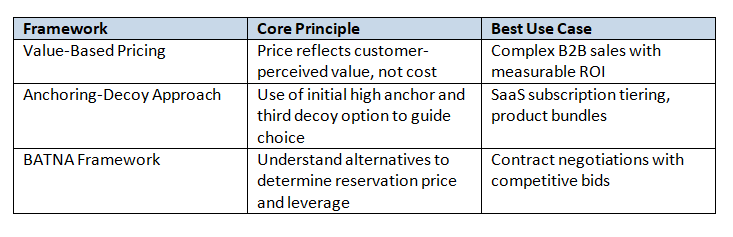
Each framework can be combined or adapted depending on industry context and buyer sophistication. For example, Amazon’s procurement teams leverage BATNA extensively to benchmark vendor proposals, while Salesforce uses value-based pricing methodologies in enterprise deals to justify premium fees.
Step-by-Step Process
Mastering price negotiation requires a systematic approach. Below is a detailed six-step process with actionable guidelines.
Step 1: Preparation and Research
Thoroughly analyze the customer’s business, pain points, and budget constraints. Identify their BATNA and your own reservation price. Gather competitive intelligence and previous deal data.
Step 2: Establish Value Before Price
Articulate and quantify your product’s unique value proposition. Use case studies, ROI calculators, and testimonials to build a compelling case.
Step 3: Set Anchors Strategically
Begin with a well-reasoned, slightly higher price anchor to frame the negotiation. Avoid lowballing as it lowers perceived value and weakens leverage.
Step 4: Introduce Options and Decoys
Present multiple pricing tiers or bundles with a "decoy" option priced to make the preferred offer appear more attractive.
Step 5: Handle Objections with Empathy and Data
Use calibrated questions (“What’s your biggest concern about this pricing?”) and counter with evidence of value, total cost of ownership, and risk mitigations.
Step 6: Close with Confidence and Confirm Commitment
Once agreement is reached, summarize terms clearly and secure verbal or written confirmation promptly. Avoid last-minute discount requests by reinforcing value.
Real-World Case Studies
Examining real companies reveals how these principles are applied in practice.
Apple: Premium Pricing and Brand Loyalty
Apple sets prices at a premium level, leveraging the price-quality heuristic and brand prestige. In negotiations with channel partners, Apple maintains strict price floors, refusing to discount beyond a narrow range. This preserves brand perception and margin integrity, reinforcing the product’s aspirational value.
Outcome: Apple consistently achieves some of the highest gross margins in consumer electronics and cultivates deep customer loyalty.
McKinsey & Company: Value-Based Fees
McKinsey uses value-based pricing tied to measurable business outcomes. They negotiate fees based on the impact and ROI delivered to clients rather than hourly rates. This approach requires upfront alignment on value metrics and transparency.
Outcome: McKinsey has secured multi-million dollar contracts with Fortune 500 firms, commanding fees that reflect strategic influence rather than commodity consulting.
Amazon Procurement: BATNA and Competitive Leverage
Amazon’s procurement team rigorously benchmarks suppliers and uses BATNA analysis to drive aggressive price negotiations. They often pit vendors against one another, using data-driven insights to justify price reductions without sacrificing quality.
Outcome: Amazon maintains low cost of goods sold, supporting its competitive pricing model while fostering supplier innovation.
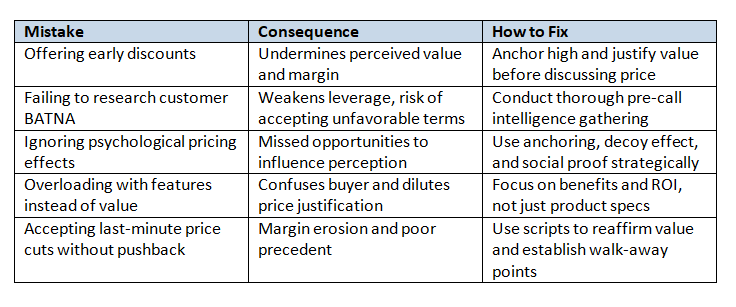
Common Mistakes and How to Avoid Them
Advanced Tactics
For seasoned negotiators, advanced strategies can further protect margins and close premium deals.
- Use Time Scarcity: Introduce limited-time offers or exclusive access to encourage faster commitment.
- Employ the “Foot-in-the-Door” Technique: Secure agreement on smaller terms first to build momentum toward full price acceptance.
- Leverage Multi-Party Negotiations: Engage multiple stakeholders to create consensus and reduce buyer’s ability to negotiate down.
- Data-Driven Negotiation Playbooks: Use CRM analytics and deal history to customize negotiation scripts and anticipate objections.
Scripts and Templates
Below are ready-to-use dialogue scripts for common negotiation scenarios.
Script 1: Initial Price Presentation
“Based on the value we’ve discussed and the outcomes you aim to achieve, our proposed investment is $X. This reflects the premium quality and ROI our solution delivers, as evidenced by [case study]. How does this align with your expectations?”
Script 2: Handling Discount Requests
“I understand budget is a concern. Can you share what price range you had in mind? Let’s explore options that maximize value within your constraints without compromising the results you need.”
Script 3: Responding to Price Pushback
“I appreciate your perspective. Keep in mind, lower-priced alternatives often lack the scalability and support you require, which can lead to higher costs down the line. Our pricing accounts for the total cost of ownership.”
Script 4: Closing Confirmation
“Great, to confirm we’re aligned on the scope and investment of $X. I will send over the agreement by end of day. Please let me know if you have any questions before we proceed.”
Frequently Asked Questions
Q1: How do I set an effective price anchor without scaring off the buyer?
A1: Anchor with a price slightly above your target but justified by clear value metrics. Use data and testimonials to soften the psychological impact. Avoid arbitrarily high anchors that appear unrealistic.
Q2: When is it appropriate to offer discounts in price negotiation?
A2: Offer discounts only after securing agreement on value and when they are tied to concessions, such as volume commitments or longer contract terms. Never give discounts upfront.
Q3: How can I handle multiple stakeholders with conflicting price expectations?
A3: Use a consultative approach to uncover the priorities of each stakeholder, then tailor your value messaging accordingly. Facilitate internal consensus by emphasizing shared business outcomes.
Q4: What role does reciprocity play in price negotiations?
A4: Reciprocity encourages buyers to reciprocate concessions. For example, if you agree to a small price reduction, request a shorter payment term or expanded contract scope in return.
Q5: Can psychological pricing techniques backfire?
A5: Yes, if used manipulatively or without transparency. Buyers may lose trust if they feel tricked. Use these techniques ethically to highlight real value and facilitate mutual benefit.
Conclusion
Effective price negotiation is an indispensable skill that directly impacts your company’s profitability and competitive positioning. By deeply understanding the psychology behind price perception and applying rigorously tested frameworks, you can confidently steer conversations toward premium outcomes. Real-world exemplars like Apple and McKinsey prove that disciplined negotiation preserves margin while enhancing customer relationships.
Armed with step-by-step processes, advanced tactics, and practical scripts, you are now equipped to elevate your price negotiations from reactive haggling to strategic value conversations. Take control of your deals today by integrating these insights and frameworks—your margins, brand, and bottom line depend on it.
References
- Kahneman, D., & Tversky, A. (1979). Prospect Theory: An Analysis of Decision under Risk. Econometrica.
- Ariely, D. (2008). Predictably Irrational: The Hidden Forces That Shape Our Decisions. HarperCollins.
- Cialdini, R. B. (2007). Influence: The Psychology of Persuasion. Harper Business.
- McKinsey & Company. (2020). The Art of Pricing: How to Capture More Value. McKinsey Insights.
- Harvard Business Review. (2016). Negotiating to Win: How Amazon Drives Bargaining Power. HBR.
- Nagle, T., Hogan, J., & Zale, J. (2016). The Strategy and Tactics of Pricing: A Guide to Growing More Profitably. Routledge.