Communication Styles Across Cultures: How to Adapt Your Message for Global Audiences

In 2017, a major technology partnership between a leading American Silicon Valley firm and a Japanese conglomerate fell apart after months of discussions. The American negotiators, accustomed to direct, transactional communication, pushed aggressively for rapid decisions and explicit commitments. Meanwhile, their Japanese counterparts emphasized consensus-building through the nemawashi process, expecting extensive behind-the-scenes consultation and subtle non-verbal cues that the Americans missed entirely. This cultural disconnect led to mistrust, misinterpretation, and ultimately, the collapse of a deal worth hundreds of millions of dollars.
This story is just one vivid example of how cross-cultural negotiation differs fundamentally from domestic business interactions. At the heart of these challenges lie invisible cultural scripts—assumptions about communication, authority, time, and relationships that shape how people interpret messages and signals. These scripts, often unconscious, can cause even the most skilled negotiators to misread trust signals, fail to build rapport, and stumble over differing expectations of formality, directness, and decision-making processes. Without deep cultural intelligence, negotiators risk costly misunderstandings and missed opportunities.
In this comprehensive guide, you will master the foundational research from renowned cultural scholars such as Geert Hofstede, Erin Meyer, Richard Lewis, Edward Hall, Richard Gesteland, David Livermore, and Trompenaars & Hampden-Turner. You will gain country-specific insights—from Japan’s ringi system and China’s guanxi to Germany’s Sachlichkeit and Brazil’s jeitinho—and learn exact scripts and step-by-step frameworks to adapt your communication style effectively. Whether you lead global sales teams, negotiate international deals, or manage cross-cultural teams, this article will equip you with actionable tools and expert strategies to succeed across cultures.
· Table of Contents
· The Science of Cultural Differences in Negotiation
· Key Cultural Frameworks and Comparative Analysis
· Step-by-Step Cultural Preparation Strategy
· Real-World Case Studies of Cross-Cultural Negotiations
· Country and Region-Specific Insights Table
· Advanced Cross-Cultural Communication Strategies
· Scripts and Templates for Global Audiences
· Frequently Asked Questions on Cross-Cultural Communication
· Conclusion and Call to Action
· References and Further Reading
The Science of Cultural Differences in Negotiation
Understanding cultural differences in negotiation requires grounding in seminal research that highlights how values, communication styles, and social norms vary worldwide. Seven major frameworks provide deep insights into these variations:
Geert Hofstede’s six cultural dimensions explain how national cultures differ across Power Distance (acceptance of hierarchy), Individualism vs Collectivism, Masculinity vs Femininity (achievement vs quality of life), Uncertainty Avoidance, Long-Term Orientation, and Indulgence. For example, Japan scores high on Uncertainty Avoidance (92) and Long-Term Orientation (88), reflecting a preference for stability and planning, while the United States scores lower on Uncertainty Avoidance (46) and higher on Individualism (91), underscoring a propensity for directness and autonomy.
Erin Meyer’s Culture Map breaks down communication and negotiation into eight dimensions: Communicating (low vs high context), Evaluating (direct vs indirect negative feedback), Persuading (principles-first vs applications-first logic), Leading (egalitarian vs hierarchical), Deciding (consensual vs top-down), Trusting (task-based vs relationship-based), Disagreeing (confrontational vs avoids confrontation), and Scheduling (linear vs flexible time). For instance, Scandinavian countries like Sweden prioritize egalitarian leadership and linear time, while Middle Eastern cultures lean toward hierarchical leadership and polychronic time.
Richard Lewis categorizes cultures into Linear-Active (task-oriented, organized, planned; e.g., Germany, USA), Multi-Active (emotional, people-oriented, flexible; e.g., Brazil, Italy), and Reactive (listening, respectful, indirect; e.g., Japan, China). This model helps explain why Brazilian negotiators may appear warm and expressive, while Japanese counterparts emphasize listening and harmony.
Edward Hall introduced the concepts of high-context vs low-context communication and monochronic vs polychronic time. High-context cultures (e.g., Japan, Arab countries) rely heavily on implicit messages and context, whereas low-context cultures (e.g., Germany, USA) prefer explicit verbal communication. Polychronic cultures (e.g., India, Latin America) handle multiple tasks and flexible scheduling, contrasting with monochronic cultures (e.g., Switzerland) that focus on punctuality and sequential task completion.
Richard Gesteland’s dimensions focus on deal vs relationship orientation, formal vs informal communication, rigid vs fluid time management, and expressive vs reserved behavior. For example, Middle Eastern cultures are relationship-focused and expressive, while Nordic countries tend to be deal-focused and reserved.
David Livermore’s Cultural Intelligence (CQ) theory centers on four capabilities: CQ Drive (motivation), CQ Knowledge (understanding cultural norms), CQ Strategy (planning and adapting), and CQ Action (executing appropriately). High CQ is a strong predictor of negotiating success across cultures.
Trompenaars & Hampden-Turner’s model highlights universalism vs particularism (rules vs relationships), individualism vs communitarianism, neutral vs emotional expression, specific vs diffuse contexts, and achievement vs ascription (status by performance vs status by age, class). For example, in China’s particularistic culture, relationships often supersede contracts, while in the UK’s universalistic culture, rules and legal agreements dominate.
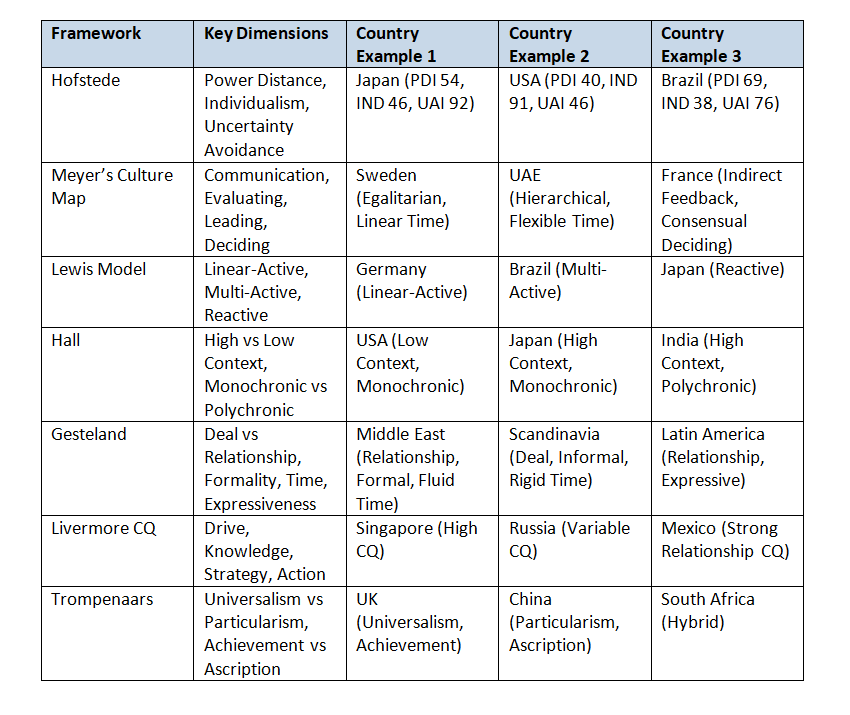
These frameworks provide lenses to decode complex negotiation dynamics and explain why a one-size-fits-all communication style often fails in cross-cultural settings.
Key Cultural Frameworks
To operationalize these theories, three frameworks stand out for practical negotiation preparation and adaptation:
1. Erin Meyer’s Culture Map: Focuses on communication and leadership styles, essential for tailoring messages and feedback.
2. Hofstede’s Dimensions: Offers quantitative scores to benchmark cultural tendencies and anticipate preferences in hierarchy, individualism, and risk tolerance.
3. Trompenaars & Hampden-Turner’s Model: Highlights relational vs rule-based approaches and emotional expression, crucial for trust-building.
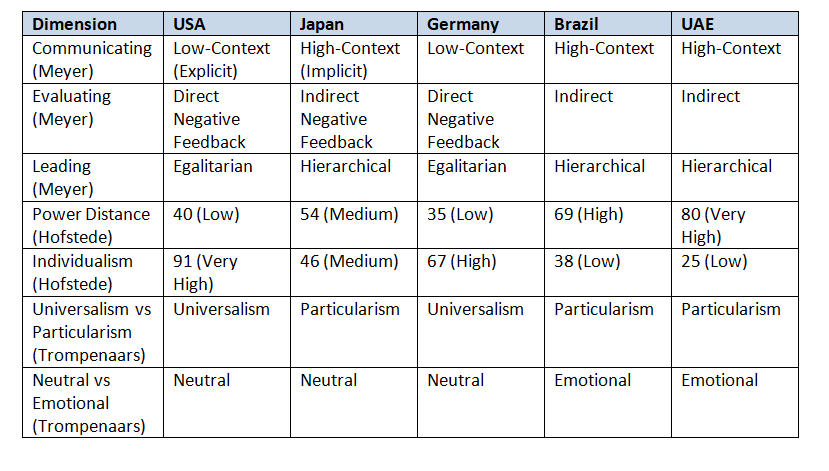
This comparison highlights the need to modulate tone, directness, and formality depending on the cultural context.
Step-by-Step Cultural Preparation Strategy
Step 1: Conduct Comprehensive Cultural Research
Begin by studying your counterparts’ national culture using Hofstede scores, Meyer’s Culture Map, and country-specific business customs. For example, understand Japan’s emphasis on harmony and consensus, or Brazil’s relational warmth and flexible time orientation. Use credible sources such as the Hofstede Insights website and Erin Meyer’s research.
Step 2: Analyze Communication and Decision-Making Styles
Identify whether your counterparts prefer direct or indirect communication, hierarchical or consensual decision-making, and linear or flexible scheduling. For instance, German negotiators expect Sachlichkeit—fact-based, unemotional exchanges—and punctuality, while Indian negotiators may prioritize relationship-building before addressing business.
Step 3: Build Relationships and Establish Trust
In collectivist and relationship-focused cultures (China, Middle East), invest time in guanxi or wasta networks before discussing contracts. Use face-saving strategies and demonstrate respect for hierarchy. In contrast, deal-focused cultures like Scandinavia expect swift task-based trust.
Step 4: Adapt Your Communication Style
Tailor your message for high-context cultures by paying attention to non-verbal signals, indirect feedback, and silence. For low-context cultures, be explicit and transparent. Adjust tone and formality: use formal titles in Korea and Saudi Arabia, but informal greetings in Australia.
Step 5: Manage Face and Save Harmony
Avoid public criticism in high face cultures such as Japan or China. Use indirect language and positive framing. For example, replace “Your proposal is flawed” with “Perhaps we could explore additional options.”
Step 6: Close with Cultural Awareness
Understand how different cultures handle agreement and closing. Some (Japan) prefer tentative consensus followed by written confirmation, others (USA) expect clear, immediate contracts. Confirm next steps explicitly according to local expectations.
Real-World Case Studies
Case Study 1: The Failed American-Japanese Tech Deal (2017)
Context: American startup pushed for quick contract signing; Japanese partner expected nemawashi consensus.
Cultural Dynamics: Low-context directness vs high-context indirect consensus building; differing time orientation.
Outcome: Breakdown due to impatience and misreading silence as agreement; lesson: respect local decision processes.
Case Study 2: Successful German-Brazilian Manufacturing Partnership (2018)
Context: German firm adapted to Brazil’s multi-active style by emphasizing relationship-building and flexible scheduling.
Cultural Dynamics: Germany’s task-focused punctuality adapted to Brazil’s polychronic warmth and expressive communication.
Outcome: Trust established through social events and patience; robust multi-year deal signed.
Case Study 3: Middle East-European Energy Negotiation (2019)
Context: European negotiators learned to engage with local wasta networks and respect hierarchical protocols.
Cultural Dynamics: Relationship-oriented, high power distance culture balanced with European deal-focus.
Outcome: Deal signed after months of informal meetings; trust built through respect for traditions.
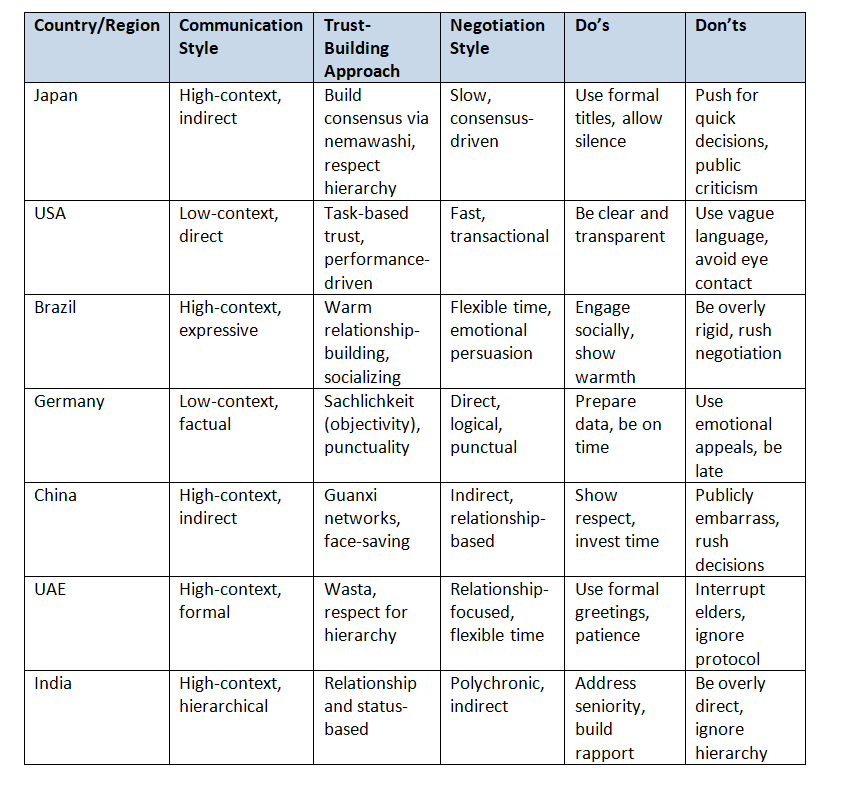
Country/Region-Specific Insights
Advanced Strategies
Managing Interpreters: Use trained, culturally aware interpreters. Brief them in advance on negotiation aims. Speak in short, clear sentences and pause regularly. Avoid slang or idioms.
Building Guanxi, Wasta, and Relationships: Invest time in social interactions, gift-giving (where appropriate), and engaging influential local contacts. Understand the reciprocity principle and long-term orientation.
Navigating Hierarchy and Face: Observe seating arrangements, address senior members first, and use honorifics. Avoid direct confrontation. Use indirect language to manage disagreements and maintain harmony.
Adapting Persuasion Styles: In principle-first cultures (France, Germany), build arguments with theory and logic. In application-first cultures (USA, Australia), emphasize practical benefits and examples.
Reading Non-Verbal Signals: Be attentive to proxemics (distance), eye contact (varies from respectful avoidance to engagement), gestures (some have different meanings), and silence (reflective vs discomfort).
Scripts and Templates
Example Message: Requesting a follow-up meeting after initial discussions
1. German Version (Direct, Formal, Low-Context)
Subject: Follow-up Meeting Request
Dear Mr. Schmidt,
Thank you for the productive discussion on March 15th. To further align on the project specifications, I would like to schedule a follow-up meeting next week. Please let me know your availability.
Best regards,
Anna Müller
2. Japanese Version (Indirect, Formal, High-Context)
Subject: Regarding Next Steps
Dear Mr. Tanaka,
I hope this message finds you well. Following our recent meeting, we would be honored to continue our discussions at your convenience. If it pleases you, may we propose a meeting sometime next week?
With deep respect,
Anna Müller
3. Brazilian Version (Warm, Expressive, High-Context)
Subject: Looking Forward to Our Next Meeting
Olá João,
It was a pleasure speaking with you last week! I truly appreciated your insights. Let's find a time next week to continue our conversation. Please tell me when would be good for you.
Abraços,
Anna
4. American Version (Direct, Informal, Low-Context)
Subject: Next Meeting?
Hi John,
Thanks for the great talk last week. Can we schedule a follow-up meeting next week to discuss the next steps? Let me know what works.
Best,
Anna
5. UAE Version (Formal, High-Context)
Subject: Proposal for Further Discussion
Dear Mr. Al-Mansouri,
I trust you are well. Following our recent fruitful meeting, we would be grateful for the opportunity to meet again at a time most convenient for you to continue our discussions.
Respectfully,
Anna Müller
Frequently Asked Questions
Q1: How can I identify if my counterpart’s culture is high-context or low-context?
Look for reliance on implicit communication, non-verbal cues, and indirectness in message delivery. High-context cultures (e.g., Japan, Arab countries) expect you to read between the lines, while low-context cultures (USA, Germany) value explicit clarity.
Q2: What are the best strategies for building trust in collectivist cultures?
Invest time in personal relationships, show respect for hierarchy, engage in informal social settings, and demonstrate commitment beyond the transaction. Avoid rushing business discussions.
Q3: How should I handle disagreements in cultures that avoid confrontation?
Use indirect language, ask open-ended questions to explore differences, and frame critiques positively. For example, say “Have you considered another perspective?” instead of “You are wrong.”
Q4: How important is punctuality across cultures?
In monochronic cultures (Germany, Switzerland), punctuality is critical and signals respect. In polychronic cultures (India, Latin America), schedules are more fluid. Always research and adapt accordingly to avoid offending.
Q5: Can I rely on interpreters to manage cultural nuances?
Interpreters help bridge language barriers but may not fully convey cultural subtleties. Always brief interpreters thoroughly and remain culturally aware yourself to manage tone, pacing, and politeness.
Conclusion
Mastering communication styles across cultures is not merely a nice-to-have skill but a critical determinant of success in global negotiations. The invisible cultural scripts that dictate how messages are sent, received, and interpreted can either build bridges or create costly misunderstandings. By leveraging respected frameworks such as Hofstede’s dimensions, Meyer’s Culture Map, and Trompenaars’ model, alongside deep country-specific insights and adaptable scripts, international executives can navigate these complexities with confidence.
This guide has equipped you with a robust toolkit—from detailed preparation strategies to advanced techniques in managing face, hierarchy, and persuasion—to tailor your communication for any cultural context. Embrace cultural intelligence as a strategic asset and transform your global negotiations into lasting partnerships. Begin applying these insights today and unlock the full potential of your cross-cultural engagements.
References
· Hofstede, G. (2001). Culture’s Consequences: Comparing Values, Behaviors, Institutions, and Organizations Across Nations. Sage Publications.
· Meyer, E. (2014). The Culture Map: Breaking Through the Invisible Boundaries of Global Business. PublicAffairs.
· Lewis, R. D. (2006). When Cultures Collide: Leading Across Cultures. Nicholas Brealey Publishing.
· Hall, E. T. (1976). Beyond Culture. Anchor Books.
· Gesteland, R. R. (2012). Cross-Cultural Business Behavior: Marketing, Negotiating, Sourcing and Managing Across Cultures. Copenhagen Business School Press.
· Livermore, D. (2015). Leading with Cultural Intelligence: The Real Secret to Success. AMACOM.
· Trompenaars, F., & Hampden-Turner, C. (2012). Riding the Waves of Culture: Understanding Diversity in Global Business. Nicholas Brealey Publishing.