Competitive vs Collaborative Negotiation Strategy: A Comprehensive Guide for Business Leaders

In 2018, IBM and Samsung engaged in high-stakes patent licensing negotiations that would shape their multi-billion-dollar technology partnership. Both sides arrived with strong interests but vastly different approaches: IBM employed a collaborative, relationship-focused negotiation strategy while Samsung initially adopted a competitive, zero-sum stance. The outcome? A landmark agreement that balanced royalty fees with strategic alliance benefits, preserving long-term value for both companies. This scenario encapsulates the critical tension between competitive and collaborative negotiation strategies in today’s complex business landscape.
In an era defined by rapid technological innovation, global competition, and intricate supply chains, mastering negotiation strategies is no longer optional—it’s a strategic imperative. Whether closing multimillion-dollar M&A deals, managing supplier contracts, or resolving labor disputes, understanding when to apply competitive versus collaborative negotiation approaches can determine organizational success or failure. With mounting pressure to create value while preserving relationships, executives must navigate these paradigms with precision.
By the end of this article, you will have a deep understanding of the psychological foundations, strategic frameworks, and practical processes behind competitive and collaborative negotiation. You will gain actionable insights from real-world cases, learn to avoid common pitfalls, and acquire advanced tactics and ready-to-deploy scripts. This guide will equip you with the skills to confidently choose and execute the right negotiation strategy for any business context.
· Table of Contents
· The Strategic Foundation: Theory, Psychology, and Research
· Key Frameworks and Models: Comparison of Leading Negotiation Frameworks
· Step-by-Step Process: How to Execute Competitive and Collaborative Strategies
· Real-World Case Studies: IBM-Samsung, Amazon Procurement, and Labor Union Negotiations
· Common Pitfalls and How to Avoid Them
· Advanced Tactics: Expert Negotiation Techniques
· Scripts and Templates: Exact Dialogue and Email Formats
· Frequently Asked Questions
· Conclusion: Synthesis and Call to Action
· References
The Strategic Foundation — Theory, Psychology, and Research Behind Negotiation Strategies
Negotiation is an inherently complex social interaction shaped by cognitive biases, power dynamics, and conflicting interests. Daniel Kahneman’s seminal work on decision-making under uncertainty highlights how heuristics and framing influence negotiators’ perceptions of value and risk. For instance, the “anchoring effect” often distorts initial offers, making early competitive bids psychologically impactful.
Fisher and Ury’s Harvard Principled Negotiation framework revolutionized negotiation thinking by distinguishing between positional bargaining (often competitive) and interest-based bargaining (collaborative). Their emphasis on separating people from the problem and focusing on mutual interests laid the groundwork for integrative negotiation, which aims for win-win outcomes rather than zero-sum distributive deals.
Robert Cialdini’s research on influence and persuasion further clarifies why collaborative strategies often succeed by leveraging principles like reciprocity, commitment, and liking. Conversely, Shell’s “Bargaining for Advantage” synthesizes these insights into a strategic approach that balances competitive and cooperative tactics depending on context, BATNA strength, and relational goals.
Psychologically, competitive negotiation aligns with distributive bargaining, where parties view the resource as fixed and limited—creating an adversarial mindset. Collaborative negotiation aligns with integrative bargaining, seeking to expand the pie through creative trade-offs and shared value. Understanding these underlying cognitive and social mechanisms enables negotiators to consciously choose and adapt their approach rather than react instinctively.
Key Frameworks and Models
Competitive and collaborative negotiation strategies are best understood through established frameworks that map negotiation dynamics, goals, and processes. Below are three seminal models:
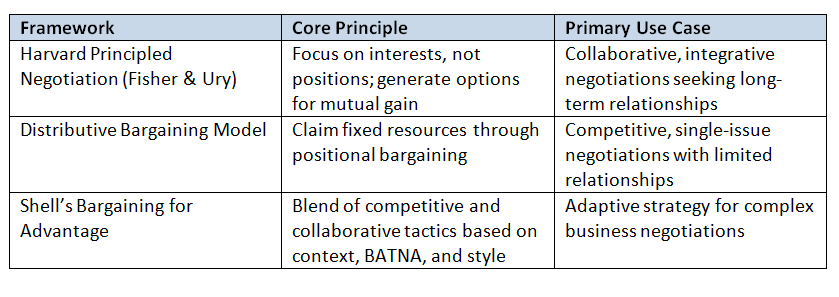
These frameworks differ in their assumptions and emphasis but complement each other in practical use. The Harvard model prioritizes relationship and value creation, ideal for complex, ongoing business partnerships. Distributive bargaining suits one-off transactions such as commodity purchases or salary negotiations where the resource pool is limited. Shell’s model offers a pragmatic middle ground, prescribing situational awareness and tactical flexibility.
Understanding the Zone of Possible Agreement (ZOPA) is critical across these frameworks. Competitive strategies often focus on pushing the deal price to one’s BATNA (Best Alternative to a Negotiated Agreement), while collaborative strategies work to expand ZOPA through joint problem-solving. The MESO (Multiple Equivalent Simultaneous Offers) technique, an advanced integrative tactic, exemplifies collaborative negotiation by allowing parties to evaluate multiple trade-off packages simultaneously.
Step-by-Step Process — Executing Competitive and Collaborative Negotiation Strategies
Before any negotiation, rigorously analyze your BATNA and estimate your counterpart’s. For competitive strategy, this means identifying your walk-away point and reservation price to maximize leverage. For collaborative strategy, preparation involves understanding both parties’ interests, constraints, and potential value-creating opportunities.
Decide whether a competitive or collaborative approach aligns with your goals. Use decision trees considering factors such as relationship importance, deal complexity, and resource divisibility. For example:
- Is long-term partnership critical? → Collaborative
- Is this a one-time price negotiation with limited future interaction? → Competitive
Competitive negotiators use aggressive anchors to shift the negotiation range. Collaborative negotiators employ interest-based framing to invite joint problem-solving. Scripts vary accordingly (see Scripts section).
Collaborative strategy requires open information sharing and empathy to uncover underlying interests. Competitive strategy limits disclosure, focusing on signaling strength and testing limits.
In competitive bargaining, concessions are minimized and often reciprocated tit-for-tat. Collaborative bargaining uses MESO offers to explore integrative solutions and trade-offs.
Confirm terms explicitly and document agreements. Collaborative strategies emphasize joint implementation plans to preserve relationships; competitive tactics ensure enforceability and safeguard against exploitation.
Analyze outcomes versus objectives, relationship status, and lessons learned. This feedback loop enhances future negotiations.
Decision Tree for Strategy Selection
- Is the relationship long-term and valuable?
- Yes → Collaborative
- No → Proceed to next question
- Is the issue complex with multiple interests?
- Yes → Collaborative
- No → Competitive
- Is the resource fixed and zero-sum?
- Yes → Competitive
- No → Collaborative
Real-World Case Studies
IBM leveraged a collaborative approach, focusing on mutual innovation benefits and strategic alliance. Despite Samsung’s initial competitive posturing, IBM’s interest-based framing expanded the ZOPA, resulting in a multi-year licensing agreement valued at hundreds of millions, preserving ongoing R&D collaboration.
Amazon employs primarily competitive negotiation tactics with suppliers, driven by its enormous purchasing power and cost leadership strategy. By anchoring aggressively and leveraging BATNA strength, Amazon secures favorable pricing. However, for strategic suppliers, Amazon shifts to collaborative tactics to ensure supply chain stability.
The UAW uses collaborative negotiation frameworks to balance worker demands and automaker constraints. For example, during the 2019 General Motors contract talks, both parties employed integrative bargaining to address wages, health benefits, and job security, avoiding strikes and preserving the labor-management relationship.
Common Pitfalls and How to Avoid Them
Choosing a competitive approach for a relationship-critical negotiation can damage trust. Conversely, a collaborative approach in a zero-sum negotiation can lead to exploitation. Avoid by applying the strategy decision tree and conducting thorough context analysis.
Overly aggressive anchors can alienate counterparts; too soft anchors sacrifice value. Calibrate anchor strength using market research and BATNA leverage.
In collaboration, withholding key interests undermines joint value creation. In competition, oversharing reduces leverage. Use precise information disclosure aligned with strategy.
Failing to nurture relationships post-deal reduces future opportunities. Establish joint implementation and communication plans.
Advanced Tactics — Expert-Level Techniques
Present multiple equivalent offers simultaneously to discover preferences and create value. This tactic applies primarily in collaborative negotiations.
Use silence to encourage concessions in competitive contexts, and manage deadlines to create urgency without appearing desperate.
Recast issues to highlight shared interests or redefine value components. For example, reframing a price negotiation around total cost of ownership opens integrative options.
Anchor negotiations around independent benchmarks such as market prices, industry standards, or expert opinions to reduce conflict and justify offers.
Scripts and Templates
“Based on our analysis and current market conditions, we propose a rate of $X, which reflects the upper range of industry standards. This offer is firm considering our alternatives.”
“We’d like to understand your key priorities and constraints so we can explore options that create value for both of us. Could you share what outcomes matter most to you?”
Subject: Proposal for Multiple Options to Meet Your Needs
Dear [Name],
To move forward efficiently, we’ve prepared three alternative proposals that balance different priorities. Please review and let us know which aligns best with your objectives:
Option 1: [Details]
Option 2: [Details]
Option 3: [Details]
Looking forward to your feedback.
Best regards,
Frequently Asked Questions
Q1: When should I use a competitive negotiation strategy over a collaborative one?
A1: Use competitive strategies when dealing with one-time transactions, limited relational value, or fixed resources. Collaborative strategies fit complex issues requiring ongoing relationships and potential value expansion.
Q2: How do I prepare differently for competitive vs collaborative negotiations?
A2: Competitive preparation focuses on BATNA strength, reservation prices, and leverage points. Collaborative preparation requires mapping interests, potential trade-offs, and fostering trust-building signals.
Q3: What is the risk of mixing competitive and collaborative tactics during the same negotiation?
A3: Switching tactics without signaling can confuse counterparts and erode trust. However, strategic blending (per Shell’s model) can be effective if applied consciously and transparently.
Q4: How can I identify the other party’s negotiation style?
A4: Observe their communication cues, concession patterns, and information sharing. Early probing questions and active listening reveal whether they prioritize positions or interests.
Q5: Are collaborative negotiations always better?
A5: No. While collaborative negotiations often yield superior long-term value, they require time, trust, and willingness to disclose. Competitive approaches can be more efficient and effective in specific transactional contexts.
Conclusion
Navigating the tension between competitive and collaborative negotiation strategies is a defining skill for today’s business leaders. Rooted in rigorous psychological research and validated frameworks, these strategies offer distinct pathways to value creation and claim. By mastering the strategic foundation, applying proven frameworks, and executing disciplined processes, you can optimize outcomes across diverse negotiation scenarios.
Real-world cases from IBM’s patent licensing to Amazon’s procurement reveal the nuanced application of these strategies, while awareness of common pitfalls ensures you avoid costly errors. Advanced tactics such as MESO offers and framing elevate your negotiation sophistication, and ready-to-use scripts enable immediate implementation.
Begin applying these insights now by assessing your upcoming negotiations through the decision tree provided, preparing strategically, and choosing the approach best aligned with your goals and context. The negotiation advantage awaits those who combine theory, practice, and adaptive execution.