Concession Strategy in Negotiation: How to Give and Get More

Negotiators at Amazon’s procurement division frequently face immense pressure to secure supplier contracts that align with tight cost targets. In a pivotal 2018 negotiation with a major electronics supplier, Amazon’s team employed a meticulously planned concession strategy that allowed them to strategically concede on delivery timelines while extracting deeper price discounts, ultimately saving millions and fostering a long-term partnership. This scenario exemplifies the high stakes and nuanced art of concession in negotiation—where the ability to give and get more can dictate deal success or failure.
In today’s hyper-competitive global business environment, effective concession management is no longer optional but a strategic imperative. With complex multinational deals, rapidly shifting market conditions, and empowered counterparts, negotiators must understand not just when to concede, but how to do so in ways that maximize value and preserve leverage. The psychology of concessions—rooted in behavioral economics and social influence—reveals that poorly timed or excessive concessions can erode trust, signal weakness, and undermine outcomes. Conversely, strategic concessions can open pathways to integrative agreements, deepen relationships, and create win-win scenarios that traditional distributive bargaining misses.
This comprehensive guide will empower you to master concession strategy from foundational theory to advanced tactics. By journey’s end, you will understand the psychological drivers behind concessions, be fluent in multiple frameworks such as Harvard’s Principled Negotiation and Shell’s Bargaining for Advantage, and possess a detailed, step-by-step concession process. You will also gain insight from real-world corporate case studies, learn to avoid common pitfalls with corrective measures, and acquire expert-level tactics plus ready-to-use negotiation scripts. This article is your definitive blueprint for giving and getting more through concessions in any negotiation context.
· Table of Contents
· The Strategic Foundation: Core Theory, Psychology, and Research
· Key Frameworks and Models for Concession Strategy
· Step-by-Step Process to Effective Concessions
· Real-World Case Studies of Concession Mastery
· Common Pitfalls and How to Avoid Them
· Advanced Tactics for Experienced Negotiators
· Scripts and Templates for Concession Dialogue
· Frequently Asked Questions on Concession Strategy
· Conclusion: Synthesizing Key Insights and Next Steps
· References
The Strategic Foundation — Core Theory, Psychology, and Research
Concession strategy sits at the intersection of negotiation theory, behavioral psychology, and influence science. Understanding why and how negotiators concede requires unpacking several foundational research pillars.
First, Kahneman and Tversky’s Prospect Theory (1979) revolutionized how we view risk in negotiation. Their concept of loss aversion—the idea that losses loom larger than gains psychologically—explains why negotiators resist concessions that feel like giving up value. This resistance can cause impasses or overly aggressive stances. However, strategic concessions framed properly (e.g., as trade-offs rather than losses) can mitigate this aversion and facilitate deal progress.
Fisher and Ury’s seminal work Getting to Yes (1981) introduced principled negotiation, emphasizing separating people from the problem and focusing on interests rather than positions. This framework encourages negotiators to use concessions integratively—to expand the pie rather than simply divide it. Concessions become tools for creating value, not just signs of weakness.
Robert Cialdini’s Influence (2006), grounded in social psychology, highlights reciprocity as a core principle governing concessions. When one party makes a concession, the other is inclined to reciprocate, fostering cooperation. Skilled negotiators use calibrated concessions to trigger reciprocal moves, advancing negotiations strategically.
Deepak Malhotra and Max Bazerman’s Negotiation Genius (2007) integrates behavioral insights with practical tools, emphasizing the importance of anchoring concessions around a strong BATNA (Best Alternative to a Negotiated Agreement). Without a clear BATNA, negotiators risk conceding too quickly or without leverage, resulting in suboptimal agreements.
Finally, G. Richard Shell’s Bargaining for Advantage (2006) combines economic, psychological, and strategic perspectives, advocating for planned concession sequences that preserve options. Shell underscores the importance of timing, concession size, and signaling to maximize negotiation outcomes.
Collectively, these research contributions establish that concession strategy is not ad hoc generosity but a sophisticated process balancing psychological realities with strategic leverage to achieve superior deals.
Key Frameworks and Models — Comparison of Leading Concession Strategies
Three dominant frameworks provide structured approaches to concession management in negotiation:
1. Harvard Principled Negotiation: Focuses on interests over positions, advocating for mutual gains and collaborative concessions.
2. Shell’s Bargaining for Advantage: Emphasizes preparation, BATNA clarity, and strategic concession sequencing to maintain bargaining power.
3. Malhotra & Bazerman’s Negotiation Genius: Combines behavioral economics with tactical advice on anchoring, concession pacing, and reciprocal exchanges.
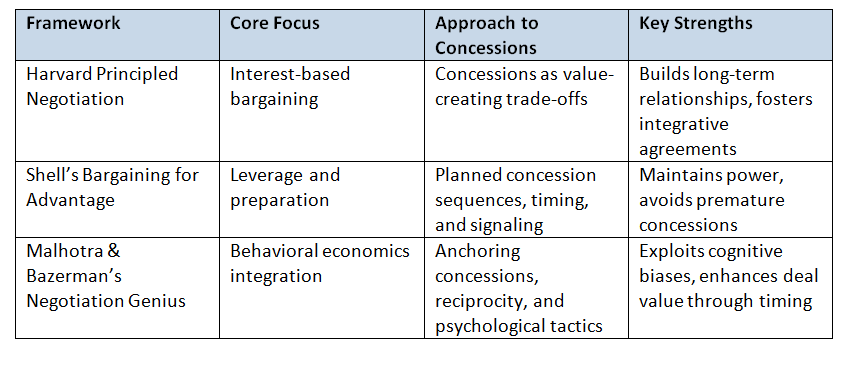
These frameworks, while distinct, are complementary. Effective negotiators blend interest-based collaboration with tactical leverage management and psychological insight to optimize concession outcomes. The choice of framework depends on context—e.g., labor union negotiations may prioritize principled negotiation, while M&A dealmakers might lean on Shell’s leverage focus.
Step-by-Step Process — Detailed Walkthrough to Effective Concessions
Step 1: Prepare Thoroughly – Define Your BATNA and Concession Boundaries
Before negotiation, identify your Best Alternative to a Negotiated Agreement (BATNA). Knowing your fallback clarifies how much value you can afford to concede. Simultaneously, establish concession boundaries—minimum acceptable terms and maximum concessions—based on quantitative and qualitative criteria.
Step 2: Analyze Counterpart’s Interests and BATNA
Through research and questioning, uncover the other party’s interests, constraints, and alternatives. Understanding their BATNA and priorities allows you to tailor concessions that address their underlying needs effectively, increasing the chance of reciprocal concessions.
Step 3: Develop a Concession Strategy Matrix
Map potential concessions along two axes: value to you vs. value to them. Prioritize concessions that cost you little but are valuable to the counterpart (low cost, high impact). Plan the sequence and timing of concessions, reserving high-value concessions for later stages or conditional on reciprocation.
Step 4: Anchor the Negotiation with a Strong Opening Position
Set an ambitious yet credible initial offer to establish the negotiation zone. Anchoring influences the perceived value of subsequent concessions. Avoid conceding immediately after the anchor; instead, allow the counterpart to respond.
Step 5: Make Strategic Concessions Using MESO (Multiple Equivalent Simultaneous Offers)
Present multiple equivalent offers simultaneously to signal flexibility and invite the counterpart to choose preferences. This technique fosters integrative bargaining and allows you to offer concessions on less critical issues in exchange for gains on others.
Step 6: Signal Concessions Clearly and Request Reciprocity
Frame concessions explicitly as trade-offs, not pure giveaways. Use calibrated language (“In order to accommodate your delivery schedule, we can offer a 5% price reduction, contingent on volume commitment.”). Prompt the counterpart to respond with concessions of similar value, reinforcing reciprocity norms.
Step 7: Monitor Negotiation Dynamics and Adapt Negotiation Strategy
Track concessions given and received, ensure you do not concede too rapidly or disproportionately. Stay alert for signs of counterpart’s resistance or eagerness. Adapt concession size, timing, or issues if the negotiation dynamic shifts.
Step 8: Close with Confirmed Agreement and Document Concession History
Once agreement emerges, recap concessions on both sides to reinforce fairness and commitment. Formalize terms clearly to avoid post-deal misunderstandings or renegotiation triggers.
Real-World Case Studies — Exemplars of Concession Mastery
Case Study 1: Apple vs Samsung Patent Licensing Negotiations
During protracted patent licensing battles, Apple strategically conceded on certain non-core technology rights to Samsung in exchange for higher royalty rates on critical components. This selective concession preserved Apple’s competitive advantage while securing lucrative revenue streams. The lesson: differentiate concession value by issue criticality.
Case Study 2: IBM Enterprise Software Licensing Deals
IBM’s sales teams use MESO offers extensively, providing clients with multiple contract package options. By conceding on service levels or customization fees in exchange for longer contract terms, IBM balances immediate revenue with customer retention. The strategic use of multiple concessions tailored to client preferences maximizes deal value.
Case Study 3: 2011 U.S. Federal Government Debt Ceiling Negotiations
In high-stakes political bargaining, concessions on spending cuts were traded for promises on tax reforms. However, poor signaling and rushed concessions without clear reciprocity led to market uncertainty. The lesson: timing and communication of concessions are as important as content.
Common Pitfalls and How to Avoid Them
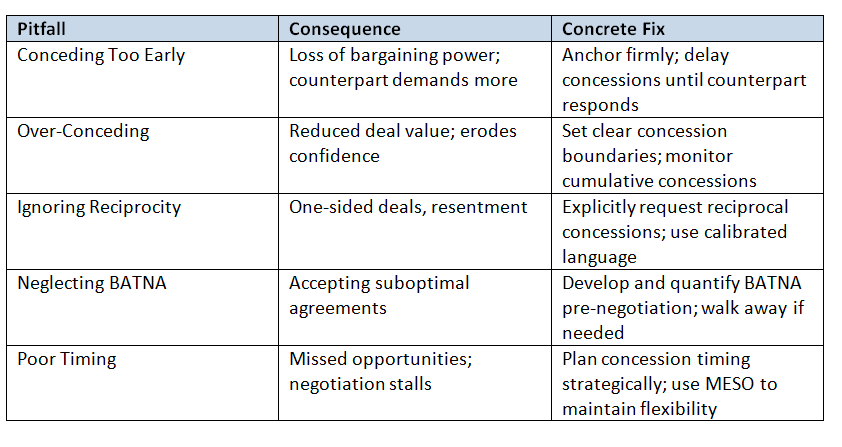
Negotiators frequently fall into traps that undermine concession effectiveness:
- Conceding Too Early: Signals weakness, reduces leverage.
- Over-Conceding: Depletes value unnecessarily.
- Failing to Signal Reciprocity: Leads to one-sided concessions.
- Ignoring BATNA: Results in accepting poor deals.
- Poor Timing: Concessions given too late or too soon hurt outcomes.
Advanced Tactics — Expert-Level Techniques for Experienced Negotiators
1. Conditional Concessions with Contingent Clauses: Offer concessions tied to specific performance metrics or milestones to safeguard interests.
2. Strategic Silence Post-Concession: Use pauses after concessions to pressure counterpart into reciprocation without verbal prompting.
3. Decoy Concessions: Present concessions on low-priority issues to distract from core demands.
4. Concession Bundling: Package multiple concessions into a single offer to create perceived higher value and raise counterpart’s reference points.
5. Emotional Framing: Leverage loss aversion by framing concessions as “risk reductions” or “avoiding losses” rather than pure giveaways.
6. Third-Party Endorsements: Use objective external standards (industry benchmarks, legal rulings) to justify concession levels and resist undue pressure.
Scripts and Templates — Exact Dialogue and Written Templates
Script Example: Signaling a Conditional Concession
“[Your Name]: In recognition of your need for expedited delivery, we are prepared to accelerate the timeline by two weeks, contingent upon a 10% increase in order volume. This adjustment allows us to allocate additional resources without compromising quality. Would this arrangement work for you?”
Template: Concession Trade-Off Email
Subject: Proposal Adjustment for Mutual Benefit
Dear [Counterpart],
Following our recent discussions, we have reviewed the terms and identified an opportunity to better align with your priorities. We are willing to adjust [Issue A] by [specific concession], contingent upon your agreement to [counter-concession on Issue B].
This reciprocal adjustment aims to create value for both sides and move us closer to a mutually beneficial agreement.
Please let me know your thoughts.
Best regards,
Frequently Asked Questions — Detailed Q&A
Q1: How do I determine the right size of a concession?
A1: The optimal concession size balances signaling goodwill without eroding leverage. Use your BATNA to set a minimum acceptable value, then plan incremental concessions starting small to test counterpart response. Behavioral research shows that large initial concessions can trigger suspicion or loss of respect (Shell, 2006). Employ MESO to offer multiple small concessions on less critical issues rather than a single large one.
Q2: When is the best time to make a concession in negotiation?
A2: Timing depends on negotiation dynamics. Early concessions can build trust but risk weakening your position. Research by Malhotra & Bazerman (2007) suggests waiting until the counterpart expresses willingness or makes a concession first leverages reciprocity principles. Mid-stage concessions often maximize impact by responding to counterpart signals. Late concessions should be reserved for closing deadlocks or securing final agreements.
Q3: How can I avoid giving away too much during concessions?
A3: Establish clear concession boundaries grounded in your BATNA and objectives. Track cumulative concessions carefully and use calibrated language to frame concessions as conditional trade-offs. Avoid emotional decision-making by preparing scripts and using objective standards for justification. If pressured, pause and re-assess rather than conceding impulsively.
Q4: What role does reciprocity play in concession strategy?
A4: Reciprocity is foundational in social influence, compelling parties to respond in kind to concessions. Effective negotiators make explicit, calibrated concessions while requesting comparable returns, reinforcing a cooperative exchange cycle. Ignoring reciprocity risks one-sided deals and damaged relationships (Cialdini, 2006).
Q5: How do cultural differences impact concession strategies?
A5: Cultures vary in directness, face-saving, and negotiation styles, affecting concession interpretation. For example, East Asian cultures may prefer indirect concessions framed to preserve harmony, while Western cultures expect explicit trade-offs. Awareness of counterpart cultural norms helps tailor concession language, timing, and signaling to maximize acceptance and avoid misunderstandings.
Conclusion
Mastering concession strategy is essential for negotiators seeking to maximize value, preserve leverage, and build sustainable agreements in today’s complex business landscape. By grounding your approach in robust psychological research, employing proven frameworks, and adopting a disciplined step-by-step process, you can transform concessions from liabilities into powerful negotiation tools. Real-world examples from Apple, IBM, and beyond demonstrate that strategic concessions enable negotiators to give purposefully and get more in return.
As you incorporate advanced tactics and scripts detailed herein, you will be equipped to navigate diverse negotiation contexts with confidence and agility. The ability to manage concessions skillfully not only improves immediate deal outcomes but also fosters trust and long-term partnerships. Start applying these insights today and elevate your negotiation results to the highest level.
References
Fisher, R., & Ury, W. (1981). Getting to Yes: Negotiating Agreement Without Giving In. Penguin Books.
Kahneman, D., & Tversky, A. (1979). Prospect Theory: An Analysis of Decision under Risk. Econometrica, 47(2), 263–291.
Cialdini, R. B. (2006). Influence: The Psychology of Persuasion. Harper Business.
Shell, G. R. (2006). Bargaining for Advantage: Negotiation Strategies for Reasonable People. Penguin Books.
Malhotra, D., & Bazerman, M. H. (2007). Negotiation Genius: How to Overcome Obstacles and Achieve Brilliant Results at the Bargaining Table and Beyond. Bantam.
Ury, W. L., Brett, J. M., & Goldberg, S. B. (1988). Getting Disputes Resolved: Designing Systems to Cut the Costs of Conflict. Jossey-Bass.