
Concession Tactics in Negotiation: How to Give Ground Without Losing Value

In 2012, Apple and Samsung were locked in a fierce patent infringement lawsuit and licensing negotiation that could redefine their competitive futures. During high-stakes talks, Apple made a critical concession, offering Samsung limited cross-licensing rights in return for a substantial upfront payment. However, Samsung misread the concession as a sign of weakness and pushed aggressively, nearly derailing the deal. The tension escalated until mediators guided both sides to better understand the nuanced psychology behind concessions—turning the tide toward a mutually beneficial agreement. This scenario highlights the razor-thin line negotiators walk when conceding: give ground too freely, and you lose value; hold firm too rigidly, and the deal collapses.
Concession tactics are powerful because they tap directly into behavioral and neurological mechanisms that govern human decision-making. Concessions activate reciprocity norms, trigger loss aversion, and engage the mental framing of fairness. Neuroscience shows that perceived concessions reduce threat responses and increase cooperation signals in the brain's social cognition circuits. Yet, without careful calibration, concessions can backfire, signaling desperation or inviting exploitation. Behavioral economists like Daniel Kahneman explain how anchoring and framing effects shape concession impact, while experts like Chris Voss emphasize tactical empathy and calibrated concessions for maximum leverage.
This guide will train you to master concession tactics with surgical precision: how to strategically give ground without losing leverage; how to deploy calibrated concessions that increase value; how to recognize and counter concession plays from others; and how to use exact scripts proven in real-world high-stakes negotiations. Whether you are a corporate dealmaker, procurement leader, labor negotiator, or elite salesperson, you will gain actionable insights and frameworks to transform concessions from potential liabilities into strategic assets.
· Table of Contents
· The Science Behind This Tactic
· How This Tactic Works in Practice
· Step-by-Step: How to Deploy This Tactic
· How to Recognize and Counter This Tactic
· Real-World Case Studies
· Common Mistakes When Using This Tactic
· Scripts and Templates
· Frequently Asked Questions
· Conclusion
· References
The Science Behind This Tactic
Concession tactics rest on a foundation of well-researched behavioral economics and social psychology principles. Understanding these scientific underpinnings explains why concessions influence negotiations and how to optimize their use.
In summary, concessions are psychological lever arms that influence social norms, cognitive biases, and emotional responses simultaneously. Mastery requires nuanced application informed by these scientific insights.
How This Tactic Works in Practice
Concession tactics vary widely in form and intensity, ranging from subtle nudges to overt sacrifices. Their effectiveness depends on context, relationship dynamics, negotiation phase, and cultural factors. Below is a matrix illustrating common deployment scenarios and expected outcomes:
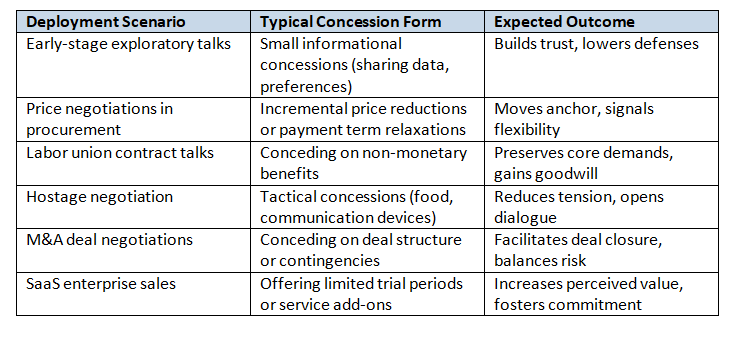
Concessions can be unilateral or conditional, explicit or implicit. Advanced practitioners employ calibrated concessions—proportional, strategic, and often packaged with a request for reciprocity. Over-concession risks include signaling weakness, eroding perceived value, and encouraging counterpart exploitation. Under-concession may stall negotiations or lead to impasses.
The spectrum of concession tactics includes:
· Soft Concessions: Small, non-critical compromises that build rapport without significant value loss.
· Conditional Concessions: Offers made contingent on reciprocal concessions or milestones.
· Strategic Concessions: Calculated moves designed to shift negotiation dynamics or re-anchor expectations.
· Bluff or Feigned Concessions: Pretending to concede to gain information or test counterpart resolve.
Understanding which form to deploy and when is essential for maintaining leverage.
Step-by-Step: How to Deploy This Tactic
Deploying concession tactics requires discipline, timing, and precision. Follow these six steps to maximize impact without losing leverage:
Step 1: Prepare Your Reservation Point and Concession Range
Before negotiations begin, clearly define your bottom line (reservation point) and the maximum concession range. Use research-based anchoring techniques to set initial offers favorably. Preparation prevents concessions driven by emotion or pressure.
Step 2: Open Strong with Anchored Offers
Start negotiations with an offer anchored above your target outcome, leaving room to concede strategically. This sets the cognitive reference for subsequent concessions.
Example script: “Based on our analysis, we believe a value closer to $1.2 million reflects the project’s scope.”
Step 3: Signal Willingness to Negotiate with Small Early Concessions
Offer small, non-monetary or informational concessions early to build rapport and demonstrate flexibility without sacrificing core value.
Example script: “We are happy to share our initial projections to help align expectations.”
Step 4: Use Conditional Concessions to Elicit Reciprocity
Make concessions contingent on counterpart reciprocation to maintain balance.
Example script: “If you can agree to the revised timeline, we can consider adjusting payment terms accordingly.”
Step 5: Frame Concessions as Mutual Gains, Not Sacrifices
Use framing to highlight how concessions create value for both parties, reducing loss aversion.
Example script: “By adjusting the delivery schedule, we both benefit from reduced risk and faster implementation.”
Step 6: Pause After Each Concession to Observe Counterpart Response
Allow silence after concessions to let the counterpart process and respond. Use calibrated questions to gauge reactions and guide next steps.
Example script: “How does this adjustment align with your priorities?”
This disciplined approach preserves leverage, encourages reciprocity, and moves negotiations toward value-creating agreements.
How to Recognize and Counter This Tactic
Recognizing when the other party uses concession tactics is critical to avoid exploitation and maintain leverage. Below is a table mapping common signals to effective counter-responses, including exact scripts:
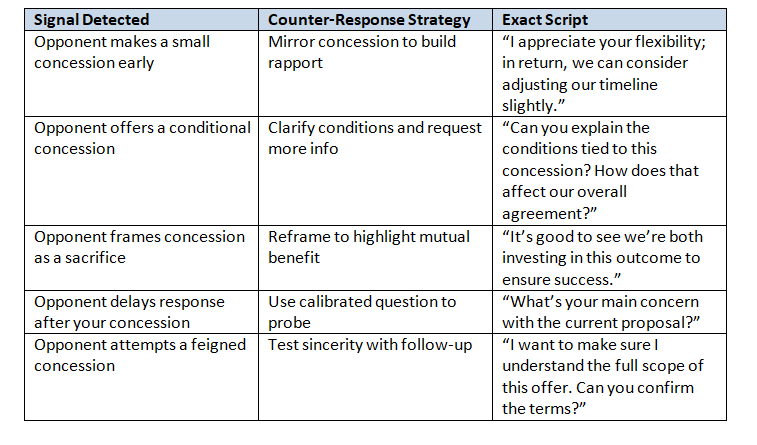
Countering concessions effectively requires controlled responses that maintain negotiation balance, preserve value, and invite reciprocal behavior.
Real-World Case Studies
Case Study 1: Apple vs Samsung Licensing Negotiations (2013)
Apple’s concession to offer Samsung limited cross-licensing terms was strategic, designed to unlock revenue streams and reduce litigation costs. Apple framed concessions as mutual benefits, avoiding signaling desperation. Samsung’s initial misinterpretation nearly derailed talks but was corrected through tactical empathy and calibrated follow-up questions. Lesson: framing and reading concession signals prevent deal collapse.
Case Study 2: NFL Player Contract Negotiations (2018)
During contract talks with star player Aaron Rodgers, the NFL team used incremental concessions on signing bonuses and guarantees. Rodgers’ camp countered by demanding conditional concessions linked to performance milestones. Both sides employed calibrated concessions to achieve a deal that balanced risk and reward. Lesson: conditional concessions enforce reciprocity and maintain leverage.
Case Study 3: Hostage Negotiation in the Philippines (2010)
Negotiators used concessions like providing food and communication devices to reduce hostage tension. These concessions, combined with tactical empathy, de-escalated hostility and opened channels for dialogue. Lesson: concessions can build trust in high-stakes emotional contexts.
Common Mistakes When Using This Tactic
· Conceding Too Early or Too Much: Undermines your bargaining power and signals desperation.
· Failing to Condition Concessions: Giving unreciprocated concessions erodes value.
· Poor Framing of Concessions: Presenting concessions as losses rather than mutual gains increases resistance.
· Ignoring Counterpart’s Emotional State: Missing signs of frustration or exploitation leads to impasse.
· Not Pausing to Observe: Rushing through concessions without gauging the reaction forfeits leverage.
Fixes involve disciplined preparation, calibrated communication, and emotional intelligence.
Scripts and Templates
Script 1: Email Offering Conditional Concession (SaaS Sales)
“Dear [Name],
To support your team’s evaluation, we can extend the trial period by two additional weeks, contingent on agreeing to a minimum 12-month contract term. This allows you to fully experience our solution while aligning our partnership timeline.
Please let me know your thoughts.
Best regards,
Script 2: Phone Call Concession with Framing (Procurement)
“I understand budget constraints, so we’re willing to adjust payment terms to a 60-day cycle, which helps us both manage cash flow more effectively. How does that work for you?”
Script 3: In-Person Meeting Small Early Concession (Labor Negotiations)
“We recognize your concerns about shift scheduling, so we’re open to piloting a flexible shift program in one department initially. This helps us evaluate impact before a broader rollout.”
Script 4: Countering a Feigned Concession (Negotiation)
“I appreciate your offer. To better understand, could you clarify which parts of the proposal are negotiable and which are fixed?”
Script 5: Calibrated Question After Concession (General)
“Given this adjustment, what would be your ideal next step?”
Frequently Asked Questions
Q1: How do I know how much to concede without losing value?
A1: Define your reservation point and maximum concession range pre-negotiation. Use incremental, conditional concessions framed as mutual gains to minimize loss. Test reactions after each step before proceeding.
Q2: Can concession tactics backfire?
A2: Yes. Over-concession signals weakness, invites exploitation, and may erode perceived value. Avoid unconditional concessions and always seek reciprocity.
Q3: How do cultural differences affect concession tactics?
A3: Cultures emphasizing harmony may expect more concessions early; competitive cultures may view concessions as weakness. Tailor your approach with cultural intelligence.
Q4: What’s the role of silence after making a concession?
A4: Silence forces the counterpart to process and respond, often eliciting reciprocal concessions or revealing true priorities. Resist filling the silence prematurely.
Q5: How can I counter a concession tactic if I’m under pressure?
A5: Use calibrated questions to clarify conditions and intentions, mirror their concession to maintain rapport, and pause before responding to avoid reactive concessions.
Conclusion
Concession tactics are indispensable tools in any negotiator’s arsenal, enabling the delicate balance of giving ground while preserving value. Rooted in behavioral economics and social psychology, concessions leverage reciprocity, loss aversion, and framing to move negotiations forward. Mastery involves disciplined preparation, calibrated deployment, and acute sensitivity to counterpart signals.
By integrating the step-by-step frameworks, scripts, and countermeasures detailed in this guide, professionals can transform concessions from risky liabilities into strategic assets that unlock value and build lasting agreements. Begin practicing these techniques today to elevate your negotiation outcomes and confidently give ground without losing your edge.