Confidence in Negotiation: How to Build and Project It

Negotiation is a pivotal skill in both professional and personal realms, yet many professionals falter not because of lack of knowledge but due to insufficient confidence. Confidence in negotiation is more than a feeling; it is an actionable skill that influences how you communicate, persuade, and ultimately close deals. In today’s hyper-competitive, fast-paced environment, projecting confidence can be the difference between a successful negotiation and a missed opportunity.
This comprehensive guide will explore the psychological underpinnings of confidence in negotiation, practical methods to build and project it, and exercises designed to embed these skills into your daily practice. Whether you are a seasoned executive or an emerging sales professional, you will learn how to leverage confidence to transform your negotiation outcomes.
· Table of Contents
· Understanding Confidence in Negotiation: Definition and Importance
· Psychological Foundations: Cognitive Biases and Social Dynamics
· Building Negotiation Confidence: Preparation and Mindset Techniques
· Projecting Confidence: Communication Skills and Nonverbal Cues
· Practical Exercises to Enhance Confidence
· Overcoming Common Confidence Barriers
· Frequently Asked Questions
· Conclusion and Next Steps
· References
Understanding Confidence in Negotiation: Definition and Importance
Confidence in negotiation refers to the self-assuredness and belief in one’s ability to effectively engage, influence, and reach mutually beneficial agreements. It is a critical determinant of how you approach negotiation scenarios, whether you assert your interests or defer unnecessarily.
Research from Harvard Business School underscores that negotiators who exhibit confidence are more likely to command respect, anchor higher initial offers, and resist unfavorable concessions. Confidence is not an innate trait but a skill that can be cultivated through deliberate practice and psychological conditioning.
Consider the example of Sheryl Sandberg, former COO of Facebook, who emphasizes “leaning in” during negotiations—actively engaging with assertiveness. Her approach illustrates how confidence can empower negotiators to claim value without alienating counterparts, balancing assertiveness with empathy.
Psychological Foundations: Cognitive Biases and Social Dynamics
Understanding the psychological mechanisms behind confidence can help negotiators harness it effectively. Three key theories and biases are critical here:
· Self-Efficacy Theory (Bandura): This framework posits that belief in one’s capabilities influences motivation and performance. Enhancing self-efficacy through mastery experiences improves negotiation confidence.
· Anchoring Bias: Setting a confident initial offer acts as a psychological anchor, influencing the negotiation range. Confident negotiators use anchoring strategically to shape outcomes.
· Social Proof and Mirroring: Demonstrating confidence through body language that mirrors the counterpart builds rapport and trust, leveraging social dynamics to influence decisions.
For example, during a salary negotiation, a candidate who enters with a well-researched, assertive opening number leverages anchoring, nudging the employer’s offer upward. Simultaneously, the candidate’s confident tone and posture reassure the employer of their value proposition.
Application of Psychological Frameworks
Integrating these principles involves deliberate actions:
· Cultivate self-efficacy by reflecting on past negotiation successes and visualizing positive outcomes.
· Prepare your opening offer to serve as an effective anchor, substantiated by market research.
· Practice mirroring subtle gestures and tone to build rapport without imitation becoming obvious.
Building Negotiation Confidence: Preparation and Mindset Techniques
Preparation is the cornerstone of negotiation confidence. Extensive research by negotiation scholars like Leigh Thompson shows that negotiators who prepare thoroughly exhibit higher confidence and perform better.
Preparation should include:
· BATNA Analysis: Identify your Best Alternative to a Negotiated Agreement to understand your fallback and strengthen your position.
· Goal Setting: Define clear objectives and minimum acceptable terms to reduce uncertainty.
· Scenario Planning: Anticipate objections and rehearse responses to mitigate anxiety.
Mindset Techniques to Boost Confidence
Psychological readiness is equally important. Techniques include:
· Cognitive Reframing: Shift negative self-talk (“I might fail”) to positive affirmations (“I am prepared and capable”).
· Power Posing: Amy Cuddy’s research suggests adopting expansive postures before negotiation increases testosterone and decreases cortisol, enhancing confidence.
· Mindfulness Meditation: Reduces stress and enhances focus, helping negotiators stay present and composed.
· Practical Exercise: Before your next negotiation, spend 5 minutes in a power pose and mentally rehearse your key points aloud to embed confidence.
Projecting Confidence: Communication Skills and Nonverbal Cues
Confidence is as much about how you communicate as what you communicate. Nonverbal behaviors convey far more than words in negotiation contexts.
· Eye Contact: Maintains engagement and signals honesty. Avoiding eye contact can undermine perceived confidence.
· Vocal Tone: A steady, clear voice with controlled pacing projects assurance. Rapid, high-pitched speech can convey nervousness.
· Body Language: Upright posture, open gestures, and controlled hand movements reflect confidence and openness.
The Role of Active Listening and Assertiveness
Confident negotiators balance assertiveness with active listening:
- Use paraphrasing and summarizing to demonstrate understanding, which builds trust.
- Employ calibrated questions (e.g., “How can we solve this challenge together?”) to guide dialogue collaboratively.
Script Example: Confident Response to a Low Offer
“Thank you for your offer. Based on my research and the value I bring, I was expecting something closer to [anchor figure]. Can we explore options that reflect this?”
Practical Exercises to Enhance Confidence
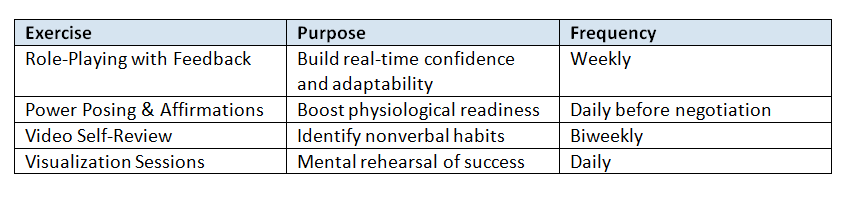
Building confidence is an iterative process. Here are targeted exercises:
· Role-Playing: Engage with a partner simulating negotiation scenarios, focusing on confident delivery and handling objections.
· Video Review: Record practice sessions to self-assess nonverbal cues and tone.
· Visualization: Spend 10 minutes daily imagining successful negotiations, focusing on feelings of confidence and calm.
· Feedback Loops: Solicit constructive feedback from mentors or coaches to refine approach.
Exercise Plan Example
Overcoming Common Confidence Barriers
Even experienced negotiators face confidence challenges. Common barriers include:
· Fear of Rejection: Anticipated negative outcomes can paralyze action. Combat this by reframing rejection as feedback, not personal failure.
· Impostor Syndrome: Doubting one’s qualifications undermines confidence. Counteract by listing qualifications and past successes.
· Cultural Differences: Misreading social cues can erode confidence. Prepare by researching cultural norms and adapting communication style.
Strategies for Managing Anxiety
- Practice deep breathing and grounding techniques to reduce physiological stress.
- Set realistic expectations to avoid pressure-induced performance anxiety.
- Use incremental exposure: start with low-stakes negotiations to build confidence progressively.
Frequently Asked Questions
Q1: How can I quickly boost my confidence before an unexpected negotiation?
A1: Employ power posing for 2 minutes, engage in deep breathing exercises, and mentally rehearse your key points. These activate physiological and psychological states conducive to confidence.
Q2: Is it better to be aggressive or collaborative to appear confident?
A2: Confidence is best projected through assertive yet respectful communication. Aggressiveness can backfire by creating resistance, while collaboration paired with assertiveness fosters trust and influence.
Q3: How does body language impact negotiation outcomes?
A3: Nonverbal cues like eye contact, posture, and gestures significantly influence perceptions of competence and trustworthiness. Consistent confident body language can lead to better offers and agreements.
Q4: Can preparation really improve confidence even if I’m naturally shy?
A4: Yes. Preparation reduces uncertainty and equips you with scripts and responses, which empower even introverted negotiators to project confidence effectively.
Q5: What are some signs I am projecting low confidence during negotiation?
A5: Common signs include avoiding eye contact, speaking too softly or rapidly, fidgeting, and conceding too quickly. Awareness enables corrective action mid-negotiation.
Conclusion
Confidence in negotiation is not a fixed attribute but a trainable competency that combines psychological insight, strategic preparation, and effective communication. By systematically building self-efficacy, mastering preparation techniques like BATNA analysis, and honing the delivery of verbal and nonverbal cues, negotiators can significantly enhance their negotiation skills, influence and outcomes.
Take deliberate steps starting today: prepare thoroughly, practice confidence-boosting exercises, and mindfully project assurance in every negotiation. The payoff is not only better deals but a lasting professional presence that commands respect.
References
· Cuddy, Amy. Presence: Bringing Your Boldest Self to Your Biggest Challenges. Little, Brown and Company, 2015.
· Fisher, Roger, William Ury, and Bruce Patton. Getting to Yes: Negotiating Agreement Without Giving In. Penguin Books, 2011.
· Bandura, Albert. Self-Efficacy: The Exercise of Control. W.H. Freeman, 1997.
· Thompson, Leigh. The Mind and Heart of the Negotiator. Pearson, 2014.
· Shell, G. Richard. Bargaining for Advantage: Negotiation Strategies for Reasonable People. Penguin Books, 2006.