Conflict Resolution in Negotiation: The Definitive Guide for Leaders and Negotiators

Negotiations can rapidly spiral into high-stakes confrontations where tempers flare, stakes skyrocket, and deals teeter on the brink of collapse. Consider a multinational merger negotiation where two CEOs face a deadlock over valuation, each suspecting the other of bad faith. The room grows tense; subtle insults and manipulative tactics creep in, threatening years of effort and billions in value. This is no hypothetical scenario. Such moments define careers and corporate futures.
The psychological and strategic stakes in these scenarios are immense. Research by Daniel Kahneman reminds us that most decisions in negotiations happen within the first few minutes under System 1 thinking—fast, intuitive, and emotional—often derailing otherwise rational processes. Many negotiators underestimate how quickly emotional hijacking, manipulation, and social identity triggers can sabotage a deal before substantive discussions even begin. Understanding and mastering the emotional undercurrents and strategic responses is critical to turning conflict into collaboration.
In this definitive guide, you will master deeply researched psychological concepts like the amygdala hijack and tactical empathy from Chris Voss's FBI techniques, William Ury’s "Going to the Balcony" framework, and the Thomas-Kilmann Conflict Mode Instrument. You will gain a step-by-step process for managing escalating tension, real-world case studies from hostage negotiations to toxic corporate disputes, and exact scripts for diffusing manipulation and hostility. Whether you are a CEO, manager, lawyer, or sales leader, this article will equip you with actionable insights to resolve conflict and close deals under pressure.
· Table of Contents
- The Psychology Behind This Challenge
- Key Frameworks and Models
- Step-by-Step Process for Conflict Resolution
- Real-World Case Studies
- Recognizing and Countering Difficult Negotiation Tactics
- Advanced Techniques for Expert Negotiators
- Scripts and Templates for Common Scenarios
- Frequently Asked Questions
- Conclusion
- References
The Psychology Behind This Challenge
Negotiation conflict is fundamentally a psychological battle played out in real-time. Understanding the underlying neuroscience and behavioral science is essential to navigating and resolving conflicts effectively.
At the core is the **amygdala hijack**, a concept popularized by Daniel Goleman, where the brain’s emotional center (the amygdala) overrides the rational prefrontal cortex in moments of perceived threat. This triggers fight, flight, or freeze responses, causing negotiators to react impulsively with aggression, withdrawal, or stonewalling—often derailing conversations before substantive issues are addressed.
Daniel Kahneman’s *System 1 and System 2* thinking framework explains how fast, automatic, emotional System 1 processes dominate early negotiation interactions. This leads to snap judgments and biases, like anchoring or confirmation bias, which distort perceptions of the counterpart’s intentions. Master negotiators learn to engage System 2—slow, deliberate, analytical thought—to override these instincts.
Chris Voss’s concept of **tactical empathy** builds on this understanding, encouraging negotiators to consciously recognize and validate the emotions and perspectives driving counterpart behavior, defusing hostility and opening pathways to collaboration.
John Gottman’s work on **emotional flooding** in interpersonal conflict highlights how intense negative emotions overwhelm cognitive capacity, making constructive dialogue impossible. Recognizing signs of flooding and employing calming techniques is vital to restoring negotiation flow.
Social psychology’s **social identity theory** further explains how group affiliations and perceived status threats can escalate conflict. Negotiators must be aware that parties struggle not only over issues but also over respect, identity, and face-saving.
Together, these psychological principles underline that conflict resolution in negotiation is as much about managing emotions, perceptions, and identities as it is about logic and terms.
Key Frameworks and Models
Successful negotiators rely on tested frameworks that synthesize psychological insight with tactical approaches. Here we compare three foundational models essential to conflict resolution in negotiation.
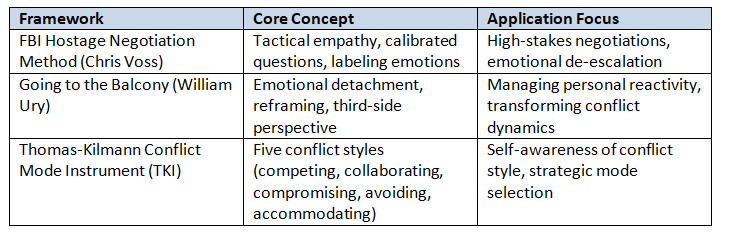
The FBI method emphasizes **tactical empathy**, mirroring, and labeling to build rapport and reduce hostility—even with adversaries who appear irrational or aggressive. Voss teaches negotiators to slow down conversations, listen actively, and ask calibrated "how" and "what" questions that compel the other side to reveal information or rethink positions.
William Ury’s “Going to the Balcony” metaphor advises negotiators to mentally step back, observe their emotions, and gain perspective. This detachment enables them to avoid reactive escalation and identify underlying interests beyond stated positions—engaging the “third side” or neutral parties where possible to mediate.
The Thomas-Kilmann model helps negotiators identify their default conflict modes and adapt based on situational needs. For example, using a collaborating style to integrate interests when trust exists or a competing style when urgent decisions are required.
These frameworks complement each other by combining emotional regulation, strategic engagement, and self-awareness—cornerstones of effective conflict resolution.
Step-by-Step Process for Conflict Resolution
Mastering conflict resolution requires a systematic approach that integrates psychological techniques at every stage. Below is a detailed six-step process:
Step 1: Preparation and Self-Regulation
Before entering negotiation, conduct a rigorous mental preparation:
- Identify your triggers and typical emotional responses (fight, flight, freeze)
- Practice deep-breathing or mindfulness to reduce baseline anxiety
- Set clear objectives and fallback positions to reduce uncertainty
This aligns with Amy Cuddy’s research on **presence under pressure**, where posture and physiological preparation influence cognitive control and confidence.
Step 2: Establish Rapport and Tactical Empathy
Begin by building connection:
- Use mirroring and labeling to validate counterpart emotions (“It seems like this issue is frustrating you.”)
- Ask calibrated open-ended questions (“How can we solve this problem together?”)
- Listen actively, paraphrasing to show understanding
This engages System 2 thinking and lowers amygdala activation.
Step 3: Identify Interests Behind Positions
Move beyond surface demands:
- Use William Ury’s technique of **going to the balcony** mentally to detach and observe
- Ask “Why is this important to you?” to uncover underlying needs
- Map interests on a shared whiteboard or document
This reframing shifts conflict from positional bargaining to joint problem-solving.
Step 4: Address Emotional Flooding and De-escalation
If emotions escalate:
- Label the emotion explicitly (“I see this is really stressful for you.”)
- Employ pauses and silence to allow cooling
- Suggest breaks if needed to prevent hijacks
John Gottman’s research shows that emotional flooding requires immediate de-escalation to restore dialogue.
Step 5: Explore Creative Options and Trade-offs
Brainstorm solutions that expand the pie:
- Use the Thomas-Kilmann model to decide when to collaborate or compromise
- Introduce hypothetical scenarios ("What if we tried this approach?")
- Be open to third-party mediation or objective standards
This step leverages System 2 deliberation and builds trust.
Step 6: Close with Clear Agreements and Follow-Up
Finalize terms with clarity:
- Summarize agreements aloud, confirming mutual understanding
- Document commitments with timelines and responsibilities
- Plan follow-up meetings to monitor implementation
This reduces ambiguity and prevents future conflict.
Real-World Case Studies
Examining high-profile conflicts reveals how theory translates into practice.
Case Study 1: FBI Hostage Negotiations — The 1972 Brooklyn Bank Robbery
During a tense 55-hour standoff, FBI negotiators used **tactical empathy** and labeling (“I understand you feel trapped”) to build rapport with hostage-takers. By slowing conversations and asking calibrated questions, they defused aggression and secured peaceful release without violence. The key lesson: emotional connection can override rational impasses under extreme pressure.
Case Study 2: General Motors vs. UAW 2019 Labor Dispute
This protracted labor negotiation threatened a nationwide strike. GM’s negotiators employed **Ury’s Going to the Balcony** by stepping back from heated exchanges to reframe the conflict around shared long-term goals of stability and competitiveness. They combined this with Thomas-Kilmann collaboration to find trade-offs on healthcare benefits and wage increases. The strike was averted, preserving billions in shareholder value.
Case Study 3: Diplomatic Crisis — Cuban Missile Crisis 1962
President Kennedy’s team used a combination of emotional regulation, third-side mediation, and calibrated public statements to de-escalate nuclear standoff with the USSR. Avoiding reactive escalation (amygdala hijack), they crafted back-channel communications and created face-saving options for both sides. This exemplifies how high-stakes negotiation success depends on managing identity and emotions alongside hard power.
Recognizing and Countering Difficult Tactics
Negotiators frequently encounter manipulative and aggressive tactics designed to destabilize or coerce. Recognizing these and responding effectively is crucial.
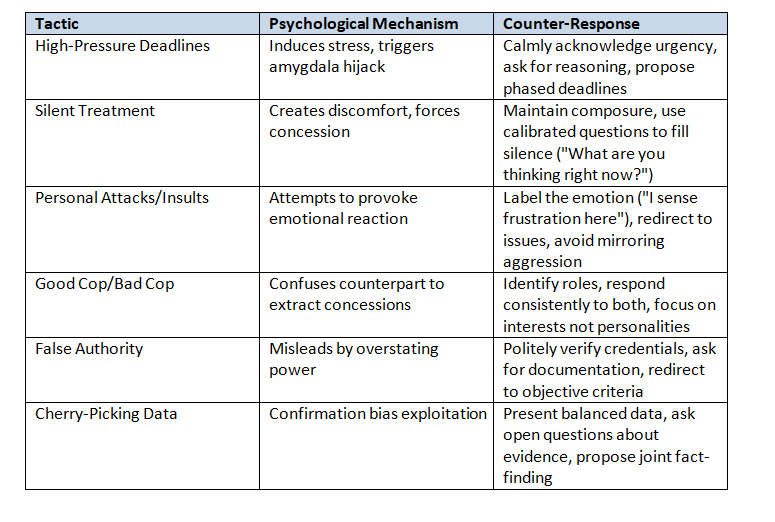
These counter-responses rely on maintaining emotional regulation, tactical empathy, and calibrated questioning to neutralize manipulation.
Advanced Techniques for Expert Negotiators
Beyond foundational tactics, expert negotiators employ sophisticated psychological and strategic maneuvers:
- **Micro-Expression Reading** (Paul Ekman): Detect subtle facial cues revealing concealed emotions, allowing timely intervention before escalation.
- **Moral Framing** (Jonathan Haidt): Reframe arguments to align with counterpart’s moral foundations (e.g., fairness, loyalty) to increase receptivity.
- **Power Posing and Presence** (Amy Cuddy): Use nonverbal signals to project confidence and reduce anxiety, influencing counterpart perceptions and outcomes.
- **Third-Side Engagement** (William Ury): Involve neutral parties or systemic actors to mediate entrenched conflicts, expanding resolution possibilities.
- **Pre-Commitment Devices**: Establish binding commitments early to constrain irrational behavior and build trust.
- **Controlled Concessions**: Use calibrated, incremental concessions tied to reciprocal gains to maintain leverage.
Incorporating these advanced methods requires deliberate practice and situational judgment but yields disproportionate advantages in complex negotiations.
Scripts and Templates
Below are exact word-for-word dialogue templates for common difficult scenarios:
1. **De-escalating Personal Attacks**
“I can see this topic is very important to you, and I want to understand your perspective better. Let’s focus on the issue so we can find a solution that works for both of us.”
2. **Responding to High-Pressure Deadlines**
“I appreciate the urgency you’re expressing. Can you help me understand what’s driving this timeline? Perhaps we can explore options that meet your needs while ensuring quality outcomes.”
3. **Handling Silent Treatment**
“I notice there’s a pause—what are your thoughts right now? I want to make sure we’re addressing any concerns you may have.”
4. **Countering False Authority**
“That’s an interesting point. Could you please share any documents or references that support this position so we can review them together?”
5. **Inviting Joint Problem-Solving**
“Let’s brainstorm possible solutions without constraints. What ideas do you have that might help both of us achieve our goals?”
Frequently Asked Questions
Q1: How can I prevent emotional hijacking during tense negotiations?
A1: Preparation is key. Practice mindfulness and deep breathing to maintain presence. Recognize early signs of amygdala hijack—racing heart, tunnel vision—and consciously engage System 2 thinking by slowing down, labeling emotions, and taking strategic pauses.
Q2: What is tactical empathy, and how does it differ from sympathy?
A2: Tactical empathy involves actively understanding and acknowledging the other party’s feelings and perspective without necessarily agreeing. It is a strategic tool to build rapport and influence, unlike sympathy, which is feeling pity or sorrow.
Q3: When should I use a competitive conflict style versus a collaborative one?
A3: Use competition when time is critical or stakes are high and you have leverage. Collaborate when relationships matter long-term, and trust exists. The Thomas-Kilmann model helps you assess situational appropriateness.
Q4: How do I handle a counterpart who uses manipulation or deception?
A4: Stay calm, verify information through objective data, use calibrated questions to uncover inconsistencies, and avoid reacting emotionally. Label suspicious behavior neutrally to prompt transparency.
Q5: Can third-party mediation always resolve negotiation deadlocks?
A5: While third-party mediators can provide neutral perspectives and facilitate communication, success depends on willingness of parties to engage and the mediator’s skill. Sometimes, internal emotional regulation and reframing are prerequisites.
Conclusion
Conflict resolution in negotiation is a nuanced, psychologically complex art that separates successful leaders from those who falter in high-pressure moments. By understanding the neuroscience of emotional hijacking, leveraging proven frameworks like tactical empathy and going to the balcony, and employing strategic communication techniques, negotiators can transform adversarial conflict into collaborative opportunity. Real-world cases from FBI hostage crises to multinational corporate disputes underscore that emotional mastery and tactical precision win the day.
Armed with this comprehensive guide, negotiation professionals can confidently face even the most challenging conflicts, recognizing manipulation, regulating emotions, and steering conversations toward mutually beneficial solutions. Begin integrating these insights today—prepare rigorously, practice empathetic listening, and deploy these scripts and frameworks to secure your next high-stakes agreement with clarity and composure.
References
- Kahneman, D. (2011). *Thinking, Fast and Slow*. Farrar, Straus and Giroux.
- Voss, C., & Raz, T. (2016). *Never Split the Difference: Negotiating As If Your Life Depended On It*. HarperBusiness.
- Ury, W. (1991). *Getting Past No: Negotiating in Difficult Situations*. Bantam.
- Gottman, J. M. (1994). *What Predicts Divorce? The Relationship Between Marital Processes and Marital Outcomes*. Lawrence Erlbaum.
- Ekman, P. (2003). *Emotions Revealed: Recognizing Faces and Feelings to Improve Communication and Emotional Life*. Times Books.
- Haidt, J. (2012). *The Righteous Mind: Why Good People Are Divided by Politics and Religion*. Pantheon.
- Cuddy, A. (2015). *Presence: Bringing Your Boldest Self to Your Biggest Challenges*. Little, Brown and Company.