Cost Reduction Strategies in Procurement: A Practical Guide

In today’s hyper-competitive global marketplace, organizations like Toyota and Apple are driven not only by innovation but by relentless cost control in their procurement functions. Imagine a multinational manufacturer grappling with raw material price volatility while facing pressure from shareholders to improve margins. Procurement leaders are tasked with more than just buying cheaper—they must engineer sustainable cost reductions that preserve quality, mitigate risks, and foster supplier collaboration. The stakes are high: a failure to optimize procurement costs can erode competitive advantage and shareholder value.
Successful procurement cost reduction is a strategic imperative, leveraging data-driven frameworks and psychological insight into negotiation dynamics. Leaders who master this domain integrate tools like the Kraljic Matrix for supplier segmentation, should-cost modeling to understand true supplier costs, and Total Cost of Ownership (TCO) analyses to capture hidden expenses. Beyond frameworks, savvy procurement managers adopt lean procurement principles and value engineering to innovate savings opportunities, while maintaining supplier relationships built on trust and transparency.
This comprehensive guide will equip you with the strategic foundation, proven frameworks, detailed step-by-step processes, and real-world case studies to transform your procurement cost reduction efforts. You will gain actionable tactics including negotiation scripts and counter-tactics, advanced strategies for complex categories, and templates to streamline implementation. Whether you are a CPO, category manager, or sales director on the selling side, this pillar article will empower you to unlock significant, sustainable procurement savings without sacrificing value.
· Table of Contents
· The Strategic Foundation: Procurement cost reduction frameworks and psychology
· Key Frameworks and Models: Kraljic Matrix, TCO, Should-Cost Modeling
· Step-by-Step Process: Six essential stages with tactics and language
· Real-World Case Studies: Toyota, NHS procurement, Boeing
· Tactics and Counter-Tactics: Procurement negotiation scripts table
· Advanced Strategies: Lean procurement, value engineering, supplier collaboration
· Scripts and Templates: Word-for-word negotiation and category management scripts
· Frequently Asked Questions: Expert answers on challenges and pitfalls
· Conclusion: Summary and call to action
· References: Authoritative sources and research
The Strategic Foundation
Cost reduction in procurement is more than a transactional activity; it requires a strategic mindset integrating frameworks, behavioral insights, and data analytics. Foundational research from Harvard Business School and MIT underscores that procurement cost savings are sustainable only when aligned with organizational objectives and market realities.
One cornerstone is the strategic sourcing framework, which shifts focus from price alone to value creation and risk management. This approach embraces cross-functional collaboration, supplier innovation, and continuous improvement. Behavioral economics also informs negotiation psychology, emphasizing the importance of BATNA (Best Alternative to a Negotiated Agreement) and ZOPA (Zone of Possible Agreement) to understand leverage and craft mutually beneficial outcomes.
Procurement managers must also appreciate the dynamics of supplier segmentation. The Kraljic Portfolio Purchasing Model, introduced in 1983, remains a seminal tool, categorizing suppliers based on supply risk and profit impact to tailor strategies ranging from partnership to competitive bidding. Integrating Total Cost of Ownership (TCO) analysis further broadens perspective beyond purchase price, accounting for logistics, quality, maintenance, and end-of-life costs.
Modern procurement leaders combine these strategic foundations with robust data analytics platforms, enabling real-time insights into spend patterns and supplier performance. This fusion of theory and technology empowers proactive cost reduction that anticipates market shifts rather than reacting to them.
Key Frameworks and Models
Three frameworks form the backbone of effective procurement cost reduction: the Kraljic Matrix, Total Cost of Ownership (TCO), and Should-Cost Modeling. Below is a comparative overview illustrating their purpose, application, and strategic value.
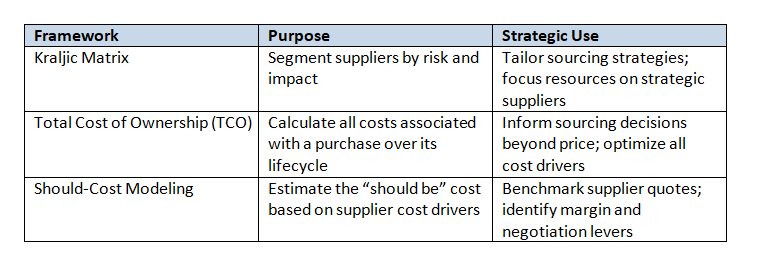
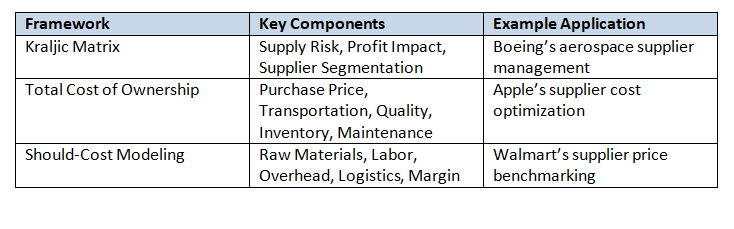
The Kraljic Matrix segments supplier categories into four quadrants: Strategic, Leverage, Bottleneck, and Non-Critical, defined by supply risk and profit impact. For instance, Boeing uses this model to manage aerospace component suppliers, focusing intense collaboration on strategic suppliers to co-develop innovations while applying competitive pressure on leverage items.
Total Cost of Ownership (TCO) expands cost visibility. Apple’s supplier relationship management involves deep TCO analyses including inventory holding, transportation, quality defects, and supplier financial stability. This comprehensive view enables Apple to optimize supplier mixes and negotiate better terms.
Should-Cost Modeling empowers procurement teams to construct detailed cost breakdowns based on raw materials, labor, overhead, logistics, and profit margins. Walmart’s procurement teams use should-cost models to challenge supplier pricing, driving down costs while maintaining service levels.
Step-by-Step Process
Implementing cost reduction strategies requires a structured approach. Below are six critical steps, each with specific tactics and recommended language for procurement professionals.
Step 1: Spend Analysis and Category Segmentation
Begin by analyzing spend data to identify high-impact categories. Use advanced analytics tools to segment spend by supplier, geography, and purchase type.
Tactic: Leverage supplier spend dashboards to detect outliers and consolidate spend.
Language: “Our analysis shows that 60% of our spend is concentrated in five key categories where we see potential for strategic leverage.”
Step 2: Supplier Segmentation Using Kraljic Matrix
Classify suppliers into quadrants to prioritize engagement and develop tailored strategies.
Tactic: Host cross-functional workshops to validate supplier risk and impact assessments.
Language: “Given the supply risk and profit impact, we categorize Supplier X as strategic, warranting collaborative development.”
Step 3: Conduct Total Cost of Ownership (TCO) Assessment
Calculate all direct and indirect costs associated with each supplier or category.
Tactic: Collaborate with finance and operations to capture hidden costs like inventory carrying and warranty claims.
Language: “While Supplier Y’s unit price is competitive, our TCO analysis reveals higher logistics and quality costs.”
Step 4: Develop Should-Cost Models
Build detailed cost models to understand supplier cost structures and identify negotiation levers.
Tactic: Gather industry benchmarks and supplier cost driver data to build models.
Language: “Our should-cost model indicates that material costs represent 55% of the total, providing a negotiation focus area.”
Step 5: Strategic Sourcing and Negotiation
Design sourcing strategies aligned with supplier segmentation and cost insights; prepare negotiation scripts.
Tactic: Use BATNA and ZOPA frameworks to define negotiation boundaries.
Language (Buyer): “Based on our analysis, we expect pricing to reflect the efficiencies we’ve identified; can you walk me through your cost drivers?”
Language (Supplier): “We recognize your cost model and are committed to finding a solution that balances quality and price.”
Step 6: Implement Continuous Improvement and Supplier Collaboration
Establish KPIs and joint cost reduction initiatives with strategic suppliers.
Tactic: Launch supplier performance scorecards and regular review meetings.
Language: “Let’s work together on a continuous improvement plan targeting 5% cost reduction over the next 12 months.”
Real-World Case Studies
Examining industry leaders demonstrates how cost reduction strategies translate into tangible results.
Toyota applies lean procurement principles aligned with the Kraljic Matrix to manage over 3,000 suppliers globally. By segmenting suppliers and fostering continuous improvement, Toyota reduces procurement costs while maintaining high quality and innovation, supporting its Just-In-Time production system.
The NHS procurement function illustrates the power of Total Cost of Ownership and strategic sourcing in public sector cost control. By consolidating purchasing across trusts and applying TCO analysis to medical supplies, the NHS saved over £1 billion annually, demonstrating the impact of data-driven procurement.
Boeing’s approach to should-cost modeling and supplier collaboration in aerospace manufacturing mitigates supply risk and drives down component costs. Their detailed cost transparency has enabled them to negotiate pricing aligned with market realities while ensuring program timelines.
Each case underscores the importance of combining frameworks, analytics, and relationship management to achieve cost reductions that are both significant and sustainable.
Tactics and Counter-Tactics
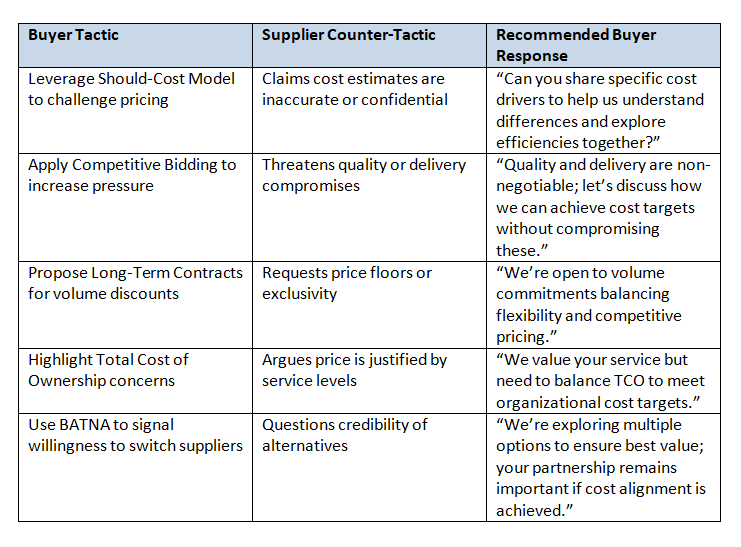
Negotiation is a dynamic process requiring preparation for potential supplier counter-responses. The table below summarizes common buyer tactics, typical supplier counter-tactics, and recommended buyer responses.
Advanced Strategies
For procurement leaders seeking expert-level cost reduction techniques, consider these approaches:
Lean Procurement: Adapt lean manufacturing principles to procurement processes, eliminating waste in requisition, approval, and payment cycles. Amazon applies this to reduce procurement cycle times and administrative costs.
Value Engineering: Collaborate with suppliers and internal stakeholders to redesign products or components to lower costs without sacrificing functionality. Apple frequently uses value engineering in component redesign to optimize costs.
Supplier Innovation Programs: Establish platforms for suppliers to propose cost-saving innovations, incentivizing continuous improvement beyond price negotiations. Toyota’s supplier kaizen programs exemplify this.
Dynamic Market Intelligence: Integrate Porter’s Five Forces analysis to anticipate market power shifts and new entrants, adjusting sourcing strategies proactively.
Supplier Risk Management: Use advanced analytics to monitor financial health and geopolitical risks, ensuring cost reductions do not increase supply chain vulnerability.
Scripts and Templates
Below are actionable, word-for-word scripts for key procurement conversations:
1. Initial Supplier Engagement Script:
“Good morning, we’re reviewing our category sourcing strategy and would like to understand your cost structures and value propositions better. Could you share how your pricing aligns with current market trends and your cost drivers?”
2. Should-Cost Challenge Script:
“We’ve developed a should-cost model based on industry benchmarks and would appreciate your insights on the assumptions. Our goal is to identify areas for mutual cost optimization without compromising quality.”
3. Negotiation Opening Script:
“Our objective is a partnership that balances cost efficiency and service excellence. Based on our analysis, we believe there is room to align pricing more closely with market dynamics. How do you propose we approach this together?”
4. Counter-Tactic Response Script:
“We recognize your concerns regarding confidentiality and quality. To address this, we propose a joint workshop to explore detailed cost drivers and co-develop improvement initiatives.”
5. Continuous Improvement Kickoff Script:
“To sustain cost reductions, let’s establish regular review meetings and KPIs focused on quality, delivery, and cost. We believe this collaboration will drive ongoing value for both parties.”
Frequently Asked Questions
Q1: How do I prioritize which categories to target for cost reduction?
A1: Start with a comprehensive spend analysis to identify categories with the highest spend and volatility. Apply the Kraljic Matrix to segment by risk and profit impact. Prioritize strategic and leverage items where you have the most influence and opportunity for savings.
Q2: What if suppliers resist sharing detailed cost information?
A2: Build trust through transparency and confidentiality agreements. Use should-cost models based on industry data to initiate discussions. Frame cost sharing as a collaboration opportunity rather than a confrontation.
Q3: How to balance cost reduction with supplier relationships?
A3: Focus on joint value creation and continuous improvement. Avoid aggressive tactics that damage trust. Use supplier segmentation to tailor approaches: collaborate intensively with strategic suppliers and apply competitive pressure on less critical ones.
Q4: How can technology support procurement cost reduction?
A4: Analytics platforms enable real-time spend visibility and performance tracking. E-sourcing tools facilitate competitive bidding and scenario modeling. Collaboration portals enhance supplier communication and innovation sourcing.
Q5: What are common pitfalls in procurement cost reduction initiatives?
A5: Pitfalls include focusing solely on price without TCO, neglecting supplier risk, failing to engage internal stakeholders, and underestimating negotiation preparation. A structured, data-driven approach mitigates these risks.
Conclusion
Effective cost reduction strategies in procurement demand a blend of strategic frameworks, analytical rigor, behavioral insight, and relationship management. By leveraging tools like the Kraljic Matrix, Total Cost of Ownership, and Should-Cost Modeling, procurement leaders can identify high-impact opportunities, negotiate effectively, and sustain savings through continuous improvement and supplier collaboration.
This practical guide has provided you with a comprehensive roadmap—complete with actionable steps, real-world examples, negotiation scripts, and expert tactics—to transform your procurement cost management. To realize these benefits in your organization, start by conducting a detailed spend analysis and applying the frameworks discussed. Commit to ongoing supplier partnerships and data-driven decision making to drive procurement excellence and lasting competitive advantage.
References
- Kraljic, P. (1983). Purchasing Must Become Supply Management. Harvard Business Review.
- Ellram, L. M. (1995). Total Cost of Ownership: An Analysis Approach for Purchasing. International Journal of Physical Distribution & Logistics Management.
- Monczka, R., Handfield, R., Giunipero, L., & Patterson, J. (2015). Purchasing and Supply Chain Management. Cengage Learning.
- Porter, M. E. (1979). How Competitive Forces Shape Strategy. Harvard Business Review.
- NHS Supply Chain Annual Report (2022). NHS Procurement Efficiency and Savings.
- Liker, J. K. (2004). The Toyota Way: 14 Management Principles from the World's Greatest Manufacturer. McGraw-Hill.