Crisis Negotiation Basics: What Business Professionals Can Learn from the FBI

In the dead of night, an armed individual barricades themselves inside a corporate office, threatening harm and demanding impossible terms. As tension escalates, the clock ticks down, with hundreds of lives hanging in the balance. This is no ordinary business meeting — it is a crisis negotiation scenario where every word, gesture, and pause can mean the difference between catastrophe and calm resolution. The FBI’s crisis negotiation teams have mastered this high-stakes environment, blending cutting-edge psychology with tactical interpersonal skills to de-escalate volatile situations that would paralyze most leaders.
For business professionals, managers, and negotiators, understanding the lessons from FBI crisis negotiation is invaluable. Too often, conflict spirals because negotiators rely solely on logic or positional bargaining, ignoring the emotional turbulence beneath. Research from Daniel Kahneman’s System 1 and System 2 thinking reveals that under pressure, people default to instinctive, emotional responses (System 1), often derailing rational problem-solving (System 2). This emotional flooding can trigger fight-flight-freeze reactions, amplifying distrust and impasse. Tactical empathy, a concept championed by Chris Voss, and trust repair theories from John Gottman offer proven pathways to calm emotional surges and build rapport even in the most fractured negotiations.
This comprehensive guide will empower you to master the core psychological dynamics behind crisis negotiation, apply the FBI’s proven frameworks and processes, and leverage advanced techniques with precise scripts designed for high-conflict business scenarios. You will gain actionable insights into identifying and countering difficult tactics, repairing trust ruptures, and strategically guiding conversations toward collaborative outcomes — skills that transform high-stakes conflicts from potential disasters into opportunities for durable resolution.
· Table of Contents
· The Psychology Behind This Challenge
· Key Frameworks and Models for Crisis Negotiation
· Step-by-Step Process for Managing High-Stakes Negotiations
· Real-World Case Studies: FBI and Business Conflicts
· Recognizing and Countering Difficult Dynamics
· Advanced Techniques for Expert Negotiators
· Scripts and Templates for Common Crisis Scenarios
· Frequently Asked Questions
· Conclusion and Call to Action
· References
The Psychology Behind This Challenge
High-conflict negotiations, especially crises, engage primal brain systems that override deliberate cognition. The amygdala, an almond-shaped cluster of neurons deep in the brain, acts as an emotional alarm system. When it detects threat, it triggers an “amygdala hijack,” flooding the system with stress hormones that impair rational thought and amplify emotional reactivity. This neurological cascade underpins the fight-flight-freeze response widely documented in trauma and crisis situations.
Daniel Kahneman’s dual-process theory offers a framework to understand this phenomenon. System 1 operates automatically and quickly, driven by intuition and emotion, while System 2 is slower, more deliberate, and logical. During crises, System 1 dominates, causing negotiators and counterparts to make impulsive, emotionally charged decisions. Recognizing this shift is critical to applying calming techniques that re-engage System 2, enabling thoughtful dialogue.
Chris Voss’s concept of tactical empathy directly addresses this emotional surge by intentionally recognizing and verbalizing the counterpart’s feelings to reduce defensiveness and build rapport. This approach aligns with John Gottman’s research on emotional flooding in relationships, showing that labeling emotions can de-escalate conflict and open pathways to trust repair. Trust repair theory further explains how ruptures in collaborative engagement can be mended by validating emotions and demonstrating vulnerability.
Behavioral economics research, including the ultimatum game, reveals that people often reject offers perceived as unfair even at personal cost, highlighting the importance of fairness and emotional validation in negotiations. Understanding these psychological drivers enables negotiators to strategically manage emotional states and move beyond zero-sum dynamics toward integrative solutions.
Key Frameworks and Models
Several frameworks underpin effective crisis negotiation, each addressing different facets of conflict management and emotional regulation. Below are three foundational models accompanied by a comparative analysis.
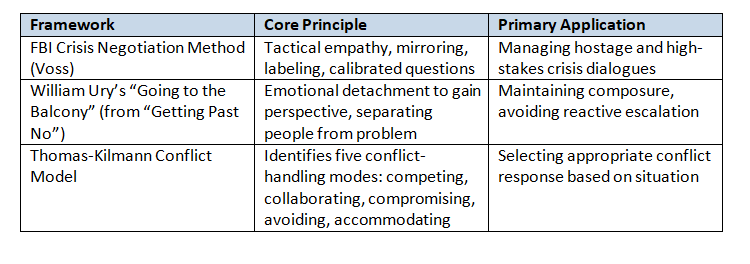
The FBI Crisis Negotiation Method emphasizes active listening techniques such as mirroring (repeating key words/phrases), labeling emotions ("It sounds like you’re feeling..."), and calibrated questions ("How can we solve this together?") to engage System 2 thinking and reduce emotional flooding.
Ury’s “Going to the Balcony” metaphor encourages negotiators to mentally step away from the heat of confrontation, gaining clarity and emotional resilience to respond rather than react. This aligns with Amy Cuddy’s research on presence and power posing, which enhances negotiators’ physiological regulation under pressure.
The Thomas-Kilmann model assists negotiators in diagnosing their own and others’ conflict styles, enabling strategic shifts to collaboration or accommodation when necessary, rather than defaulting to competition or avoidance that often worsen crises.
Step-by-Step Process
Effective crisis negotiation unfolds through a disciplined, psychologically informed sequence. Below is a detailed walkthrough with six essential steps:
Step 1: Establish Contact and Build Rapport
Initiate communication with calm tone and open body language. Use tactical empathy by identifying and verbalizing the counterpart’s emotional state. Example script: "I can hear the frustration in your voice, and I want to understand what’s most important to you right now."
Psychological technique: Labeling emotions reduces amygdala activation and builds trust.
Step 2: Gather Intelligence through Active Listening
Employ mirroring and open-ended calibrated questions to encourage the counterpart to share concerns and needs. Example: "What’s the biggest challenge you’re facing right now?"
Technique: Mirroring fosters deeper engagement; calibrated questions shift focus to problem-solving.
Step 3: Manage Emotional Escalation
Recognize signs of emotional flooding (rapid speech, raised volume, erratic behavior). Use “going to the balcony” to mentally detach and respond calmly. Intervene with validation: "It makes sense you feel overwhelmed in this situation."
Technique: Emotional validation and steady presence reduce fight-flight-freeze responses.
Step 4: Propose Collaborative Solutions
Frame options using inclusive language and avoid ultimatums. Use behavioral economics insights to emphasize fairness and mutual benefit. Example: "Let’s work together on a solution that addresses your needs and keeps everyone safe."
Technique: Anchoring offers in fairness increases acceptability.
Step 5: Repair Trust Breakdowns
If trust erodes, apply Gottman’s trust repair steps: acknowledge harm, express regret, make amends, and commit to change. Example: "I realize that my earlier statements may have caused frustration. That was not my intent, and I want to correct it."
Technique: Vulnerability and accountability rebuild damaged rapport.
Step 6: Secure Commitment and Plan Follow-up
Confirm agreement verbally and outline next steps clearly. Use summarizing scripts: "To confirm, we’ve agreed to X, Y, and Z. I’ll check back with you at this time to ensure everything is on track."
Technique: Clear communication prevents misunderstandings and reinforces cooperation.
Real-World Case Studies
Understanding how these principles play out in real crises reinforces their practical value.
Case Study 1: The 1993 Waco Siege, FBI Hostage Negotiation
Over 50 days, FBI negotiators engaged with the Branch Davidians using tactical empathy and patience. Though ultimately ending tragically, the negotiation team’s initial success in reducing violence demonstrated the power of calm communication, labeling emotions, and respect for the counterpart’s worldview.
Lesson: Persistence in empathy-based dialogue can de-escalate even extreme standoffs.
Case Study 2: The 2018 GE and Baker Hughes M&A Negotiations Breakdown
Corporate leaders faced intense mistrust and public pressure. Applying trust repair frameworks after failed initial talks allowed parties to revisit terms collaboratively, resulting in a successful merger.
Lesson: Repairing trust ruptures is critical in high-stakes corporate negotiations.
Case Study 3: The 2011 Wisconsin Teacher Strike
Union leaders and state officials used collaborative frameworks to navigate ultimatums and emotional flooding. By employing calibrated questions and focusing on shared goals, they reached a compromise avoiding prolonged disruption.
Lesson: Tactical empathy and problem-oriented questions defuse labor disputes.
Recognizing and Countering Difficult Dynamics
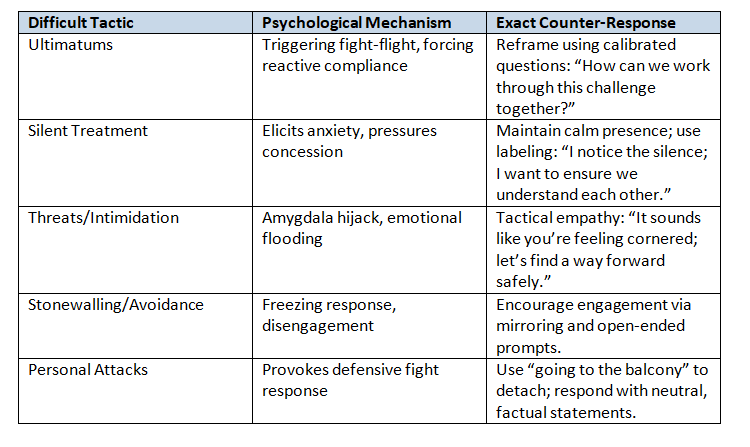
High-conflict negotiations often feature tactics designed to manipulate or escalate. The table below maps common difficult behaviors to their psychological basis and recommended countermeasures.
Advanced Techniques
For seasoned negotiators, incorporating these expert-level strategies can tip the balance in fraught discussions:
· Emotional Label Sequencing — layering multiple emotion labels to deepen rapport (“It sounds like you’re frustrated and worried about the outcome.”)
· Strategic Pausing — deliberate silences to encourage counterpart to fill conversational gaps, revealing more information.
· Harnessing Amygdala Hijack Awareness — explicitly naming the stress response to normalize emotions and regain control.
· Reciprocal Vulnerability — selectively sharing one’s own feelings to prompt counterpart openness, based on Gottman’s trust research.
· Scenario Anchoring — framing options within “worst-case” and “best-case” to expand perceived possibilities and reduce zero-sum thinking.
Scripts and Templates
Below are precise word-for-word scripts tailored to common crisis negotiation challenges:
Script 1: De-escalating an Ultimatum
“I hear that you’re feeling this is the only option. Help me understand what would make this acceptable for you?”
Script 2: Addressing Emotional Flooding
“It seems like this situation is really overwhelming. I want you to know I’m here to listen and work through this together.”
Script 3: Repairing Trust After a Misstep
“I realize my last comment may have caused upset. That wasn’t my intention, and I’m committed to making this right.”
Script 4: Encouraging Engagement During Silence
“I notice it’s been quiet for a moment. I want to make sure you feel comfortable sharing what’s on your mind.”
Script 5: Redirecting Personal Attacks
“I want to focus on the issue, not the person. Let’s work together to find a solution that works.”
Frequently Asked Questions
Q1: How can I apply FBI negotiation techniques in non-crisis business situations?
A1: FBI negotiation principles like tactical empathy, active listening, and calibrated questions are universally applicable. They help manage emotions, build rapport, and navigate impasses in everyday business conflicts, making interactions more collaborative and less adversarial.
Q2: What is tactical empathy and why is it effective?
A2: Tactical empathy is the deliberate effort to understand and verbalize the other party’s emotions and perspective without agreeing or conceding. It reduces defensiveness, fosters trust, and engages the rational mind, increasing the likelihood of cooperative outcomes.
Q3: How do I recognize when someone is emotionally flooded?
A3: Signs of emotional flooding include rapid or loud speech, erratic or agitated behavior, silence or withdrawal, and difficulty processing information. Recognizing these cues allows you to pause, validate emotions, and shift the interaction toward calm dialogue.
Q4: What should I do if the other party uses threats or intimidation?
A4: Maintain composure and apply tactical empathy to acknowledge the underlying fear or pressure driving those tactics. Avoid escalating, reframe the conversation with open questions, and seek common ground to defuse tension.
Q5: Are ultimatums ever effective in negotiations?
A5: Ultimatums often backfire by triggering fight-flight responses and hardening positions. Instead, framing requests via collaborative calibrated questions encourages problem-solving and reduces resistance.
Conclusion
Crisis negotiation is far more than managing hostile scenarios; it is a profound mastery of human psychology under duress. By adopting the FBI’s tactical empathy, emotional regulation, and trust repair frameworks, business professionals can transform high-conflict situations into opportunities for mutual understanding and durable agreement. The neuroscience of emotional flooding and behavioral economics of fairness guide us to communicate with presence, patience, and precision — skills that convert threats into dialogues and impasses into breakthroughs.
As you integrate these techniques, remember that crisis negotiation is as much an art as a science, demanding continual practice and reflection. Begin by applying the step-by-step processes, experiment with the scripts, and deepen your awareness of emotional dynamics. The ability to navigate conflict with confidence and compassion will not only serve you in moments of crisis but elevate every negotiation you undertake. Take the first step today: commit to learning and practicing these principles, and watch your leadership in conflict transform.
Need more knowedge please visit:
https://www.michalchmielecki.com/difficult-negotiations
References
· Kahneman, Daniel. (2011). Thinking, Fast and Slow. Farrar, Straus and Giroux.
· Voss, Chris & Raz, Tahl. (2016). Never Split the Difference: Negotiating As If Your Life Depended On It. HarperBusiness.
· Ury, William. (1991). Getting Past No: Negotiating Your Way from Confrontation to Cooperation. Bantam.
· Gottman, John & Silver, Nan. (2015). The Seven Principles for Making Marriage Work. Harmony Books.
· Cialdini, Robert. (2007). Influence: The Psychology of Persuasion. Harper Business.
· Ekman, Paul. (2003). Emotions Revealed: Recognizing Faces and Feelings to Improve Communication and Emotional Life. Times Books.