Cross-Border Negotiation Challenges: What Goes Wrong and How to Fix It

International business executives gathered in a sleek conference room in Shanghai, poised to finalize a billion-dollar joint venture between a US tech giant and a leading Chinese manufacturer. Months of negotiations had laid the groundwork, yet the deal abruptly collapsed over a misunderstanding — the American team’s direct approach clashed with the Chinese emphasis on consensus and relationship-building. What seemed like simple miscommunication masked deeper cultural and strategic misalignments. This high-stakes failure highlights the critical challenges inherent in cross-border negotiation, where cultural nuances, legal complexities, and trust dynamics intersect.
International negotiations differ fundamentally from domestic deals. They unfold across layered contexts of divergent cultures, languages, legal systems, time zones, and communication styles. While domestic negotiators often rely on shared assumptions and norms, cross-border professionals must decode complex cultural signals, navigate unfamiliar contract frameworks like CISG or ICC rules, and build trust across linguistic and political divides. Many professionals underestimate these challenges, falling prey to oversimplified stereotypes or failing to prepare adequately for cultural differences, which can derail even the most promising negotiations.
This comprehensive guide arms you with the essential tools to master cross-border negotiation challenges. You will delve deep into foundational cultural frameworks from Hofstede, Lewis, Hall, and Erin Meyer; dissect key international negotiation models; explore step-by-step strategies tailored for global contexts; analyze landmark case studies like US-China trade talks and EU-UK Brexit negotiations; and gain advanced techniques for managing interpreters, saving face, and leveraging wasta or guanxi. Precise scripts and templates adapted to cultural contexts will empower your communication, while a detailed FAQ anticipates your most pressing questions. By the end, you will be equipped to navigate complexity confidently and close deals that transcend borders.
· Table of Contents
· The Foundations of International Negotiation
· Key Frameworks and Cultural Models
· Step-by-Step Strategy for Cross-Border Negotiations
· Real-World Case Studies of International Negotiation
· Country-Specific Negotiation Insights and Tactics
· Advanced Strategies for Managing Cultural Complexity
· Scripts and Templates for Global Negotiations
· Frequently Asked Questions on Cross-Border Negotiation
· Conclusion: Synthesizing Insights and Next Steps
· References
The Foundations of International Negotiation
Negotiating across borders is a complex interplay of culture, psychology, and structural factors that demand a nuanced understanding beyond conventional business acumen. Several scholarly frameworks provide the foundation to decode these complexities.
Geert Hofstede’s cultural dimensions remain seminal in distinguishing national cultures’ core values influencing negotiation behavior. His six dimensions—power distance, individualism versus collectivism, uncertainty avoidance, masculinity versus femininity, long-term orientation, and indulgence—shape how parties perceive hierarchy, trust, risk, gender roles, time horizons, and gratification. For example, high power distance cultures like Malaysia expect respect for hierarchy in negotiations, whereas low power distance countries such as Denmark prefer egalitarian approaches.
Richard Lewis’s cultural types categorize societies into Linear-Active (task-oriented, highly organized), Multi-Active (emotion-driven, relationship-focused), and Reactive (listening, accommodative) negotiators. Germans exemplify linear-active behavior, preferring facts and punctuality, while Brazilians embody multi-active traits, valuing personal connections and flexibility. Japanese negotiators typify reactive styles prioritizing harmony and consensus.
Edward Hall’s concepts of high-context versus low-context communication and monochronic versus polychronic time reveal how information is conveyed and how time is managed. High-context cultures like Japan and Arab countries rely heavily on implicit messages, non-verbal cues, and long-term relationships, whereas low-context cultures like the US and Germany expect explicit verbal communication. Monochronic cultures focus on schedules and deadlines, while polychronic cultures embrace multitasking and fluid timing.
Erin Meyer’s “The Culture Map” integrates these dimensions into eight scales: communicating, evaluating, persuading, leading, deciding, trusting, disagreeing, and scheduling. Her research shows that, for instance, French negotiators use high-context persuasion techniques with theoretical arguments, while Americans prefer low-context, direct evidence-based persuasion.
These foundational insights reveal why cross-border negotiations are not merely about price or terms but about bridging fundamentally different worldviews and interaction styles. Misreading these signals can lead to mistrust, stalled talks, or failed deals. Mastering these cultural underpinnings is the first step toward effective international negotiation.
Key Frameworks and Cultural Models
Understanding international negotiation requires operationalizing cultural theories into actionable frameworks. Below are three essential models with comparative data across major economies.
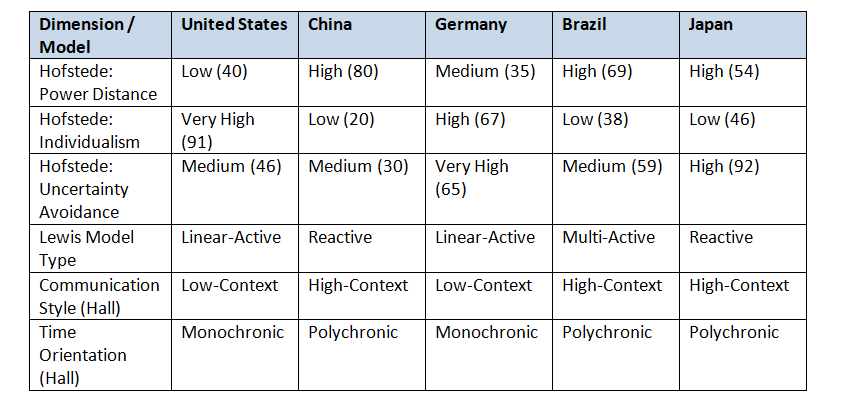
This table encapsulates key differences: The US’s low power distance and individualism encourage direct, egalitarian negotiation, contrasting with China’s hierarchical, collectivist, and high-context approach that values patience and relationships. Germany’s high uncertainty avoidance and linear-active style demand structured, precise agreements. Brazil’s multi-active, high-context culture focuses on personal engagement and flexible timing. Japan’s reactive, high-context, and polychronic nature prioritizes harmony and consensus-building.
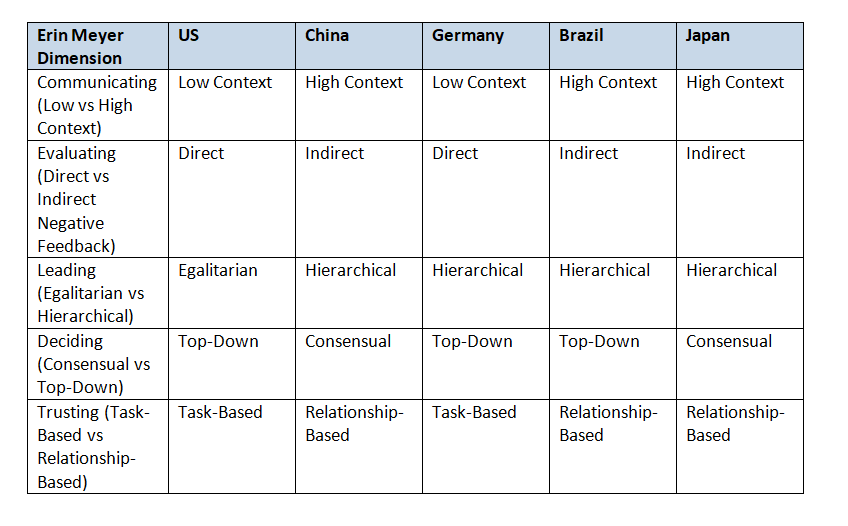
This comparative framework helps negotiators anticipate behavioral expectations: Americans deliver direct feedback and prefer individual decision-making, while Chinese and Japanese emphasize indirect communication, consensus, and relationship trust.
Step-by-Step Strategy for Cross-Border Negotiations
Successfully navigating cross-border negotiations requires a disciplined, culturally informed process. Below is a detailed six-step strategy integrating cultural intelligence and international best practices.
Step 1: Comprehensive Cultural and Contextual Preparation
Begin with rigorous research on the counterpart’s cultural values using Hofstede, Lewis, and Meyer frameworks. Analyze the legal environment—assess applicability of international contract laws like CISG or UNCITRAL conventions. Understand political risks and economic conditions with tools like the World Bank’s Political Risk Index. Prepare multilingual briefing materials and secure skilled interpreters if necessary. Identify the counterpart’s BATNA (Best Alternative to a Negotiated Agreement) and prepare your own ZOPA (Zone of Possible Agreement).
Step 2: Establishing Rapport and Building Trust
Prioritize relationship-building, especially with collectivist and high-context cultures. Use culturally appropriate greetings, honorifics, and gift protocols. Engage in nemawashi (Japan) or wasta (Middle East) style informal consultations before formal talks. Demonstrate respect for hierarchy and social rituals. Share personal stories or common interests to build emotional connections.
Step 3: Opening with Clear, Culturally Adapted Communication
Tailor your opening statements to the communication style—direct and explicit for low-context cultures (Germany, US), indirect and subtle for high-context cultures (China, Japan). Acknowledge cultural sensitivities and express willingness to understand their perspective. Clarify agenda and objectives while remaining flexible.
Step 4: Exploration and Information Exchange
Use open-ended questions and active listening. For reactive cultures, read non-verbal cues carefully and allow silence for reflection. Avoid aggressive probing that may cause loss of face. Verify understanding frequently using paraphrasing. Manage interpreter roles to ensure accuracy and cultural nuance.
Step 5: Bargaining and Problem-Solving
Adopt principled negotiation techniques—separate people from the problem, focus on interests not positions, generate multiple options, and insist on objective criteria. Modify your approach based on cultural context: direct bargaining in low-context cultures; indirect, relationship-preserving tactics in high-context cultures. Employ concessions strategically to maintain face.
Step 6: Closing and Follow-Up
Confirm agreement details explicitly in writing, accounting for cross-cultural contract interpretation differences. Use diplomatic language to maintain goodwill. Plan follow-up communications respecting time zone differences and preferred communication channels. Reinforce relationship through post-deal engagement, such as site visits or joint celebrations.
Real-World Case Studies of International Negotiation
Analyzing landmark international negotiations provides practical lessons on what goes wrong and how to fix it.
Case Study 1: US-China Trade Negotiations (2018-2020)
Context: Prolonged trade talks between the US and China involved tariffs, intellectual property, and market access issues.
Cultural Dynamics: US negotiators’ direct, deadline-driven style clashed with China’s patient, long-term relationship focus and indirect communication. Misinterpretations of intent and inconsistent messaging eroded trust.
Outcome: Multiple delays and tariff escalations before a Phase One deal.
Lesson: Incorporating cultural intelligence, such as understanding China’s face-saving needs and consensus-building, can prevent escalation. Employing neutral mediators and iterative small wins fosters progress.
Case Study 2: EU-UK Brexit Withdrawal Agreement (2017-2019)
Context: Complex negotiations over trade, citizens’ rights, and border protocols post-Brexit.
Cultural Dynamics: The UK’s more adversarial negotiation style conflicted with the EU’s consensus-driven, rule-bound approach. Differences in time orientation and legal frameworks complicated talks.
Outcome: Protracted negotiations with multiple extensions and a politically sensitive backstop arrangement.
Lesson: Aligning negotiation styles by adopting a principled negotiation framework focusing on mutual interests and objective standards, along with transparent communication, eased deadlocks.
Case Study 3: Japan-US Automotive Trade Talks (1980s)
Context: US pressure on Japan to open automotive markets.
Cultural Dynamics: US’s direct, confrontational tactics backfired against Japan’s indirect, harmony-focused nemawashi process.
Outcome: Initial failures followed by adoption of behind-the-scenes consensus-building steps.
Lesson: Respecting Japanese decision-making culture and investing time in informal consultations is critical for success.
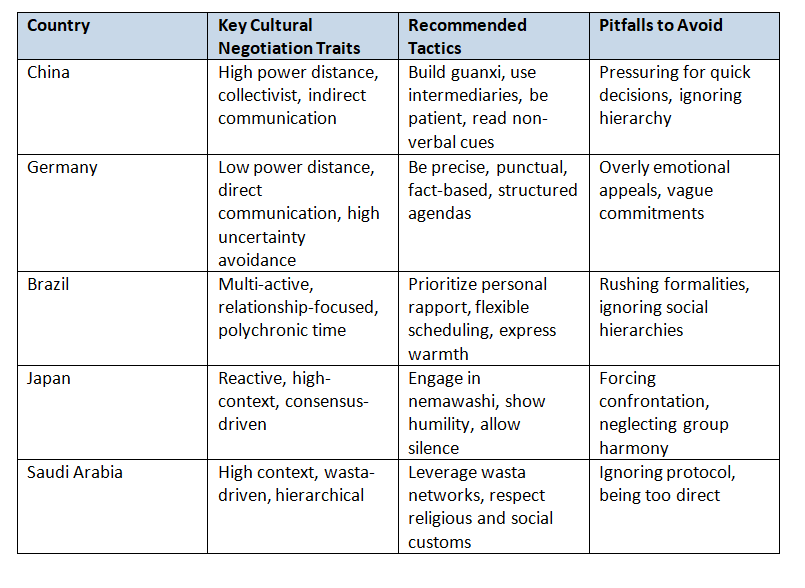
Country-Specific Negotiation Insights and Challenge-Specific Tactics
The following table summarizes key negotiation tactics tailored to cultural nuances across selected countries.
Advanced Strategies for Managing Cultural Complexity
Expert negotiators deploy advanced techniques to navigate nuanced international challenges:
Managing Interpreters: Use professional interpreters briefed on negotiation objectives and technical terminology. Allow for pauses to verify translations. Avoid side conversations without interpreters present.
Building Guanxi/Wasta: Invest time in building trusted relationships through social events, referrals, and mutual favors. Recognize these networks’ influence on decision-making.
Navigating Hierarchy: Identify decision-makers and influencers early. Address them with appropriate titles and deferential language. Tailor negotiation pace to accommodate hierarchical approvals.
Handling Face-Saving: Use indirect language to deliver negative feedback. Offer alternatives that allow counterpart to maintain dignity. Avoid public criticism or confrontation.
Managing Time Differently: Adapt to monochronic or polychronic time cultures. Avoid rushing deadlines in polychronic contexts; plan buffer time and flexible milestones.
Scripts and Templates for Global Negotiations
Below are example word-for-word scripts adapted to cultural contexts.
1. US to Chinese Counterpart (Opening Email)
Dear Mr. Li,
I hope this message finds you well. Following our recent discussions, we are excited about the opportunity to work together. We value the importance of building a strong, long-term relationship and look forward to exploring how we can best align our mutual goals.
Please let us know a convenient time for a preliminary meeting. We are committed to understanding your perspectives and working collaboratively.
Best regards,
John Smith
2. German to Brazilian Counterpart (Meeting Opening)
Guten Tag, Senhor Silva,
Thank you for meeting with us today. We appreciate your hospitality and look forward to a productive exchange. We aim to discuss the project milestones clearly and agree on a realistic timeline considering your operational context.
Please feel free to share any insights or concerns upfront.
Vielen Dank.
3. Japanese to US Counterpart (Feedback during Negotiation)
4. Saudi Arabian to European Counterpart (Follow-Up Email)
Dear Mr. Dupont,
It was a pleasure meeting you last week. We are grateful for your openness and the respectful dialogue. In the spirit of strengthening our cooperation, we would appreciate your feedback on the draft agreement at your earliest convenience.
Please let us know if there is anything we can clarify.
Warm regards,
Ahmed Al-Fahad
5. Indian to US Counterpart (Negotiation Script Excerpt)
Frequently Asked Questions on Cross-Border Negotiation
Q1: How do cultural dimensions like power distance impact negotiation tactics?
A1: Power distance influences how negotiators perceive hierarchy and authority. In high power distance cultures (e.g., China, Saudi Arabia), decisions are centralized; negotiators should address senior figures and demonstrate respect. In low power distance cultures (e.g., US, Denmark), a more egalitarian approach works. Ignoring power distance can cause offense or stall approvals.
Q2: What role does international contract law play in cross-border negotiations?
A2: International contract frameworks such as the CISG provide standardized rules governing sales contracts across borders, reducing legal uncertainty. Knowledge of these laws helps negotiators draft enforceable agreements, avoid pitfalls, and understand dispute resolution mechanisms like ICC arbitration.
Q3: How can negotiators effectively manage language barriers?
A3: Employ professional interpreters familiar with technical terms and cultural nuances. Speak clearly and at moderate speed. Avoid idioms or slang. Confirm understanding frequently. Written summaries post-meeting help ensure consistency.
Q4: What strategies help build trust in high-context cultures?
A4: Invest time in informal interactions, demonstrate reliability, honor commitments, and show respect for traditions. Relationship-building activities and patience in decision-making enhance trust, which is often prioritized over contractual details.
Q5: How can negotiators handle conflicting time orientations?
A5: Recognize whether counterparts follow monochronic (linear, deadline-focused) or polychronic (flexible, relationship-focused) time. Adjust planning to include buffer periods, allow for interruptions or extended discussions, and communicate deadlines with cultural sensitivity.
Conclusion
Cross-border negotiation challenges stem from the rich complexity of cultural, legal, linguistic, and psychological factors that far exceed the scope of domestic deals. Misunderstandings rooted in these differences can cause costly failures, yet they also present opportunities for those who master the art and science of international negotiation. By grounding your approach in rigorous cultural frameworks, adopting step-by-step strategic processes, learning from real-world cases, and applying advanced tactics like managing interpreters and face-saving, you can transform potential obstacles into avenues for trust, value creation, and lasting partnerships.
As global business continues to accelerate, your ability to navigate cross-border negotiation challenges will differentiate you as a trusted dealmaker and strategic leader. Begin integrating these insights and tools today — and turn complexity into competitive advantage. For tailored support in your upcoming international negotiations, contact our expert consulting team to develop a culturally intelligent, legally sound, and strategically effective plan.