Cross-Cultural Communication in Negotiation: How to Be Understood and Persuasive Globally
In 2018, a landmark trade negotiation between a leading German automotive firm and their Japanese supplier nearly collapsed over a seemingly minor communication breakdown. The German team’s direct, solution-focused approach clashed with the Japanese team’s preference for harmony and consensus-building through nemawashi—a behind-the-scenes consultation process. The result? Weeks of delay, frayed relationships, and a costly contract renegotiation that could have been avoided with a deeper understanding of cross-cultural communication in negotiation.
This example underscores the strategic stakes involved in international negotiations today. Professionals often underestimate how deeply culture shapes communication styles, decision-making processes, and perceptions of persuasion. The complexity is layered: Hofstede’s cultural dimensions reveal differing values on power distance and uncertainty avoidance; Erin Meyer’s Culture Map highlights communication and scheduling variances; Edward Hall’s high vs low context framework explains implicit vs explicit messaging. Missing these nuances can derail deals, damage relationships, and expose companies to legal and political risks across jurisdictions.
This definitive guide will equip you with a robust strategic foundation and actionable frameworks—drawing from Hofstede, Meyer, Lewis, and Hall—plus detailed scripts, country-specific insights, and advanced techniques for navigating legal and relational hurdles in global deals. You will master six concrete negotiation steps tailored for cultural adaptation, learn real-world case studies from US-China trade to Middle Eastern wasta dynamics, and gain expert tactics for managing interpreters, hierarchy, and face-saving. By the end, you’ll be prepared to communicate persuasively and build trust across cultures, transforming complexity into competitive advantage.
· Table of Contents
· The Strategic Foundation: Key Cultural and Legal Frameworks
· Key Frameworks and Models: Hofstede, Meyer, Lewis Comparison
· Step-by-Step Strategy: Six Essential Tactics for Cross-Cultural Negotiation
· Real-World Case Studies: US-China Trade, EU-UK Brexit, Middle East Wasta
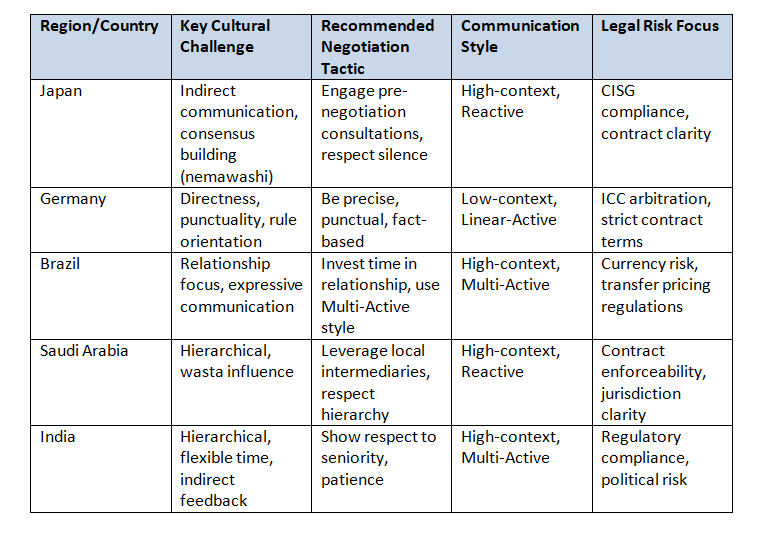
· Country/Region-Specific Insights: Tactical Cultural Challenge Matrix
· Advanced Strategies: Interpreters, Relationship-Building, Legal Risk Mitigation
· Scripts and Templates: Word-for-Word Negotiation and Email Examples
· Frequently Asked Questions: Deep Dives into Common Cross-Cultural Challenges
· Conclusion: Mastering Persuasion in Global Negotiations
· References: Authoritative Sources and Research
The Strategic Foundation — Key Cultural and Legal Frameworks
Understanding cross-cultural communication in negotiation begins with mastering how culture shapes behavior and expectations. The seminal work of Geert Hofstede introduced six cultural dimensions that influence negotiation dynamics worldwide: Power Distance Index (PDI), Individualism vs Collectivism (IDV), Masculinity vs Femininity (MAS), Uncertainty Avoidance Index (UAI), Long-Term Orientation vs Short-Term Normative Orientation (LTO), and Indulgence vs Restraint (IVR). For example, high PDI cultures like South Korea expect hierarchical respect in negotiations, whereas low PDI cultures such as Denmark emphasize equality and direct dialogue.
Erin Meyer’s Culture Map builds on these insights with eight dimensions directly relevant to negotiation: Communicating (low-context vs high-context), Evaluating (direct negative feedback vs indirect), Persuading (principles-first vs applications-first), Leading (egalitarian vs hierarchical), Deciding (consensual vs top-down), Trusting (task-based vs relationship-based), Disagreeing (confrontational vs avoids confrontation), and Scheduling (linear-time vs flexible-time). These dimensions explain why Brazilian negotiators prioritize relationship-building and emotional expressiveness, while German negotiators focus on facts and punctuality.
Richard Lewis categorizes cultures into Linear-Active, Multi-Active, and Reactive types, highlighting behavioral patterns in communication and decision-making. Linear-Active negotiators (Germans, Swiss) prefer structured agendas and factual arguments, Multi-Active (Italians, Latin Americans) prioritize emotional involvement and relationships, and Reactive (Japanese, Chinese) focus on listening and harmony.
Edward Hall’s high- vs low-context communication theory clarifies the degree of implicit messaging expected. High-context cultures (Japan, Arab countries) rely on shared understanding and nonverbal cues, which can confuse low-context negotiators (USA, Germany) who expect explicit, clear communication. Similarly, Hall’s monochronic vs polychronic time orientation affects scheduling expectations and perceptions of punctuality.
From a legal perspective, knowledge of international contract law frameworks such as the United Nations Convention on Contracts for the International Sale of Goods (CISG), ICC arbitration rules, UNCITRAL guidelines, and Incoterms 2020 is crucial to mitigate risks. These frameworks govern contract formation, performance, dispute resolution, and delivery terms, all of which interact with cultural negotiation styles.
Finally, political risk frameworks like PESTLE analysis and country risk ratings help negotiators anticipate external factors—geopolitical instability, regulatory changes, currency volatility—that may impact deal viability and negotiation tactics.
This strategic foundation ensures negotiators appreciate cross-cultural complexity holistically—from communication nuances to legal and political risk.
Key Frameworks and Models — Comparative Analysis
This section compares Hofstede’s, Meyer’s, and Lewis’s frameworks to clarify their application in cross-cultural negotiation.
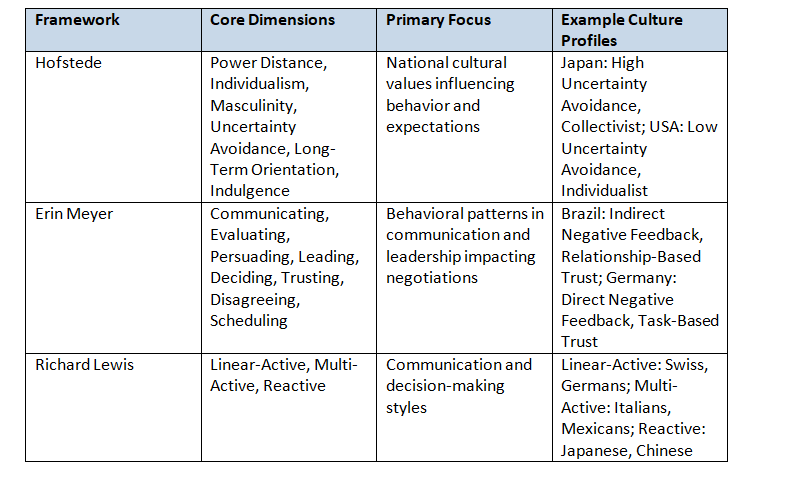
These three frameworks complement each other: Hofstede provides the macro cultural values; Meyer translates those values into negotiation-specific behaviors; Lewis offers practical communication style archetypes. Successful negotiators integrate insights from all three to tailor their approach.
Step-by-Step Strategy — Six Essential Tactics for Cross-Cultural Negotiation
Step 1: Conduct Deep Cultural Research and Prepare
Before negotiations, analyze the counterpart’s culture using Hofstede, Meyer, and Lewis frameworks. Understand their communication style, decision-making process, and negotiation priorities. Use PESTLE to assess external risks. Prepare flexible agendas respecting their timing preferences (monochronic vs polychronic).
Key phrase for research briefing: “According to [Country]’s cultural profile, a consensus-driven approach with respect for hierarchy will facilitate mutual trust.”
Step 2: Build Relationships and Trust Proactively
In relationship-based cultures like Brazil or Middle East, invest time in personal connections before discussing terms. Use small talk and social rituals. In task-based cultures like Germany or Scandinavia, focus on competence and reliability.
Suggested conversation starter for relationship-building: “I appreciate learning more about your team’s values and how we can align our goals for mutual success.”
Step 3: Adapt Communication Style to Context
If negotiating with high-context cultures (Japan, Arab countries), pay attention to non-verbal cues, indirect language, and silence. Use softening language to avoid confrontation. For low-context cultures (USA, Germany), be explicit, transparent, and direct.
Softening phrase example: “I wonder if we might consider alternative approaches to address this point?”
Step 4: Manage Hierarchy and Decision-Making Protocols
Respect expected power distance levels. For hierarchical cultures (South Korea, India), address senior decision-makers with deference and allow time for internal consultation. In egalitarian cultures (Netherlands, New Zealand), encourage open dialogue with all stakeholders.
Polite form for hierarchical respect: “We value your leadership and would appreciate your guidance on the next steps.”
Step 5: Negotiate on Principles, Not Positions
Apply Fisher & Ury’s principled negotiation adapted for culture. Focus on interests and objective criteria. In cultures preferring applications-first persuasion (USA), present specific cases; for principles-first cultures (France), open with theory and frameworks.
Script for principled approach: “Let’s identify shared interests and evaluate options based on mutually acceptable standards.”
Step 6: Address Legal and Risk Factors Explicitly
Clarify governing law, dispute resolution, and Incoterms early to avoid misunderstandings. Account for currency risk and transfer pricing compliance. Use clear language and confirm understanding, especially with language barriers.
Closing phrase example: “To ensure clarity, shall we review the contract clauses together with your legal team?”
Real-World Case Studies — Lessons from Global Negotiations
Case Study 1: US-China Trade Negotiations (2019–2020)
The US-China trade war highlighted how differences in negotiating style—China’s emphasis on relationship-building (guanxi) and long-term orientation versus the US’s direct, deadline-driven approach—affected talks. US negotiators often overlooked China’s preference for incremental concessions and consensus, leading to stalled progress. Adaptations included employing cultural liaisons and pacing negotiations to allow internal Chinese consultations.
Lesson: Patience and cultural empathy are critical to bridging negotiation style gaps.
Case Study 2: EU-UK Brexit Withdrawal Agreement (2016–2020)
The Brexit negotiations exemplified high-stakes, multi-layered diplomacy with diverse cultural norms within Europe. The UK’s more adversarial style clashed with the EU’s consensus-driven, rule-based approach. Legal frameworks like the Vienna Convention and UNCITRAL arbitration mechanisms were pivotal in framing discussions.
Lesson: Combining cultural awareness with rigorous legal preparation enables complex multi-party negotiations.
Case Study 3: Middle Eastern Wasta in Business Deals
In Gulf Cooperation Council countries, wasta (personal connections and influence) plays a central role. Western firms unfamiliar with this dynamic have struggled to build trust or access decision-makers. Successful negotiators engage local intermediaries and respect social hierarchies, blending formal contracts with informal networks.
Lesson: Recognizing and integrating informal cultural systems is essential for market entry and deal-making.
Country/Region-Specific Insights or Challenge Matrix
Advanced Strategies — Expert-Level Techniques
Managing Interpreters: Use professional interpreters briefed on technical and cultural specifics. Speak in short, clear sentences. Pause frequently for accurate interpretation. Avoid slang or idioms.
Relationship-Building Across Cultures: Combine formal business discussions with social interactions. Use gift-giving judiciously, respecting cultural norms (e.g., no clocks in China). Maintain consistent communication post-negotiation.
Face-Saving Strategies: In high face cultures (China, Korea), avoid public criticism or direct rejection. Use indirect language like “perhaps we might explore other options” to maintain harmony.
Hierarchy Navigation: Identify decision-makers and influencers early. Address formal titles and roles appropriately. Allow time for internal approvals, especially in high PDI countries.
Legal Risk Mitigation: Partner with local legal experts. Ensure contracts align with CISG or relevant local laws. Include clear dispute resolution clauses specifying venue and rules (ICC, UNCITRAL). Use Incoterms 2020 to clarify shipping obligations.
Scripts and Templates — Word-for-Word Examples
Script 1: Opening a Meeting with a Japanese Client
“Thank you very much for meeting with us today. We deeply respect your team’s expertise and look forward to working together to find solutions beneficial for both our companies. Before we proceed, we would appreciate any insights you might wish to share regarding your priorities.”
Script 2: Relationship-Building Email to Brazilian Partner
“Dear [Name],
It was a pleasure to connect during last week’s conference. I truly enjoyed learning about your company’s vision and values. I look forward to exploring opportunities where we can collaborate effectively while building a strong partnership grounded in trust and mutual respect.
Warm regards,
Script 3: Polite Disagreement with a German Counterpart
“Thank you for your detailed proposal. I appreciate the thorough analysis. May I respectfully suggest we consider an alternative approach that might better address some uncertainties? I would be happy to share data supporting this perspective.”
Script 4: Clarifying Legal Terms with Middle Eastern Partner
“To ensure our mutual understanding, I propose we arrange a joint session with our respective legal teams to review the contract clauses, particularly regarding governing law and dispute resolution. This will help us avoid potential challenges and strengthen our cooperation.”
Script 5: Virtual Meeting Protocol for Multicultural Teams
“Before we begin, I’d like to briefly review our agenda and confirm that everyone is comfortable with the language and communication tools. Please feel free to ask for clarification at any point or to indicate if you need a moment to respond.”
Frequently Asked Questions
Q1: How can I detect high-context communication in negotiations?
High-context communication relies on implicit messages, nonverbal cues, and shared background. Signs include long pauses, indirect answers, use of silence to convey disagreement, and avoidance of explicit “no.” Cultures like Japan, Arab countries, and Latin America often exhibit this style. Observing these signals and asking open-ended questions helps decode meaning.
Q2: What is the best way to handle disagreements in cultures that avoid confrontation?
In cultures such as Japan or Thailand, direct disagreement may cause loss of face. Use indirect language, pose hypothetical scenarios, or suggest alternatives gently. For example, instead of “I disagree,” say “Perhaps we might explore other possibilities.” Building trust over time is key to enabling open dialogue.
Q3: How do I address time zone and scheduling challenges in global negotiations?
Respect differing time orientations; monochronic cultures like Germany expect strict scheduling, while polychronic cultures such as India are more flexible. Use tools like shared calendars, confirm meeting times in all time zones, and allow buffer time. Prioritize agenda items to accommodate time constraints.
Q4: What legal frameworks govern international sales contracts?
The CISG provides uniform rules for international sale of goods among signatory countries. ICC arbitration rules and UNCITRAL guidelines govern dispute resolution. Understanding which framework applies and specifying it in contracts reduces litigation risk. Incoterms 2020 clarify shipping responsibilities.
Q5: How can I mitigate foreign exchange risk during negotiation?
Include currency clauses specifying payment currency and timing. Use forward contracts or hedging instruments. Negotiate payment terms to allow flexibility. Consult finance teams and legal advisors to incorporate these terms effectively.
Conclusion
Mastering cross-cultural communication in negotiation is no longer optional but essential for global business success. By integrating proven cultural frameworks with practical strategies, negotiators can bridge divides, build trust, and craft deals that withstand legal and political complexities. Appreciating and adapting to diverse communication styles transforms potential misunderstandings into competitive advantage.
Start applying these insights today by conducting thorough cultural research, customizing your approach with the detailed scripts and tactics provided, and proactively managing legal and relational risks. Your ability to be understood and persuasive across cultures will unlock unprecedented global opportunities.
References
Geert Hofstede, Gert Jan Hofstede, Michael Minkov (2010). Cultures and Organizations: Software of the Mind.
Erin Meyer (2014). The Culture Map: Breaking Through the Invisible Boundaries of Global Business.
Richard D. Lewis (2006). When Cultures Collide: Leading Across Cultures.
Edward T. Hall (1976). Beyond Culture.
Roger Fisher, William Ury, Bruce Patton (2011). Getting to Yes: Negotiating Agreement Without Giving In.
United Nations Commission on International Trade Law (UNCITRAL) (2010). UNCITRAL Model Law on International Commercial Arbitration.
International Chamber of Commerce (ICC) (2020). Incoterms 2020.