Cross-Cultural Negotiation Case Studies: Real Deals, Real Lessons

In 2015, a major European automotive firm attempted to finalize a joint venture with a leading Japanese manufacturer. Despite months of discussions, the deal collapsed dramatically during a critical negotiation session in Tokyo. The European executives, favoring direct and transactional communication, aggressively pushed terms without prior consensus-building. Meanwhile, their Japanese counterparts, valuing nemawashi—a behind-the-scenes consensus process—and ringi decision-making, perceived the approach as disrespectful and rushed. The result was a loss of face for both parties, a severed relationship, and millions in lost revenue potential.
This dramatic failure encapsulates the strategic and cultural stakes embedded in cross-cultural negotiation. Global executives often underestimate subtle but critical cultural dimensions such as communication style, time orientation, and relationship-building protocols. Misreading these cues or imposing one’s own negotiation norms can lead to breakdowns, sunk costs, and damaged reputations. Yet, mastering these cultural intricacies is essential for securing deals, building trust, and gaining competitive advantage in today’s interconnected markets.
This comprehensive guide will equip you with proven frameworks from Hofstede, Meyer, Hall, and others, detailed country-specific case studies, actionable step-by-step negotiation strategies, and precise language scripts tailored for diverse cultural contexts. Whether negotiating with China’s guanxi-driven networks, Germany’s Sachlichkeit approach, or Brazil’s warmth-infused jeitinho, you will gain the cultural intelligence and practical tools to negotiate effectively across borders and close real deals with real lessons.
· Table of Contents
· The Theoretical Foundation: Deep Dive into Cultural Frameworks
· Key Frameworks and Models: Comparative Analysis Across Countries
· Step-by-Step Strategy: Six Essential Negotiation Steps with Cultural Adaptations
· Real-World Case Studies: Successes and Failures from Asia, Europe, and the Americas
· Country/Region-Specific Insights: Do’s and Don’ts Table for 10 Key Markets
· Advanced Strategies: Expert-Level Cross-Cultural Negotiation Techniques
· Scripts and Templates: Exact Word-for-Word Language for Diverse Cultures
· Frequently Asked Questions: Deep Dives into Common Cross-Cultural Challenges
· Conclusion: Synthesizing Key Insights and Next Steps
· References: Authoritative Sources for Further Study
The Theoretical Foundation — Deep Dive into Relevant Cultural Frameworks
Understanding cross-cultural negotiation starts with a deep comprehension of established cultural frameworks that decode national behaviors and communication. Below is a synthesis of the most influential models and how their dimensions apply in negotiation contexts.
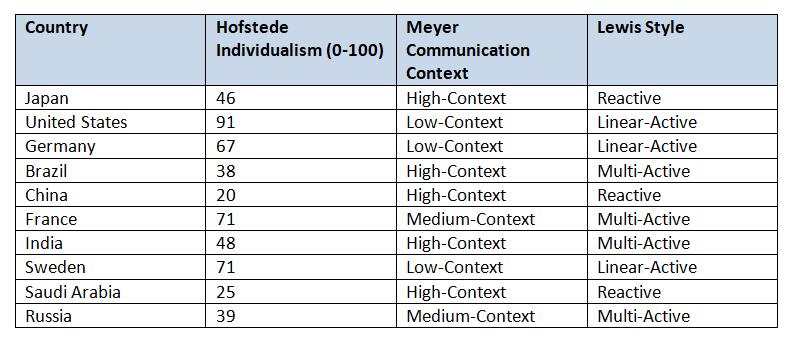
Geert Hofstede’s six cultural dimensions provide a foundational lens. For example, Japan scores low on Individualism (46) and high on Uncertainty Avoidance (92), reflecting group-oriented, risk-averse behaviors conducive to consensus-building like nemawashi. In contrast, the United States scores very high on Individualism (91) and low on Uncertainty Avoidance (46), emphasizing autonomy and flexibility in deal-making.
Erin Meyer’s Culture Map expands on communication and trust. For instance, Japan exhibits high-context communication where implicit messages and non-verbal cues dominate, unlike Germany’s low-context style, which favors explicit and direct communication. Meyer also highlights differences in trust-building; Asians often build relationship-based trust, whereas Europeans may prefer task-based trust.
Richard Lewis’s tri-modal model classifies cultures as Linear-Active (German, Scandinavian), Multi-Active (Latin America, Southern Europe), or Reactive (Asian cultures). This categorization explains why Germans focus on structured, task-based negotiations, while Brazilians embrace emotional warmth and flexibility.
Edward Hall’s concepts of high-context vs low-context communication and monochronic vs polychronic time are critical. For example, Middle Eastern cultures are high-context and polychronic, often juggling multiple conversations and valuing relationship primacy, whereas Scandinavians are low-context and monochronic, preferring punctuality and directness.
Richard Gesteland’s dimensions further shed light on negotiation style contrasts: deal-focus vs relationship-focus, formal vs informal, rigid vs fluid time, and expressive vs reserved behaviors. Understanding a culture like Korea’s reserved but hierarchical style compared with the American expressive and deal-focused approach is vital.
David Livermore’s Cultural Intelligence (CQ) framework provides a dynamic, actionable model emphasizing CQ Drive (motivation), CQ Knowledge (understanding), CQ Strategy (planning), and CQ Action (behavior) as skills to master for intercultural success.
Trompenaars and Hampden-Turner’s seven dimensions, including Universalism vs Particularism and Neutral vs Emotional, help explain why a French negotiator’s intellectual debate style may clash with an Indian preference for harmony and hierarchical respect.
In sum, these frameworks complement and intersect to provide a rich, multi-dimensional understanding of cultural behaviors essential for negotiation.
Key Frameworks and Models
Three frameworks provide practical comparative insights for negotiators:
1. Hofstede’s Cultural Dimensions
2. Erin Meyer’s Culture Map Communication and Trust Scales
3. Lewis’s Communication Style Model (Linear-Active, Multi-Active, Reactive)
Step-by-Step Strategy
Step 1: Conduct Deep Cultural Research and Self-Assessment
Before entering negotiations, study the other party’s cultural profiles using Hofstede, Meyer, and Lewis frameworks. Assess your own cultural biases and prepare to adapt. For instance, if negotiating with China, recognize the importance of guanxi (relationships) and mianzi (face).
Step 2: Build Relationship-Based Trust
In cultures like the Middle East, India, and China, invest time in informal meetings, dinners, and social interactions to establish trust. Use active listening and empathetic gestures. Avoid rushing to transactional terms early.
Step 3: Adapt Communication Style
Match the communication context. With Japanese or Saudi partners, use indirect, high-context communication. Avoid bluntness. With Germans or Americans, be clear, direct, and fact-focused. Use pauses wisely and confirm understanding.
Step 4: Manage Time Expectations
Understand monochronic vs polychronic time. Scandinavian partners expect punctuality and strict agendas; Latin American partners may prioritize flexibility. Allocate buffer times and communicate timelines explicitly.
Step 5: Navigate Hierarchy and Decision Processes
Respect hierarchical norms. For example, in Korean or Indian contexts, address senior decision-makers with formality and deferential language. In egalitarian Scandinavian contexts, expect group consensus and inclusive dialogue.
Step 6: Use Appropriate Conflict Resolution Modes
Apply Thomas-Kilmann modes selectively. For example, use accommodating or collaborating approaches with collectivist cultures to preserve harmony. With individualistic cultures, assertiveness and compromise may be more acceptable.
Each step must be tailored to the cultural context, leveraging CQ Strategy to plan and CQ Action to execute effectively.
Real-World Case Studies
Case Study 1: China-US Tech Partnership Failure (2018)
A US tech giant’s attempt to enter a joint venture with a Chinese state-owned firm failed after Western executives ignored guanxi networks and pushed for rapid contractual closure. The Chinese side valued prolonged trust-building and face-saving negotiations. The failure highlighted the criticality of relationship primacy and indirect communication.
Case Study 2: German-Brazilian Infrastructure Deal (2017)
German engineers struggled initially in negotiations with Brazilian counterparts due to contrasting communication styles—German linear-active and direct vs. Brazilian multi-active and expressive. After adapting to more flexible scheduling and warmer social interaction, the deal succeeded. The lesson: adapt to emotional expressiveness and fluid time.
Case Study 3: Japan-France Luxury Brand Acquisition (2019)
The French acquirers underestimated the Japanese ringi consensus system, presenting a finalized offer without prior internal consultation. The Japanese side delayed and ultimately withdrew. The acquisition only proceeded after French executives engaged in nemawashi and informal consensus-building rounds, demonstrating respect for Japanese decision-making culture.
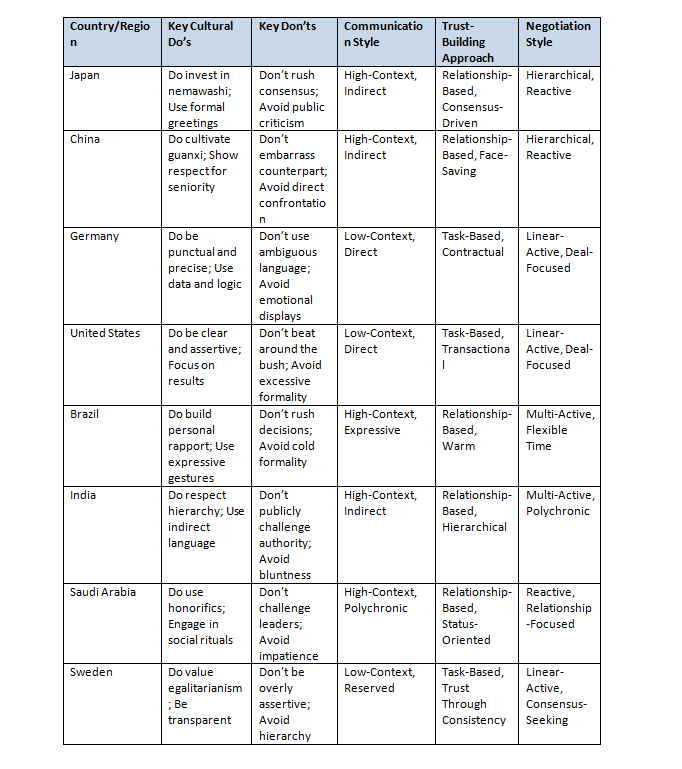
Country/Region-Specific Insights
Advanced Strategies
- Employ Cultural Intelligence (CQ) cycles continuously during negotiations to reassess assumptions and adapt dynamically. For example, adjust your CQ Action if nonverbal cues indicate discomfort.
- Use “mirroring” techniques to build subconscious rapport, adapting speech rate, tone, and body language to the counterpart’s style, especially effective in high-context cultures.
- Leverage Trompenaars’ Universalism vs Particularism insight by identifying when to apply universal principles and when to customize agreements according to relational nuances.
- Anticipate and prepare for different conflict modes in intercultural disputes; for instance, use collaboration to reconcile German directness with Brazilian emotional expressiveness.
- Integrate Gesteland’s deal-focus vs relationship-focus dimension by balancing task and relational elements strategically, especially in multiparty negotiations involving mixed cultures.
These expert-level techniques require advanced preparation and cultural self-awareness but yield superior negotiation outcomes.
Scripts and Templates
Script 1: Japanese Nemawashi Introduction
“I would very much appreciate the opportunity to meet informally with your team to better understand all perspectives before we move forward. This aligns with our respect for thorough consensus and ensures our proposal truly reflects your needs.”
Script 2: Chinese Guanxi Building
“We value this partnership deeply and would like to find time to share a meal, to build mutual understanding and trust beyond our formal discussions. We believe strong relationships are the foundation of long-term success.”
Script 3: German Direct Proposal
“Based on our analysis, we propose the following terms which clearly define responsibilities and timelines. Please review the attached data supporting our offer. We welcome your detailed feedback.”
Script 4: Brazilian Warmth and Flexibility
“We are excited about working together and are open to adjusting schedules and plans to ensure a comfortable and productive collaboration. Let’s keep the dialogue open and enjoy this journey.”
Script 5: Indian Hierarchical Respect
“It is an honor to present this proposal and we respectfully seek your guidance and approval to proceed further. We look forward to your valued insights and continuing our fruitful relationship.”
Frequently Asked Questions
Q1: How important is understanding time orientation in cross-cultural negotiation?
A1: Extremely important. Cultures with monochronic time (e.g., Germany, Sweden) prioritize punctuality and deadlines, while polychronic cultures (e.g., Middle East, Latin America) view time more fluidly, emphasizing relationships over schedules. Misalignment can cause frustration and mistrust.
Q2: What role does ‘face’ play in Asian negotiations?
A2: ‘Face’ (mianzi) represents a person’s social standing and dignity. Losing face can damage relationships permanently. Negotiators should avoid public criticism, use indirect language, and seek win-win solutions to preserve face and maintain trust.
Q3: How can negotiators manage conflicts arising from different emotional expressiveness?
A3: Recognizing cultural norms for emotional expression is key. For example, a Brazilian’s warmth may seem unprofessional to Germans. Using Thomas-Kilmann’s conflict modes, negotiators can adapt by accommodating or collaborating as appropriate to preserve harmony or assert clarity.
Q4: Are formalities important in all cultures?
A4: No. Some cultures (Japan, Saudi Arabia) require strict formalities and honorifics to show respect. Others (US, Scandinavia) favor informality and egalitarianism. Misjudging formality can offend or undermine authority.
Q5: How do you handle multi-party negotiations across cultures?
A5: Multi-party settings require understanding each culture’s decision-making process, hierarchy, and communication style. Employing advance preparation, setting clear agendas, and facilitating inclusive dialogue prevent misunderstandings and ensure collective buy-in.
Conclusion
Cross-cultural negotiation is as much an art as a science, demanding cultural intelligence, humility, and strategic adaptability. The stakes are high — lost deals can cost millions and irreparably damage reputations. However, by grounding your approach in robust cultural frameworks, applying stepwise strategic adaptations, and learning from real-world case studies, you can transform complexity into opportunity. Whether navigating Japan’s consensus-building rituals, China’s relational networks, or Brazil’s expressive warmth, the key is to respect and integrate cultural differences rather than override them.
This guide equips you with the frameworks, country-specific insights, and practical scripts to elevate your intercultural negotiation prowess. We encourage you to deepen your cultural intelligence continuously, practice adaptive communication, and apply these lessons to your next global deal. The rewards of mastering cross-cultural negotiation are profound — stronger relationships, successful deals, and sustainable international growth await.
References
- Hofstede, G. (2011). *Dimensionalizing Cultures: The Hofstede Model in Context*. Online Readings in Psychology and Culture.
- Meyer, E. (2014). *The Culture Map: Breaking Through the Invisible Boundaries of Global Business*. PublicAffairs.
- Lewis, R. D. (2006). *When Cultures Collide: Leading Across Cultures*. Nicholas Brealey Publishing.
- Hall, E.T. (1976). *Beyond Culture*. Anchor Books.
- Livermore, D. (2015). *Leading with Cultural Intelligence: The Real Secret to Success*. AMACOM.
- Trompenaars, F., & Hampden-Turner, C. (2012). *Riding the Waves of Culture: Understanding Diversity in Global Business*. Nicholas Brealey Publishing.