Cultural Differences in Business Negotiation: What Every Professional Must Know

In 2015, a $500 million joint venture between a leading American tech firm and a Japanese conglomerate collapsed after months of negotiations. The American negotiators, eager to finalize the deal, pushed for quick decisions and direct agreements, while their Japanese counterparts insisted on prolonged consensus-building rituals like nemawashi and ringi. Misreading the Japanese team’s patience for indecisiveness, the Americans withdrew, leaving millions on the table and a partnership unrealized. This high-profile failure underscores a critical truth in global business: negotiating across cultures is not just about the numbers—it's about decoding invisible cultural scripts that govern communication, trust, and decision-making.
Cross-cultural negotiation differs fundamentally from domestic deals because of these unseen frameworks. Negotiators unwittingly operate under assumptions shaped by their own cultural norms, often misinterpreting silence, gestures, or even the pace of dialogue. Trust, a cornerstone of successful agreements, manifests differently—what builds rapport in Brazil may offend in Germany. Without cultural intelligence, negotiators risk misreading signals, causing friction that can derail the most promising opportunities. Understanding these nuances is not optional; it is essential for anyone operating in today’s interconnected markets.
This comprehensive guide will equip you with the most respected cultural frameworks—from Geert Hofstede’s six cultural dimensions to Erin Meyer’s Culture Map, Richard Lewis’s behavioral profiles, Edward Hall’s context analysis, and David Livermore’s Cultural Intelligence model. You will gain country-specific insights, actionable preparation strategies, and exact scripts tailored for diverse cultural contexts. Through real-world case studies and advanced techniques, you will master the art and science of cross-cultural negotiation, transforming potential pitfalls into opportunities for breakthrough deals.
· Table of Contents
· The Science of Cultural Differences in Negotiation
· Key Cultural Frameworks and Country Comparisons
· Step-by-Step Cultural Preparation Strategy
· Real-World Cross-Cultural Case Studies
· Country and Region-Specific Insights Table
· Advanced Cross-Cultural Negotiation Strategies
· Scripts and Templates for Different Cultural Contexts
· Frequently Asked Questions
· Conclusion and Call to Action
· References
The Science of Cultural Differences in Negotiation
Negotiation is fundamentally a human interaction shaped by culture’s invisible architecture. Several seminal frameworks provide lenses through which to understand these influences. Geert Hofstede’s cultural dimensions remain foundational, offering six measurable scales: Power Distance, Individualism vs. Collectivism, Masculinity vs. Femininity, Uncertainty Avoidance, Long-Term Orientation, and Indulgence vs. Restraint. For example, Japan scores high on Uncertainty Avoidance (92) and Long-Term Orientation (88), emphasizing meticulous planning and future rewards, while the USA scores relatively low on Uncertainty Avoidance (46) and Long-Term Orientation (26), favoring flexibility and short-term gains. Such contrasts explain varied negotiation pacing and risk tolerance.
Erin Meyer’s Culture Map elaborates on eight dimensions of workplace culture impacting negotiation: Communicating (low-context vs high-context), Evaluating (direct negative feedback vs indirect), Persuading (principle-first vs application-first), Leading, Deciding, Trusting, Disagreeing, and Scheduling. Meyer highlights China’s high-context communication, where much is implied and harmony preserved, versus Germany’s low-context, explicit style. Similarly, Brazilian negotiators’ warmth and expressiveness contrast with Scandinavian reservedness and egalitarianism.
Richard Lewis categorizes cultures as Linear-Active (e.g., Germany, USA), Multi-Active (e.g., Mexico, Italy), or Reactive (e.g., Japan, China). Linear-Active negotiators prefer facts, punctuality, and sequential processes; Multi-Active rely on emotion, relationships, and multitasking; Reactives prioritize listening, harmony, and patience. For instance, a German-American deal might stall with Brazilian Multi-Active negotiators who expect flexibility in scheduling and a relational approach.
Edward Hall’s theory on high-context versus low-context cultures explains how communication relies on explicit words or shared context. Japan and Arab countries are high-context, demanding sensitivity to nonverbal cues and indirect speech, while the USA and Germany are low-context, valuing clarity and directness. Hall’s monochronic vs polychronic time concepts also impact scheduling and deadlines; Germans are monochronic and rigid with time, whereas Arabs and Latin Americans operate polychronically, comfortable with fluid timing.
Richard Gesteland’s dimensions—deal-focus vs relationship-focus, rigid-time vs fluid-time, formal vs informal, and expressive vs reserved—further nuance our understanding. Middle Eastern cultures like Saudi Arabia are relationship-focused and fluid-time oriented, requiring patience and prioritization of personal connections over schedules, contrasting with deal-focused, rigid-time cultures like Germany.
David Livermore’s Cultural Intelligence (CQ) framework articulates four capabilities crucial for cross-cultural success: CQ Drive (motivation), CQ Knowledge (understanding norms), CQ Strategy (planning and awareness), and CQ Action (adapting behavior). High CQ negotiators consciously monitor cultural dynamics, adjust their tactics, and build trust effectively across borders.
Trompenaars & Hampden-Turner’s dimensions (universalism vs particularism, individualism vs communitarianism, neutral vs emotional, specific vs diffuse, achievement vs ascription) explain further complexities. For example, China’s particularism demands tailored, relationship-based agreements, whereas the USA’s universalism favors rule-based, contractual deals.
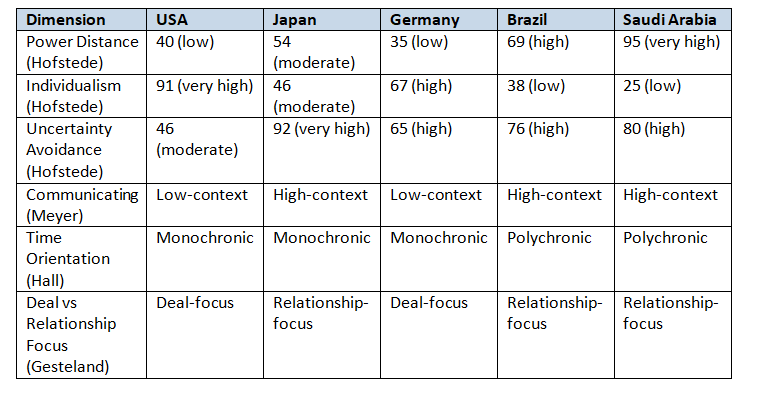
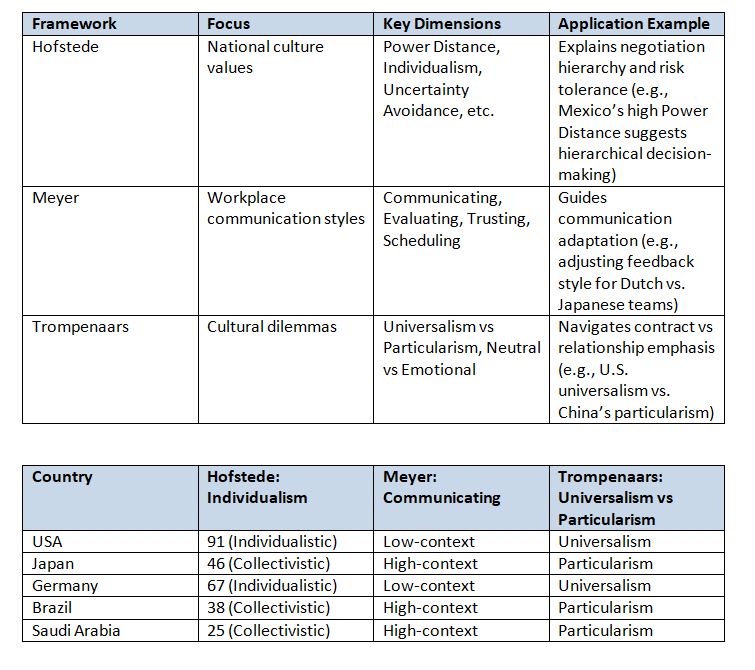
Key Cultural Frameworks
To navigate cross-cultural negotiations effectively, mastering key frameworks is vital. Here we compare three of the most practical and widely applied: Hofstede’s Dimensions, Erin Meyer’s Culture Map, and Trompenaars & Hampden-Turner’s cultural dilemmas.
Step-by-Step Cultural Preparation Strategy
Step 1: Conduct Deep Cultural Research
Before any negotiation, gather detailed cultural intelligence. Use sources like Hofstede Insights, Meyer’s Culture Map, and country-specific business etiquette guides. Understand power structures, communication styles, and negotiation pacing. For instance, researching South Korean nunchi—the ability to read the room—prepares you to observe subtle cues and hierarchical respect.
Step 2: Build Relationships Proactively
In many cultures—China’s guanxi, Middle Eastern wasta, Indian relationship-building—trust precedes business. Allocate time for informal meetings, social dinners, and gift exchanges. Avoid jumping straight into contract details. Use open-ended questions to signal genuine interest in partners’ values and goals.
Step 3: Adapt Communication Style
Tailor your verbal and non-verbal communication. For high-context cultures like Japan and Saudi Arabia, moderate directness, use silence strategically, and avoid public confrontation. In contrast, Germans and Americans value explicitness and frankness. Adjust your evaluative feedback accordingly, following Meyer’s guidelines.
Step 4: Manage Face and Hierarchy Carefully
Face-saving is paramount in East Asia and the Middle East. Avoid public criticism, respect status differences, and use indirect language to navigate disagreements. In India, defer to senior decision-makers but engage middle managers to build consensus. Recognize that Japanese nemawashi—the informal consensus-building before formal meetings—may require patience.
Step 5: Build and Sustain Trust
Trust-building protocols differ: Scandinavians prefer competence-based trust, Latin Americans emphasize affect-based trust. Use active listening, demonstrate reliability, and follow up consistently. Employ cultural intelligence CQ Strategy to anticipate possible misunderstandings and prepare contingency plans.
Step 6: Close with Cultural Sensitivity
The closing phase varies greatly: Americans often expect explicit contract sign-off, while in the Arab world, verbal agreements and ongoing relationships matter more. Avoid rushing; emphasize mutual benefits, and allow space for after-meeting consultations, as seen in Chinese ringi consensus.
Real-World Case Studies
Context: An American software company sought rapid market entry in Japan through a partnership. The U.S. team’s direct approach clashed with Japanese ringi consensus practices, which require circulating proposals for approval before formal meetings.
Cultural Dynamics: Americans’ low-context, deal-focused, and monochronic style conflicted with Japan’s high-context, relationship-focused, and long-term orientation. The U.S. team misinterpreted delays as disinterest.
Outcome & Lesson: The deal fell apart. Lesson: Respect for nemawashi and ringi processes is essential. Preparing for indirect communication and prolonged consensus can prevent costly breakdowns.
Context: A German engineering firm negotiated with a Brazilian distributor. Germans initially frustrated by what they saw as flexible deadlines and emotional communication.
Cultural Dynamics: Brazilians’ Multi-Active style and high-context communication required Germans to adapt scheduling expectations and engage in warm, personal interactions.
Outcome & Lesson: By appointing a bilingual mediator and scheduling informal social events, the Germans built affect-based trust, resulting in a long-term contract. Lesson: Adapting to warmth and relational expectations unlocks success.
Context: A European consortium attempted to secure a contract in Saudi Arabia. The Europeans focused on technical specifications and rigid timelines.
Cultural Dynamics: Saudi Arabia’s high Power Distance, fluid-time, and relationship-focus via wasta meant negotiations involved extensive socializing and deferral to senior tribal leaders.
Outcome & Lesson: Europeans initially saw delays as inefficiency but later recognized that relationship-building was critical. Lesson: Patience and respect for hierarchy are prerequisites in Gulf negotiations.
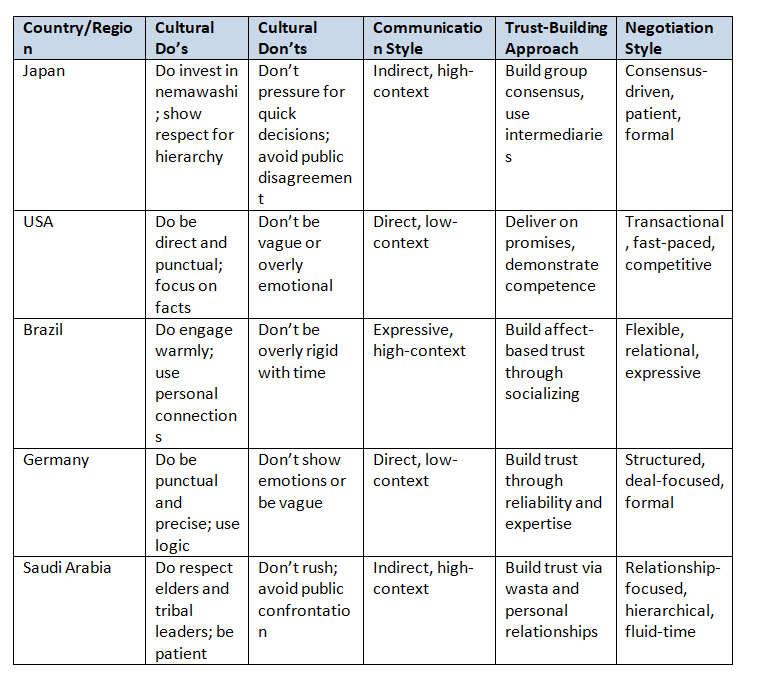
Country/Region-Specific Insights
Advanced Strategies
Managing interpreters effectively means briefing them thoroughly on cultural nuances and negotiation objectives. Avoid literal translations; encourage interpreters to convey intent and tone. Building guanxi in China requires reciprocity over time—small gifts and favors create indebtedness and loyalty.
Navigating hierarchy involves mapping decision-makers carefully. In India, acknowledging seniority and using intermediaries avoids cultural faux pas. Adapting persuasion styles means using principle-first arguments in France or application-first in the USA, per Meyer’s persuading dimension.
Reading non-verbal signals includes recognizing Korean nunchi—observing subtle facial expressions and tone shifts—and Middle Eastern proxemics, where close physical distance can indicate trust or dominance.
Scripts and Templates
American: “We need to finalize the contract by next Friday to proceed with the launch.”
Japanese: “We appreciate your timeline and will carefully review internally. We hope for a positive outcome soon.”
Adapted Japanese Script: “We value your proposal deeply and are engaging with all stakeholders to ensure mutual satisfaction. We look forward to continued dialogue.”
German: “Please provide detailed specifications and expect delivery by March 15.”
Brazilian: “We are excited about this partnership and will do our best to meet your expectations, though timelines might adjust based on local conditions.”
Adapted Brazilian Script: “We truly appreciate this opportunity and are committed to delivering excellent results, working closely with you every step of the way.”
American: “This agreement is final and effective immediately upon signing.”
Saudi: “We are honored by this agreement and look forward to strengthening our relationship over time, God willing.”
French: “Based on the evidence, our position is logically sound and should be accepted.”
Korean: “We understand your position and will consult with our team to harmonize with shared goals.”
Frequently Asked Questions
Q1: How do I prepare for negotiations with high power distance cultures?
A1: Research the hierarchy and decision-making processes. Address senior leaders with respect, avoid bypassing them, and allow time for hierarchical approvals. For example, in Saudi Arabia (Power Distance 95), deferring to elders is critical.
Q2: What are common pitfalls when negotiating with high-context cultures?
A2: Expect indirect communication and implicit messages. Avoid pressing for explicit answers too quickly. Silence may indicate reflection, not disagreement. Cultures like Japan and China require reading between the lines.
Q3: How can I build trust quickly in collectivist societies?
A3: Invest time in relationship-building activities, show loyalty, and demonstrate cultural respect. Use social events, gift-giving where appropriate, and involve trusted intermediaries. Brazil and India prioritize affect-based trust.
Q4: How should I handle disagreement in cultures that avoid confrontation?
A4: Use indirect language, ask open-ended questions, and employ third-party mediators. In East Asian cultures, public disagreement threatens face, so approach conflicts privately and diplomatically.
Q5: Can cultural intelligence be learned, and how?
A5: Yes, through deliberate study of cultural frameworks, exposure to diverse cultures, reflective practice, and feedback. Developing CQ Drive, Knowledge, Strategy, and Action helps negotiators adapt effectively.
Conclusion
In today’s globalized markets, cultural differences in business negotiation can make or break deals worth millions. Understanding frameworks such as Hofstede’s cultural dimensions, Meyer’s Culture Map, and Trompenaars’ dilemmas equips professionals with the vocabulary and insight to decode complex cultural signals. Mastery of these concepts, combined with real-world case experience and tailored communication, transforms seemingly insurmountable barriers into bridges for collaboration.
By systematically preparing—investing in research, relationship-building, trust protocols, and adaptable scripts—negotiators gain a decisive edge. Cross-cultural competence is no longer a soft skill but a strategic imperative. Embrace cultural intelligence to unlock new markets, foster lasting partnerships, and achieve negotiation breakthroughs that transcend borders.
Take the first step today: assess your team’s Cultural Intelligence, deepen your knowledge of your target market’s unique negotiation culture, and begin practicing adaptive communication strategies. The world’s most successful negotiators are those who do not just speak the language of business but also the language of culture.