Cultural Differences in Negotiation: A Country-by-Country Breakdown for Global Business Success

Negotiations between multinational companies often falter not because of price disagreements or contract terms, but due to profound cultural misunderstandings. Take the 2012 joint venture talks between a leading American tech firm and a South Korean conglomerate. Despite promising market potential, the deal collapsed after American negotiators, focused on direct communication and rapid decision-making, misread the Korean partners' indirect cues and emphasis on hierarchy and consensus. Months of painstaking relationship-building were neglected, and the parties parted ways frustrated. Conversely, a 2015 EU-UK negotiation over post-Brexit trade arrangements succeeded in large part due to diplomats’ acute cultural intelligence—balancing British low-context directness with continental Europe's more formal, process-driven style, they crafted communication protocols that preserved dignity and facilitated compromise.
International negotiation is fundamentally more complex than domestic deals. Beyond language differences lie deep-rooted cultural paradigms: varying attitudes toward hierarchy and authority, contrasting expectations of time and deadlines, distinct approaches to trust and relationship-building, and diverse communication styles ranging from high-context indirectness to blunt low-context clarity. Laws and regulations vary by jurisdiction, adding legal complexity, while time zone differences challenge scheduling and real-time interactions. Most negotiators dangerously underestimate these layers or treat cultural differences superficially, risking deal failure, reputational damage, or costly misunderstandings.
This comprehensive guide equips you to master these challenges by unlocking the core cultural frameworks developed by scholars like Geert Hofstede, Richard Lewis, Edward Hall, and Erin Meyer. You will gain practical, country-specific negotiation tactics, step-by-step strategies tailored for cross-border deals, advanced techniques for relationship management, and exact scripts adaptable to diverse cultural contexts. Whether preparing for a joint venture in China, an acquisition in Germany, or diplomatic talks in the Middle East, this definitive country-by-country breakdown will elevate your global negotiation acumen.
· Table of Contents
· The Foundations of International Negotiation: Cultural, Psychological, and Structural Dimensions
· Key Frameworks and Cultural Models with Country Comparisons
· Step-by-Step Strategy for Cross-Cultural Negotiations
· Real-World Case Studies: US-China, EU-UK, Japan-US
· Country-Specific Negotiation Insights and Tactical Table
· Advanced Strategies: Managing Hierarchy, Face, and Time
· Scripts and Templates for Multicultural Negotiation Scenarios
· Frequently Asked Questions
· Conclusion and Call to Action
· References and Further Reading
The Foundations of International Negotiation
International negotiation is a multidimensional process requiring sensitivity to cultural, psychological, and structural factors that differ markedly from domestic contexts. Geert Hofstede’s seminal research highlights how national cultures vary on six dimensions with direct implications for negotiation:
- Power Distance: Degree to which less powerful members accept hierarchical order without question. High power distance cultures (e.g., India, Mexico) expect clear authority lines during negotiations, whereas low power distance cultures (e.g., Netherlands, Australia) prefer egalitarian interaction.
- Individualism vs. Collectivism: Individualistic societies (e.g., US, UK) prioritize personal goals and direct negotiation, while collectivist cultures (e.g., China, Japan) emphasize group harmony and consensus.
- Uncertainty Avoidance: Cultures high in uncertainty avoidance (e.g., Germany, Japan) seek structured, rule-based negotiations, whereas those low in this dimension (e.g., Singapore, Sweden) tolerate ambiguity and flexible approaches.
- Long-term Orientation: Societies with long-term orientation (e.g., China, South Korea) focus on enduring relationships and future rewards, contrasting with short-term oriented cultures (e.g., US, Russia) that prioritize quick results.
- Masculinity vs. Femininity: Masculine cultures (e.g., Japan, Italy) value assertiveness and competition, while feminine cultures (e.g., Norway, Netherlands) favor cooperation and quality of life.
- Indulgence vs. Restraint: Indulgent societies (e.g., Mexico, US) allow gratification of desires, whereas restrained cultures (e.g., Egypt, Russia) exercise stricter social norms.
Richard Lewis’s model categorizes cultures into Linear-Active (task-oriented, scheduled, factual - Germany, Switzerland), Multi-Active (emotional, relationship-oriented, flexible - Latin America, Southern Europe), and Reactive (listening, accommodating, indirect - China, Japan). Recognizing these archetypes aids in anticipating negotiation rhythms and communication styles.
Edward Hall’s high-context vs. low-context communication theory further deepens understanding. High-context cultures (e.g., Japan, Arab countries) rely heavily on implicit messages, non-verbal cues, and shared history, while low-context cultures (e.g., USA, Germany) depend on explicit verbal communication. Hall also distinguishes monochronic time cultures that value punctuality and sequential task completion (e.g., Germany, Switzerland) from polychronic cultures that multitask and emphasize relationships over strict schedules (e.g., Middle East, India).
Erin Meyer’s "The Culture Map" expands these insights into eight dimensions, including communicating, evaluating, persuading, leading, deciding, trusting, disagreeing, and scheduling. Her work provides nuanced guidance on adjusting negotiation styles according to cultural preferences—for example, adapting direct negative feedback in the Netherlands to a more indirect approach in Indonesia.
Key Frameworks and Cultural Models
This section presents three core frameworks essential for cross-cultural negotiation, supplemented by a comparative table illustrating country-specific cultural dimension scores.
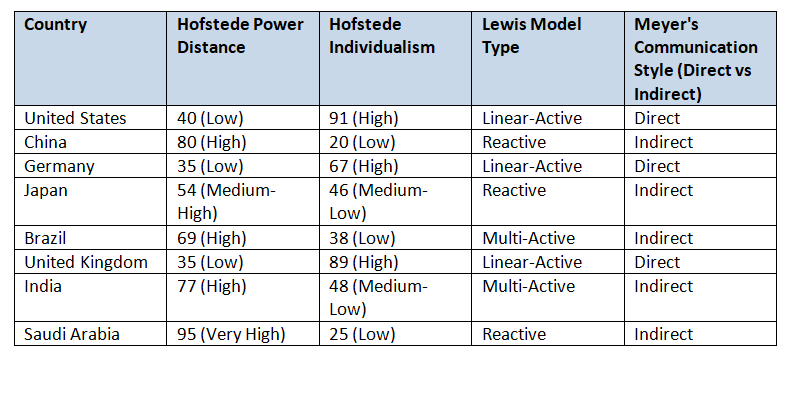
Together, these models form a comprehensive toolkit for diagnosing cultural challenges and tailoring negotiation strategies country by country.
Step-by-Step Strategy for Cross-Cultural Negotiations
Mastering international negotiation requires a structured approach that respects cultural nuances at each stage. Below is a detailed six-step process:
Step 1: Preparation and Cultural Research
Before any interaction, conduct deep research on the counterpart's cultural values, business practices, and negotiation style using Hofstede scores, Lewis’s archetypes, and Meyer's Culture Map. Identify language barriers, time zone differences, and legal frameworks (e.g., CISG applicability). Prepare materials accordingly, including culturally adapted presentations.
Step 2: Opening and Relationship Building
In high-context or collectivist cultures (China, Middle East), invest significant time in establishing personal relationships and trust (guanxi, wasta). Begin meetings with informal conversation rather than jumping into agenda items. In contrast, low-context, individualistic cultures (US, Germany) expect prompt agenda setting and direct introductions.
Step 3: Exploration and Information Exchange
Use open-ended questions to clarify interests and priorities, but adapt to communication style—direct questioning in Linear-Active cultures, indirect and reading between lines in Reactive cultures. Be sensitive to non-verbal cues and pauses signaling discomfort or disagreement.
Step 4: Bargaining and Concessions
Understand the counterpart’s negotiation style: Multi-Active cultures may negotiate emotionally and expect flexibility, Reactive cultures may avoid public disagreement and prefer private consensus-building. Use principled negotiation techniques (Fisher & Ury) emphasizing mutual interests over positions, but tailor persuasion methods accordingly.
Step 5: Closing the Deal
In high uncertainty avoidance countries (Japan, Germany), formalize agreements with detailed contracts and precise terms. In low uncertainty avoidance cultures, verbal agreements and flexibility may suffice initially. Confirm understanding explicitly to avoid ambiguity.
Step 6: Follow-Up and Relationship Maintenance
Sustain post-deal relationships through culturally appropriate communication frequency and style. For collectivist cultures, ongoing personal engagement is critical. For individualistic cultures, focus on performance and deliverables.
Real-World Case Studies
US-China Trade Negotiations (2018-2020)
The US-China trade war negotiations illustrated clashes between America’s low power distance, direct communication style and China’s high power distance, indirect approach, and long-term orientation. US negotiators initially misread Chinese consensus-building (nemawashi) as evasiveness. Successful breakthroughs came after US teams adjusted to Chinese protocols, engaging senior officials with patience and showing respect for hierarchy and “face.” This shift enabled partial agreements despite deep underlying tensions.
EU-UK Brexit Talks (2017-2020)
The Brexit negotiations highlighted divergent cultural styles within Europe. British negotiators favored a pragmatic, low-context communication style with focus on sovereignty and speed, while EU representatives adhered to high-context, process-oriented diplomacy prioritizing institutional unity. Recognizing these differences, negotiators created layered communication channels, leveraging intermediaries and formal protocols to manage conflict and preserve working relationships.
Japan-US M&A Deal (2014)
A US tech giant’s acquisition of a Japanese firm stalled initially due to contrasting negotiation styles. American negotiators pushed for rapid decisions and direct feedback, while Japanese counterparts expected extensive consensus-building and indirect communication to save face. The deal progressed after US teams incorporated “nemawashi” style informal consultations and softened direct language, respecting hierarchy and group harmony, leading to a landmark cross-cultural transaction.
Country-Specific Negotiation Insights and Tactical Table
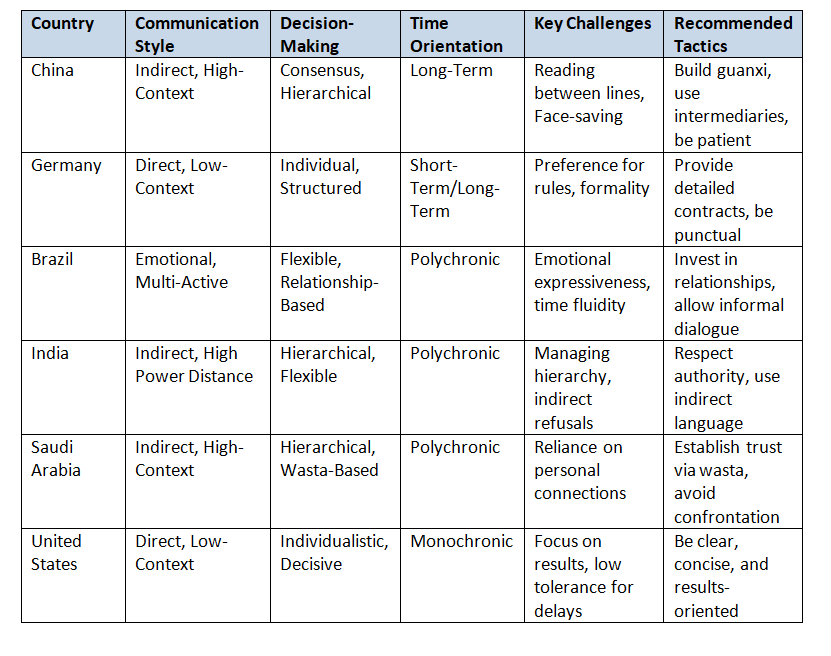
The following table summarizes key negotiation characteristics, challenges, and effective tactics for selected countries:
Advanced Strategies for Expert Negotiators
Scripts and Templates for International Negotiations
“Thank you very much for taking the time to meet with us today. We deeply respect the tradition and values your company upholds. We hope to build a mutually beneficial relationship through careful and thoughtful discussion.”
“Could you please elaborate on the specific terms regarding delivery timelines? We want to ensure full alignment and compliance with your standards.”
“Dear Mr. Al-Farsi,
It was a privilege to meet you yesterday. We greatly appreciate your hospitality and the insightful discussion. We look forward to continuing our collaboration and exploring opportunities that honor our shared values.
Best regards,
“I understand your perspective and value your insights. Perhaps we could also consider an alternative approach that might address some of the concerns raised?”
“Dear Mr. Singh,
Following our recent discussion, I would like to confirm that we have agreed on the following points: [bullet summary]. Please let us know if any clarification is needed.
Warm regards,
Frequently Asked Questions
1. How can I prepare for negotiations with a high power distance culture?
Research the organizational hierarchy beforehand, identify key decision-makers, and show respect through formal titles and deferential language. Be patient with top-down decision processes.
2. What are effective strategies for negotiating with indirect communicators?
Pay close attention to non-verbal cues, silence, and context. Use open-ended questions and allow space for the other party to express concerns subtly. Avoid forcing direct answers.
3. How do I manage time zone differences in virtual negotiations?
Schedule meetings at mutually convenient times, confirm availability well in advance, and use asynchronous communication tools to supplement live discussions. Be mindful of cultural attitudes toward punctuality.
4. What legal frameworks govern international contract negotiations?
Familiarize yourself with the United Nations Convention on Contracts for the International Sale of Goods (CISG), International Chamber of Commerce (ICC) arbitration rules, and local contract laws. Include arbitration clauses in contracts.
5. How do I handle conflict resolution in cultures that avoid direct disagreement?
Use mediators or trusted third parties, propose face-saving solutions, and emphasize shared goals and interests. Avoid public confrontations and opt for private discussions.
Conclusion
Navigating cultural differences in international negotiation is not optional—it is a strategic imperative for global business success. By integrating foundational cultural frameworks with tailored country-specific tactics, negotiators can build trust, avoid costly misunderstandings, and close deals that endure. This guide has provided you with the intellectual tools, practical steps, real-world examples, and exact scripts to elevate your cross-cultural negotiation mastery.
We encourage you to embed these insights into your negotiation preparation and execution processes. Embrace cultural intelligence as a competitive advantage and transform every international deal into an opportunity for lasting partnership. For personalized coaching and advanced workshops on global negotiation, contact our expert team today.
References
· Hofstede, G. (2001). Culture's Consequences: Comparing Values, Behaviors, Institutions and Organizations Across Nations. Sage Publications.
· Lewis, R. D. (2006). When Cultures Collide: Leading Across Cultures. Nicholas Brealey Publishing.
· Hall, E. T. (1976). Beyond Culture. Anchor Books.
· Meyer, E. (2014). The Culture Map: Breaking Through the Invisible Boundaries of Global Business. PublicAffairs.
· Fisher, R., Ury, W., & Patton, B. (2011). Getting to Yes: Negotiating Agreement Without Giving In. Penguin Books.
· United Nations Commission on International Trade Law (UNCITRAL). (1980). United Nations Convention on Contracts for the International Sale of Goods (CISG).