Cultural Mistakes in Negotiation: The Blunders That Kill Deals and How to Avoid Them

Negotiations between international partners can be fraught with unseen cultural pitfalls. Consider the infamous collapse of a 2015 joint venture between a German automotive giant and a Chinese state-owned enterprise. Despite months of promising talks and lucrative contract terms, the deal unraveled in the final stages. The German team, relying on direct, task-focused communication, pushed for rapid agreement and detailed contract clauses. Meanwhile, the Chinese counterparts, deeply committed to guanxi (relationship-building) and maintaining mianzi (face), perceived this approach as disrespectful and rushed, causing distrust that ultimately killed the deal. This costly failure illustrates how invisible cultural scripts, unspoken assumptions, and misread signals can derail even the most promising negotiations.
Cross-cultural negotiation differs fundamentally from domestic deals because it involves layers of implicit cultural expectations. Executives must decode invisible scripts—such as the Japanese nemawashi informal consensus-building or Middle Eastern wasta relationship primacy—to avoid misunderstandings. Simple missteps, like ignoring hierarchical protocols in Korea’s nunchi culture or underestimating the Scandinavian preference for egalitarian dialogue, can erode trust and stall progress. Successful negotiators cultivate cultural intelligence (CQ) to interpret complex verbal and non-verbal cues and to build trust where directness or transactional focus might otherwise cause offense.
In this comprehensive guide, you will master the leading cultural frameworks pioneered by Geert Hofstede, Erin Meyer, Richard Lewis, Edward Hall, Richard Gesteland, David Livermore, and Trompenaars & Hampden-Turner. You will gain country-specific negotiation insights, step-by-step preparation strategies, and exact scripts adapted for diverse cultural contexts. By the end, you will be equipped to identify and avoid the blunders that kill deals and to turn cultural differences into a strategic advantage.
· Table of Contents
· The Science of Cultural Differences in Negotiation
· Key Cultural Frameworks with Country Comparisons
· Step-by-Step Cultural Preparation Strategy
· Real-World Case Studies of Cross-Cultural Negotiations
· Country/Region-Specific Insights: Do’s, Don’ts, and Styles
· Advanced Cross-Cultural Negotiation Strategies
· Scripts and Templates for Cross-Cultural Communication
· Frequently Asked Questions
· Conclusion
· References
The Science of Cultural Differences in Negotiation
Understanding the scientific foundation of cultural differences is critical to anticipating negotiation challenges and designing effective strategies. Multiple scholars have developed robust models to quantify and explain cultural dimensions influencing negotiation behavior.
Geert Hofstede’s six cultural dimensions remain the most widely referenced. His 2021 data shows Japan scoring high on Uncertainty Avoidance (92) and Collectivism (46 individualism score), emphasizing structured processes like nemawashi consensus. By contrast, the United States scores low in Uncertainty Avoidance (46) and very high in Individualism (91), favoring direct, transactional negotiation approaches. Germany’s high Masculinity (66) and low Power Distance (35) explain their focus on Sachlichkeit (objectivity) with less hierarchical deference. India’s high Power Distance (77) and Collectivism (48 individualism score) reflect deference to hierarchy and emphasis on relationship-building.
Erin Meyer’s Culture Map offers eight practical dimensions for negotiation adaptation: communicating, evaluating, persuading, leading, deciding, trusting, disagreeing, and scheduling. For example, the French prefer indirect, intellectual argumentation (high-context communicating) and hierarchical decision-making, whereas Scandinavians favor low-context, egalitarian, consensus-driven styles. Brazil’s multi-active culture leads with emotional expressiveness and flexible scheduling, contrasting sharply with Japan’s reactive, harmony-focused approach.
Richard Lewis categorizes cultures into Linear-Active (e.g., German, American), Multi-Active (e.g., Brazilian, Italian), and Reactive (e.g., Japanese, Chinese) types. This helps negotiators anticipate pacing, communication style, and decision protocols. Edward Hall’s theory of high-context (implicit communication, e.g., Middle East, East Asia) versus low-context cultures (explicit communication, e.g., Germany, USA) helps decode whether messages are conveyed directly or need interpretation of subtle signals.
Richard Gesteland’s dimensions of deal-focus vs relationship-focus and formal vs informal further clarify cultural negotiation priorities. Middle Eastern and Latin American cultures skew toward relationship-focus and informality, requiring personal trust before deal-making. Conversely, Northern European and North American cultures prioritize deal-focus and formality. Additionally, Gesteland’s rigid-time vs fluid-time dimension explains why punctuality is critical in Germany but flexible in India or Brazil.
David Livermore’s Cultural Intelligence (CQ) framework—comprising CQ Drive (motivation), CQ Knowledge (understanding), CQ Strategy (planning), and CQ Action (behavior)—provides a practical roadmap for developing negotiators’ cultural adaptability. Trompenaars & Hampden-Turner contribute with universalism vs particularism and achievement vs ascription dimensions, important for understanding contract enforcement versus relationship reliance, and status based on results versus birth or position.
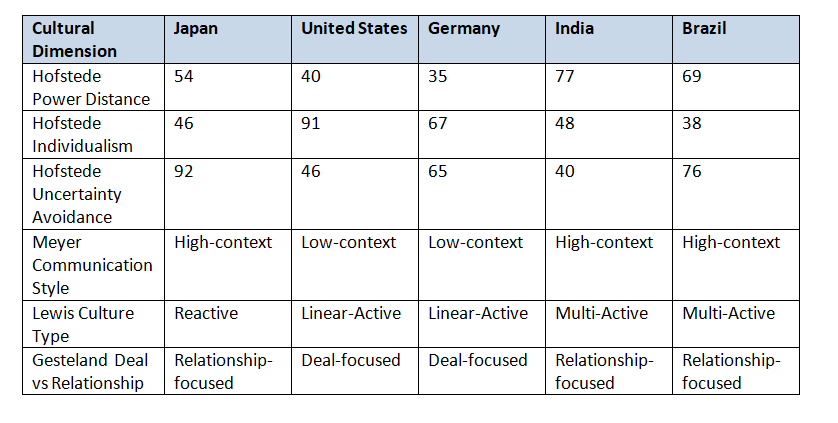
This multidimensional science explains why a German direct approach may offend a Brazilian counterpart expecting warmth and flexibility or why an American’s eagerness to close can alienate a Korean partner requiring hierarchical deference and nunchi (social awareness).
Key Cultural Frameworks
Three frameworks are essential for practical negotiation preparation:
1. Hofstede’s Cultural Dimensions
2. Erin Meyer’s Culture Map
3. Lewis’s Cultural Types
Their complementary perspectives provide a comprehensive toolkit.
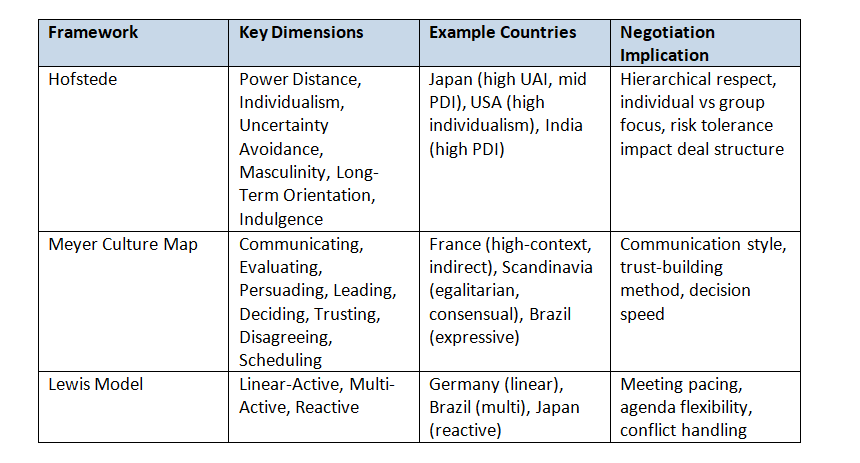
These frameworks intersect; for instance, Japan’s reactive style aligns with high-context communication and mid-level power distance, explaining their preference for harmony and consensus like ringi circulation before decisions.
Step-by-Step Cultural Preparation Strategy
Step 1: Conduct In-Depth Cultural Research
Before any negotiation, study relevant cultural dimensions and frameworks for the partner’s country. Use sources like Hofstede Insights, Meyer’s Culture Map, and real-world case studies. Identify key cultural values influencing communication, hierarchy, time orientation, and conflict resolution.
Step 2: Build Relationships and Trust Early
In relationship-focused cultures (China, Middle East, Brazil), prioritize face-to-face meetings, social activities, and informal conversations to establish guanxi or wasta networks. Avoid rushing to contracts before trust is established.
Step 3: Adapt Communication Style
Assess whether the counterpart prefers high or low-context communication. Use indirect language and reading between the lines in Japan or the Middle East. Be more explicit and direct with German or American counterparts. Adjust tone, formality, and gestures accordingly.
Step 4: Understand and Respect Hierarchy
Identify power distance levels. Show appropriate deference in high PDI cultures (India, Korea) by addressing senior figures first and using formal titles. Conversely, engage egalitarian styles in Scandinavian or Dutch contexts.
Step 5: Plan for Time Orientation and Decision-Making
Anticipate fluid vs rigid time attitudes. Allow extra time for consensus-building in Japan (nemawashi) or Brazil (jeitinho). Prepare for faster, task-driven decisions in the USA or Germany. Factor in scheduling flexibility and patience.
Step 6: Incorporate Face-Saving and Conflict Avoidance
In high-context or collectivist cultures, avoid public criticism or direct confrontation. Use subtle persuasion and private feedback. Recognize the importance of mianzi (face) in China and nunchi in Korea to maintain harmony.
Step 7: Close Deals with Cultural Sensitivity
Confirm agreements with the appropriate level of formality. In universalist cultures (USA, Germany), written contracts are essential. In particularist cultures (China, Middle East), rely on ongoing relationship management and verbal commitments supported by trust.
Real-World Case Studies
Case Study 1: The German-Chinese Automotive Venture Collapse
As introduced, German negotiators pushed for fast formalization, reflecting low-context, deal-focused culture with low power distance. Chinese executives operated within a high-context, relationship-focused paradigm requiring trust through guanxi and face-saving. The failure to recognize these differences led to breakdown. Lesson: Prioritize relational groundwork before contract specifics.
Case Study 2: Successful Korean-American Tech Partnership
American team learned to adapt to Korean hierarchical norms, addressing senior executives first, listening carefully to non-verbal cues (nunchi), and allowing longer decision cycles. They softened direct criticism and incorporated harmony-seeking language, which enabled a smooth alliance. Lesson: Cultural intelligence and CQ strategy accelerate trust-building.
Case Study 3: Brazilian-French Negotiation for Energy Project
Brazilian warmth and expressive style initially clashed with French intellectual argumentation and formality. Through mutual adaptation—Brazilian negotiators adopting more structured agendas and French participants embracing informal socializing—the deal was salvaged. Lesson: Flexibility and empathy overcome contrasting styles.
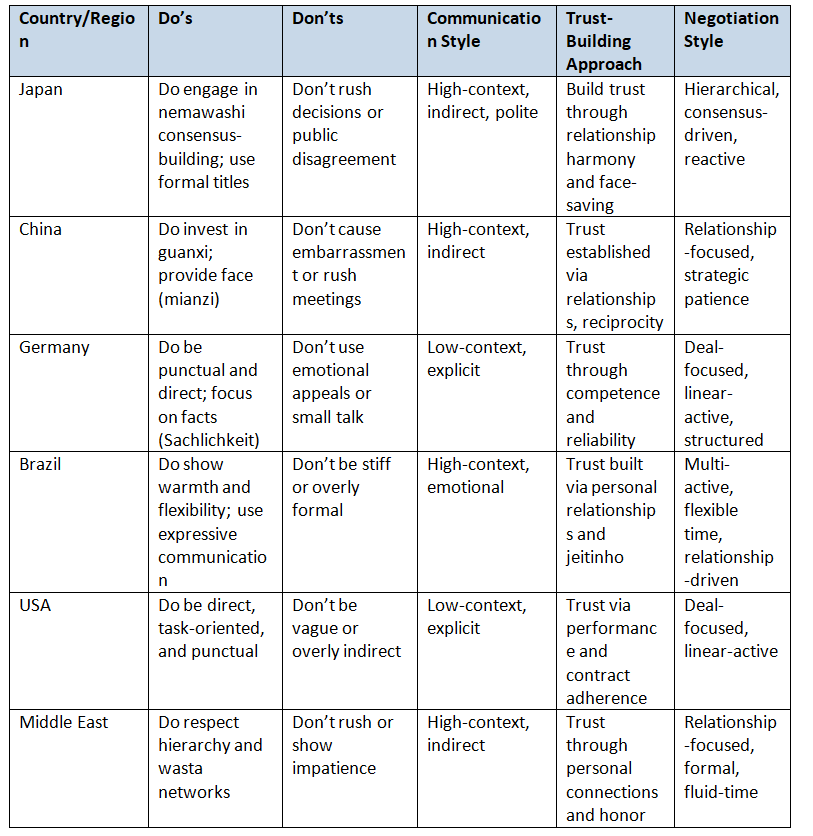
Country/Region-Specific Insights
Advanced Strategies
Managing interpreters effectively requires briefing them on cultural nuances and negotiation goals, ensuring literal translation does not lose implicit meaning. Building guanxi in China or wasta in the Middle East demands patience, gift-giving protocols, and ongoing social engagement beyond formal meetings.
Navigating hierarchy means understanding who holds decision power and the appropriate protocol for addressing superiors and subordinates. Using honorifics in Japan or deferring to elders in India demonstrates respect. Adapting persuasion styles involves recognizing whether logic, emotion, or authority carry more weight. For example, French negotiators prize intellectual debate, while Middle Eastern partners respond more to relational appeals.
Reading non-verbal signals is crucial: Korean nunchi involves subtle observation of mood and context; Brazilian expressiveness contrasts with Scandinavian reservedness. Eye contact, gestures, and silence all convey different meanings across cultures and influence negotiation tone and progress.
Scripts and Templates
Below are adapted scripts delivering the same message—requesting a contract extension—tailored to cultural contexts:
German Negotiation Script
Following our recent discussions, we kindly request a two-week extension to finalize the contract details. We appreciate your punctual attention to this matter and assure you of our commitment to meeting the revised deadline. Please confirm at your earliest convenience.
Best regards,
Japanese Negotiation Script
Thank you very much for your continued cooperation. Regarding the contract finalization, we humbly ask for your kind understanding in granting us an additional two weeks to ensure thorough review. We deeply value your guidance and support. We look forward to your favorable consideration.
Sincerely yours,
Brazilian Negotiation Script
I hope this message finds you well. We are very excited about our partnership and want to ensure everything is perfect. Could we kindly ask for an extra two weeks to finalize the contract? We appreciate your flexibility and look forward to celebrating this great opportunity together.
Warm regards,
American Negotiation Script
Thanks for your help so far. We’d like to request a two-week extension on the contract finalization to make sure all details are covered. Please let us know if this works for you. Looking forward to moving ahead.
Best,
Frequently Asked Questions
1. What is the biggest cultural mistake in international negotiations?
The most common mistake is assuming that one’s own communication style and negotiation approach are universal. For example, applying directness in high-context cultures like Japan or the Middle East can cause offense and breakdowns. Understanding cultural context is essential.
2. How can I build trust quickly with a culturally different partner?
Prioritize relationship-building activities aligned with the partner’s cultural values. In collectivist cultures, invest time in informal meetings and social engagements. Demonstrate respect for hierarchy and face-saving practices. Use patience and follow-up to show commitment.
3. How do I handle conflicts when cultural norms clash?
Avoid direct confrontation in high-context or collectivist cultures. Use indirect communication, private discussions, and third-party mediation if necessary. Understand the cultural basis for disagreement styles to find common ground.
4. When is it appropriate to use interpreters, and how to ensure accuracy?
Use professional interpreters when language barriers hinder nuance. Brief them on cultural context, key negotiation points, and non-verbal cues. Pause frequently to confirm understanding and avoid misinterpretation.
5. How important is non-verbal communication in cross-cultural negotiation?
Non-verbal cues such as eye contact, gestures, posture, and silence carry significant meaning and vary greatly across cultures. Misreading these signals can cause mistrust or offense. Learning culture-specific non-verbal norms enhances negotiation effectiveness.
Conclusion
Cross-cultural negotiation is as much an art as a science, requiring deep cultural intelligence, humility, and adaptability. The invisible scripts that guide behavior—whether Japan’s ringi consensus, China’s guanxi, or Germany’s Sachlichkeit—must be mastered to avoid blunders that kill deals. This guide has provided you with the scientific foundations, actionable preparation steps, real-world examples, and exact scripts to navigate diverse cultural landscapes confidently.
The key to transforming cultural differences from barriers into bridges lies in diligent research, relationship-centered trust-building, communication adaptation, and respect for local customs and values. By applying these principles, you will not only prevent costly negotiation failures but unlock new opportunities for sustainable global partnerships. Begin your journey toward cultural mastery today and turn every negotiation into a winning deal.
References
· Geert Hofstede, Gert Jan Hofstede, Michael Minkov. "Cultures and Organizations: Software of the Mind" (2010)
· Erin Meyer. "The Culture Map: Breaking Through the Invisible Boundaries of Global Business" (2014)
· Richard D. Lewis. "When Cultures Collide: Leading Across Cultures" (2018)
· Edward T. Hall. "Beyond Culture" (1976)
· Richard Gesteland. "Cross-Cultural Business Behavior" (2012)
· David Livermore. "Leading with Cultural Intelligence" (2015)
· Fons Trompenaars & Charles Hampden-Turner. "Riding the Waves of Culture" (2012)