Cultural Negotiation Frameworks: The Models Every Global Dealmaker Must Master

In 2018, a major U.S. technology company faced a dramatic setback when its ambitious partnership deal with a leading Japanese electronics firm collapsed at the final stage. Despite initial enthusiasm, the American negotiators’ direct, transactional style clashed with the Japanese team’s preference for consensus-building through nemawashi and ringi processes. The Americans pushed for immediate agreement, ignoring the subtle signals of hesitation and the importance of face-saving. As a result, months of effort unraveled, costing millions in lost opportunity and damaging reputations on both sides.
This scenario is not unique. Across continents and cultures, global dealmakers frequently stumble over the nuanced, deeply ingrained cultural dimensions that shape negotiation styles, expectations, and outcomes. Failing to appreciate these differences leads to misunderstandings, eroded trust, and ultimately failed deals. What makes mastering cultural negotiation frameworks so critical is that it transforms negotiation from a transactional exchange into a strategic dialogue informed by cultural intelligence. Most professionals dangerously underestimate the role of culture, assuming that universal negotiation tactics suffice regardless of context.
In this comprehensive guide, you will master the foundational cultural models that decode negotiation behaviors worldwide — from Hofstede’s 6 dimensions and Erin Meyer’s Culture Map to Richard Lewis’s typologies and Edward Hall’s context theories. We will analyze country-specific examples such as China’s guanxi and mianzi, Brazil’s jeitinho, Germany’s Sachlichkeit, and Korea’s nunchi. You will gain actionable step-by-step strategies, expert-level adaptation techniques, exact word-for-word scripts tailored for cultural contexts, and practical checklists. By the end, you will possess an indispensable toolkit to navigate any cross-cultural negotiation confidently and successfully.
· Table of Contents
· The Theoretical Foundation: Core Cultural Frameworks and Dimensions
· Key Frameworks and Models: Comparative Analysis with Country Scores
· Step-by-Step Cross-Cultural Negotiation Strategy
· Real-World Case Studies: Lessons from Global Deals
· Country and Region-Specific Insights: Do’s, Don’ts, and Styles
· Advanced Strategies for Expert-Level Cultural Adaptation
· Scripts and Templates: Exact Language for Different Cultures
· Frequently Asked Questions: Deep Dive into Cultural Challenges
· Conclusion: Synthesizing Insights and Next Steps
· References: Authoritative Sources for Further Study
The Theoretical Foundation — deep dive into relevant cultural frameworks
Understanding the cultural dimensions that influence negotiation requires a deep dive into the seminal frameworks developed by leading scholars. Each model offers a unique lens to interpret behaviors, communication styles, time orientation, power dynamics, and conflict resolution approaches across cultures.
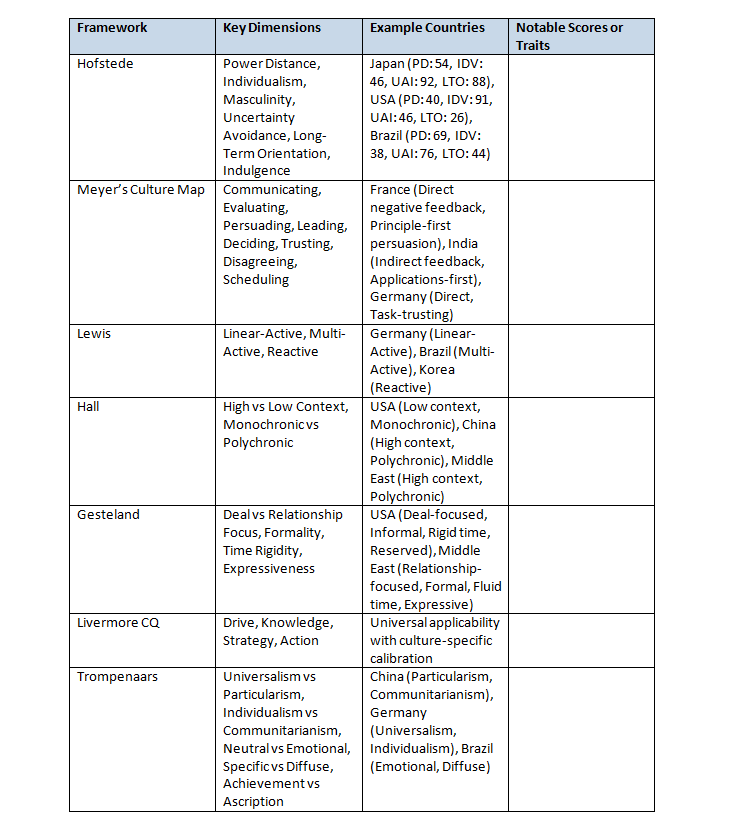
Geert Hofstede’s 6 Cultural Dimensions remain foundational. These include Power Distance (PD), Individualism vs Collectivism (IDV), Masculinity vs Femininity (MAS), Uncertainty Avoidance (UAI), Long-Term Orientation (LTO), and Indulgence vs Restraint (IVR). For example, Japan scores high on Uncertainty Avoidance (92) and Long-Term Orientation (88), emphasizing risk minimization and future planning, whereas the USA scores low on Uncertainty Avoidance (46) with a strong individualistic (91) culture favoring immediate results.
Erin Meyer’s Culture Map builds on Hofstede adding eight dimensions specifically relevant to global business: Communicating (low vs high context), Evaluating (direct vs indirect negative feedback), Persuading (principles vs applications-first), Leading (egalitarian vs hierarchical), Deciding (consensual vs top-down), Trusting (task vs relationship-based), Disagreeing (confrontational vs avoids confrontation), and Scheduling (linear vs flexible time). For instance, the French prefer principle-first persuasion and value intellectual argumentation, while Indians lean toward applications-first and relational trust.
Richard Lewis classifies cultures as Linear-Active (task-oriented, highly organized, e.g., Germans), Multi-Active (emotional, flexible, e.g., Brazilians), and Reactive (listening and accommodating, e.g., Koreans). This model helps negotiators anticipate pacing, responsiveness, and decision-making approaches.
Edward Hall’s theories of high-context vs low-context communication and monochronic vs polychronic time are critical. High-context cultures (China, Japan, Middle East) rely heavily on implicit cues and relationships, while low-context cultures (USA, Germany, Scandinavia) prefer explicit verbal communication. Monochronic cultures prioritize schedules and deadlines strictly; polychronic cultures accommodate fluid timing and multitasking, impacting negotiation flow.
Richard Gesteland’s dimensions of deal-focus vs relationship-focus, formality, time rigidity, and expressiveness provide practical insight into negotiation etiquette. For example, Middle Eastern and Latin American cultures emphasize relationship-building and expressiveness, whereas Northern European cultures prioritize deal-focus and reserved behavior.
David Livermore’s Cultural Intelligence (CQ) model breaks competence into Drive (motivation), Knowledge (understanding), Strategy (planning), and Action (behavioral adaptation). CQ is the practical skillset that enables negotiators to apply theoretical models in real time.
Trompenaars & Hampden-Turner highlight universalism vs particularism, individualism vs communitarianism, neutral vs emotional, specific vs diffuse, and achievement vs ascription dimensions. These inform how negotiators perceive rules, relationships, emotions, and status recognition. For example, China’s particularistic culture contrasts with Germany’s universalism, affecting contract rigidity and renegotiation flexibility.
Key Frameworks and Models — 2-3 named frameworks with a comparison table
To operationalize cultural insights, three frameworks stand out for negotiation practitioners: Hofstede, Meyer’s Culture Map, and Hall’s Context Model. Each provides complementary perspectives on behavior and communication styles that shape negotiation dynamics.
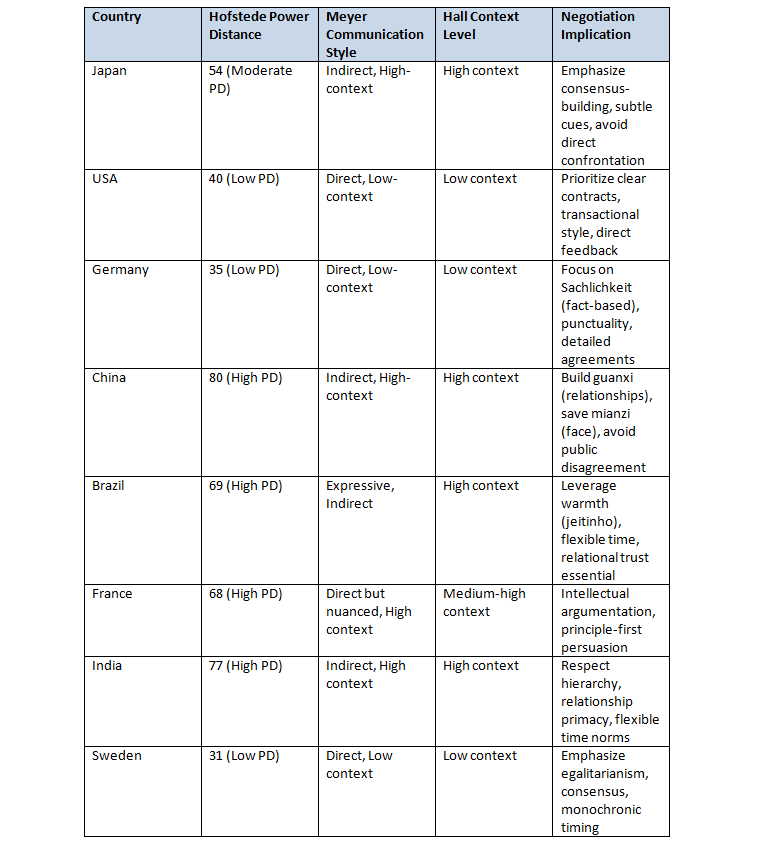
Hofstede’s quantitative country scores allow benchmarking power distance and individualism levels, critical to understanding hierarchy and autonomy expectations. Meyer’s Culture Map adds nuance in communication and decision-making styles essential for interaction and influence tactics. Hall’s low/high context and monochronic/polychronic distinctions clarify how explicit negotiators must be and how they manage time.
Step-by-Step Strategy
Step 1: Conduct Deep Cultural Research Before Engagement
Understand the counterpart’s cultural profiles using Hofstede, Meyer, and Hall frameworks. Identify power distance, communication style, decision-making, and time orientation. Use authoritative country data and business etiquette guides.
Step 2: Build Relationship Foundation with Cultural Sensitivity
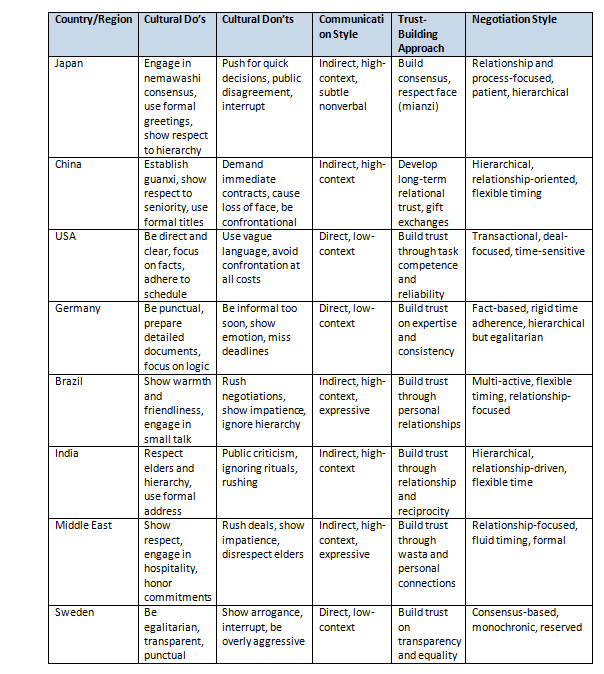
In high-context, relationship-focused cultures such as China and Middle East, invest time in trust-building (guanxi, wasta). Use relational language, respect hierarchy, and avoid rushing to contract terms.
Step 3: Adapt Communication Style Appropriately
Match your communication to direct or indirect preferences. For example, soften negative feedback with buffering in India or Brazil, while being clear and fact-based in Germany or USA. Use silence and nonverbal cues in Japan and Korea.
Step 4: Manage Decision-Making Expectations
Anticipate hierarchical or consensual decision-making. In Japan, expect ringi system consensus and nemawashi groundwork. In Scandinavian countries, prepare for collaborative group decisions. Clarify timelines respectfully.
Step 5: Negotiate Time and Scheduling Flexibly
Respect monochronic cultures’ punctuality and agenda focus (Germany, USA). Accommodate polychronic cultures’ fluid timing and multitasking (Middle East, Brazil). Build buffer time and flexible milestones.
Step 6: Address Conflict with Culturally Appropriate Modes
Use Thomas-Kilmann modes: For conflict-avoidant Asian cultures, prioritize accommodating and avoiding to preserve harmony. In contrast, American or French counterparts may prefer competing or collaborating for direct resolution. Tailor your approach accordingly.
Step 7: Close Deals with Face-Saving and Formality Awareness
Ensure closure respects face considerations (mianzi) in China and Korea. Use formal protocols and gift-giving in Middle East and Japan. In low-context cultures, formalize agreements clearly in writing.
Real-World Case Studies
Case Study 1: U.S.-Japan Technology Partnership Collapse
Context: U.S. firm pushed for a rapid deal, ignoring Japan’s nemawashi consensus-building.
Cultural Dynamics: U.S. low-context, direct, transactional vs. Japan’s high-context, indirect, hierarchical consensus.
What Happened: Japanese partners withheld agreement to avoid public disagreement, leading to breakdown.
Lesson: Patience and preparatory consensus-building with ringi process is essential in Japan.
Case Study 2: Brazil-Germany Manufacturing Joint Venture Success
Context: German firm adjusted to Brazilian warmth, jeitinho flexibility, and relationship focus.
Cultural Dynamics: German linear-active, task-focused vs. Brazilian multi-active, relationship-centric.
What Happened: Germans allowed greater schedule flexibility and invested in social bonding, enabling trust and deal closure.
Lesson: Adapt scheduling rigidity and engage relationally to bridge cultural gaps.
Case Study 3: China-UAE Energy Deal
Context: U.S.-based negotiators failed to appreciate Chinese guanxi and Middle Eastern wasta networks.
Cultural Dynamics: High power distance and relationship-driven cultures.
What Happened: Initial deal faltered due to lack of trust and insufficient relationship cultivation.
Lesson: Prioritize building connections and respect intermediaries in both Middle East and China.
Country/Region-Specific Insights
Advanced Strategies
• Employ Cultural Intelligence (CQ) Cycle: Continuously assess CQ Drive, Knowledge, Strategy, and Action to adapt dynamically during negotiations.
• Use Nunchi (Korean cultural intuition) techniques to read atmosphere and implicit cues.
• Leverage Trompenaars’ universalism vs particularism to decide contract flexibility and renegotiation openness.
• Apply Thomas-Kilmann Conflict Modes depending on cultural preference: Collaborate in low PD cultures; Accommodate or Avoid in high PD, harmony-valuing cultures.
• Utilize Gesteland’s formal/informal and expressive/reserved dimensions to modulate your demeanor and presentation.
• Engage in pre-negotiation “soft power” tactics: social dinners in Brazil, tea ceremonies in Japan, majlis gatherings in Middle East to build rapport.
Scripts and Templates
Script 1: U.S. to Japanese Partner - Initiating Negotiation
“We appreciate the opportunity to explore this partnership. We understand the importance of thorough review and consensus among your team. Please let us know how we can assist in facilitating the internal discussions to ensure all voices are heard.”
Script 2: German to Brazilian Partner - Managing Scheduling Flexibility
“We value our timeline to move forward efficiently. We also understand that maintaining strong relationships is key. Let’s build some flexibility into the schedule to honor your process while keeping momentum.”
Script 3: American to Chinese Partner - Addressing Face Concerns
“We respect the importance of this partnership and want to ensure our discussions preserve mutual respect. Please share any concerns privately so we can address them constructively.”
Script 4: Indian to Middle Eastern Partner - Building Trust
“We are honored to engage with your esteemed organization and look forward to building a lasting relationship based on mutual respect and shared goals.”
Script 5: Scandinavian to French Partner - Handling Intellectual Debate
“We appreciate the thorough and principled approach your team brings. We welcome a robust discussion of ideas to reach the best possible outcome.”
Frequently Asked Questions
Q1: How do I identify which cultural negotiation framework to apply in a new country?
A1: Start with Hofstede’s country scores for baseline cultural dimensions, then complement with Erin Meyer’s Culture Map for communication and decision-making styles. Use Edward Hall for context and time orientation. Cross-reference with real-world business etiquette guides and consult local experts if possible.
Q2: How can I manage negotiations when my culture values directness but the counterpart prefers indirect communication?
A2: Adapt by softening your language, using buffering phrases, and paying close attention to nonverbal cues. For example, instead of saying “Your proposal is unacceptable,” say “We have some concerns we would like to explore further.” Allow space for the counterpart to respond without losing face.
Q3: What is the role of relationship-building in high power distance cultures?
A3: In high PD cultures like China, India, and Middle East, relationships and hierarchy are deeply intertwined. Building trust with senior decision-makers and respecting formalities is essential. Rushed or superficial interactions risk deal failure.
Q4: How can I adapt my conflict management style across cultures?
A4: Use the Thomas-Kilmann model as a guide. For harmony-valuing cultures, prioritize accommodating and avoiding strategies to preserve relationships. For low PD or individualistic cultures, collaborating or competing may be effective. Always gauge cultural preferences before responding.
Q5: Are there universal negotiation tactics that work across all cultures?
A5: While some principles like respect, preparation, and clear communication are universal, tactics must be adapted culturally. For instance, direct confrontation may be acceptable in Germany but catastrophic in Japan. Mastery of cultural intelligence is key to applying universal principles effectively.
Conclusion
Mastering cultural negotiation frameworks is no longer optional for global dealmakers; it is imperative for success and sustainability. The interplay of power distance, communication styles, time orientation, trust-building, and conflict management shapes negotiations in profound ways that transcend transactional tactics. By integrating insights from Hofstede, Meyer, Hall, Lewis, Gesteland, Livermore, and Trompenaars, professionals can decode cultural complexities and engage with confidence and respect.
This guide has equipped you with the theoretical foundations, comparative country data, step-by-step strategies, case study lessons, country-specific do’s and don’ts, advanced adaptation techniques, and precise scripts. The next step is deliberate practice: applying these frameworks with cultural intelligence to elevate your negotiation performance and forge enduring global partnerships. Begin today to transform your approach and thrive in the diverse, dynamic world of cross-cultural dealmaking.
References
• Hofstede, G. (2011). Dimensionalizing Cultures: The Hofstede Model in Context. Online Readings in Psychology and Culture.
• Meyer, E. (2014). The Culture Map: Breaking Through the Invisible Boundaries of Global Business. PublicAffairs.
• Lewis, R. D. (2006). When Cultures Collide: Leading Across Cultures. Nicholas Brealey Publishing.
• Hall, E. T. (1976). Beyond Culture. Anchor Books.
• Livermore, D. (2015). Leading with Cultural Intelligence: The Real Secret to Success. AMACOM.
• Trompenaars, F., & Hampden-Turner, C. (2012). Riding the Waves of Culture: Understanding Diversity in Global Business. Nicholas Brealey Publishing.
• Gesteland, R. R. (2012). Cross-Cultural Business Behavior: Marketing, Negotiating, Sourcing and Managing Across Cultures. Copenhagen Business School Press.