De-Escalation Techniques in Negotiation: The Definitive Guide for High-Stakes Conflict Resolution

In a tense conference room, a multibillion-dollar merger hangs in the balance. The lead negotiators from both sides have just exploded into accusations—voices rising, fingers pointing, the deal teetering on collapse. One misstep, one reactive word, and years of painstaking work could unravel in minutes. This is not just a negotiation; it’s a psychological battleground where emotions, power plays, and unresolved fears collide. The stakes couldn’t be higher, and yet the path to resolution depends on mastering a subtle, often overlooked skill: de-escalation.
Why do so many negotiations derail early, even before the substantive issues are addressed? The answer lies in the very human wiring of our minds. When threatened, our brains default to survival instincts—fight, flight, or freeze—that cloud rational thinking. Most negotiators dive into positional arguments or aggressive counterattacks, inadvertently fueling the conflict spiral. Winners in high-stakes negotiations are those who recognize these psychological triggers early, then strategically apply calming, trust-building, and reframing techniques to regain control. It’s not about overpowering the other side but guiding emotional currents toward cooperation.
In this comprehensive guide, you will master the essential tools of de-escalation designed for negotiators, managers, and business leaders facing volatile interactions. Drawing on cutting-edge research from Daniel Kahneman, Chris Voss, William Ury, Paul Ekman, and others, you will explore the neuroscience underpinning conflict, proven frameworks like the FBI’s hostage negotiation tactics, and real-world case studies that reveal what works under pressure. You will learn exact word-for-word scripts, step-by-step processes, and advanced psychological strategies to defuse tension, neutralize manipulation, and convert adversaries into partners. Prepare to transform your toughest conversations into opportunities for breakthrough agreement.
· Table of Contents
· The Psychology Behind This Challenge
· Key Frameworks and Models
· Step-by-Step Process for De-Escalation
· Real-World Case Studies
· Recognizing and Countering Difficult Negotiation Tactics
· Advanced Techniques in De-Escalation
· Scripts and Templates for Negotiators
· Frequently Asked Questions
· Conclusion
· References
The Psychology Behind This Challenge
High-conflict negotiations ignite primal brain responses that can sabotage reasoned dialogue before it begins. Central to this is the amygdala hijack phenomenon, identified by neuroscientist Daniel Goleman, where the amygdala—the brain’s emotional alarm system—overrides the prefrontal cortex’s logical functions. When negotiators sense threat or betrayal, this triggers emotional flooding, a state of overwhelming negative emotion described by psychologist John Gottman, which narrows focus to survival rather than problem-solving.
Daniel Kahneman’s dual-process theory of cognition explains this further. System 1 thinking is fast, automatic, and emotional—precisely the mode activated in conflict. System 2, slow and deliberate, is necessary for complex negotiation but is often shut down by emotional arousal. Skilled negotiators must recognize when parties have defaulted into System 1, then guide them back toward System 2 reasoning through de-escalation.
Chris Voss, former FBI lead hostage negotiator, emphasizes tactical empathy: the deliberate understanding and verbal acknowledgment of the counterpart’s emotions and perspectives. This does not imply agreement but signals respect and helps reduce defensive postures. Voss’s approach leverages social identity theory, which shows how group membership and perceived status influence negotiation behavior. By affirming the other party’s identity and dignity, negotiators reduce the threat level.
The fight-flight-freeze response—evolutionary survival mechanisms—manifest as aggression, withdrawal, or stonewalling in the negotiation room. Recognizing these signs early, such as micro-expressions identified by Paul Ekman or physiological cues like rapid breathing, enables timely intervention. Without this awareness, negotiators risk escalating conflict unintentionally.
Understanding these psychological dynamics is the foundation for all effective de-escalation techniques. It equips negotiators to read emotional states accurately, anticipate reactive behaviors, and apply strategic interventions that restore collaborative dialogue.
Key Frameworks and Models
Several frameworks provide structured approaches to de-escalation in negotiation. Below are three foundational models used by expert negotiators worldwide:
1. Chris Voss’s FBI Hostage Negotiation Method: Focuses on tactical empathy, calibrated questions, labeling emotions, and “mirroring” to build rapport and defuse tension.
2. William Ury’s “Going to the Balcony” Technique from Getting to Yes: Encourages negotiators to emotionally detach and observe the conflict from a higher perspective to maintain composure and strategic clarity.
3. Thomas-Kilmann Conflict Mode Instrument (TKI): A behavioral model categorizing conflict responses into five modes—competing, collaborating, compromising, avoiding, accommodating—and guiding negotiators on when to shift modes to reduce escalation.
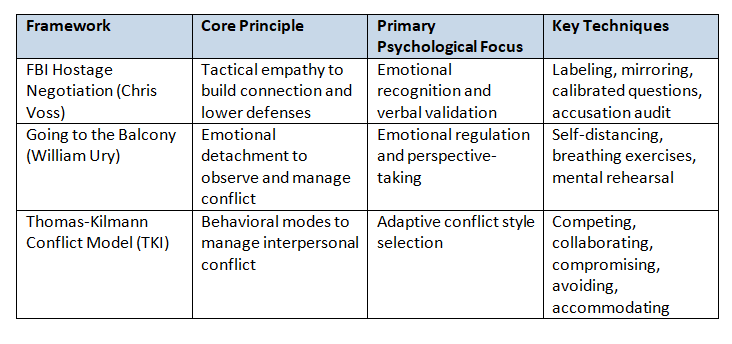
These frameworks are complementary. For example, Voss’s method equips negotiators with verbal tools to engage emotional counterparts, Ury’s technique provides a mindset for maintaining calm, and TKI helps determine the best behavioral approach given situational dynamics. Mastery of all three enhances versatility in managing escalating negotiations.
Step-by-Step Process for De-Escalation
Effective de-escalation follows a deliberate sequence designed to interrupt conflict momentum, lower emotional arousal, and restore rational dialogue. Below is a detailed six-step process integrating psychological insights and tactical communication techniques.
Step 1: Recognize Early Warning Signs
Detect emotional flooding or amygdala hijack cues: raised voices, interruptions, rapid speech, defensive body language, micro-expressions of anger or fear. Use Paul Ekman’s research to spot fleeting emotional tells. Early recognition prevents escalation.
Step 2: Create Psychological Safety
Apply Chris Voss’s tactical empathy by acknowledging emotions aloud: “It sounds like you feel this deal isn’t fair.” Use open body language, maintain a calm tone, and reduce physical distance cautiously to convey non-threat.
Step 3: Employ Labeling and Mirroring
Label the counterpart’s emotions explicitly: “You seem frustrated by how this is unfolding.” Mirror their last few words softly to encourage elaboration without confrontation. Both techniques validate feelings and promote cooperation.
Step 4: Use Calibrated Questions
Shift the focus to problem-solving by asking open-ended, non-threatening questions: “How can we work together to find a solution that meets your needs?” This invites collaboration and reduces defensiveness.
Step 5: Go to the Balcony
If emotions remain high, mentally “step back” to observe without reaction, per William Ury’s method. Regulate breathing, count silently to 10, and avoid reactive language or gestures. This preserves negotiation control.
Step 6: Reframe and Redirect
Use reframing language to shift negative narratives: “I hear the frustration, and I believe we both want a deal that benefits us long-term.” Guide the conversation back to shared goals and interests.
By following these steps, negotiators systematically defuse tension and rebuild pathways to agreement.
Real-World Case Studies
Understanding how de-escalation techniques function in practice solidifies learning. Here are three high-profile examples:
1. FBI Hostage Negotiation in the 1993 Waco Siege
During the Waco standoff, negotiators used labeling and tactical empathy to communicate with David Koresh’s followers. While the siege ended tragically, early phases demonstrated how verbal acknowledgment of fears reduced immediate violence. Lesson: Tactical empathy can de-escalate life-threatening standoffs, but must be combined with broader strategic coordination.
2. Boeing and Union Negotiations 2019
Facing a protracted labor strike, Boeing management applied calming framing and calibrated questions in bargaining sessions. Negotiators emphasized shared goals of company survival to shift from positional deadlock to collaborative problem-solving. Lesson: Reframing and open-ended questioning break gridlocks in labor conflicts.
3. Diplomatic Crisis: Cuban Missile Crisis 1962
President Kennedy and advisors used “going to the balcony” mental distancing to avoid reactionary decisions under Cold War pressure. Backchannel communications employed labeling of fears and intentions, reducing perceived threat and enabling the naval quarantine agreement. Lesson: Emotional regulation and perspective-taking at leadership level prevent catastrophic escalation.
These cases illustrate the universal applicability of de-escalation, from tactical law enforcement to multinational diplomacy.
Recognizing and Countering Difficult Tactics
Negotiators often face manipulative or aggressive tactics designed to provoke escalation. Below is a table mapping common tactics, their psychological mechanisms, and precise counter-responses.
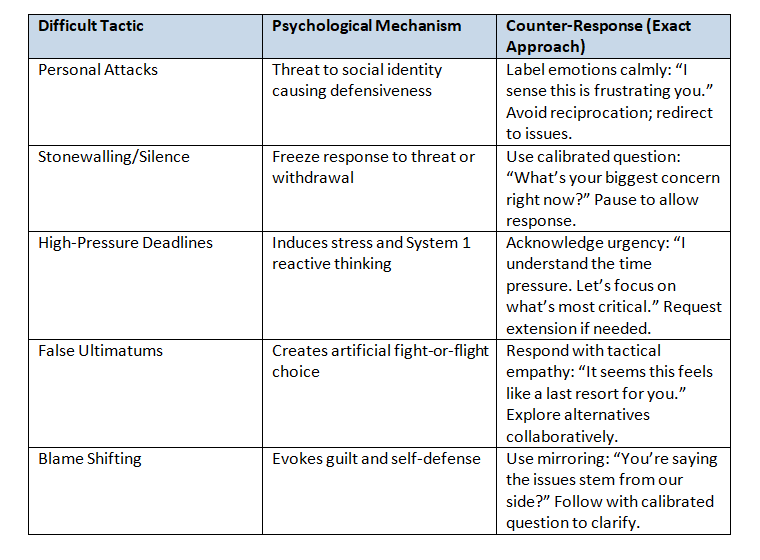
Mastery of these counters neutralizes escalation triggers and preserves negotiation integrity.
Advanced Techniques in De-Escalation
Beyond foundational skills, expert negotiators leverage nuanced psychological and strategic methods:
- Emotional Labeling with Micro-Expression Awareness: Combine Ekman’s micro-expression spotting with verbal labeling to validate hidden emotions, revealing unspoken concerns.
- Accusation Audit: Preemptively acknowledge potential criticisms (“You might think we’re being unreasonable”), disarming defensiveness before it arises.
- Strategic Silence: Use well-timed pauses after difficult statements to encourage counterpart disclosure and emotional processing.
- Presence Under Pressure: Employ Amy Cuddy’s power posing and breathing techniques to maintain calm confidence that influences counterpart’s responses.
- Third Side Intervention: William Ury’s concept of a neutral party facilitating dialogue to de-escalate entrenched disputes through reframing and shared narrative building.
These techniques require practice and situational judgment but yield exponential improvements in complex negotiation environments.
Scripts and Templates for Negotiators
Below are exact word-for-word scripts to deploy during common escalation scenarios:
1. When the Other Party Raises Voice
“I can see this is very important to you, and I want to understand fully. Let’s take a moment so we can work through this together.”
2. When Opponent Uses Personal Attacks
“It sounds like you’re frustrated. I want to keep our focus on the issues so we can find a solution that works for both of us.”
3. When Faced with Stonewalling/Silence
“I notice you’re quiet. I’m interested in your thoughts—what’s on your mind right now?”
4. When Dealing with False Ultimatums
“I understand why this feels like a critical point. Let’s explore all the options before deciding on the best path forward.”
5. When Negotiation Becomes Deadlocked
“Perhaps we can take a short break to reflect and come back with fresh perspectives.”
These scripts incorporate tactical empathy and emotional regulation, proven to lower defenses and restore dialogue.
Frequently Asked Questions
Q1: How quickly should I intervene when a negotiation starts to escalate?
A1: Immediate intervention is critical. Emotional escalation often follows an exponential curve. Early recognition of amygdala hijack signs allows you to apply de-escalation techniques before conflict hardens. Use labeling and tactical empathy within the first 2-3 minutes of tension rising.
Q2: Can de-escalation techniques work in virtual negotiations?
A2: Yes, though more challenging due to reduced nonverbal cues. Focus on verbal tone, pacing, and explicit emotional labeling. Use video where possible to observe facial micro-expressions. Calibrated questions gain extra importance to invite openness.
Q3: What if the other party refuses to engage in calm dialogue?
A3: Maintain your own composure and “go to the balcony” to regulate your emotions. Use strategic silence to create space. If escalation persists, consider involving a neutral third party or mediator trained in conflict resolution.
Q4: How do I handle manipulative tactics like blame shifting without escalating?
A4: Respond with curiosity, mirroring their statements to prompt elaboration. Avoid defensiveness. Use calibrated questions to uncover underlying interests rather than reacting to accusations. Label the emotion behind the tactic to reduce its power.
Q5: Are these techniques effective with culturally diverse negotiation counterparts?
A5: Yes, but cultural sensitivity is essential. Some cultures may interpret direct labeling differently. Adapt your tone and phrasing to align with cultural norms while preserving the principles of empathy and respect. When in doubt, research cultural context beforehand.
Conclusion
Mastering de-escalation techniques is indispensable for negotiators confronting high-conflict, high-stakes situations. By understanding the underlying psychology—emotional flooding, amygdala hijack, System 1 thinking—and applying structured frameworks such as tactical empathy, “going to the balcony,” and adaptive conflict modes, professionals can transform potentially destructive interactions into collaborative problem-solving opportunities. The ability to recognize early signs, deploy precise verbal and nonverbal interventions, and maintain presence under pressure separates successful negotiators from those who falter.
This definitive guide has equipped you with a robust toolkit: actionable step-by-step processes, real-world case insights, counter-tactic matrices, advanced strategies, and exact scripts proven in the field. To elevate your negotiation outcomes, integrate these techniques into your preparation and live negotiations. For deeper mastery, consider specialized training in emotional intelligence and tactical communication. Your next high-stakes negotiation need not become a battlefield—empower yourself to lead with calm, clarity, and confidence.
References
1. Kahneman, D. (2011). Thinking, Fast and Slow. Farrar, Straus and Giroux.
2. Voss, C., & Raz, T. (2016). Never Split the Difference: Negotiating As If Your Life Depended On It. Harper Business.
3. Ury, W. (1991). Getting Past No: Negotiating in Difficult Situations. Bantam Books.
4. Ekman, P. (2003). Emotions Revealed: Recognizing Faces and Feelings to Improve Communication and Emotional Life. Times Books.
5. Gottman, J. M. (1994). What Predicts Divorce? The Relationship Between Marital Processes and Marital Outcomes. Lawrence Erlbaum Associates.
6. Cuddy, A. (2015). Presence: Bringing Your Boldest Self to Your Biggest Challenges. Little, Brown and Company.