Decision-Making Skills in Negotiation

Effective negotiation is fundamentally a process of decision-making under uncertainty, complexity, and interpersonal dynamics. The ability to make sound decisions during negotiation directly influences the outcome — whether it’s closing a sales deal, resolving a conflict, or forging a strategic partnership. In today’s fast-paced global business environment, mastering decision-making skills in negotiation is not just beneficial but essential for leaders and sales professionals aiming to maximize value creation and minimize risk.
Decision-making in negotiation requires more than intuition; it demands a structured approach grounded in psychological principles, strategic frameworks, and practical exercises. This article explores the theory and application of decision-making skills within negotiation contexts, supported by real-world examples and actionable techniques. By the end, readers will be equipped to enhance their negotiation acumen through improved cognitive strategies, emotional regulation, and tactical communication.
You will learn how to identify decision biases, apply frameworks like BATNA and anchoring effectively, leverage psychological tools such as active listening and mirroring, and practice exercises designed to sharpen your judgment. Whether you are negotiating contracts, managing stakeholder relationships, or leading complex negotiations, these insights will elevate your ability to make confident, informed decisions that drive successful outcomes.
· Table of Contents
· The Psychology of Decision-Making in Negotiation
· Key Decision-Making Frameworks for Negotiators
· Cognitive Biases and Their Impact on Negotiation
· Emotional Intelligence and Decision-Making
· Practical Exercises to Enhance Negotiation Decisions
· Real-World Examples of Decision-Making in Negotiation
· Frequently Asked Questions
· Conclusion
· References
The Psychology of Decision-Making in Negotiation
Decision-making in negotiation is inherently a psychological process involving perception, judgment, and choice under uncertainty. Negotiators must evaluate incomplete information, predict counterpart behavior, and balance competing interests. Understanding the cognitive architecture behind decision-making enables negotiators to recognize how mental shortcuts and emotional states influence their choices.
One foundational model is Daniel Kahneman’s Dual-Process Theory, which distinguishes between System 1 (fast, intuitive) and System 2 (slow, analytical) thinking. Negotiators often rely on System 1 to make rapid judgments, but these decisions may be prone to biases such as anchoring or confirmation bias. Effective decision-making requires engaging System 2 to critically evaluate options and outcomes.
Additionally, the Prospect Theory, developed by Kahneman and Tversky, explains how people value gains and losses differently, often exhibiting loss aversion. In negotiation, this means parties may behave more defensively to avoid losses rather than pursuing equivalent gains, affecting concessions and risk tolerance.
· Key psychological principles relevant to negotiation decision-making:
· Anchoring Effect – The tendency to rely heavily on the first piece of information offered.
· Framing Effect – Decisions are influenced by how options are presented.
· Confirmation Bias – Seeking information that confirms pre-existing beliefs.
· Reciprocity – The social norm of responding to a positive action with another positive action.
A practical application is to consciously slow down decisions during negotiation to engage analytical thinking and question initial impressions. For example, when presented with an opening offer, negotiators should pause to analyze whether the anchor is reasonable or a deliberate tactic.
Key Decision-Making Frameworks for Negotiators
Structured frameworks guide negotiators to make decisions strategically rather than reactively. Three highly effective frameworks include BATNA, ZOPA, and the Decision Tree Analysis.
· BATNA (Best Alternative to a Negotiated Agreement)
Developed by Fisher and Ury in "Getting to Yes," BATNA represents the best course of action if the current negotiation fails. Knowing your BATNA empowers you to make decisions with confidence and avoid accepting unfavorable deals.
Practical exercise: Before negotiation, list all alternatives and assess their value objectively. Compare offers against your BATNA to decide whether to accept or walk away.
· ZOPA (Zone of Possible Agreement)
ZOPA defines the range where parties’ interests overlap, enabling a deal. Identifying ZOPA early helps negotiators focus decision-making on realistic outcomes.
· Decision Tree Analysis
This quantitative method maps possible negotiation paths, outcomes, and probabilities to evaluate expected utilities. It’s especially useful in complex, multi-stage negotiations.
Example: Applying BATNA and ZOPA in Sales Negotiation
A sales manager negotiating a software contract researches competitors’ offerings (BATNA) and estimates the client’s budget constraints to identify ZOPA. By knowing the lowest acceptable price and alternative options, the manager can decide whether to counteroffer or withdraw.
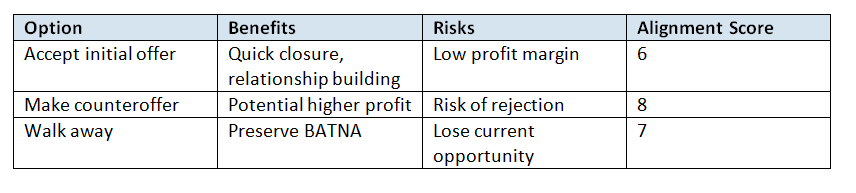
Practical Tip: Use a Negotiation Decision Matrix
Create a matrix listing options, their benefits, risks, and alignment with strategic goals. Rate each on a numeric scale to facilitate objective decision-making.
Cognitive Biases and Their Impact on Negotiation
Cognitive biases distort decision-making by filtering information through subjective lenses. Awareness and mitigation of biases enhance negotiation outcomes.
· Anchoring Bias
Negotiators fixate on initial numbers or positions, even if arbitrary. For example, an opening price set deliberately high aims to anchor expectations upward.
Mitigation: Counter-anchor with your own data-supported figures and question the rationale behind initial offers.
· Confirmation Bias
Focusing only on information that supports your position can blind you to new evidence.
Mitigation: Seek disconfirming data actively and invite alternative viewpoints from your team or counterparts.
· Overconfidence Bias
Excessive belief in one’s judgment can lead to risky decisions and underestimating counterpart strategies.
Mitigation: Use scenario planning and involve a second opinion to challenge assumptions.
· Status Quo Bias
Preference for maintaining current conditions may cause missed opportunities.
Mitigation: Evaluate all options, including unconventional ones, before deciding.
Exercise: Bias Awareness Journal
During negotiations, keep a journal noting moments when you felt strongly about a position. Later, review entries to identify any patterns of bias influencing your decisions.
Emotional Intelligence and Decision-Making
Emotions profoundly affect negotiation decisions. Emotional intelligence (EI) — the ability to recognize, understand, and manage emotions — improves decision quality and relationship building.
Psychologist Daniel Goleman identifies five components of EI: self-awareness, self-regulation, motivation, empathy, and social skills. Each plays a role in negotiation decision-making:
- Self-awareness allows negotiators to recognize emotional triggers that might cloud judgment.
- Self-regulation helps maintain composure under pressure, preventing impulsive decisions.
- Empathy facilitates understanding the counterpart’s perspective, leading to more collaborative decisions.
- Social skills improve communication and trust, which are essential for joint decision-making.
Example: Managing Emotion in High-Stakes Negotiations
In labor negotiations, emotions can run high. A negotiator trained in EI might recognize rising frustration and use active listening and mirroring to de-escalate tension, maintaining a focus on interests rather than positions.
Practical Exercise: Emotional Check-In
Before entering negotiation, pause for a 2-minute self-assessment of your emotional state. Acknowledge feelings but decide intentionally to keep emotions from driving your decisions.
Practical Exercises to Enhance Negotiation Decisions
Improving decision-making skills requires deliberate practice. The following exercises build cognitive and emotional competencies:
· Role-Playing with Scenario Variations
Practice negotiation scenarios with different constraints or surprises to train adaptability and critical thinking.
· BATNA Development Workshop
Regularly update and rehearse your BATNA assessment to ensure clarity on alternatives.
· Decision Debrief Sessions
After negotiations, review decision points, what influenced them, and lessons learned.
· Mindfulness Meditation
Incorporate mindfulness to improve focus and reduce impulsivity during negotiations.
Sample Script for Anchoring Awareness
When faced with an opening anchor:
"Thank you for your offer. To ensure we’re aligned, could you share how you arrived at this figure? I’d like to understand the basis before discussing further."
This script invites transparency and buys time for analysis.
Real-World Examples of Decision-Making in Negotiation
IBM’s negotiation with Apple in the 1990s involved complex intellectual property and market positioning issues. IBM’s negotiators used detailed decision tree analyses to forecast outcomes and preserve BATNA options, ultimately crafting a mutually beneficial alliance.
During the 1978 peace negotiations, negotiators employed emotional intelligence to manage historic animosities and build trust, enabling breakthrough decisions that led to the accords.
A SaaS company’s sales team trained in anchoring techniques and BATNA assessments consistently improved close rates by setting strong initial price anchors and knowing when to walk away.
Frequently Asked Questions
What is the most important decision-making skill in negotiation?
The ability to assess and compare your BATNA objectively is often considered the most critical skill. It sets the threshold for acceptable agreements and prevents poor concessions.
How can I avoid being influenced by anchoring bias?
Recognize when an anchor is presented, pause to analyze its validity, counter-anchor with your own data, and use open-ended questions to understand the counterpart’s reasoning.
Can emotions help or hurt negotiation decisions?
Emotions can both help by signaling underlying interests and hurt by causing impulsive reactions. Developing emotional intelligence enables negotiators to harness emotions constructively.
How do I improve decision-making under pressure?
Practice mindfulness, prepare alternatives in advance, and rehearse negotiation scenarios to build confidence and reduce stress-driven errors.
What role does active listening play in decision-making?
Active listening enhances information gathering and builds rapport, which leads to better-informed decisions by revealing true interests and priorities.
Conclusion
Mastering decision-making skills in negotiation is a multifaceted endeavor involving psychological insight, strategic frameworks, and emotional acumen. By understanding cognitive biases, applying proven tools like BATNA, and practicing emotional regulation, negotiators can enhance their ability to make informed, confident decisions that drive superior outcomes.
Investing time in deliberate exercises, reflective debriefs, and continuous learning transforms negotiation from a reactive event into a strategic advantage. Start integrating these skills today to elevate your negotiation effectiveness and achieve lasting success.
References
- Fisher, R., Ury, W., & Patton, B. (2011). Getting to Yes: Negotiating Agreement Without Giving In. Penguin Books.
- Kahneman, D. (2011). Thinking, Fast and Slow. Farrar, Straus and Giroux.
- Goleman, D. (1995). Emotional Intelligence: Why It Can Matter More Than IQ. Bantam Books.
- Raiffa, H. (1982). The Art and Science of Negotiation. Harvard University Press.
- Malhotra, D., & Bazerman, M. (2007). Negotiation Genius: How to Overcome Obstacles and Achieve Brilliant Results at the Bargaining Table and Beyond. Bantam.