Difficult Negotiation Case Studies: Lessons from Real High-Stakes Deals

In the early hours of a bitterly cold January morning, FBI hostage negotiators faced one of their most harrowing challenges: a lone gunman barricaded inside a suburban home, holding a family hostage. The stakes were life and death. Every word, tone, and pause could tip the balance between tragedy and rescue. Months later, in a corporate boardroom across the country, a hostile takeover negotiation teetered on collapse, with billions of dollars and thousands of jobs hanging in the balance. These high-pressure scenarios share common elements: intense emotions, strategic complexity, and the need for precise psychological insight.
Most negotiators, even experienced ones, falter under such pressure because they underestimate how emotions hijack rational thinking, over-rely on positional bargaining, or fail to repair trust when it fractures. Nobel laureate Daniel Kahneman’s research on System 1 and System 2 thinking explains why snap judgments often override deliberate thought during crises. Chris Voss’s concept of tactical empathy reveals how understanding emotional drivers can open pathways to agreement where none seemed possible. Meanwhile, William Ury’s frameworks demonstrate how stepping back and managing conflict dynamics can prevent impasses from becoming stalemates.
This comprehensive guide will empower you to master the art of difficult negotiations by walking you through the neuroscience and psychology behind conflict, comparing powerful frameworks, detailing a step-by-step negotiation process, and analyzing real-world case studies from hostage crises to corporate board battles. You will learn expert-level strategies not commonly covered in beginner guides, access precise scripts for tricky moments, and develop skills to recognize and counteract the most challenging negotiation behaviors. Prepare to transform your approach and achieve breakthrough results when the stakes couldn’t be higher.
· Table of Contents
- The Psychology Behind This Challenge
- Key Frameworks and Models
- Step-by-Step Process for Difficult Negotiations
- Real-World Case Studies
- Recognizing and Countering Difficult Dynamics
- Advanced Techniques in High-Stakes Negotiation
- Scripts and Templates for Tough Scenarios
- Frequently Asked Questions
- Conclusion
- References
The Psychology Behind This Challenge
Understanding the psychological forces at work during difficult negotiations is foundational to mastering them. When stakes soar, human brains often default to survival mechanisms that undermine rational dialogue. One of the clearest explanations is the phenomenon known as the amygdala hijack. Identified by psychologist Daniel Goleman, this occurs when the brain’s emotional center—the amygdala—overrides the prefrontal cortex’s logical reasoning in response to threat. This leads to impulsive fight, flight, or freeze reactions.
Kahneman’s System 1 and System 2 thinking further elucidate this dynamic. System 1 operates unconsciously and quickly, relying on heuristics, biases, and emotional shortcuts. System 2 is slower, deliberate, and logical but requires cognitive resources that are often depleted during stress. In high-pressure negotiations, System 1 dominates, causing parties to react defensively, misread intentions, or escalate conflict unnecessarily.
Chris Voss’s concept of tactical empathy offers a way to engage the emotional System 1 constructively by acknowledging and validating the counterpart’s feelings without necessarily agreeing with their position. This approach can reduce emotional flooding—a state John Gottman describes as overwhelming stress that impairs communication—allowing negotiators to regain control.
Trust plays a pivotal role and can be fragile in difficult negotiations. Gottman’s research on trust repair highlights that even small breaches can trigger the “four horsemen” of criticism, contempt, defensiveness, and stonewalling, which poison dialogue. Repair requires timely, sincere efforts addressing both emotional and cognitive components of trust.
Behavioral economics research into ultimatum games illustrates how people often reject offers perceived as unfair even at personal cost, driven by fairness concerns and emotional reactions rather than pure economic gain. This underscores the importance of framing and perceived respect in negotiations.
These psychological insights reveal why skilled negotiators must manage emotional states, build tactical empathy, and repair trust continuously, rather than relying solely on logical argument or positional bargaining.
Key Frameworks and Models
Several negotiation frameworks have been developed by leading experts to address the complexities of high-stakes, difficult negotiations. Below are three essential models, each with unique emphases but overlapping principles:
1. FBI’s Behavioral Change Stairway Model (BCSM) — Developed by the FBI’s Crisis Negotiation Unit and popularized by Chris Voss, BCSM outlines five progressive stages: Active Listening, Empathy, Rapport, Influence, and Behavioral Change. The model emphasizes tactical empathy and calibrated questions to de-escalate crises.
2. William Ury’s “Going to the Balcony” — From Ury’s seminal book *Getting Past No*, this metaphorical step encourages negotiators to emotionally and mentally detach (“go to the balcony”) to gain perspective, regulate emotions, and prevent destructive escalation while preparing to re-engage with problem-solving.
3. Thomas-Kilmann Conflict Mode Instrument (TKI) — A behavioral model identifying five conflict styles: Competing, Collaborating, Compromising, Avoiding, and Accommodating. It helps negotiators diagnose their own and their counterpart’s conflict preferences and adapt accordingly to move toward resolution.
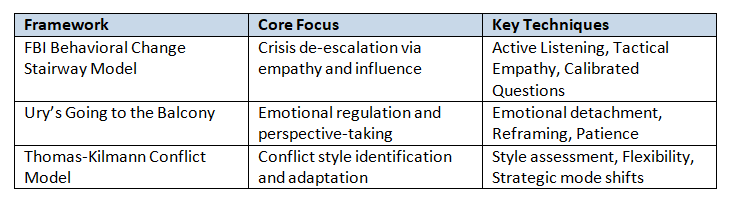
Each model provides complementary insights: BCSM delivers concrete steps to build rapport and influence behavior, Ury’s approach strengthens emotional control and strategic patience, and TKI allows dynamic adaptation to conflict styles. Mastery involves integrating these frameworks fluidly depending on context.
Step-by-Step Process for Difficult Negotiations
Navigating a difficult negotiation requires a deliberate, psychologically informed process. Below is a six-step sequence integrating research-based techniques to guide negotiators from initial contact to durable agreement.
Step 1: Prepare Thoroughly with Psychological Insight
Successful negotiations start long before the first word. Prepare by researching the counterpart’s interests, pressures, and likely emotional states. Anticipate possible triggers and plan how to counteract amygdala hijack responses. Use Kahneman’s System 2 thinking to formulate objective goals and fallback positions. Develop tactical empathy by identifying underlying emotions and motivations.
Step 2: Establish Rapport Through Active Listening and Mirroring
Begin with active listening to demonstrate respect and build trust. Employ Voss’s mirroring technique—repeating the last few words your counterpart says—to encourage elaboration and calm defensiveness. Label emotions explicitly (“It sounds like you feel frustrated”), which validates feelings and reduces emotional flooding.
Step 3: Control Emotional Climate by “Going to the Balcony”
Maintain awareness of your own emotional state. If tension escalates, mentally step back as Ury suggests to regain composure. Use breathing techniques and deliberate pauses. This prevents reactive escalation and clarifies strategic thinking.
Step 4: Use Calibrated Questions to Unlock Information
Ask open-ended, non-threatening questions that shift cognitive load to the other party and elicit problem-solving (“How am I supposed to do that?”). This engages System 2 and reduces adversarial posture. Avoid yes/no questions that encourage defensiveness.
Step 5: Rebuild Trust Actively if Fractured
If trust is damaged, acknowledge the breach sincerely, apologize if appropriate, and propose reparative actions. Use Gottman’s trust repair steps: take responsibility, show vulnerability, and offer concrete commitments. Avoid defensive or blaming language.
Step 6: Close with Collaborative Problem-Solving and Clear Agreements
Focus on interests rather than positions, seeking win-win solutions. Use the TKI model to identify when collaboration or compromise best serves resolution. Confirm mutual understanding with summaries and written agreements to prevent future misunderstandings.
Real-World Case Studies
Examining real high-stakes negotiations provides rich insight into how theory translates to practice.
Case Study 1: The 1993 Waco Siege Negotiations
After a 51-day standoff between the FBI and the Branch Davidians, negotiators applied the Behavioral Change Stairway Model extensively. Early tactical empathy helped build rapport with David Koresh, delaying violence. However, breakdowns in trust and external pressures led to a tragic conclusion. Lesson: Emotional regulation and trust maintenance are critical, but external political pressures can derail even skilled negotiations.
Case Study 2: The 2018 General Motors United Auto Workers Strike
A labor dispute involving 48,000 workers threatened GM’s operations. Negotiators used calibrated questions and active listening to uncover core worker concerns about job security and health benefits. Ury’s “balcony” approach helped management avoid reactive stances despite production pressures. The strike ended with a compromise preserving many jobs and benefits. Lesson: Systematic emotional regulation and interest-based bargaining bring durable labor peace.
Case Study 3: The 2015 Volkswagen Emissions Scandal M&A Crisis
During an attempted acquisition amid scandal fallout, broken trust and public scrutiny threatened deal collapse. Negotiators deployed trust repair frameworks emphasizing transparency and concrete remedial steps. Applying TKI's collaborative mode helped rebuild relationships between board members. Lesson: Repairing trust swiftly and transparently is essential to salvaging deals under reputational risk.
Recognizing and Countering Difficult Dynamics
Negotiators face many difficult tactics and dynamics. Identifying the underlying psychology enables precise countermeasures.
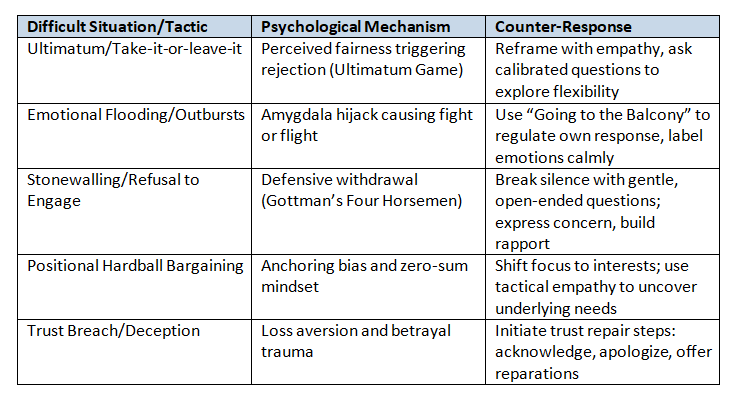
This diagnostic approach allows negotiators to respond strategically rather than reactively, preserving dialogue and influence.
Advanced Techniques in High-Stakes Negotiation
Beyond foundational tactics, expert negotiators deploy advanced psychological and strategic methods:
- **Labeling with Emotional Precision:** Leveraging Paul Ekman’s microexpression research, subtle recognition and verbalization of fleeting emotions can diffuse tension before it escalates.
- **Controlled Presence Under Pressure:** Inspired by Amy Cuddy’s research into power posing and presence, using body language and breath control to project calm authority influences counterpart behavior nonverbally.
- **Strategic Use of Silence:** Deliberate pauses after key statements compel counterparts to fill the void, often revealing critical information or softening their position.
- **Third-Side Intervention:** William Ury’s concept of engaging a neutral “third side” (mediators, respected leaders) to shift conflict dynamics and facilitate resolution in intractable disputes.
- **Framing and Reframing:** Utilizing Robert Cialdini’s principles of influence by framing offers in ways that appeal to reciprocity, social proof, or scarcity to increase acceptance.
These techniques require practice and psychological savvy but can tip difficult negotiations toward success.
Scripts and Templates for Tough Scenarios
Below are exact scripts crafted to navigate common difficult negotiation moments:
1. **De-escalating Emotional Flooding**
“I can hear that this is really frustrating for you. It sounds like this issue is very important. Let’s take a moment to make sure I understand your main concern correctly.”
2. **Responding to Ultimatums**
“I understand that you feel strongly about this condition. Help me understand what led you to this position so we can explore options that might work for both of us.”
3. **Rebuilding Trust After a Breach**
“I want to acknowledge that my earlier actions caused concern, and I regret that. My goal is to rebuild your trust by [specific actions]. What can I do to make this right from your perspective?”
4. **Handling Silence/Stonewalling**
“I notice we haven’t heard much from you on this point. I’d really value your thoughts whenever you’re ready to share.”
5. **Introducing a Collaborative Problem-Solving Approach**
“Instead of focusing on positions, let’s explore what outcomes would be most beneficial for both sides and see how we might achieve them together.”
Frequently Asked Questions
Q1: How can I prevent emotional hijacking during high-pressure negotiations?
A1: Preparation and self-awareness are key. Recognize your emotional triggers, practice “going to the balcony” to mentally detach when overwhelmed, and use breathing or mindfulness techniques to engage System 2 thinking over impulsive System 1 reactions.
Q2: What is the best way to handle a counterpart who refuses to compromise?
A2: Identify their underlying interests using calibrated questions and tactical empathy. Sometimes, hard positions mask deeper concerns. Reframe the negotiation around shared goals and explore creative alternatives that address those needs.
Q3: How do I repair trust quickly after a mistake?
A3: Follow Gottman’s trust repair model: take responsibility without excuses, express genuine remorse, offer a clear plan to prevent recurrence, and invite open dialogue to rebuild connection.
Q4: Can silence really be an effective negotiation tool?
A4: Yes. Strategic silence compels your counterpart to speak first, often revealing information or softening their stance. It also signals confidence and control.
Q5: What role does body language play in difficult negotiations?
A5: Body language profoundly influences perceptions of credibility, confidence, and openness. Maintaining calm, open posture and steady eye contact projects presence and authority, helping manage counterpart emotions and responses.
Conclusion
Difficult negotiations demand more than tactical savvy—they require deep psychological insight, emotional intelligence, and disciplined self-regulation. By understanding how the brain responds under stress, leveraging proven frameworks like the FBI’s Behavioral Change Stairway and Ury’s “Going to the Balcony,” and practicing stepwise processes that integrate tactical empathy and trust repair, negotiators can convert seemingly intractable conflicts into opportunities for durable agreement.
The real-world case studies illustrate that success often hinges on managing emotions as much as managing positions. Incorporating advanced techniques such as microexpression labeling, presence under pressure, and strategic silence elevates negotiators from competent to exceptional. Use the provided scripts to navigate your toughest moments with confidence and precision. Now is the time to deepen your expertise, strengthen your psychological toolkit, and approach your next difficult negotiation with the clarity and control that high-stakes situations demand.
Take the next step: apply these lessons in upcoming negotiations, train your team in these frameworks, and consider professional coaching to refine these skills. Your ability to navigate difficulty will define your success in today’s complex, high-pressure world.
References
1. Kahneman, D. (2011). *Thinking, Fast and Slow*. Farrar, Straus and Giroux.
2. Voss, C., & Raz, T. (2016). *Never Split the Difference: Negotiating As If Your Life Depended On It*. HarperBusiness.
3. Ury, W. (1991). *Getting Past No: Negotiating with Difficult People*. Bantam Books.
4. Gottman, J. M., & Gottman, J. S. (2015). *The Seven Principles for Making Marriage Work*. Harmony Books.
5. Cialdini, R. B. (2006). *Influence: The Psychology of Persuasion*. Harper Business.
6. Ekman, P. (2003). *Emotions Revealed: Recognizing Faces and Feelings to Improve Communication and Emotional Life*. Times Books.