Emotional Negotiations: How to Stay in Control Under Pressure

In a tense boardroom in Manhattan, two executives sit facing each other, a multimillion-dollar merger on the line. Voices rise, accusations fly, and the negotiation spirals into acrimony. The lead negotiator from one side suddenly feels a surge of anger and frustration—his heart races, palms sweat, and his mind blanks. The other side senses weakness and presses harder, pushing for more concessions. The deal, which should have closed smoothly, now teeters on collapse. This is the reality of emotional negotiations: when pressure mounts, even the most seasoned professionals risk losing control, allowing emotions to dictate outcomes rather than strategy.
Negotiations are often won or lost in the first few minutes, when emotional undercurrents set the tone for what follows. Most negotiators underestimate the power of their own emotional responses and overestimate the rationality of their counterparts. Daniel Kahneman’s concept of System 1 and System 2 thinking reveals why snap judgments and emotional reactions can derail conversations before logical reasoning takes hold. Add to this the manipulative tactics some adversaries deploy, and the challenge of maintaining composure under fire becomes a battlefield of its own.
This definitive guide will equip you with the psychological understanding and practical tools to master emotional negotiations. You will learn to recognize and manage your emotional triggers, use tactical empathy as championed by FBI negotiation expert Chris Voss, employ William Ury’s “Going to the Balcony” framework, and navigate conflict styles using the Thomas-Kilmann model. You will find step-by-step processes, exact scripts to defuse tension, real-world case studies demonstrating success and failure, plus advanced techniques for seasoned negotiators. By the end, you will possess the confidence and control to turn high-stakes, high-emotion negotiations decisively in your favor.
· Table of Contents
· The Psychology Behind This Challenge
· Key Frameworks and Models
· Step-by-Step Process to Stay in Control
· Real-World Case Studies
· Recognizing and Countering Manipulative Tactics
· Advanced Techniques for Expert Negotiators
· Scripts and Templates for Difficult Scenarios
· Frequently Asked Questions
· Conclusion
· References
The Psychology Behind This Challenge
At the heart of emotional negotiations lies the battle between instinct and reason. The human brain is wired to respond rapidly to perceived threats—whether physical, social, or psychological. This response often manifests as an “amygdala hijack,” a term coined by psychologist Daniel Goleman, where the amygdala triggers a flood of emotional reactions before the neocortex can engage rational thought. This is the neurological basis for losing control under pressure.
Daniel Kahneman’s distinction between System 1 and System 2 thinking further illuminates this dynamic. System 1 operates automatically and quickly, with little effort or voluntary control, often driven by emotion and heuristics. Conversely, System 2 is deliberate, analytical, and slower. In negotiations, most conflicts escalate when System 1 dominates due to stress or provocation, leading to reactive behaviors such as aggression, withdrawal, or avoidance.
Chris Voss, former FBI lead hostage negotiator, introduced “tactical empathy,” a technique that deliberately engages the counterpart’s emotional state to build rapport and influence outcomes. Tactical empathy requires negotiators to recognize and validate emotions without necessarily agreeing, thus defusing hostility and opening communication channels.
John Gottman’s research on emotional flooding, especially in high-conflict relationships, reveals that when individuals feel overwhelmed by negative emotions, their capacity to listen and problem-solve plummets. Emotional flooding in negotiations results in shutdowns or eruptions that stall progress.
The fight-flight-freeze response—a primal reaction to perceived threats—explains why negotiators may become confrontational (fight), evasive (flight), or silent (freeze) under pressure. Awareness of these reactions enables strategic self-regulation.
Finally, social identity theory explains part of what fuels emotional negotiation conflicts. Individuals derive self-esteem and group belonging from identities such as company affiliation, role, or ideology. Threats to these identities often escalate emotional responses and entrench positions.
· Key Psychological Concepts in Emotional Negotiations
· Amygdala Hijack: Emotional override of rational brain
· System 1 vs System 2 (Kahneman): Automatic vs deliberate thinking
· Tactical Empathy (Voss): Recognizing and validating emotions strategically
· Emotional Flooding (Gottman): Overwhelm that impedes communication
· Fight-Flight-Freeze: Instinctive stress responses
· Social Identity Theory: Group-based emotional triggers
Key Frameworks and Models
The complexity of emotional negotiations has inspired several frameworks to help negotiators maintain control and steer discussions productively. Below are three essential models, each with distinct approaches and advantages. Understanding their differences equips negotiators to select and blend strategies according to context.
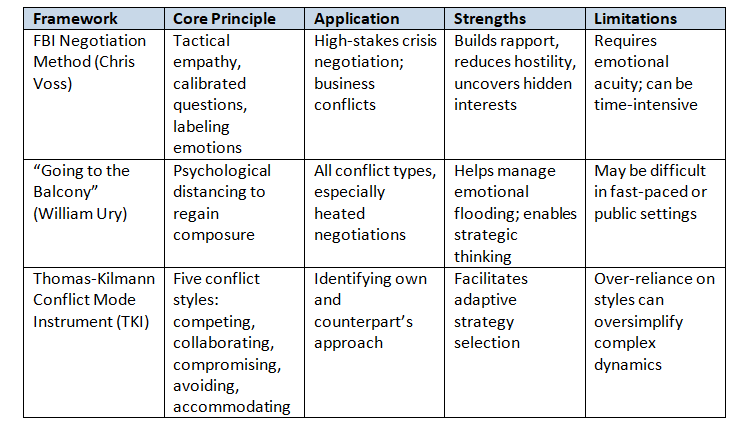
Chris Voss’s FBI method is rooted in tactical empathy and active listening techniques such as labeling (“It seems like you’re frustrated about the timeline”) and calibrated questions (“How can we work together to solve this?”) This approach engages System 2 thinking in the counterpart by validating emotions rather than dismissing them, encouraging openness.
William Ury’s “Going to the Balcony” metaphor advises negotiators to mentally step back from the drama—to observe one’s emotions without being swept away—thereby avoiding reactive behaviors. This technique combats emotional flooding and the amygdala hijack by fostering self-awareness.
The Thomas-Kilmann Conflict Mode Instrument provides a framework to recognize one’s default conflict-handling style and to anticipate the other party’s. For example, knowing that your counterpart tends to “compete” while you tend to “avoid” enables you to adjust tactics and improve outcomes.
Step-by-Step Process to Stay in Control
Maintaining control in emotional negotiations is a skill developed through deliberate practice and awareness. The following six-step structured process integrates psychological insights and proven negotiation techniques.
Step 1: Prepare Emotionally and Strategically
Before the negotiation, invest time in self-awareness. Identify your emotional triggers and rehearse calming techniques such as deep diaphragmatic breathing or brief mindfulness exercises. Use visualization to anticipate challenging moments and your ideal responses. Frame your goals clearly with an understanding of underlying interests.
Step 2: Establish Connection With Tactical Empathy
Initiate the dialogue by acknowledging the counterpart’s perspective and emotions. Use labeling phrases: “It sounds like you’re concerned about the deadlines,” or “I sense this is a sensitive topic.” This lowers defenses and signals respect, enabling System 2 thinking.
Step 3: Monitor Your Emotional State and Use “Going to the Balcony”
Continuously self-check for signs of emotional flooding: racing heart, tunnel vision, or impulsive urge to respond. When detected, mentally “go to the balcony” by focusing on your breathing or repeating a grounding phrase. This prevents amygdala hijack and preserves rationality.
Step 4: Identify Conflict Styles and Adapt Your Approach
Observe your counterpart’s behavior and categorize their conflict style per Thomas-Kilmann: Are they competing aggressively? Avoiding difficult topics? Collaborating for solutions? Adjust your tactics accordingly — e.g., counter a competitor with calm assertiveness, or engage an avoider by building trust.
Step 5: Use Calibrated Questions and Effective Pauses
Ask open-ended, calibrated questions to promote problem-solving (“What’s the biggest obstacle you see here?”). Use strategic pauses after their responses to let them elaborate. Silence often encourages disclosure and reduces tension.
Step 6: Anchor and Redirect Emotional Energy Constructively
If emotions escalate, use “label and redirect” scripts such as: “I can see this is frustrating — let’s focus on what we can control right now.” Reframe conflict as a joint problem, creating a shared purpose that channels emotions positively.
· Psychological Techniques Embedded in the Process
· Deep Breathing and Mindfulness (Step 1 & 3)
· Labeling and Tactical Empathy (Step 2 & 6)
· “Going to the Balcony” Distancing (Step 3)
· Conflict Style Assessment (Step 4)
· Calibrated Questions and Pauses (Step 5)
Real-World Case Studies
Understanding emotional negotiation through real examples provides powerful learning. Below are three illustrative cases demonstrating the stakes, strategies used, and lessons learned.
Case Study 1: FBI Hostage Negotiation—The 1993 Waco Siege
During the 1993 Waco standoff, FBI negotiators faced a heavily armed religious group. Early in the siege, emotional tensions ran high, with negotiators struggling to maintain calm dialogue amid provocations. Applying tactical empathy and labeling, negotiators worked to build rapport and reduce hostility, delaying violent escalation. Ultimately, despite tragic outcomes, the negotiation phases before the final assault illustrate the power of emotional control and empathy in crisis.
Case Study 2: Corporate Merger Deadlock—Disney and Comcast Bidding War (2004)
In a fierce bidding war over Pixar, Disney’s CEO Bob Iger faced aggressive tactics from Comcast. Negotiations threatened to collapse amid mistrust and emotional posturing. Iger used “going to the balcony” techniques, maintaining composure under pressure and focusing on long-term relationship building rather than reactive tit-for-tat. This approach helped Disney secure the acquisition at a favorable price.
Case Study 3: Toxic Client Scenario—Law Firm Billing Dispute
A senior partner negotiated with a longstanding but increasingly difficult client disputing invoices. The client’s combative tone and threats jeopardized the relationship. Using tactical empathy, the partner acknowledged the client’s frustrations and reframed the conversation towards mutual interests. Employing calibrated questions uncovered hidden concerns about perceived value. The partner’s emotional regulation and strategic dialogue salvaged the contract and improved future communications.
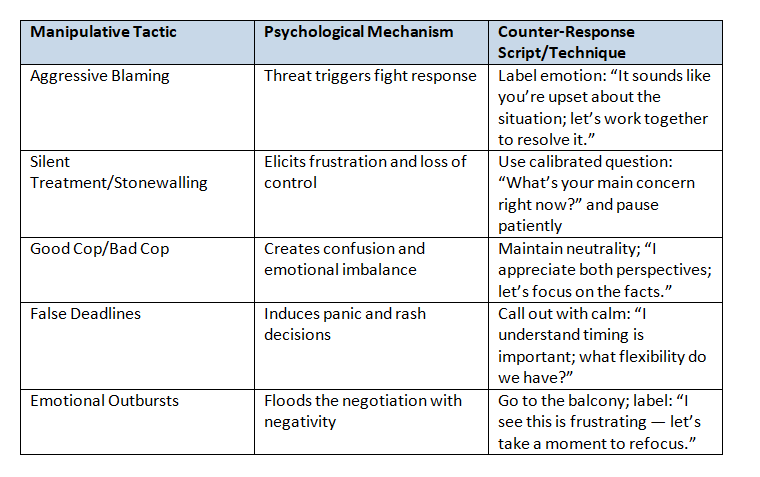
Recognizing and Countering Tactics
Difficult counterparts often deploy psychological tactics to unsettle negotiators emotionally or gain advantage. Recognizing these and having precise counter-responses is essential.
Advanced Techniques for Expert Negotiators
Once foundational skills are mastered, elevating negotiation control involves nuanced, expert-level methods.
- Micro-Expression Reading: Following Paul Ekman’s research, experts learn to detect fleeting emotional tells that reveal true feelings, enabling preemptive responses.
- Presence Under Pressure: Inspired by Amy Cuddy, maintaining power poses and controlled breathing increases confidence hormones (testosterone) and lowers stress hormones (cortisol), improving composure.
- Moral Psychology Awareness: Drawing on Jonathan Haidt’s work, understanding the moral foundations driving counterpart behavior (e.g., loyalty, authority) helps tailor influence strategies.
- Third Side Mediation: William Ury’s “Third Side” concept encourages involving neutral parties or reframing the conflict as a community problem to reduce zero-sum mindsets.
- Psychological Anchoring: Use subtle emotional or cognitive anchors early to set the tone, such as sharing vulnerability to invite reciprocity or framing offers with positive social proof.
Scripts and Templates for Difficult Scenarios
Below are exact word-for-word scripts proven to de-escalate tension and maintain control.
Script 1: Defusing Blame
“I understand why this is frustrating for you. Let’s unpack the issues together so we can find a solution that works.”
Script 2: Handling Silence
“I notice it’s quiet. I want to make sure we’re addressing your concerns—what’s on your mind?”
Script 3: Responding to Ultimatums
“I hear your position clearly. Before we decide, can we explore the implications of this approach together?”
Script 4: Redirecting Emotional Outbursts
“It seems this is really important to you. Let’s pause for a moment so we can focus on resolving it effectively.”
Script 5: Navigating Deadlocks
“Let’s take a step back and look at what we both want to achieve. How can we move forward in a way that benefits us both?”
Frequently Asked Questions
Q1: How do I prevent myself from getting emotionally hijacked during negotiations?
A1: Practice self-awareness techniques such as mindfulness and breathing exercises before and during negotiations. Recognize early signs of emotional flooding and use “going to the balcony” to mentally distance yourself. Preparation reduces surprise triggers.
Q2: Can tactical empathy be perceived as manipulative?
A2: Tactical empathy is about genuinely acknowledging emotions without agreeing. When applied sincerely, it builds trust. The key is authenticity; insincere use can backfire and damage rapport.
Q3: What if my counterpart refuses to engage emotionally or stonewalls?
A3: Use calibrated questions to gently probe underlying concerns, and maintain patience. Labeling their silence or reluctance (“I notice this is difficult to discuss”) can invite dialogue. Sometimes, taking a break and resuming later helps.
Q4: How do I manage negotiations when multiple parties have conflicting emotional interests?
A4: Identify the key emotional drivers for each party using social identity and moral psychology insights. Employ the “third side” mediation framework to reframe conflicts beyond zero-sum. Facilitate separate conversations when needed.
Q5: Are these techniques effective in virtual negotiations where emotional cues are limited?
A5: While virtual settings reduce some nonverbal cues, vocal tone, pacing, and word choice remain critical. Explicitly check in about feelings and perceptions more frequently. Use video when possible for richer feedback.
Conclusion
Mastering emotional negotiations is not simply about suppressing feelings but strategically engaging and regulating them to achieve desired outcomes. Understanding the underlying neuroscience and psychological dynamics empowers negotiators to preempt reactive spirals and foster constructive dialogue. By integrating tactical empathy, self-distancing techniques, conflict style awareness, and calibrated communication, professionals can navigate the most challenging negotiations with resilience and influence.
Equip yourself with these frameworks, practice the step-by-step processes, and internalize the advanced techniques and scripts outlined here. The ability to stay in control under pressure transforms negotiations from battlegrounds of conflict into arenas of collaborative problem-solving, driving better decisions and stronger relationships. Start applying these proven methods today to elevate your negotiation effectiveness and lead with confidence even in the most emotional of encounters.
References
1. Kahneman, D. (2011). Thinking, Fast and Slow. Farrar, Straus and Giroux.
2. Voss, C., & Raz, T. (2016). Never Split the Difference: Negotiating As If Your Life Depended On It. HarperBusiness.
3. Ury, W. (1991). Getting Past No: Negotiating with Difficult People. Bantam Books.
4. Gottman, J. M. (1994). What Predicts Divorce? The Relationship Between Marital Processes and Marital Outcomes. Lawrence Erlbaum Associates.
5. Cialdini, R. B. (2006). Influence: The Psychology of Persuasion. Harper Business.
6. Ekman, P. (2009). Telling Lies: Clues to Deceit in the Marketplace, Politics, and Marriage. W.W. Norton & Company.
7. Haidt, J. (2012). The Righteous Mind: Why Good People Are Divided by Politics and Religion. Pantheon Books.
8. Cuddy, A. (2015). Presence: Bringing Your Boldest Self to Your Biggest Challenges. Little, Brown and Company.