Ethical vs Unethical Negotiation Tactics: Where Is the Line?

In 2012, during the high-profile patent dispute between Apple and Samsung, the courtroom was not just a legal battlefield but a showcase of negotiation tactics that pushed the boundaries between ethical and unethical behavior. Samsung’s legal team accused Apple of overreaching with aggressive claims, while Apple’s attorneys employed psychological pressure and selective disclosure to gain the upper hand. The negotiations preceding the trial revealed a complex interplay of tactics — some transparent and principled, others manipulative and borderline deceptive. The consequences were dramatic: billions in damages awarded, market dominance reshaped, and reputations forever altered. This scenario exemplifies how negotiation tactics can either build trust or fracture relationships when ethical boundaries are blurred.
Negotiation is as much a psychological arena as it is a strategic one. Many negotiators mistakenly believe that pushing every advantage aggressively justifies bending the rules, influenced by cognitive biases like anchoring and overconfidence. Behavioral economics shows us, however, that tactics perceived as unethical often trigger loss aversion and reputational damage, undermining long-term value. Research by Robert Cialdini on persuasion principles, combined with Chris Voss’s tactical empathy techniques, reveals that sustainable negotiation success stems from respecting ethical lines while skillfully influencing counterpart behavior. The critical error most practitioners make is failing to differentiate hard bargaining from manipulative practices that erode trust and jeopardize deals.
This comprehensive guide will equip you to discern ethical from unethical tactics with precision by leveraging proven psychological frameworks and game theory insights. You will master step-by-step processes to ethically maximize outcomes, recognize hallmark signals of unethical behavior, and deploy calibrated counter-strategies. We present detailed case studies from corporate mergers to hostage negotiations, alongside exact scripts and dialogue templates for real-world application. By the end, you will confidently navigate the complex moral landscape of negotiation, securing superior results without sacrificing integrity or long-term relationships.
· Table of Contents
· The Psychology and Science Behind Ethical and Unethical Negotiation Tactics
· Key Frameworks and Models for Ethical Boundaries in Negotiation
· Step-by-Step Ethical Negotiation Process
· Real-World Case Studies: Lessons from High-Stakes Negotiations
· Recognition and Counter-Response Guide for Unethical Tactics
· Advanced Insights: Beyond Basic Ethics in Negotiation
· Scripts and Templates for Ethical Influence and Defense
· Frequently Asked Questions on Ethical Negotiation Practices
· Conclusion: Synthesizing Ethics and Effectiveness in Negotiation
· References and Authoritative Sources
The Psychology and Science Behind This Topic
Negotiation is fundamentally a social interaction governed by psychological mechanisms, cognitive biases, and behavioral economics principles that shape decision-making. Understanding these underpinnings is essential to distinguishing ethical tactics from unethical ones.
Robert Cialdini’s seminal work on influence identifies six principles—reciprocity, commitment and consistency, social proof, authority, liking, and scarcity—that negotiators harness to ethically guide counterparts toward agreement. Ethical negotiators use these principles transparently to create win-win outcomes, while unethical practitioners exploit them covertly, leading to manipulation and breach of trust.
Daniel Kahneman’s research on cognitive biases, particularly anchoring and loss aversion, reveals how negotiators can be unconsciously influenced by initial offers or threats framed around potential losses. Ethical negotiators frame offers to highlight mutual gains, whereas unethical negotiators weaponize loss aversion by exaggerating consequences or bluffing risks to coerce concessions.
Chris Voss, a former FBI hostage negotiator, introduced tactical empathy as a tool to genuinely understand and address counterpart concerns to facilitate agreement. The counterpart’s perception of authenticity is crucial; unethical negotiators feign empathy to manipulate, eroding rapport.
Game theory further models negotiation interactions as either zero-sum (pure competition) or positive-sum (collaborative value creation) games. Ethical negotiation strategies seek the latter, aligning with the Nash equilibrium concept, where neither party gains by unilateral deviation. Unethical tactics often induce defection akin to the prisoner's dilemma, leading to suboptimal mutual outcomes.
The psychological stakes are profound: ethical tactics build durable agreements and long-term relationships, fostering reputational capital. Unethical tactics may yield short-term gain but increase distrust, retaliation, and damaged credibility—often outweighing any immediate advantage.
Key Frameworks and Models
This section presents three foundational frameworks that guide ethical negotiation practices, contrasted with typical unethical approaches.
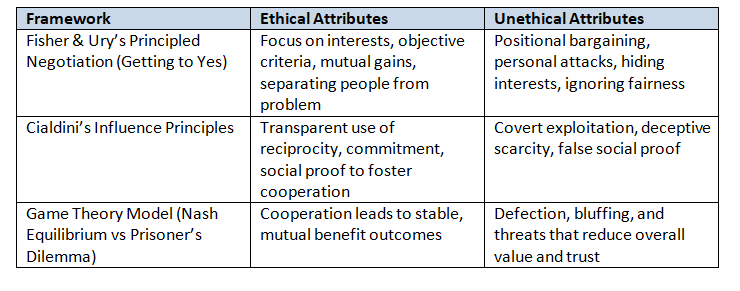
These frameworks emphasize transparency, mutual respect, and value creation as hallmarks of ethical tactics. By contrast, unethical negotiation often relies on deception, coercion, and information asymmetry.
Step-by-Step Process or Analysis
This section details a six-step process to identify, avoid, and ethically leverage negotiation tactics.
Step 1: Preparation with Ethical Clarity
Define your negotiation goals aligned with your values and the counterpart’s legitimate interests. Research counterpart’s needs and constraints transparently.
Sample script: “To ensure we find an outcome beneficial to both sides, let’s clarify our mutual priorities upfront.”
Psychological guidance: Anchoring your mindset on fairness reduces temptation to overreach.
Step 2: Establishing Rapport Using Tactical Empathy
Use mirroring and labeling (per Chris Voss) genuinely to build trust.
Example: “It sounds like you’re concerned about delivery timelines. That’s understandable given your market pressures.”
Avoid feigned empathy which triggers suspicion.
Step 3: Presenting Offers with Transparency and Objective Criteria
Frame proposals using data and standards rather than arbitrary positions.
Example: “Based on industry benchmarks, this pricing reflects market value and quality.”
Avoid vague or inflated claims that mislead.
Step 4: Recognizing Unethical Signals
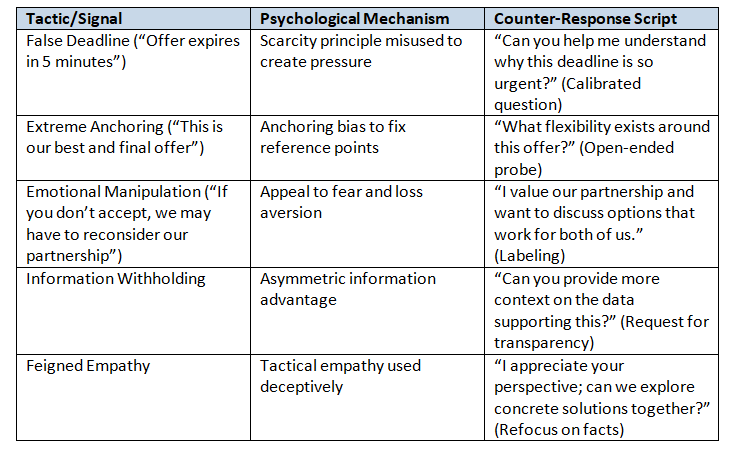
Watch for tactics like false deadlines, extreme anchoring, or emotional manipulation.
Example: If pressured with “This offer expires in 5 minutes,” question the legitimacy.
Step 5: Deploying Calibrated Questions to Defuse Manipulation
Ask open-ended, problem-solving questions to expose and neutralize unethical tactics.
Example: “What are the key factors driving this tight deadline?”
Psychological mechanism: Invokes reciprocity and shifts dialogue to collaborative problem-solving.
Step 6: Closing with Commitment and Integrity
Confirm agreements with clear terms and mutual acknowledgment to avoid post-deal disputes.
Example: “To ensure we both have full clarity, I will summarize our agreement as follows…”
Maintain consistency to foster trust for future negotiations.
Real-World Case Studies
Case 1: Apple vs Samsung Patent Negotiations (2011-2014)
Context: Complex patent infringement dispute involving billions in damages.
What happened: Apple’s legal team used aggressive anchoring and selective disclosure tactics; Samsung countered with extensive data challenges.
Lesson: Overly aggressive positional bargaining led to protracted litigation. Ethical principled negotiation might have preserved partnership potential and reduced costs.
Case 2: NFL Contract Dispute – 2011 Lockout
Context: NFL players and owners locked out over revenue sharing.
What happened: Both sides used public pressure, threats, and brinkmanship tactics.
Lesson: Unethical brinkmanship damaged trust and fan loyalty. Later negotiations incorporated more transparency and joint problem-solving, improving outcomes.
Case 3: U.S.-Iran Nuclear Negotiations (2013-2015)
Context: High-stakes diplomatic negotiation over nuclear program constraints.
What happened: Tactical empathy and principled negotiation frameworks helped bridge deep mistrust.
Lesson: Demonstrates power of ethical negotiation tactics in resolving seemingly intractable disputes.
Recognition and Counter-Response Guide
Advanced Insights
Experienced negotiators understand that ethical boundaries are not rigid lines but dynamic zones influenced by culture, context, and power asymmetries. Advanced ethical negotiation requires:
- Meta-cognitive awareness: continuously monitoring your own tactics to avoid inadvertent unethical behavior.
- Power balancing through calibrated concessions that build reciprocity without exploitation.
- Leveraging “ethical power” as described by Machiavelli and Sun Tzu — gaining influence by reputation for fairness.
- Integrating behavioral nudges that respect autonomy, avoiding manipulation while encouraging cooperation.
- Using “accusation audits” (Chris Voss) proactively to acknowledge counterpart suspicions, defusing potential distrust.
- Applying legal and compliance frameworks simultaneously with psychological tactics to ensure enforceability and integrity.
These insights elevate negotiation from mere deal-making to principled value creation with sustained relationship equity.
Scripts and Templates
1. [Addressing a False Deadline]
“I understand timing is important. Could you please explain the factors driving this tight deadline? I want to make sure we align on priorities realistically.”
2. [Deflecting Extreme Anchoring]
“That’s an initial offer I hear. To better evaluate, can you share what aspects are flexible or negotiable?”
3. [Responding to Emotional Pressure]
“I appreciate your concerns about the partnership. Let’s work together to find a solution that safeguards our mutual interests.”
4. [Requesting Transparency]
“To fully understand this proposal, could you provide additional data or context behind these figures?”
5. [Confirming Ethical Agreement Closure]
“Just to confirm, we agreed on [terms]. Is there anything else you’d like to clarify to ensure full alignment before we proceed?”
Frequently Asked Questions
Q1: How can I tell if a negotiation tactic crosses into unethical territory?
A1: Look for tactics that involve deception, coercion, withholding critical information, or exploiting cognitive biases without disclosure. Ethical tactics promote transparency, respect, and mutual benefit.
Q2: Is it ever ethical to use pressure tactics like deadlines?
A2: Yes, if deadlines are genuine and communicated honestly. Using fabricated or artificially imposed deadlines to rush decisions is unethical.
Q3: How do cultural differences impact perceptions of ethical negotiation?
A3: Cultural norms influence what is considered acceptable. It’s vital to research and adapt to counterpart’s cultural context while maintaining core ethical standards like honesty and respect.
Q4: Can ethical negotiation tactics still achieve aggressive business goals?
A4: Absolutely. Ethical negotiation relies on principled leverage, clear communication, and value creation, which often lead to superior, sustainable outcomes compared to coercive tactics.
Q5: What are practical steps to recover when accused of unethical behavior during negotiation?
A5: Conduct an accusation audit by acknowledging concerns openly, provide transparent explanations, reaffirm commitment to integrity, and seek collaborative problem-solving to rebuild trust.
Conclusion
The boundary between ethical and unethical negotiation tactics is nuanced but critical. Skilled negotiators leverage behavioral science insights and principled frameworks to influence and persuade without compromising integrity. The long-term benefits of ethical negotiation—trust, reputation, and durable agreements—far outweigh any fleeting advantage gained through manipulation or deception. By mastering recognition, calibrated responses, and transparent communication, you can navigate complex negotiations confidently, securing value while safeguarding relationships.
We invite you to apply these strategies in your next high-stakes negotiation — consciously balancing power with principle. For tailored guidance and advanced negotiation training, contact our expert team and elevate your negotiation effectiveness without sacrificing ethics.
References
1. Fisher, R., Ury, W., & Patton, B. (2011). Getting to Yes: Negotiating Agreement Without Giving In. Penguin Books.
2. Cialdini, R. B. (2006). Influence: The Psychology of Persuasion. Harper Business.
3. Kahneman, D. (2011). Thinking, Fast and Slow. Farrar, Straus and Giroux.
4. Voss, C., & Raz, T. (2016). Never Split the Difference: Negotiating As If Your Life Depended On It. Harper Business.
5. Shell, G. R. (2006). Bargaining for Advantage: Negotiation Strategies for Reasonable People. Penguin Books.
6. Bazerman, M. H., & Neale, M. A. (1992). Negotiating Rationally. Free Press.