Framework Agreements in Procurement: How to Negotiate and Manage Them

Imagine a global automotive manufacturer like Toyota preparing to secure thousands of components from suppliers worldwide. The procurement team faces the daunting task of balancing cost, quality, and supply reliability across multiple categories. Without a carefully crafted framework agreement, the company risks fluctuating prices, delivery delays, and inconsistent supplier performance that could jeopardize production lines. Framework agreements provide a strategic approach to managing these complexities by establishing long-term conditions that streamline purchasing, mitigate risks, and foster supplier collaboration.
In today’s hyper-competitive supply chain environment, framework agreements are more than just contracts; they form the backbone of strategic sourcing efforts. Procurement managers and category leaders who master the negotiation and management of these agreements wield significant influence over organizational cost structures, innovation capacity, and operational agility. This article will guide you through the strategic foundations, proven frameworks, and actionable tactics to excel in framework agreements — transforming them from static contracts into dynamic tools for value creation.
By the end of this comprehensive guide, you will understand how to evaluate procurement needs using models like the Kraljic Matrix, leverage total cost of ownership (TCO) and should-cost modeling, and apply category management best practices. You will learn step-by-step negotiation processes, real-world lessons from Amazon and NHS procurement, and scripts to counter supplier tactics. Whether you are a procurement manager, CPO, or sales director, this pillar article equips you with the expertise to negotiate and manage framework agreements that drive sustainable competitive advantage.
· Table of Contents
· The Strategic Foundation: Procurement Frameworks, Models, and Psychology
· Key Frameworks and Models: Kraljic Matrix, Porter's Five Forces, and Supplier Segmentation
· Step-by-Step Process to Negotiate and Manage Framework Agreements
· Real-World Case Studies: Toyota, NHS Procurement, Amazon
· Tactics and Counter-Tactics: Negotiation Scripts and Responses
· Advanced Strategies for Expert-Level Framework Agreement Management
· Scripts and Templates for Procurement and Supplier Engagement
· Frequently Asked Questions about Framework Agreements
· Conclusion and Call to Action
· References to Authoritative Procurement Sources
The Strategic Foundation - frameworks, models, psychology with named research
Framework agreements in procurement are not merely legal instruments; they are strategic tools rooted deeply in procurement theory and behavioral economics. At their core, these agreements set pre-negotiated terms and conditions for repeated purchases over a defined period, enabling both parties to reduce transaction costs, improve supply certainty, and foster collaboration.
One foundational research insight comes from Peter Kraljic’s seminal 1983 Harvard Business Review article, “Purchasing Must Become Supply Management.” Kraljic introduced a portfolio purchasing approach categorizing supplier relationships based on supply risk and profit impact. Framework agreements are particularly effective for strategic and bottleneck items where long-term collaboration is critical.
From a psychological perspective, Robert Cialdini’s principles of influence—especially commitment and consistency—explain why framework agreements encourage supplier adherence. By locking in terms, both buyer and supplier increase mutual dependence, reducing incentives for opportunistic behavior. Furthermore, negotiation research by Leigh Thompson (2015) highlights the importance of establishing clear BATNA (Best Alternative to Negotiated Agreement) and ZOPA (Zone of Possible Agreement) boundaries upfront to avoid deadlocks.
Total Cost of Ownership (TCO) analysis strengthens the strategic foundation by expanding focus beyond price to include quality, delivery reliability, and after-sales service. For instance, Apple’s procurement teams rigorously apply should-cost modeling to forecast realistic supplier costs before negotiations, enabling more informed framework agreements that balance innovation with cost control.
In summary, effective framework agreements rest on integrating strategic sourcing models, behavioral insights, and comprehensive cost analysis to create win-win partnerships that sustain competitive advantage.
Key Frameworks and Models
To negotiate and manage effective framework agreements, procurement professionals rely on several core frameworks and models that provide structured approaches to supplier selection, risk management, and value optimization.
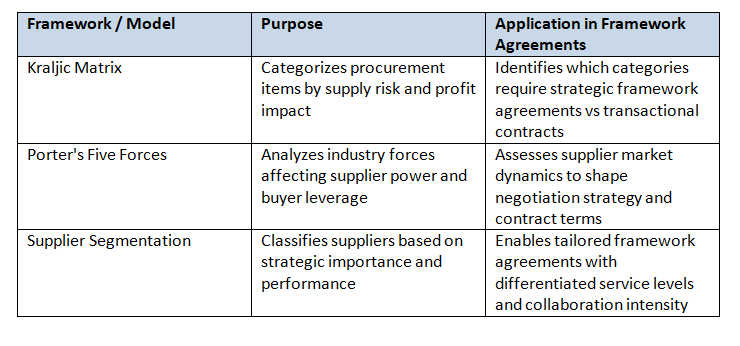
The Kraljic Matrix is foundational to deciding where framework agreements yield the most value. For example, strategic items with high supply risk and high profit impact, such as aerospace components at Boeing, benefit from multi-year frameworks that guarantee availability and foster innovation partnerships.
Porter's Five Forces analysis informs the buyer about supplier bargaining power, threat of substitutes, and competitive rivalry, critical to setting contract terms. Amazon’s procurement leverages such analysis to negotiate favorable volume discounts in highly competitive supplier markets.
Supplier segmentation complements these by grouping suppliers into strategic, preferred, and transactional tiers. NHS procurement uses this to establish framework agreements with strategic suppliers that include key performance indicators and continuous improvement clauses, while transactional suppliers operate under simpler contracts.
These frameworks collectively enable procurement leaders to design and manage framework agreements that optimize cost, reduce risk, and enhance supplier collaboration.
Step-by-Step Process - [H3] for each step (minimum 6), specific tactics and language
Effective negotiation and management of framework agreements require a disciplined, stepwise approach. Below is an actionable process with explicit tactics and word-for-word language suggestions.
Step 1: Conduct Comprehensive Spend and Category Analysis
Begin by classifying spend using the Kraljic Matrix and performing TCO analysis. Use should-cost modeling to benchmark supplier costs.
Tactic: Use cross-functional teams to gather data and identify categories suited for framework agreements.
Language: “Our analysis indicates this category has high supply risk and strategic value, warranting a framework agreement to stabilize costs and ensure capacity.”
Step 2: Define Clear Objectives and Scope
Articulate what you want to achieve: price stability, service levels, innovation, or risk mitigation.
Tactic: Document scope, volume forecasts, and key performance indicators (KPIs).
Language: “Our objective is to lock in fixed pricing for a 24-month term while incorporating quarterly performance reviews.”
Step 3: Develop a Request for Framework Proposal (RFFP)
Design an RFFP that captures requirements, evaluation criteria, and contractual terms.
Tactic: Include clauses for volume commitments, price reviews, and termination rights.
Language: “Please provide your best pricing and service terms for a multi-year framework, including escalation mechanisms.”
Step 4: Supplier Selection and Due Diligence
Evaluate suppliers using weighted scorecards based on cost, quality, risk, and innovation capabilities.
Tactic: Use supplier segmentation to shortlist candidates.
Language: “Based on your proposed terms and performance track record, we are considering you for a strategic framework partnership.”
Step 5: Negotiate Terms and Finalize Agreement
Engage in collaborative negotiations, applying BATNA and exploring ZOPA for win-win outcomes.
Tactic: Use should-cost data and competitive benchmarks to justify positions.
Language Buyer: “Given our volume forecasts and market benchmarks, we propose a price adjustment mechanism to balance risk.”
Language Supplier: “We understand your volume expectations; however, material cost volatility necessitates a flexible pricing clause.”
Step 6: Implement and Manage the Framework Agreement
Establish governance with regular performance reviews, communication protocols, and continuous improvement.
Tactic: Use supplier scorecards and feedback loops to drive compliance.
Language: “As per our framework, let’s schedule quarterly business reviews to ensure KPIs are met and identify improvement opportunities.”
Real-World Case Studies - 2-3 named examples with lessons
Toyota: Lean Procurement and Frameworks for Just-in-Time Production
Toyota’s procurement philosophy integrates lean principles with framework agreements to support its Just-in-Time (JIT) production system. By establishing long-term framework contracts with tier-one suppliers, Toyota ensures component availability while driving continuous cost and quality improvements. The company uses supplier segmentation and collaborative forecasting to align production schedules, minimizing inventory and lead times.
Lesson: Framework agreements can enable lean supply chains by fostering supplier transparency and joint problem-solving.
NHS Procurement: Framework Agreements for Public Sector Efficiency
The UK’s National Health Service (NHS) employs framework agreements extensively to standardize procurement across hospitals and trusts. By aggregating demand and establishing centralized frameworks for medical supplies and services, NHS achieves economies of scale and compliance with regulatory standards. The frameworks include detailed KPIs and penalty clauses to safeguard service levels.
Lesson: Framework agreements can deliver cost savings and regulatory compliance in complex public sector procurement.
Amazon: Dynamic Framework Agreements for Technology and Logistics
Amazon’s procurement teams use flexible framework agreements with technology vendors and logistics partners to maintain agility in a fast-moving market. Contracts incorporate scalable volume commitments and innovation incentives, supporting rapid expansion while controlling costs. Amazon leverages data analytics to monitor supplier performance and adjust terms dynamically.
Lesson: Framework agreements can balance stability with flexibility through data-driven management and adaptive contracting.
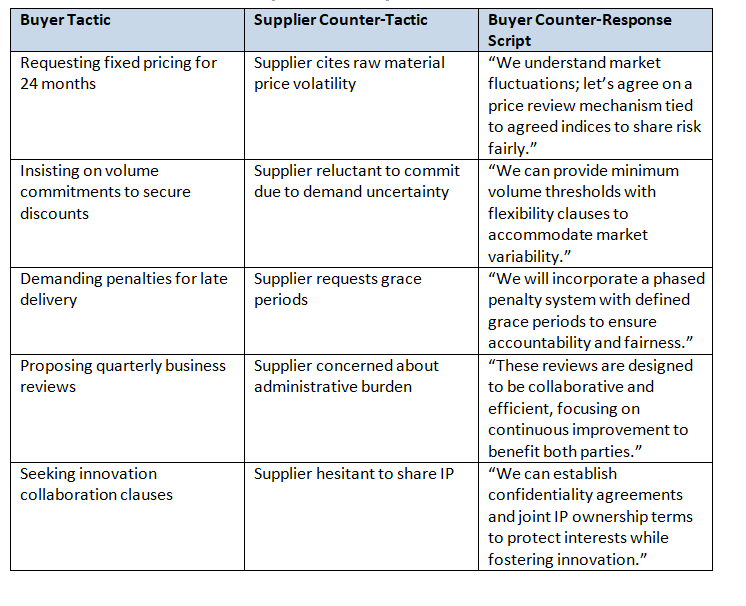
Tactics and Counter-Tactics
Advanced Strategies - expert-level techniques
Seasoned procurement professionals elevate framework agreements by integrating advanced strategies such as:
· Dynamic Contracting: Incorporating flexible terms that adjust pricing and volumes based on real-time market data and demand signals. For example, Boeing uses market index-linked pricing in aerospace component frameworks.
· Value Engineering Clauses: Embedding continuous improvement initiatives where suppliers propose cost-saving design or process enhancements during the contract term. Apple’s suppliers engage in value engineering regularly under framework contracts.
· Collaborative Risk Sharing: Establishing joint risk management committees to identify supply chain risks and mitigation strategies, as practiced by NHS procurement frameworks during the COVID-19 pandemic.
· Multi-Sourcing Frameworks: Creating parallel framework agreements with multiple suppliers to maintain competitive tension and supply resilience, a strategy employed by Walmart in grocery procurement.
· Technology-Enabled Management: Using supplier relationship management (SRM) platforms and analytics dashboards to monitor, report, and optimize framework agreement performance continuously.
These techniques require mature supplier relationships, robust governance, and digital capabilities but yield superior value creation and supply chain agility.
Scripts and Templates - 4-5 word-for-word scripts
Script 1: Initial Supplier Engagement Email
“Dear [Supplier Name],
Following our internal spend analysis, we have identified [Category/Item] as a priority for a framework agreement. We invite you to submit a proposal addressing pricing, service levels, and innovation capabilities over a multi-year term. Please refer to the attached Request for Framework Proposal for details.
We look forward to your competitive and collaborative response.
Best regards,
Script 2: Negotiation Opening Statement
“Thank you for your proposal. To align with our strategic objectives, we aim to establish a framework agreement that balances price stability, quality, and supply flexibility. Based on our should-cost modeling and market benchmarks, we propose terms that reflect shared risks and mutual benefits.”
Script 3: Responding to Supplier Price Increase Request
“We acknowledge the challenges posed by current market conditions. However, to maintain the framework’s sustainability, we propose implementing an index-linked price adjustment mechanism reviewed quarterly. This approach ensures transparency and fairness for both parties.”
Script 4: Quarterly Business Review Meeting Invitation
“Dear [Supplier],
As stipulated in our framework agreement, we would like to schedule our quarterly business review on [Date]. The agenda includes performance KPIs, delivery metrics, and continuous improvement opportunities. Please confirm your availability.
Best regards,
Script 5: Framework Agreement Termination Notice
“Dear [Supplier],
After thorough evaluation, we regret to inform you that we will not be renewing the framework agreement upon expiry on [Date]. We appreciate your partnership and encourage you to participate in our upcoming sourcing processes.
Best regards,
Frequently Asked Questions - 5 detailed Q&As
What are the main advantages of framework agreements in procurement?
Framework agreements reduce transaction costs by avoiding repetitive negotiations, ensure price and supply stability, enable volume aggregation for discounts, and foster long-term supplier collaboration. They also improve compliance and transparency across decentralized purchasing units.
How do you decide which categories are suitable for framework agreements?
Using the Kraljic Matrix, categories with high supply risk and high profit impact are prime candidates. Categories with stable demand and limited supplier markets also benefit. Conducting TCO analysis and supplier market assessments further informs suitability.
How can buyers manage risks associated with long-term framework agreements?
Risks can be mitigated by embedding price adjustment clauses, performance KPIs, termination rights, and governance mechanisms such as regular reviews. Multi-sourcing frameworks reduce dependency on single suppliers.
What negotiation tactics are effective when suppliers resist volume commitments?
Buyers can propose minimum volume thresholds combined with flexible upper limits, incorporate option clauses for scalability, and share demand forecasts transparently to build trust and reduce supplier uncertainty.
How should framework agreements be managed post-signature for maximum value?
Implement structured governance including supplier scorecards, periodic business reviews, escalation processes for issues, and regular contract compliance audits. Encourage continuous improvement and innovation collaboration.
Conclusion
Framework agreements are indispensable instruments for modern procurement, enabling organizations to secure supply stability, optimize costs, and build strategic supplier partnerships. By grounding negotiations in robust frameworks like the Kraljic Matrix and employing comprehensive TCO analysis, procurement leaders can transform these agreements into dynamic assets that support organizational agility and competitive advantage.
Mastering the negotiation and management of framework agreements requires a blend of analytical rigor, behavioral insight, and practical negotiation skills. The step-by-step processes, real-world case studies, and expert tactics detailed in this article equip procurement professionals with the tools needed to excel. Commit today to elevating your framework agreement strategy — the impact on your supply chain resilience and bottom line will be profound.
Contact our team for tailored advisory services or procurement negotiation training to accelerate your mastery of framework agreements.
References
· Kraljic, Peter. “Purchasing Must Become Supply Management.” Harvard Business Review, 1983.
· Cialdini, Robert B. “Influence: The Psychology of Persuasion.” Harper Business, 2006.
· Thompson, Leigh L. “The Mind and Heart of the Negotiator.” Pearson, 2015.
· NHS Supply Chain. “Framework Agreements Guidance.” NHS England, 2021.
· Apple Supplier Responsibility Progress Reports. Apple Inc., 2023.
· Amazon Procurement Best Practices. Amazon Corporate Publications, 2022.