Framing in Negotiation: How to Shape Perception and Win More Deals

Negotiations often hinge not merely on what is discussed but on how the information is presented. Imagine a high-stakes merger negotiation between two global tech giants. One party frames the deal as a once-in-a-lifetime opportunity to leapfrog competition, emphasizing the scarcity and exclusivity of the offer. The other party, failing to counter this narrative effectively, perceives the deal as urgent and risks conceding too early, losing millions in valuation. This pivotal use — or misuse — of framing can decisively tilt outcomes and determine who wins or loses at the bargaining table.
At its core, framing leverages deep-seated psychological biases and neurological responses. Pioneering behavioral economists like Daniel Kahneman have shown that how options are framed activates different brain circuits, triggering loss aversion, anchoring, and emotional reactions that often override pure rational calculation. Framing taps into cognitive shortcuts, shaping perception before the facts settle in, and thus molding negotiation dynamics invisibly but powerfully.
This comprehensive guide will equip you to master framing as a negotiation weapon. You will learn the scientific foundations underpinning framing, see the tactic deployed in varied real-world scenarios, and receive step-by-step instructions on implementing it yourself. Moreover, you’ll gain counter-tactics to recognize when others frame you and scripts to neutralize or flip the narrative in your favor. By the end, framing will be an indispensable, precise tool in your negotiation arsenal.
·
Table of Contents
· The Science Behind This Tactic
· How This Tactic Works in Practice
· Step-by-Step: How to Deploy This Tactic
· How to Recognize and Counter This Tactic
· Real-World Case Studies
· Common Mistakes When Using This Tactic
· Scripts and Templates
· Frequently Asked Questions
· Conclusion
· References
The Science Behind This Negotiation Tactic
Framing is rooted deeply in behavioral economics and cognitive psychology, fields that investigate how human decision-making deviates from classical rational models. Daniel Kahneman and Amos Tversky’s seminal 1981 paper on prospect theory revealed that people evaluate potential gains and losses relative to a reference point — the frame — rather than on absolute outcomes. This leads to asymmetric risk preferences: losses loom larger than equivalent gains, a phenomenon known as loss aversion.
For example, a negotiation framed as “avoiding a loss” triggers stronger emotional and neural responses than one framed as “achieving a gain,” often pushing parties toward more conservative or risk-averse decisions. Neuroscience research utilizing fMRI scans confirms that framing activates the amygdala and prefrontal cortex areas associated with emotion and executive control, influencing judgment even before conscious awareness.
Beyond loss aversion, framing interacts with other cognitive biases: anchoring (where initial numbers heavily influence subsequent judgements), confirmation bias (seeking information that confirms the frame), and the availability heuristic (relying on easily recalled examples supportive of the frame). Robert Cialdini’s principles of scarcity and commitment also apply: framing an offer as scarce or time-limited leverages social proof and urgency, compelling faster acceptance.
In negotiations, framing operates as a subtle form of influence, shifting the perceived value, fairness, or riskiness of proposals. Roger Fisher and William Ury’s “Getting to Yes” emphasizes separating people from the problem, but framing can shape perception of the problem itself, thus affecting willingness to cooperate or concede. Chris Voss’s tactical empathy approach involves understanding and then reframing the counterpart’s perspective to reshape the negotiation’s emotional landscape.
Thus, framing is not merely a linguistic trick but a neuroscientifically validated mechanism to guide decision-making and behavior in high-stakes interpersonal exchanges.
How This Tactic Works in Practice
Framing in negotiation spans a spectrum from subtle linguistic cues to overt narrative construction. Its core function is to set the interpretative lens through which information is perceived. Variations include:
- Positive vs negative framing: Emphasizing benefits or risks
- Gain frame vs loss frame: Highlighting what can be won vs what can be lost
- Scarcity framing: Stressing limited availability or time
- Social proof framing: Indicating peer acceptance or consensus
- Ethical/moral framing: Casting proposals in terms of fairness or justice
The choice of frame depends on context, counterpart psychology, and negotiation goals. For example, in enterprise SaaS sales, framing a subscription renewal as a loss of critical operational capability if not renewed taps loss aversion, whereas in labor union talks, framing wage offers as part of a broader fair-share social justice narrative may resonate better.
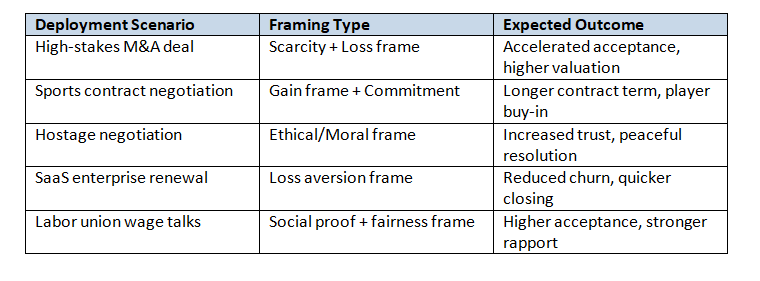
Understanding these variations helps negotiators calibrate their framing approach according to counterpart psychology and negotiation phase to optimize influence.
Step-by-Step: How to Deploy This Tactic
Step 1: Analyze Your Counterpart’s Motivations and Biases
Before framing, assess what matters most to your counterpart — are they risk-averse, focused on gains, or motivated by fairness? Use calibrated questions to elicit priorities (e.g., “What are your main concerns about this proposal?”).
Step 2: Define Your Reference Point Clearly
Establish the baseline from which gains or losses will be perceived. For example, anchor the discussion around current market prices or previous deals to set expectations.
Step 3: Choose a Frame Aligned to Your Goal
Select a frame type (loss, gain, scarcity, ethical) that aligns with your negotiation objectives and counterpart’s psychology. For instance, if urgency is needed, employ scarcity framing (“This offer expires end of day”).
Step 4: Construct Your Message with Precise Language
Use words and metaphors that evoke the intended frame. Loss frames often start with “If you don’t…” or “Avoid losing…”; gain frames highlight “You will benefit by…” or “This unlocks…”; scarcity frames emphasize “Limited availability” or “Exclusive opportunity.”
Step 5: Deploy the Frame Early and Reinforce It
Introduce your framing early to anchor perceptions. Repeat or reinforce it through follow-up communication or observable cues (e.g., time-limited offers in writing).
Step 6: Monitor and Adapt Based on Feedback
Watch for verbal and nonverbal signals indicating acceptance or resistance. Use tactical empathy and mirroring to test if the frame resonates and adjust if needed. For example, if your loss frame meets resistance, try reframing as a gain or fairness appeal.
How to Recognize and Counter This Tactic
Recognizing when you are being framed is critical to maintaining negotiation power. Common signals include:
- Repeated emphasis on risks or losses you may face
- Anchoring on specific numbers or deadlines
- Emotional language aimed at urgency or fairness
- Consistent narrative pushing a single interpretation
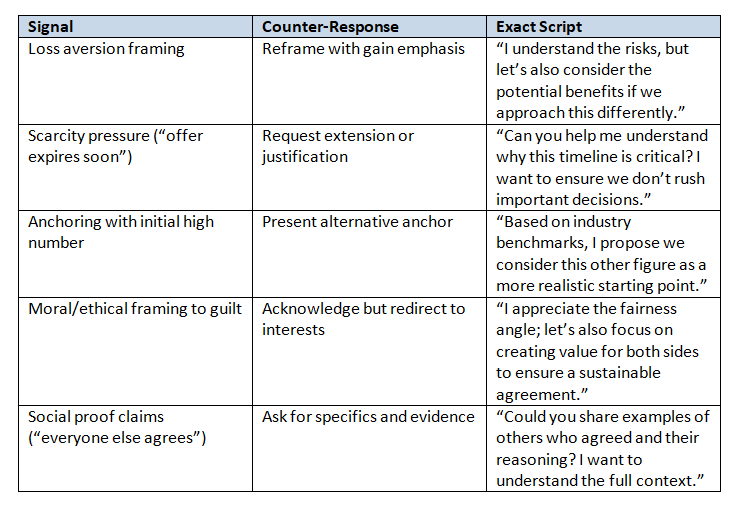
These counter-responses reduce the power of framing by shifting perception back to balanced evaluation.
Real-World Case Studies
Case Study 1: Apple vs Samsung Patent Negotiations
In the high-profile patent disputes between Apple and Samsung, Apple frequently framed Samsung’s copying as a “theft of innovation,” invoking moral and ethical frames to sway public opinion and judicial perception. This framing elevated the stakes beyond legal details, casting Samsung as a villain and influencing jury sentiment, resulting in substantial damages awarded to Apple. The lesson: powerful ethical framing can create reputational leverage beyond contract terms.
Case Study 2: NFL Contract Negotiations with Colin Kaepernick
During NFL contract talks, agents for Colin Kaepernick framed the negotiation not merely as a salary discussion but as a civil rights and social justice issue, appealing to moral and social proof frames. While this elevated the public discourse, it also polarized the negotiation environment, illustrating both the power and risks of highly charged framing. The key takeaway is to balance ethical framing with pragmatic deal terms to avoid deadlock.
Case Study 3: Hostage Negotiation in the 1996 Japanese Embassy Crisis in Peru
Lead negotiators used ethical and gain framing to shape the hostage-takers’ perception, emphasizing the long-term benefits of peaceful resolution and appealing to their sense of justice. This reframing helped de-escalate tension and contributed to a peaceful release of most hostages. This example demonstrates framing’s life-or-death impact in crisis diplomacy.
Common Mistakes When Using This Tactic
- Over-framing: Bombarding counterparts with too many frames reduces credibility and causes confusion. Fix: Choose one strong frame per negotiation phase.
- Ignoring counterpart values: Applying a frame misaligned with the counterpart’s motivations backfires. Fix: Conduct thorough counterpart analysis first.
- Lack of flexibility: Refusing to reframe when resistance is detected leads to stalemate. Fix: Monitor feedback and be ready to adapt frame.
- Neglecting nonverbal cues: Missing signs of discomfort or confusion reduces framing effectiveness. Fix: Use active listening and observe body language.
- Overuse of scarcity: False scarcity erodes trust if discovered. Fix: Only apply scarcity framing when genuinely valid.
Scripts and Templates
Script 1: Email — SaaS Renewal Loss Aversion Frame
“Dear [Client], I wanted to highlight the critical impact of not renewing your subscription by [date]. You risk losing key functionality that supports your daily operations, potentially disrupting your team’s productivity. Renewing now ensures uninterrupted service and access to upcoming features designed to boost efficiency.”
Script 2: In-Person — M&A Scarcity Frame
“As you know, this opportunity is unique in the market and won’t be available for long. We’ve had multiple parties express interest, which underscores the strategic advantage it offers your company if acted upon promptly.”
Script 3: Phone — Ethical Frame in Labor Negotiations
“I appreciate the hard work your team does. Our proposal aims to fairly balance the company’s sustainability with your members’ well-being, ensuring long-term benefits for everyone involved.”
Script 4: Countering Loss Aversion Frame
“I hear your concerns about potential losses, but let’s also explore how we can position this deal to maximize gains and build value together.”
Script 5: Countering Scarcity Pressure
“Before we commit, I’d like to understand the reasons behind the tight deadline to ensure we make a fully informed decision.”
Frequently Asked Questions
Q1: What is framing in negotiation and why is it important?
A1: Framing is the way information is presented to shape perception, influencing decisions by activating cognitive biases such as loss aversion and anchoring. It is important because it can change how offers are evaluated and increase your chances of a favorable outcome.
Q2: How can I use framing without manipulating the other party?
A2: Ethical framing involves highlighting truthful, relevant aspects of the deal aligned with both parties’ interests, not deception. Transparency and respect maintain trust while leveraging framing effectively.
Q3: Can framing backfire in negotiations?
A3: Yes. If the frame conflicts with the counterpart’s values or appears insincere, it can cause resistance or damage rapport. Flexibility and counterpart understanding mitigate this risk.
Q4: How do I practice recognizing framing tactics by others?
A4: Listen for repeated themes emphasizing risk, urgency, fairness, or social proof. Observe emotional language and sudden shifts in narrative. Asking clarifying questions can expose framing attempts.
Q5: What is the best time to apply framing during negotiations?
A5: Early framing sets the reference point, but reframing can be strategically applied throughout as new information arises or dynamics shift. Continual monitoring and adaptation are key.
Conclusion
Framing in negotiation is a powerful, scientifically grounded tool that shapes how offers and information are perceived, often determining the success or failure of deals. By understanding the underlying behavioral economics and psychology, negotiators can craft precise frames that activate cognitive biases such as loss aversion and social proof, influencing counterparts toward favorable outcomes. Mastering framing means not only deploying it effectively but also recognizing when others use it against you and responding with confidence.
Integrating framing into your negotiation toolkit transforms interactions from simple exchanges of facts into dynamic, perception-driven engagements. Begin applying these insights today with the step-by-step methods, counter-tactics, and scripts provided, and watch your negotiation results improve measurably. For senior negotiators, legal counsel, procurement managers, and business leaders aiming to close more deals with less friction, framing offers a decisive edge.
References
- Kahneman, D., & Tversky, A. (1981). Prospect Theory: An Analysis of Decision under Risk. Econometrica.
- Cialdini, R. B. (2009). Influence: Science and Practice. Pearson Education.
- Fisher, R., & Ury, W. (1981). Getting to Yes: Negotiating Agreement Without Giving In. Penguin Books.
- Voss, C., & Raz, T. (2016). Never Split the Difference: Negotiating As If Your Life Depended On It. HarperBusiness.
- Shell, R. (2006). Bargaining for Advantage: Negotiation Strategies for Reasonable People. Penguin.
- Grant, A. (2013). Give and Take: Why Helping Others Drives Our Success. Viking.