Global Business Communication: How to Communicate Persuasively Across Cultures

In 2015, a North American technology firm attempted a major joint venture with a prominent Japanese conglomerate. Despite months of technical alignment and promising financial forecasts, the deal collapsed at the last minute. The North American executives, accustomed to direct, transactional negotiations, pressed aggressively for contract finalization, overlooking Japan’s cultural emphasis on nemawashi — informal consensus-building — and the importance of saving face (mianzi). The Japanese partners perceived the approach as disrespectful and rushed, leading to a breakdown in trust and a public relations setback that cost millions. This scenario exemplifies the high stakes of cross-cultural business communication; failure to adapt messaging and negotiation style can derail multimillion-dollar deals and long-term strategic partnerships.
In today’s global economy, communication is not just about language fluency but mastering cultural nuances that shape how persuasion, trust, and agreements unfold. Executives and negotiators face complex challenges: decoding high-context versus low-context communication, managing time orientation differences, balancing relationship versus task focus, and navigating varying expressions of hierarchy and conflict. Misreading these signals leads to costly misunderstandings, stalled negotiations, and damaged reputations. Unfortunately, many professionals rely on stereotypes or apply a one-size-fits-all approach, which dangerously underestimates cultural complexity.
This definitive guide will equip you with the deep cultural intelligence and practical tools necessary to communicate persuasively across cultures. You will master key theoretical frameworks such as Hofstede’s cultural dimensions, Erin Meyer’s Culture Map, and Edward Hall’s context theories. We will explore country-specific communication styles and negotiation behaviors with real-world examples from Japan, China, Germany, Brazil, India, and more. You will gain a step-by-step strategy for adapting your language, tone, and approach, actionable scripts tailored for diverse cultures, and expert techniques for conflict de-escalation and trust-building. Whether negotiating a deal, managing global teams, or navigating multicultural partnerships, this article will transform your cross-cultural communication effectiveness.
· Table of Contents
· The Theoretical Foundation: Key Cultural Frameworks and Dimensions
· Key Frameworks and Models Compared: Hofstede, Meyer, Lewis
· Step-by-Step Strategy for Persuasive Cross-Cultural Communication
· Real-World Case Studies: Successes and Failures
· Country/Region-Specific Insights: Communication and Negotiation Do’s and Don’ts
· Advanced Strategies for Expert-Level Cross-Cultural Persuasion
· Scripts and Templates: Language Adaptation by Culture
· Frequently Asked Questions on Global Business Communication
· Conclusion and Call to Action
· References
The Theoretical Foundation — Deep Dive into Relevant Cultural Frameworks
Understanding global business communication requires grounding in foundational cultural frameworks that decode how societies vary in communication, values, and negotiation styles. Below we explore six seminal models with specific country data and the implications for persuasive communication.
Geert Hofstede’s 6 Cultural Dimensions (2010 update) remain a cornerstone of intercultural analysis:
- Power Distance Index (PDI): degree of acceptance of unequal power distribution. For example, India scores 77 (high PDI), reflecting hierarchical respect, while Denmark scores 18 (low PDI), emphasizing egalitarianism.
- Individualism vs Collectivism (IDV): US scores 91 (high individualism), China 20 (collectivist), affecting directness and group harmony.
- Masculinity vs Femininity (MAS): Japan scores 95 (masculine, competitive), Sweden 5 (feminine, consensus-driven).
- Uncertainty Avoidance Index (UAI): Greece 112 (high avoidance), Singapore 8 (low avoidance), influencing risk tolerance.
- Long-Term Orientation (LTO): South Korea 100 (long-term focus), Russia 81, US 26 (short-term).
- Indulgence vs Restraint (IVR): Brazil 59 (indulgent), China 24 (restrained).
Erin Meyer’s Culture Map (2014) provides eight communication-related dimensions crucial for negotiation:
- Communicating: Low-context (explicit) vs High-context (implicit). US is low-context; Japan, China, Middle East are high-context.
- Evaluating: Direct negative feedback (Germany, Israel) vs Indirect (Japan, India).
- Leading: Egalitarian (Nordic countries) vs Hierarchical (Russia, Mexico).
- Deciding: Consensual (Japan’s ringi system) vs Top-down (China).
- Trusting: Task-based (Germany) vs Relationship-based (Brazil, Middle East).
- Disagreeing: Confrontational (Israel) vs Avoids confrontation (Japan).
- Scheduling: Linear time (Germany) vs Flexible time (India, Brazil).
- Persuading: Principles-first (France) vs Applications-first (US).
Richard Lewis’s Model categorizes communication styles as Linear-Active (Germany, US), Multi-Active (Latin America, Southern Europe), and Reactive (Japan, China), each requiring different persuasion tactics.
Edward Hall’s theories highlight:
- High-context vs Low-context communication: High-context cultures rely heavily on non-verbal cues and implicit messages.
- Monochronic (time-focused, punctual) vs Polychronic (flexible time) cultures.
- Proxemics: personal space norms vary, impacting comfort and rapport.
Richard Gesteland’s dimensions focus on deal vs relationship focus, formality, time rigidity, and expressiveness, critical for adapting negotiation style.
David Livermore’s Cultural Intelligence (CQ) framework emphasizes CQ Drive (motivation), CQ Knowledge (cultural understanding), CQ Strategy (planning), and CQ Action (behavioral adaptation).
Trompenaars & Hampden-Turner’s dimensions include universalism vs particularism, individualism vs communitarianism, neutral vs emotional, specific vs diffuse, achievement vs ascription—all influencing communication style and trust-building.
Understanding these dimensions and how they manifest in specific countries arms negotiators with cultural intelligence critical for persuasive global business communication.
Key Frameworks and Models — Comparative Analysis
This section focuses on three widely used frameworks: Hofstede’s 6 dimensions, Erin Meyer’s Culture Map, and Richard Lewis’s communication style model. The following table compares key dimensions for eight major economies, highlighting implications for communication and persuasion.
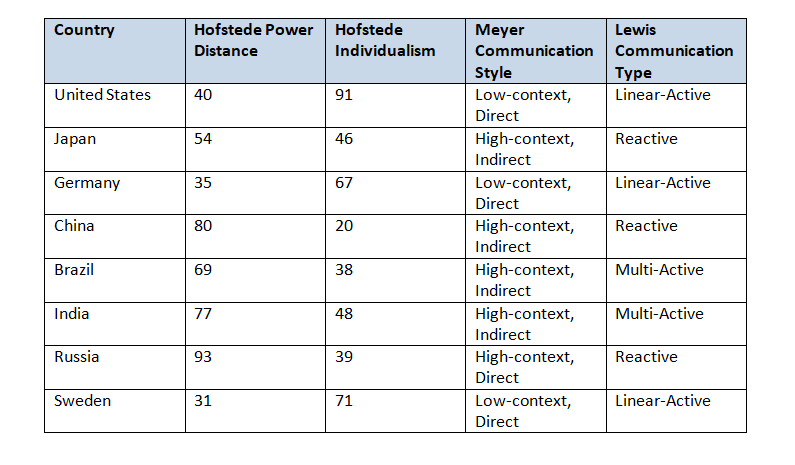
Key insights:
- Countries with high power distance (India, Russia) expect formal hierarchical communication, requiring respect for status in language and approach.
- High individualism (US, Germany) favors direct, task-focused communication and quick decision-making.
- High-context cultures (Japan, China, Brazil) rely on implicit messaging, non-verbal cues, and relationship-building (guanxi, jeitinho).
- Communication type influences meeting pace; Linear-Active prefer structured agendas, Multi-Active favor flexible, relationship-driven conversations.
These frameworks enable tailored communication strategies enhancing persuasion and reducing cultural friction.
Step-by-Step Strategy — Mastering Persuasive Cross-Cultural Communication
Step 1: Conduct Deep Cultural Research and Self-Assessment
Before engagement, study your counterpart’s cultural background using Hofstede, Meyer, and other models. Assess your own cultural biases and communication style (Lewis model). Use tools like Livermore’s CQ assessment to gauge your readiness.
· Tip: Use country-specific resources on negotiation etiquette, language nuances, and formalities.
Step 2: Build Relationship and Trust Before Business
In relationship-oriented cultures (China, Middle East, Brazil, India), invest time in informal meetings, social rituals, and reciprocity. Understand guanxi, wasta, jeitinho dynamics.
· Language example: “I truly value the opportunity to get to know you and your team better before we proceed.”
Step 3: Adapt Communication Style to Context and Culture
Match communication to high- or low-context preferences.
· For high-context: Use indirect language, read non-verbal cues, avoid blunt refusals.
· For low-context: Be explicit, clear, and structured.
Step 4: Manage Hierarchical and Decision-Making Expectations
In high PDI cultures, address senior leaders with appropriate titles and defer to their authority publicly (Japan’s nemawashi, India’s respect for elders).
In consensual cultures (Japan’s ringi), allow time for internal alignment.
Step 5: Negotiate Time and Scheduling Flexibility
Respect monochronic cultures’ punctuality (Germany, US). In polychronic cultures (India, Brazil), allow flexibility and focus on relationship quality over strict deadlines.
Step 6: Deliver Feedback and Disagreements Sensitively
Use indirect negative feedback in cultures that value harmony (Japan, China). In direct feedback cultures (Germany, Israel), be straightforward but respectful.
Conflict de-escalation protocols: acknowledge emotions, use “I” statements, seek joint solutions.
These steps, combined with cultural intelligence and humility, create persuasive communication that bridges cultural gaps.
Real-World Case Studies — Successes and Failures in Cross-Cultural Communication
Case Study 1: Siemens and Brazil’s Jeitinho Culture
Siemens initially struggled to close contracts in Brazil due to misunderstanding jeitinho — the informal problem-solving and relationship warmth Brazilians value. After hiring cultural consultants and adapting to a more flexible, personable approach, Siemens successfully built trust and closed major deals by integrating social rituals and accommodating fluid time.
Lesson: Embrace local problem-solving styles and warmth to build trust.
Case Study 2: Daimler-Benz’s German Directness vs US Subsidiary
Daimler-Benz’s German executives were frustrated with a US branch’s informal, indirect communication style, leading to missed deadlines. By training both sides on linear-active (Germany) versus more flexible US styles, and implementing structured yet empathetic communication protocols, performance improved.
Lesson: Mutual adaptation and cultural education prevent friction in multinational teams.
Case Study 3: Huawei’s Use of Guanxi in Africa
Huawei leverages China’s guanxi relationship-building by investing in local community projects and government relationships in African countries. This high-context, trust-based approach contrasts with Western transactional styles and has been key to Huawei’s market expansion.
Lesson: Relationship primacy and long-term orientation facilitate entry in collectivist cultures.
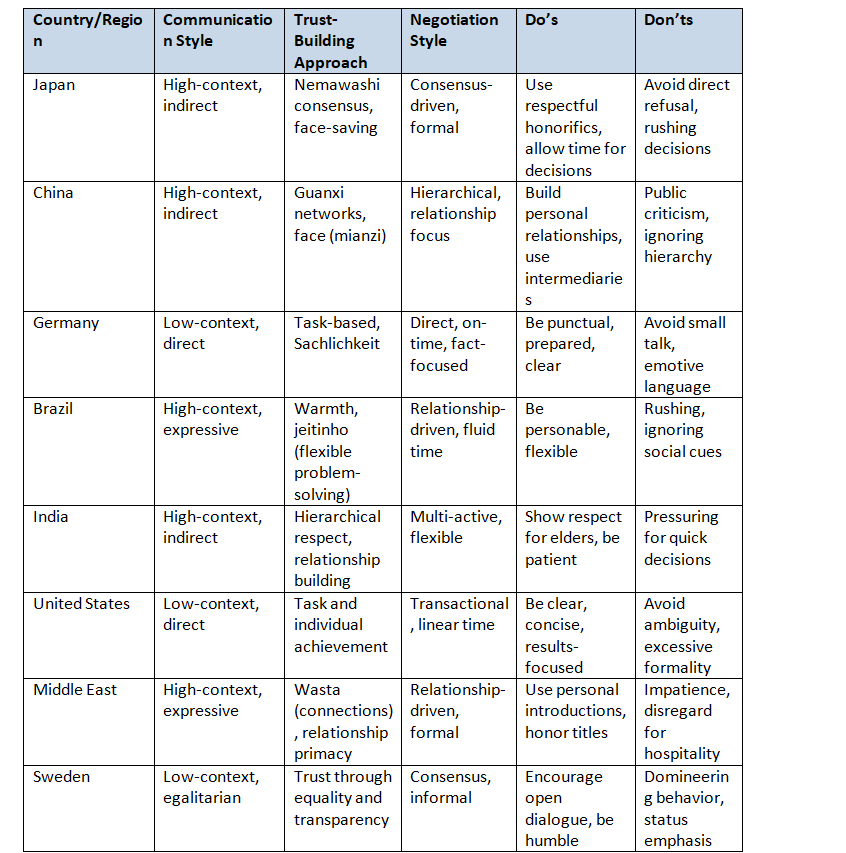
Country/Region-Specific Insights — Communication and Negotiation Across cultures Do’s and Don’ts
Advanced Strategies — Expert-Level Cross-Cultural Techniques
- Leverage CQ Strategy by continuously monitoring communication effectiveness and mentally rehearsing adaptations before meetings.
- Use “mirroring” subtly in tone, body language, and speech pace to build rapport, especially in reactive and multi-active cultures.
- Employ narrative persuasion in principle-first cultures (France) by leading with theory before application.
- Manage conflict using Thomas-Kilmann modes: adapt from competing style in low-context cultures to accommodating or avoiding in high-context cultures to maintain harmony.
- Utilize “face-saving” language and indirect refusals in East Asian contexts to avoid loss of dignity.
- Train multicultural teams with role-play simulations of cultural scenarios to build empathy and CQ Action competence.
- Use technology thoughtfully; video calls reduce high-context ambiguity but beware of bandwidth or cultural norms around formality.
These advanced tactics require deep cultural knowledge and situational awareness to execute successfully.
Scripts and Templates — Language Adaptation by Culture
Script 1: Requesting a Meeting — US vs Japan
US (Direct, low-context):
“Dear Mr. Smith,
I would like to schedule a meeting next week to discuss the project timeline and deliverables. Please let me know your availability.
Best regards,
Jane Doe”
Japan (Indirect, high-context):
“Dear Mr. Tanaka-sama,
I hope this message finds you well. If it is convenient for you, I humbly request the opportunity to meet at your earliest convenience to exchange ideas regarding the project. I appreciate your kind consideration.
Respectfully,
Jane Doe”
Script 2: Declining a Proposal — Germany vs China
Germany (Direct, low-context):
“Thank you for your proposal. After careful review, we regret to inform you that it does not meet our current requirements.
Best regards,
John Müller”
China (Indirect, high-context):
“Dear Mr. Li,
We sincerely appreciate your thoughtful proposal. At this moment, we believe further alignment is needed to fully meet mutual expectations. We look forward to continuing our discussions.
Warm regards,
John Müller”
Script 3: Giving Negative Feedback — Israel vs Japan
Israel (Direct):
“I want to be honest: the current report does not meet our standards. Let’s work together to improve it by next week.”
Japan (Indirect):
“I appreciate the effort put into the report. Perhaps there are areas that could benefit from additional refinement. Your continued dedication is highly valued.”
Script 4: Closing a Deal — Brazil vs Sweden
Brazil (Expressive, relationship-based):
“I am confident that together we can create a fantastic partnership. Let’s celebrate this new journey!”
Sweden (Reserved, egalitarian):
“We appreciate the agreement reached and look forward to cooperating effectively.”
These scripts illustrate how adapting tone, formality, and directness according to cultural expectations enhances persuasive communication.
Frequently Asked Questions
Q1: How can I quickly identify if I am dealing with a high-context or low-context culture?
A1: Observe communication style — high-context cultures rely on non-verbal cues, indirect language, and implicit messages (e.g., Japan, China, Middle East). Low-context cultures prefer explicit, clear, and direct verbal communication (e.g., US, Germany, Scandinavia). Researching Hofstede’s and Meyer’s frameworks can provide country-specific guidance.
Q2: What is the best way to handle conflicts in cultures that avoid direct confrontation?
A2: Use indirect feedback, focus on common goals, and employ conflict de-escalation techniques like active listening and “I” statements. Avoid public criticism. In these cultures, building trust first and addressing issues privately is critical.
Q3: How important is understanding power distance in negotiation?
A3: Extremely important. In high power distance cultures (India, Russia), defer respect to senior figures, use formal titles, and expect top-down decisions. In low power distance cultures (Sweden, Denmark), engage in egalitarian dialogue and consensus-building.
Q4: Can humor be used in cross-cultural business communication?
A4: Humor is highly culture-dependent. In some cultures (Brazil, US), it builds rapport when used appropriately. In others (Japan, Germany), it may be misunderstood or perceived as unprofessional. When unsure, use humor cautiously and observe counterparts’ cues.
Q5: How do I build cultural intelligence (CQ) effectively?
A5: Develop CQ Drive by cultivating curiosity and motivation to learn cultures. Increase CQ Knowledge through study and exposure. Practice CQ Strategy by planning cultural adaptations before interactions. Enhance CQ Action by adjusting verbal and non-verbal behaviors in real-time. Training, coaching, and immersive experiences accelerate CQ growth.
Conclusion
Mastering global business communication is no longer optional but essential for executives and professionals operating in today’s interconnected world. The stakes are high—miscommunication can cost multimillion-dollar deals and irreparably damage partnerships. By immersing yourself in cultural frameworks like Hofstede’s dimensions, Erin Meyer’s Culture Map, and Edward Hall’s context theories, you gain the cultural intelligence needed to decode nuanced communication patterns. Coupled with tailored strategies, country-specific insights, and adaptable scripts, you become a persuasive communicator who builds trust, navigates conflicts gracefully, and closes deals efficiently across even the most complex cultural landscapes.
We encourage you to apply the step-by-step frameworks and expert techniques outlined here to elevate your cross-cultural communication skills. Begin today by assessing your cultural intelligence, studying your key markets, and practicing adaptable communication approaches. The world’s top negotiators do not just speak multiple languages — they speak multiple cultures. Join their ranks to unlock new global opportunities and drive sustained business success.
References
- Hofstede, G. (2010). Cultures and Organizations: Software of the Mind. McGraw-Hill.
- Meyer, E. (2014). The Culture Map: Breaking Through the Invisible Boundaries of Global Business. PublicAffairs.
- Lewis, R. D. (2006). When Cultures Collide: Leading Across Cultures. Nicholas Brealey Publishing.
- Hall, E. T. (1976). Beyond Culture. Anchor Books.
- Livermore, D. (2015). Leading with Cultural Intelligence: The Real Secret to Success. AMACOM.
- Trompenaars, F., & Hampden-Turner, C. (2012). Riding the Waves of Culture: Understanding Diversity in Global Business. McGraw-Hill.