Global Negotiation Frameworks: The Models That Drive International Deal Success

International negotiations are high-stakes, complex undertakings where cultural misunderstandings and strategic missteps can cost billions of dollars and disrupt long-term partnerships. Consider the 2018 US-China trade negotiations, where subtle differences in communication styles, expectations, and legal frameworks escalated tensions, leading to tariff wars that impacted global supply chains. Negotiators who misunderstood the layered cultural signals or failed to align their negotiation frameworks with the Chinese emphasis on relationship-building and indirect communication missed critical opportunities to shape outcomes.
The strategic and cultural stakes in global negotiations are immense. Negotiators must navigate diverse cultural dimensions such as power distance, uncertainty avoidance, and communication styles, while also managing legal complexities like the CISG, ICC arbitration rules, and international contract law. Many professionals underestimate how deeply these factors influence negotiation dynamics, often relying on domestic negotiation tactics that backfire in cross-border contexts. The failure to adapt to different cultural expectations regarding hierarchy, time orientation, and risk tolerance can derail even the most promising deals.
This comprehensive guide will empower you to master the essential global negotiation frameworks that underpin international deal success. You will gain a deep understanding of cultural models from Hofstede, Erin Meyer, Richard Lewis, and Edward Hall, alongside principled negotiation techniques from Fisher & Ury tailored to the international stage. Through detailed step-by-step strategies, real-world case studies, country-specific insights, and expert scripts, you will be equipped to negotiate confidently and effectively across borders, mitigating risks and maximizing value.
· Table of Contents
· The Strategic Foundation: Key Cultural and Legal Frameworks
· Key Frameworks and Models: Comparative Analysis
· Step-by-Step Strategy for Global Negotiations
· Real-World Case Studies in International Deals
· Country/Region-Specific Insights and Challenge Matrix
· Advanced Strategies for Expert Negotiators
· Scripts and Templates for Cross-Cultural Negotiations
· Frequently Asked Questions on Global Negotiation
· Conclusion and Next Steps
· References and Further Reading
The Strategic Foundation — Deep Dive into Relevant Frameworks, Models, and Research
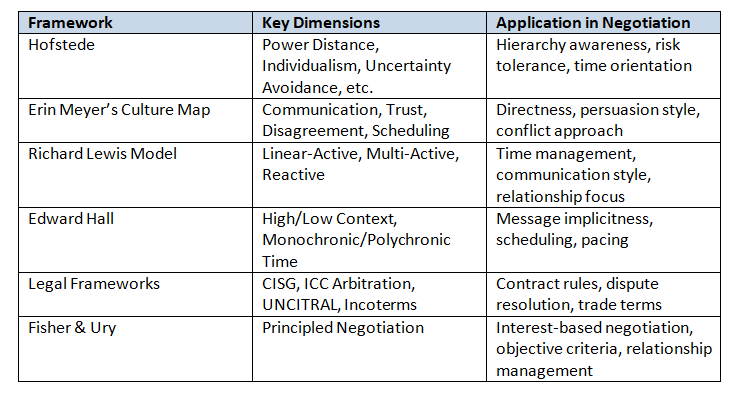
Successful global negotiation hinges on understanding the foundational cultural and legal frameworks that shape international interactions. This section explores the seminal research and models that define cultural differences and strategic negotiation considerations.
Hofstede’s Cultural Dimensions
Geert Hofstede’s research on cultural dimensions remains a cornerstone of cross-cultural negotiation. His six dimensions—Power Distance, Individualism vs. Collectivism, Masculinity vs. Femininity, Uncertainty Avoidance, Long-Term vs. Short-Term Orientation, and Indulgence vs. Restraint—explain how cultures differ in authority structures, social priorities, risk tolerance, and time horizons.
In a negotiation context, Power Distance affects hierarchical decision-making: Japanese and Korean negotiators often defer to senior executives, whereas German negotiators expect direct engagement. Uncertainty Avoidance influences risk-taking; Latin American cultures typically seek detailed contracts to mitigate ambiguity, contrasting with the US preference for flexibility.
Erin Meyer’s Culture Map
Erin Meyer’s Culture Map provides eight dimensions specifically tailored to business communication and negotiation: Communicating, Evaluating, Persuading, Leading, Deciding, Trusting, Disagreeing, and Scheduling. Meyer emphasizes the importance of high-context versus low-context communication and the degree of directness.
For example, in persuading, French negotiators use principles-first reasoning (deductive logic), whereas Americans lead with applications and results (inductive logic). In disagreeing, Dutch negotiators are confrontational, while Asians often avoid open disagreement to preserve harmony.
Richard Lewis Model
Richard Lewis categorizes cultures as Linear-Active, Multi-Active, or Reactive. Linear-Active cultures (e.g., Germany, Switzerland) are task-oriented, highly organized, and prefer direct communication. Multi-Active cultures (e.g., Brazil, Italy) are relationship-driven, emotional, and flexible with time. Reactive cultures (e.g., Japan, China) prioritize listening, indirect communication, and harmony.
Understanding this model helps negotiators adapt pacing, agenda-setting, and conflict resolution approaches to cultural preferences.
Edward T. Hall’s Context and Time Theories
Hall’s theory of High-Context vs. Low-Context communication is critical: High-context cultures (Japan, Saudi Arabia) rely heavily on implicit messages and shared understanding, whereas Low-context cultures (US, Germany) depend on explicit, detailed information.
His monochronic vs. polychronic time concepts explain scheduling and time management differences. Monochronic cultures treat time linearly and punctually (e.g., North America), while polychronic cultures multitask and have flexible views on deadlines (e.g., Middle East, Latin America).
Legal Frameworks in International Negotiations
International deals require mastery of legal frameworks such as the United Nations Convention on Contracts for the International Sale of Goods (CISG), International Chamber of Commerce (ICC) arbitration rules, UNCITRAL Model Law, and Incoterms for trade.
Negotiators must understand how these laws affect contract enforceability, dispute resolution, and risk allocation. For instance, CISG governs contracts between parties in signatory countries by default, but parties can expressly exclude it. Familiarity with these frameworks helps structure contracts to minimize legal ambiguity.
Negotiation Theory: Fisher & Ury’s Principled Negotiation
Fisher and Ury’s principled negotiation approach—separating people from the problem, focusing on interests instead of positions, generating options for mutual gain, and insisting on objective criteria—is foundational. Applied cross-culturally, negotiators must adapt to cultural norms about face-saving, hierarchy, and communication style while maintaining these core principles.
· Summary Table: Key Cultural Frameworks and Legal Considerations
Key Frameworks and Models — Comparative Analysis
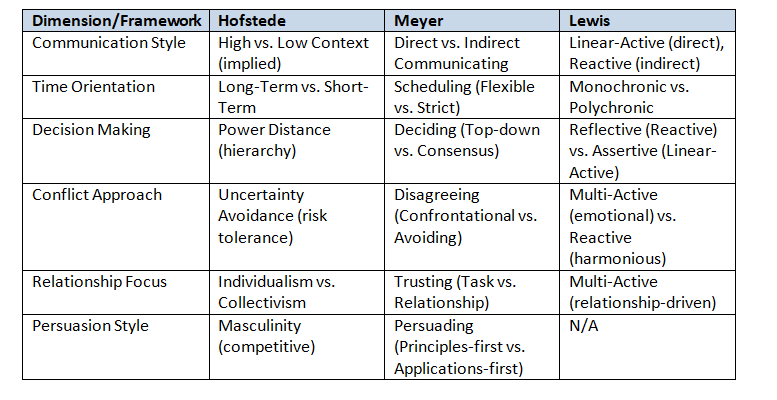
This section compares three leading negotiation frameworks: Hofstede’s Cultural Dimensions, Erin Meyer’s Culture Map, and Richard Lewis Model. Understanding their overlaps and distinctions enables negotiators to select and integrate the most relevant insights.
Implications:
- Hofstede provides macro-level cultural insights relevant for strategic alignment and risk assessment.
- Meyer offers micro-level behavioral guidance for communication and trust-building.
- Lewis simplifies cultural tendencies for practical interpersonal adjustments during negotiation.
Integrating these frameworks yields a holistic understanding critical for international deal success.
Step-by-Step Strategy
Mastering global negotiations requires a deliberate, culturally attuned process. Below is a six-step strategy with specific tactics, language recommendations, and cultural nuances.
Step 1: Pre-Negotiation Research & Cultural Profiling
- Conduct detailed research on the counterpart’s cultural dimensions using Hofstede and Meyer’s tools.
- Assess political and economic risk via PESTLE analysis and country risk ratings.
- Review relevant legal frameworks (e.g., CISG applicability, arbitration preferences).
- Prepare a BATNA (Best Alternative to a Negotiated Agreement) and estimate the ZOPA (Zone of Possible Agreement).
- Example Script: “To ensure a smooth collaboration, we have studied your company’s cultural approach and legal environment to respect your negotiation style and expectations.”
Step 2: Establish Rapport and Build Trust
- Use relationship-building techniques appropriate to the culture (e.g., wasta in the Middle East, nemawashi in Japan).
- Engage in small talk before formal discussions, especially in Latin America and Asia.
- Be mindful of hierarchical protocols; address senior executives respectfully in high power distance cultures.
- Language Tip: Use indirect compliments and avoid blunt statements in high-context cultures.
Step 3: Define Agenda and Process Transparently
- Clarify the negotiation agenda and timeline upfront, adapting to monochronic or polychronic time preferences.
- In Linear-Active cultures, provide a detailed schedule; in Multi-Active cultures, remain flexible.
- Use written summaries to reduce misunderstandings in low-context cultures.
- Example Language: “We propose the following agenda but welcome input to accommodate your preferred approach.”
Step 4: Exchange Information and Interests
- Use open-ended questions to uncover underlying interests rather than fixed positions.
- In cultures favoring indirect communication (e.g., Japan), read between the lines and observe non-verbal cues.
- Avoid confrontational questioning in cultures that value harmony; employ storytelling or analogies.
- Example Script: “Could you share what your primary objectives are in this collaboration? We want to ensure alignment on mutual goals.”
Step 5: Generate Options and Negotiate Terms
- Apply Fisher & Ury’s principled negotiation: focus on interests and generate multiple options for joint gain.
- Use objective criteria such as market data, legal standards, or industry benchmarks to resolve disagreements.
- Account for cultural preferences in decision making: consensus-driven (e.g., Scandinavian countries) vs. top-down (e.g., China).
- Language Tip: “Based on market standards, we suggest these terms to create value for both parties.”
Step 6: Formalize Agreement and Plan Follow-Up
- Confirm understanding and agreement verbally and in writing, respecting the counterpart’s formality preferences.
- For high-context cultures, allow time for internal consultation before final signatures.
- Include dispute resolution clauses aligned with chosen legal frameworks (ICC arbitration, UNCITRAL).
- Example Closing Phrase: “We appreciate your collaboration and look forward to a successful partnership.”
Real-World Case Studies
Case Study 1: US-China Trade Negotiations (2018–2020)
The protracted trade talks between the US and China illuminated the critical role of cultural understanding and legal frameworks. American negotiators favored direct communication and rigid deadlines, while Chinese officials emphasized relationship-building (guanxi), indirect messaging, and consensus. Misunderstanding these dynamics resulted in public brinkmanship and tariff escalations. The eventual partial agreement incorporated provisions respecting both countries’ legal frameworks and negotiation customs, emphasizing phased commitments.
Lesson: Align negotiation pacing and communication style to cultural expectations to prevent escalation and enable phased outcomes.
Case Study 2: EU-UK Brexit Trade Deal Negotiations (2019–2020)
Brexit negotiations revealed the clash between British pragmatism and European Union’s consensus-driven approach. The UK’s Linear-Active style conflicted with the EU’s multi-layered bureaucratic process. Legal complexity around regulatory standards and border controls required detailed application of ICC rules and trade law. British negotiators adapted by emphasizing objective criteria and incremental agreements.
Lesson: Understanding legal frameworks and institutional cultures is crucial when negotiating multi-party international deals.
Case Study 3: Japanese Nemawashi in M&A Negotiations
Japanese firms famously use nemawashi — informal consensus-building before formal meetings — to align stakeholders silently. Western corporations negotiating acquisitions often misinterpret this as indecisiveness. Successful foreign negotiators adjusted by investing time in informal discussions and respecting hierarchical protocols, leading to smoother contract finalization.
Lesson: Respect cultural decision-making processes and invest in behind-the-scenes relationship-building.
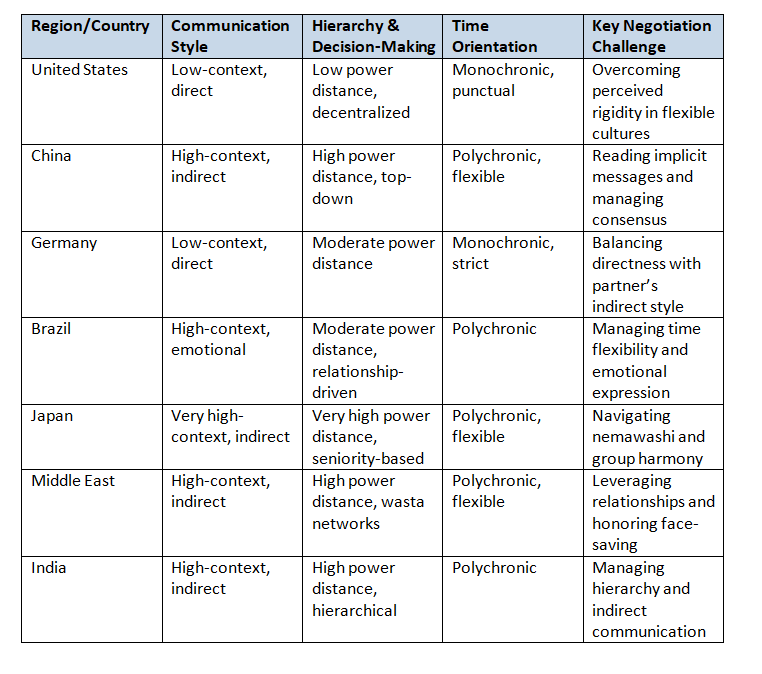
Country/Region-Specific Insights or Challenge Matrix
Advanced Strategies
Global negotiation experts employ refined techniques beyond basic frameworks.
- Managing Interpreters: Choose professional interpreters versed in business terminology and cultural nuances. Brief them beforehand on negotiation goals and sensitive terms. Use “pause and confirm” tactics to ensure accuracy.
- Relationship-Building: Invest time in informal social interactions, gift-giving where appropriate, and understanding local customs like wasta in the Middle East or “saving face” in East Asia.
- Face-Saving: Avoid public criticism; frame disagreements as joint problems. Use indirect language or third-party objective criteria to defuse tension.
- Hierarchy Navigation: Identify decision-makers early; address senior executives with proper titles and defer to protocol. In Korean and Japanese contexts, seating arrangements and gift exchanges signal respect.
- Legal Risk Mitigation: Use detailed contracts incorporating Incoterms and dispute resolution clauses. Consider political risk insurance in volatile markets. Understand transfer pricing and FX risk implications for cross-border payments.
Scripts and Templates
Script 1: Initial Email to Asian Partner (High-Context, Indirect)
Subject: Exploring Collaboration Opportunities
Dear Mr. Chen,
I hope this message finds you well. We have been following your company’s impressive growth and would like to explore potential areas for collaboration that could benefit both our organizations. Understanding the importance of mutual trust and respect, we look forward to engaging in discussions at your convenience.
Please let us know a suitable time for an introductory meeting.
Warm regards,
Script 2: Agenda-Setting for German Counterpart (Low-Context, Direct)
Subject: Proposed Agenda for Upcoming Negotiation Meeting
Dear Ms. Müller,
Ahead of our negotiation session scheduled for March 10th, please find attached the detailed agenda outlining discussion points and timelines. We welcome any suggestions to ensure all relevant topics are covered efficiently.
Looking forward to a productive meeting.
Best regards,
Script 3: Conflict Resolution in Middle Eastern Context (High-Context, Relationship-Driven)
Dear Sheikh Al-Farouq,
Thank you for your valuable feedback. We appreciate the depth of your insights and believe that by working together, we can find solutions that honor the interests of all parties. We are committed to maintaining the strong relationship between our companies and welcome further dialogue at your convenience.
Kind regards,
Script 4: Closing Confirmation for US Partner (Low-Context, Direct)
Subject: Confirmation of Agreement Terms
Dear John,
Following our recent discussions, please find attached the final draft of our agreement reflecting all negotiated terms. Kindly review and confirm your acceptance so we can proceed with formal signing.
Thank you for your cooperation.
Best,
Script 5: Follow-Up Email for Consensus Building in Japanese Context
Subject: Follow-Up on Negotiation Discussions
Dear Mr. Sato,
I would like to express my gratitude for the productive discussions last week. Understanding the importance of internal consensus within your organization, please let us know if we can provide any additional information to assist your deliberations.
We look forward to continuing our cooperation.
Sincerely,
Frequently Asked Questions
Q1: How do I adapt my negotiation style when dealing with high-context cultures?
High-context cultures rely heavily on non-verbal cues, relationships, and implicit communication. Adapt by investing time in relationship-building, avoiding blunt statements, reading between the lines, and showing respect for hierarchy. Use indirect language and be patient with slower decision-making processes.
Q2: What legal frameworks should I consider when drafting international contracts?
Consider the CISG if parties are from signatory countries, ICC arbitration rules for dispute resolution, UNCITRAL Model Law for harmonized commercial laws, and Incoterms to clarify delivery terms. Tailor contracts to local legal environments and include clear jurisdiction and arbitration clauses.
Q3: How can I manage language barriers effectively in virtual international negotiations?
Use professional interpreters or translators familiar with business jargon and cultural nuances. Speak clearly and slowly, avoid idioms or jargon, and confirm understanding frequently. Use video calls to capture non-verbal cues and share written summaries after meetings.
Q4: What is the role of BATNA in international negotiations?
BATNA (Best Alternative to a Negotiated Agreement) provides leverage and confidence. In international contexts, assess BATNA considering political risks, currency fluctuations, and cultural constraints. Knowing your BATNA helps avoid unfavorable compromises.
Q5: How do I handle hierarchical decision-making differences in global deals?
Identify decision-makers early and respect cultural protocols. In high power distance cultures, defer to senior executives and use formal titles. In low power distance cultures, engage multiple stakeholders. Adjust your approach to match the counterpart’s decision-making style to avoid delays.
Conclusion
Mastering global negotiation frameworks is indispensable for executives navigating the multifaceted complexities of international deals. By integrating cultural insights from Hofstede, Meyer, Lewis, and Hall with principled negotiation approaches and legal expertise, negotiators can build trust, manage conflicts, and craft agreements that withstand legal, political, and cultural challenges.
This guide has equipped you with a robust foundation, practical strategies, real-world examples, and adaptable scripts to elevate your international negotiation skills. Embrace these frameworks to transform cross-border challenges into opportunities for sustainable global partnerships.
Start applying these models today to sharpen your negotiation effectiveness and unlock new horizons in global business success.