Global Negotiation Mistakes: What Kills International Deals and How to Avoid Them

The collapse of a $2 billion joint venture between an American technology giant and a leading Chinese conglomerate in 2018 sent shockwaves throughout the international business community. Despite months of talks, the deal unraveled in the final stages due to misaligned expectations, cultural miscommunication, and a critical failure to understand each party’s negotiation style. This high-profile failure starkly illustrates how the seemingly small mistakes in international negotiation can have catastrophic consequences far beyond lost revenue — damaging reputations, creating geopolitical tensions, and closing doors for future business.
International negotiation is never merely about haggling over price or contract terms. It is an intricate dance involving multiple layers of complexity — from understanding deep-rooted cultural values and communication styles to navigating legal frameworks, political environments, and risk landscapes. Yet, many professionals approach these negotiations with inadequate preparation, relying on assumptions or applying domestic negotiation tactics globally. This mismatch often leads to breakdowns in trust, misinterpretation of intent, and ultimately failed deals.
This comprehensive guide equips you to master international negotiation by identifying the most common global negotiation mistakes that kill deals and providing proven strategies to avoid them. You will gain deep insights into cultural frameworks like Hofstede’s dimensions, Erin Meyer’s Culture Map, and the Lewis Model; learn step-by-step negotiation processes tailored for diverse cultures; explore real-world case studies with actionable lessons; and receive expert scripts and templates to execute flawless cross-cultural negotiations with confidence. Prepare to transform your negotiation approach and secure successful global deals.
· Table of Contents
· The Strategic Foundation: Understanding Cultural and Legal Frameworks
· Key Frameworks and Models: Hofstede, Meyer, Lewis Comparison
· Step-by-Step Strategy for Global Negotiations
· Real-World Case Studies of International Negotiation Failures and Successes
· Country and Region-Specific Insights and Challenge Matrix
· Advanced Strategies for Relationship-Building and Legal Risk Mitigation
· Scripts and Templates for Cross-Cultural Negotiations
· Frequently Asked Questions on Global Negotiation Mistakes
· Conclusion and Call to Action
· References
The Strategic Foundation — Understanding Cultural and Legal Frameworks
International negotiations unfold within a complex matrix of cultural values, communication styles, institutional norms, and regulatory environments. To avoid fatal mistakes, negotiators must ground their approach in multidisciplinary frameworks that reveal the underlying drivers of behavior across cultures and legal systems.
Geert Hofstede’s cultural dimensions remain foundational for decoding national cultural differences affecting negotiation. His six dimensions — Power Distance, Individualism vs Collectivism, Masculinity vs Femininity, Uncertainty Avoidance, Long-Term Orientation, and Indulgence — offer a diagnostic lens to anticipate how counterparts perceive authority, risk, relationship building, and time horizons. For example, high Power Distance societies like South Korea expect formal hierarchical respect in negotiations, while low Power Distance countries such as the Netherlands prefer egalitarian interaction.
Erin Meyer’s Culture Map refines this understanding by focusing on eight dimensions particularly relevant for business communication and negotiation: Communicating (low vs high context), Evaluating (direct vs indirect negative feedback), Persuading (principles-first vs applications-first), Leading (egalitarian vs hierarchical), Deciding (consensual vs top-down), Trusting (task-based vs relationship-based), Disagreeing (confrontational vs avoids confrontation), and Scheduling (linear vs flexible). This model enables negotiators to tailor their strategies to bridge communication and decision-making gaps effectively.
Richard Lewis’ model categorizes cultures as Linear-Active (task-focused, schedule-driven), Multi-Active (relationship-oriented, flexible with time), and Reactive (listening-first, harmony-seeking). Knowing whether your counterpart’s culture is, for example, Reactive Japanese versus Multi-Active Brazilian can prevent misinterpretation and frustration.
Edward Hall’s concepts of High vs Low Context communication and Monochronic vs Polychronic time deepen the grasp of implicit versus explicit messaging and time management preferences. High context cultures (Japan, Arab countries) rely heavily on non-verbal cues and unstated assumptions, making direct confrontation taboo, while low context cultures (Germany, US) prefer explicit, clear exchanges.
From a legal perspective, understanding international contract frameworks such as the United Nations Convention on Contracts for the International Sale of Goods (CISG), International Chamber of Commerce (ICC) arbitration rules, UNCITRAL model laws, and Incoterms is critical. These frameworks shape contract enforceability, dispute resolution, and risk allocation. Ignorance or misapplication can lead to costly legal battles or nullified agreements.
Additionally, integrating political risk analysis frameworks such as PESTLE (Political, Economic, Social, Technological, Legal, Environmental) and monitoring country risk ratings allows negotiators to anticipate macro-level threats that could derail deals. Transfer pricing regulations and foreign exchange risk management are crucial for financial viability and compliance in cross-border deals.
A strategic foundation built on these cultural, communication, legal, and political lenses empowers negotiators to navigate the multifaceted challenges that characterize international business transactions.
Key Frameworks and Models — Hofstede, Meyer, and Lewis Compared
To operationalize cultural insights in negotiation strategy, it is essential to understand how key models complement each other and where they differ. The following table compares Hofstede’s, Meyer’s, and Lewis’ frameworks across dimensions relevant to negotiation contexts.
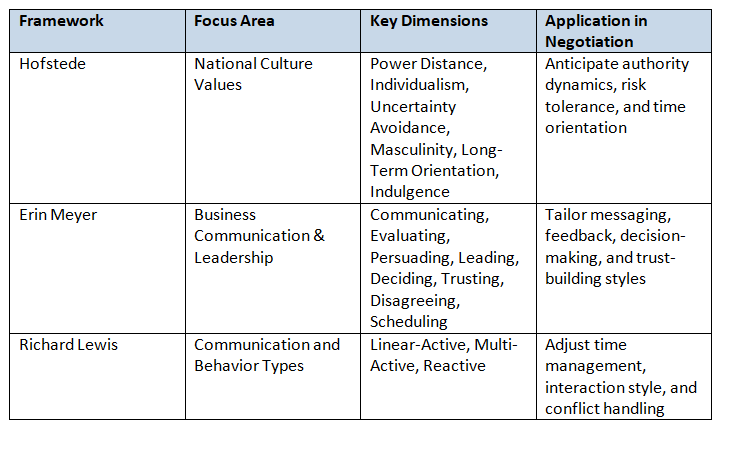
These models intersect and enrich one another. For example, a negotiator working with a Japanese Reactive culture (Lewis) operating within a high Power Distance and high Long-Term Orientation society (Hofstede) will benefit from Meyer’s guidance on indirect communication and consensual decision-making. Understanding these nuances helps prevent common mistakes like pushing for quick decisions or direct confrontation that offend and stall negotiations.
Step-by-Step Strategy for Global Negotiations
Successful international negotiations demand a systematic, culturally informed approach that combines preparation, interaction, and follow-up. Below is a stepwise strategy with specific tactics, language suggestions, and cultural guidance for each phase.
Step 1: Comprehensive Cultural and Political Research
Before initiating talks, conduct exhaustive research on the counterpart’s culture using Hofstede’s dimensions, Meyer’s Culture Map, and Lewis’ categories. Complement with political risk assessment (PESTLE) and legal environment analysis (CISG applicability, arbitration preferences).
· Tactic: Use country-specific negotiation profiles from reliable databases or consultants.
· Language: “We value understanding your cultural priorities and governance to align our approach.”
Step 2: Establish Relationship and Build Trust
In relationship-based cultures (Brazil, Middle East, China), prioritize building rapport through informal meetings, social activities, and demonstrating respect for hierarchy and traditions (e.g., wasta in Middle East, nemawashi consensus-building in Japan).
· Tactic: Allocate time upfront for personal connections; avoid rushing into contract details.
· Language: “We appreciate learning about your company’s history and values as we build a strong partnership.”
Step 3: Clarify Communication and Decision-Making Styles
Identify if counterparts prefer direct or indirect communication, principle-first or application-first persuasion, and consensual or top-down decisions. Adjust messaging accordingly.
· Tactic: Use open-ended questions to gauge communication preferences.
· Language: “How does your team typically approach decisions on strategic partnerships?”
Step 4: Define Clear Negotiation Objectives and BATNA
Specify your Best Alternative to a Negotiated Agreement (BATNA) and assess Zone of Possible Agreement (ZOPA) while considering cultural nuances affecting concessions and face-saving.
· Tactic: Prepare culturally sensitive BATNA scenarios, anticipating counterparts’ BATNA and ZOPA.
· Language: “We aim for a mutually beneficial agreement that respects both parties’ priorities.”
Step 5: Conduct Negotiation with Cultural Flexibility
Manage pacing, conflict style, and protocol. For example, in hierarchical cultures, engage senior decision-makers respectfully; in low context cultures, provide explicit terms; in polychronic cultures, expect flexible schedules.
· Tactic: Leverage interpreters trained in cultural mediation; avoid aggressive tactics.
· Language: Use softening phrases in high context cultures, e.g., “Perhaps we might consider…” rather than “We demand…”
Step 6: Formalize Agreement with Legal and Cultural Sensitivity
Draft contracts reflecting international legal standards (CISG, Incoterms), clarify dispute resolution forums, and include culturally appropriate mechanisms for face-saving and renegotiation.
· Tactic: Engage international legal counsel familiar with counterpart jurisdiction.
· Language: “This agreement honors our shared commitment and offers flexibility for future collaboration.”
Real-World Case Studies of International Negotiation Failures and Successes
Examining actual cases reveals how cultural missteps or strategic brilliance shaped outcomes.
The protracted US-China trade talks revealed the dangers of misreading negotiation tempo and risk tolerance. The US’s direct, confrontational tariff demands clashed with China’s preference for indirect communication and long-term strategic positioning. Failure to appreciate China’s high-context communication and face-saving led to escalated tensions and repeated breakdowns.
The Brexit negotiations exemplified the complexity of legal frameworks and political risk. Disparate legal interpretations of trade agreements and sovereignty clashed with economic imperatives. The EU’s rigid legalist approach contrasted with the UK’s more flexible political strategy, causing delays.
Japanese firms employ nemawashi — informal consensus-building before formal negotiations — to ensure smooth approval processes. Western companies ignoring this process faced mistrust and stalled deals.
Country and Region-Specific Insights and Challenge Matrix
Negotiation effectiveness depends on tailoring approaches to regional and country-specific factors. The table below summarizes key tactical and cultural negotiation challenges and recommendations.
Advanced Strategies — Managing Interpreters, Relationship-Building, Face-Saving, Hierarchy Navigation, and Legal Risk Mitigation
International negotiation success often hinges on mastering subtle, advanced techniques beyond basic cultural awareness.
· Managing Interpreters: Use professional interpreters trained in both language and cultural mediation. Brief them thoroughly on technical terms and negotiation goals. Avoid talking directly to the interpreter; maintain eye contact with your counterpart.
· Relationship Building: Invest in multiple social interactions, gift exchanges, and joint activities reflecting cultural customs (e.g., tea ceremonies in China, business lunches in Brazil). Prioritize trust-building over speed.
· Face-Saving: Recognize that many cultures (East Asia, Middle East) prioritize harmony and indirect conflict resolution. Use language that allows counterparts to retreat gracefully without losing dignity. Avoid public criticism.
· Hierarchy Navigation: Identify decision-makers and gatekeepers. Respect seniority in meetings and communication. In hierarchical cultures such as South Korea or Saudi Arabia, address the highest ranking person first and defer to their authority.
· Legal Risk Mitigation: Engage local legal experts to draft contracts compliant with relevant international conventions and local laws. Include arbitration clauses under ICC or UNCITRAL rules to manage disputes efficiently. Implement currency hedging for FX risks.
Scripts and Templates — Word-for-Word Negotiation and Email Examples Adapted for International Contexts
1. Initial Meeting Request Email (Japan Reactive Culture)
Subject: Request for Meeting to Explore Potential Collaboration
Dear [Name]-san,
I hope this message finds you well. We sincerely admire [Company Name]’s achievements and are interested in exploring how our organizations might work together in a manner beneficial to both.
Would it be convenient for us to arrange a meeting at a time that suits you? We are eager to listen and understand your perspectives.
Thank you for considering our request.
Respectfully,
2. Clarification of Decision-Making Process (Germany Low Context)
Dear [Name],
To ensure alignment, could you please clarify your team's decision-making process and timeline for the proposed agreement? Understanding this will help us coordinate our internal approvals effectively.
We look forward to your guidance.
Best regards,
3. Addressing Delays with Politeness (Brazil Multi-Active)
Dear [Name],
I hope all is well. We understand that schedules can be dynamic, and we want to ensure our collaboration proceeds smoothly. Please let us know if there is any support we can provide to assist with the current timeline.
Looking forward to your response.
Warm regards,
4. Offering Concessions with Face-Saving (China High Context)
Dear [Name],
In recognition of our valued partnership, we would like to propose a slight adjustment to the terms that we believe supports mutual benefit and long-term cooperation. We welcome your thoughts and look forward to your esteemed feedback.
Sincerely,
5. Finalizing Contract and Next Steps (Middle East High Power Distance)
Dear Sheikh [Name],
It is with great respect that we acknowledge the progress made in our discussions. We kindly present the final draft of the agreement for your perusal and approval. Please advise on any further considerations you deem necessary.
We remain committed to a prosperous partnership.
Kind regards,
Frequently Asked Questions
Q1: What are the most common cultural mistakes in global negotiations?
A1: Common mistakes include misinterpreting indirect communication as evasiveness, ignoring hierarchy and decision-making protocols, undervaluing relationship-building time, imposing Western time-driven agendas on polychronic cultures, and failing to recognize face-saving needs leading to public embarrassment or loss of trust.
Q2: How can I identify my counterpart’s BATNA in a cross-cultural context?
A2: Employ culturally sensitive inquiry techniques, such as open-ended questions and scenario discussions, to gauge alternatives without direct confrontation. Researching the counterpart’s market position, political environment, and previous deals also provides clues to their BATNA.
Q3: What legal frameworks should I prioritize in international contracts?
A3: The CISG governs many international sales contracts, but regional differences apply. Including arbitration clauses referencing ICC or UNCITRAL rules ensures neutral dispute resolution. Compliance with Incoterms clarifies delivery obligations. Local legal counsel should verify enforceability.
Q4: How do I manage negotiation meetings with interpreters effectively?
A4: Brief interpreters in advance; speak slowly and clearly; address your counterpart directly, not the interpreter; avoid idioms or slang; pause frequently to allow accurate translation; and observe non-verbal cues to ensure understanding.
Q5: How can I recover a negotiation that is stalling due to cultural misunderstandings?
A5: Pause and acknowledge potential cultural differences openly but diplomatically; propose a break or informal discussion; engage a cultural mediator or third-party facilitator; revisit shared goals; and rebuild trust through relationship-focused activities.
Conclusion
Avoiding global negotiation mistakes requires more than cultural awareness; it demands an integrated strategy combining deep research, adaptive communication, legal acumen, and relationship intelligence. By leveraging established frameworks such as Hofstede’s dimensions, Meyer’s Culture Map, and Lewis’ behavioral models, negotiators can anticipate potential pitfalls and tailor their approaches to diverse international contexts.
Implementing the step-by-step strategies, learning from real-world failures and successes, utilizing country-specific insights, and applying advanced techniques like managing interpreters and face-saving will elevate your negotiation outcomes. With carefully crafted scripts and templates, you can navigate complex deals confidently and respectfully. Embrace these insights to transform your international negotiations—turn challenges into opportunities and close deals that withstand cultural and strategic complexities.
Start applying these principles today to build lasting, profitable global partnerships. For personalized negotiation strategy consultation and advanced training, contact our expert team to guide your next international deal.
References
· Hofstede, G. (2001). Culture’s Consequences: Comparing Values, Behaviors, Institutions and Organizations Across Nations. Sage Publications.
· Meyer, E. (2014). The Culture Map: Breaking Through the Invisible Boundaries of Global Business. PublicAffairs.
· Lewis, R. D. (2006). When Cultures Collide: Leading Across Cultures. Nicholas Brealey Publishing.
· Hall, E. T. (1976). Beyond Culture. Anchor Books.
· Fisher, R., Ury, W., & Patton, B. (2011). Getting to Yes: Negotiating Agreement Without Giving In. Penguin Books.
· United Nations Commission on International Trade Law (UNCITRAL). (1980). United Nations Convention on Contracts for the International Sale of Goods (CISG).