Good Cop Bad Cop Tactic in Negotiation: How It Works and How to Beat It

Negotiations can be high-stakes psychological battlegrounds where influence and perception dictate outcomes. Imagine a major technology licensing negotiation between two multinational companies. The seller deploys a classic Good Cop Bad Cop routine. One executive storms in aggressively, slamming down hard terms and deadlines, projecting uncompromising demands. Moments later, a second executive enters with a softer tone, empathizing, offering concessions, and positioning themselves as the reasonable party. The buyer, caught off guard, feels compelled to accept less favorable terms, intimidated by the “bad cop” and relieved by the “good cop.” This tactic, often dramatized in films and TV, has real-world consequences—sometimes leading to rushed agreements, buyer’s remorse, or damaged long-term relationships.
The psychological power of the Good Cop Bad Cop tactic lies in how it exploits human behavioral biases and neurological responses. It leverages contrast effects, anchoring, and emotional framing to manipulate perceptions of fairness and urgency. Behavioral economics research, including Daniel Kahneman’s work on prospect theory and framing, explains why the victim of this tactic perceives the “good cop” as a savior and the “bad cop” as a threat, triggering loss aversion and compliance. Neuroscientific studies reveal that emotional circuits activated by perceived threat and relief influence decision-making processes under pressure, making negotiators more susceptible to this manipulation.
This comprehensive guide will equip you with everything needed to master this tactic like a virtuoso negotiator. You will learn the deep psychological mechanisms behind Good Cop Bad Cop, how to deploy it effectively across various negotiation contexts, and most importantly, how to detect and dismantle it when used against you. We will provide exact step-by-step processes, word-for-word scripts, counter-tactic frameworks, and decision trees developed from decades of research and real-world negotiation examples. Whether you are a senior sales director, lawyer, or procurement manager, you will gain actionable intelligence to turn the tables in your favor.
· Table of Contents
· The Science Behind This Tactic
· How This Tactic Works in Practice
· Step-by-Step: How to Deploy This Tactic
· How to Recognize and Counter This Tactic
· Real-World Case Studies
· Common Mistakes When Using This Tactic
· Scripts and Templates
· Frequently Asked Questions
· Conclusion
· References
The Science Behind This Tactic
The Good Cop Bad Cop tactic is a classic example of behavioral manipulation grounded in psychological principles and behavioral economics. At its core, the tactic leverages the cognitive biases of contrast effect, emotional framing, and social influence to create a powerful push-pull dynamic on the target negotiator.
The contrast effect describes how people evaluate options relative to comparisons made immediately before. Introduced in the foundational work by Tversky and Kahneman (1974), the contrast effect shows that a harsh demand (“bad cop”) makes a subsequent softer request (“good cop”) appear much more reasonable, increasing the likelihood of concession. This is a form of anchoring, where the initial extreme demand anchors the perceived norm.
Social psychology research from Robert Cialdini’s principles of influence (2006) also applies. The “good cop” leverages reciprocity by offering concessions, fostering a sense of obligation in the counterpart to reciprocate with agreement. Meanwhile, the “bad cop” creates scarcity by imposing pressure or deadlines, increasing the perceived cost of delay or rejection.
Chris Voss, former FBI hostage negotiator, highlights the importance of tactical empathy and calibrated questions to detect and counteract this tactic. By labeling emotions and mirroring language, negotiators can defuse the manipulative dynamic and regain control (Voss, 2016).
In sum, Good Cop Bad Cop is a multi-layered psychological strategy combining anchoring, framing, loss aversion, social reciprocity, and emotional manipulation, all designed to steer decision-making under pressure.
How This Tactic Works in Practice
Good Cop Bad Cop operates along a spectrum from subtle psychological nudges to overt theatrical performance. Its mechanics involve coordinated role-playing by two negotiators from the same side, alternating between antagonistic and conciliatory approaches to shape perceptions.
Variants include:
· Traditional dual negotiator roles with timed alternation
· Single negotiator switching tones strategically
· Hybrid approaches incorporating third-party intermediaries
The tactic’s effectiveness depends on context, relationship history, cultural norms, and the target’s negotiation experience. For less experienced negotiators, the emotional contrast is more impactful, while seasoned negotiators may detect and resist the ploy unless deployed with nuance.
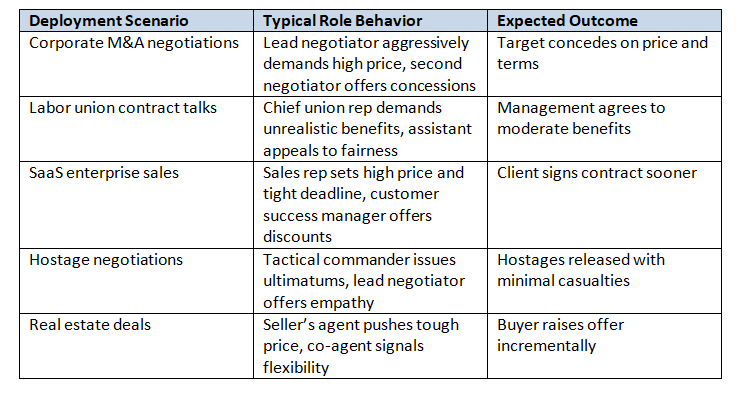
Different deployments elicit varied emotional and cognitive responses. For instance, aggressive “bad cop” behavior triggers stress, activating fight-or-flight responses, while the “good cop” reduces anxiety, fostering rapport. The net effect is a powerful push-pull leverage over the target’s decision-making frame.
Step-by-Step: How to Deploy This Tactic
To deploy Good Cop Bad Cop effectively, follow these six critical steps, each with precise timing, language, and role allocation:
Step 1: Preparation and Role Assignment
Identify two negotiators with complementary styles. The “bad cop” should be authoritative, assertive, and willing to push boundaries without burning bridges. The “good cop” must be empathetic, calm, and skilled at rapport building. Pre-define signals and timing to coordinate seamlessly.
Step 2: Initiate with the Bad Cop
Begin the negotiation with the “bad cop” setting stringent demands or ultimatums. Use calibrated, assertive language. Example script: “We need your decision by end of day, or these terms will no longer be available. Frankly, we see no room for compromise here.”
Step 3: Wait for Reaction and Observe Signals
Watch for signs of stress, hesitation, or confusion from the counterpart. The “bad cop” should maintain firm but controlled pressure without alienating. Silence and calibrated pauses amplify tension.
Step 4: Introduce the Good Cop
After sufficient pressure, have the “good cop” enter with a softer tone. Use phrases that lower defenses and offer concessions. Example: “I understand these demands sound tough. Let’s explore ways to make this work for both sides.”
Step 5: Build Rapport and Foster Reciprocity
The “good cop” should demonstrate empathy, listen actively, and offer small but meaningful concessions. Leverage Cialdini’s reciprocity principle to encourage counter-concessions. Use calibrated questions: “What would be a workable solution from your perspective?”
Step 6: Close by Alternating Pressure and Relief
Cycle between “bad cop” and “good cop” roles as needed to sustain emotional contrast and momentum. Use escalating deadlines or scarcity cues with the “bad cop” and problem-solving framing with the “good cop.” This dynamic maintains leverage until agreement.
How to Recognize and Counter This Tactic
Detecting Good Cop Bad Cop when used against you is critical to maintaining negotiation power. Key signals include abrupt shifts in tone between interlocutors, inconsistent messaging, and emotional rollercoaster effects designed to destabilize.
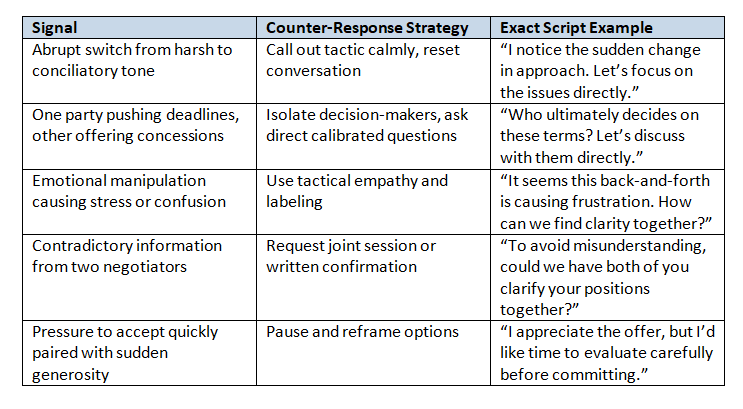
Key counter-tactics involve:
· Maintaining emotional detachment and critical thinking
· Using calibrated questions to expose inconsistencies
· Demanding transparency and joint communication
· Reframing the negotiation as a collaborative problem-solving exercise
These responses neutralize the emotional manipulation and restore balance to the bargaining process.
Real-World Case Studies
The Good Cop Bad Cop tactic has featured in numerous high-profile negotiations:
1. Apple vs Samsung Patent Negotiations (2012): During patent licensing talks, Samsung’s legal team reportedly used aggressive “bad cop” posturing followed by conciliatory offers from senior executives. Apple’s negotiators recognized the pattern, using calibrated questions to expose inconsistencies and maintain firm pricing, ultimately securing favorable licensing terms.
2. NFL Contract Disputes (2011 Lockout): The NFL owners deployed a classic Good Cop Bad Cop routine with their collective bargaining representatives. One negotiator issued hardline demands on salary caps (“bad cop”), while another offered incremental concessions (“good cop”). Players’ union leaders countered by calling for direct talks and public transparency, diffusing the tactic.
3. FBI Hostage Negotiation, 1993 Waco Siege: Tactical commanders used alternating pressure and empathy in negotiations with the Branch Davidians. The “bad cop” role applied tactical ultimatums, while lead negotiators deployed empathy and rapport building. The prolonged standoff highlighted both the power and limitations of this tactic under extreme stress.
Lessons from these examples stress the importance of recognizing role-played dynamics, insisting on transparency, and maintaining calibrated communication to avoid being manipulated.
Common Mistakes When Using This Tactic
Despite its utility, Good Cop Bad Cop misfires frequently due to:
· Poor coordination between “bad” and “good” roles leading to confusion
· Overly aggressive “bad cop” behavior causing irreparable damage
· Predictability making the tactic transparent and ineffective
· Misreading cultural or personality differences that reject adversarial roles
· Failing to adapt timing, causing the “good cop” to appear insincere
To fix these issues, negotiators should:
· Rehearse role transitions with timing cues
· Calibrate pressure to preserve relationships
· Vary approaches to avoid predictability
· Tailor tactics to cultural norms and counterpart disposition
· Ensure the “good cop” demonstrates genuine empathy and flexibility
Scripts and Templates
Below are exact scripts for deploying and countering Good Cop Bad Cop in different contexts:
1. Sales Email Deployment
Bad Cop: “Due to supplier constraints, this pricing is non-negotiable and limited to this week.”
Good Cop (follow-up): “However, I want to ensure your success and can offer flexible payment terms to help.”
2. In-Person Meeting Counter
“You seem to be taking very different positions here. Let’s get on the same page and focus on shared goals.”
3. Phone Negotiation Deployment
Bad Cop: “We can’t extend the offer beyond today. If you don’t commit, we’ll have to reconsider.”
Good Cop: “But I want to understand your concerns and see how we can make this work.”
4. Email Counter to Pressure
“I appreciate the urgency. To ensure a sound decision, I’d like to schedule a follow-up call after reviewing the details.”
5. Joint Session Request
“To avoid any confusion, would it be possible for both of you to join the next call together?”
Frequently Asked Questions
Q1: Can Good Cop Bad Cop backfire on the negotiator using it?
Yes. If overused or poorly executed, it can erode trust, make the other party defensive, and stall negotiations. Authenticity and timing are critical.
Q2: Is this tactic ethical in business negotiations?
Ethics depend on context and transparency. While psychological tactics are common, coercive or deceptive use can damage reputations and relationships.
Q3: How do cultural differences affect the tactic’s effectiveness?
Some cultures view aggressive negotiation negatively, making the “bad cop” role counterproductive. Understanding cultural norms is essential.
Q4: Can a single negotiator use this tactic alone?
Yes, by switching tone strategically during the negotiation, though it’s less effective than a paired approach.
Q5: What psychological signs indicate I am being subjected to Good Cop Bad Cop?
Rapid shifts in tone, emotional pressure followed by relief gestures, inconsistent messages, and deadlines paired with concessions are red flags.
Conclusion
The Good Cop Bad Cop negotiation tactic remains one of the most potent psychological strategies for shaping negotiation outcomes. Rooted in well-documented behavioral economics and social psychology principles, it plays on contrast, anchoring, loss aversion, and reciprocity to manipulate perceptions and decisions. However, mastery of this tactic requires more than rote role-playing—it demands deep understanding of human cognition, emotional intelligence, and cultural sensitivity.
For negotiators on both offense and defense, this guide arms you with the science, step-by-step deployment methods, countermeasures, scripts, and real-world insights to wield or neutralize Good Cop Bad Cop with confidence and precision. As negotiations grow more complex and adversarial, your ability to recognize and strategically respond to psychological tactics will be a decisive competitive advantage. Take control of your negotiation destiny—practice these principles, adapt thoughtfully, and transform potential manipulation into mutual value creation.