Handling Deadlocks in Negotiation: How to Break the Impasse

Imagine a high-stakes corporate merger negotiation teetering on the edge of collapse. After weeks of discussions, the two parties reach a deadlock, each entrenched in incompatible terms. One negotiator, sensing the growing tension, resorts to veiled threats and aggressive ultimatums, further escalating the conflict. The deal that could have transformed their companies now risks unraveling entirely. This scenario is all too common, and understanding how to break these impasses is critical for leaders, negotiators, and managers who operate in high-pressure environments.
The reality of negotiation is that battles are often won—or lost—in the first few minutes, as emotional triggers set the tone for interaction. Many negotiators fall prey to automatic, reactive patterns—what Daniel Kahneman calls System 1 thinking—leading to escalations and deadlocks. What most people get wrong is underestimating the psychological complexity beneath the surface: the fight-flight-freeze responses, social identity defenses, and hidden emotional currents that shape decisions. Without mastering these underpinnings, strategic concessions or clever tactics alone won't suffice.
This comprehensive guide empowers you to master the art and science of breaking negotiation deadlocks. You will learn how to harness tactical empathy (Chris Voss), employ William Ury’s "Going to the Balcony" mindset, use the Thomas-Kilmann Conflict Model to diagnose conflict styles, and apply exact word-for-word scripts for de-escalation. Armed with real-world case studies and actionable step-by-step processes, you’ll confidently navigate and resolve even the most intractable negotiation impasses.
· Table of Contents
· The Psychology Behind This Challenge
· Key Frameworks and Models for Breaking Deadlocks
· Step-by-Step Process to Break the Impasse
· Real-World Case Studies of Deadlock Resolution
· Recognizing and Countering Manipulation Tactics
· Advanced Techniques for High-Stakes Negotiation
· Scripts and Templates for Difficult Scenarios
· Frequently Asked Questions
· Conclusion and Call to Action
· References
The Psychology Behind This Challenge
Negotiation deadlocks are rarely just about incompatible interests—more often, they are battles of psychology and perception. At the core of many impasses is what psychologist Daniel Kahneman identifies as the dichotomy between System 1 and System 2 thinking. System 1 operates automatically and quickly, driven by emotional and intuitive responses; System 2 is slower, deliberate, and rational. In tense negotiations, parties often default to System 1, leading to reactive, emotionally charged decisions that entrench positions.
A major psychological phenomenon at play is the amygdala hijack. When negotiators feel threatened—whether by perceived disrespect, loss of face, or high stakes—the amygdala triggers a fight, flight, or freeze response. This emotional flooding, as described by John Gottman, impairs rational thinking and increases aggression or withdrawal. Recognizing and managing this emotional surge is essential to breaking deadlocks.
Chris Voss, former FBI lead hostage negotiator, emphasizes tactical empathy as a tool to bypass defenses and connect with the counterpart's emotional state. By acknowledging and verbalizing the other party’s feelings without judgment, negotiators can reduce hostility and open pathways for dialogue.
Social identity theory also explains why deadlocks persist: negotiators often see themselves and their side as part of an in-group, while viewing opponents as an out-group with opposing values. This creates moral rigidity and zero-sum thinking, escalating the impasse.
Understanding these psychological drivers allows negotiators to move beyond positional bargaining and tap into underlying needs and fears, which is crucial for breaking negotiation deadlocks.
Key Frameworks and Models
Several established negotiation frameworks offer structured approaches to diagnose and break impasses. Below is a comparison of three critical models widely used by expert negotiators:
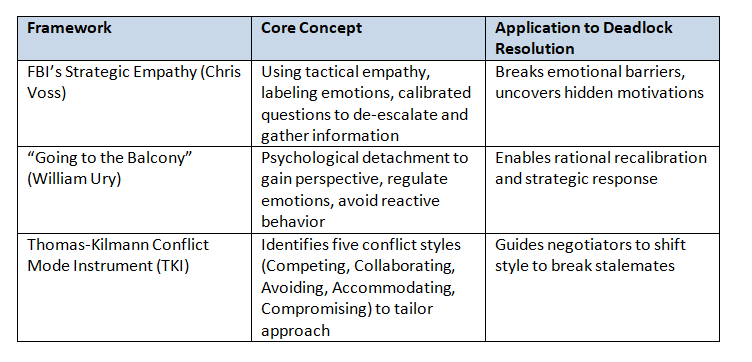
Chris Voss’s approach is grounded in real-time emotional intelligence, perfect for volatile moments when emotions threaten to spiral. William Ury’s concept encourages stepping back mentally, observing the negotiation objectively, and managing emotional impulses. The Thomas-Kilmann model helps negotiators recognize their default conflict style and adapt by choosing more constructive approaches to unlock deadlocks.
Each framework complements the others, and integrating them allows negotiators to address multiple layers of conflict simultaneously.
Step-by-Step Process
Breaking a negotiation deadlock is a deliberate, multi-stage process requiring psychological insight, strategic communication, and patience. Here is an expert-level six-step method incorporating cognitive and emotional tools:
Step 1: Emotional Self-Regulation — “Go to the Balcony”
Before engaging, consciously detach from reactive emotions by visualizing “going to the balcony” (Ury). Recognize when your amygdala is hijacked and activate System 2 thinking to maintain composure.
Techniques:
- Deep breathing and grounding exercises
- Mental rehearsal of neutral, composed responses
- Internal dialogue to affirm control over reactions
Step 2: Tactical Empathy and Active Listening
Employ Voss’s tactical empathy: silently acknowledge the counterpart’s emotions, then label them aloud to demonstrate understanding.
Script example: “It seems like you’re frustrated by the current terms.”
Benefits:
- Defuses hostility
- Encourages openness
- Builds rapport without conceding ground
Step 3: Identify Conflict Styles Using TKI
Assess your counterpart’s likely conflict style and your own. For example, if they are competing and you are avoiding, anticipate resistance and prepare to shift toward collaboration.
Application:
- Use calibrated questions to gauge mindset
- Adapt approach: be more assertive or accommodating as needed
Step 4: Reframe the Problem and Interests
Shift focus from positions (“We want X”) to underlying interests (“We need Y because…”).
Questions to probe interests:
- “What are the key outcomes you’re hoping for?”
- “What concerns keep you from agreeing to this?”
Reframing encourages creative options and breaks rigid stalemates.
Step 5: Introduce Objective Criteria and Third-Party Standards
Invoke independent benchmarks, market data, or industry standards to ground negotiations in fairness rather than power struggles.
Example:
- “According to recent market rates, this price is typical.”
- “Let’s consider what an impartial arbitrator might decide.”
This reduces perception of bias and increases legitimacy.
Step 6: Propose Conditional Concessions and “If-Then” Offers
Instead of unconditional concessions, present conditional ones that require reciprocal movement.
Script example:
- “If you can agree to X, then we can consider adjusting Y.”
This maintains leverage while signaling flexibility and progress.
By following these steps sequentially, negotiators can systematically reduce emotional barriers, clarify interests, and create momentum toward resolution.
Real-World Case Studies
Analyzing real-world deadlocks illustrates these principles in action:
Case Study 1: FBI Hostage Negotiation, 1993 Waco Standoff
During the 51-day standoff, FBI negotiators employed tactical empathy to build rapport with David Koresh’s followers. Labeling emotions and carefully calibrated questions helped reduce tension intermittently, though the final outcome was tragic due to multiple factors. The key lesson: empathy and emotional management are critical even under extreme pressure.
Case Study 2: Boeing-Airbus Trade Dispute (2004-2019)
A prolonged WTO dispute over subsidies escalated into retaliatory tariffs. Diplomatic deadlock persisted until objective criteria and third-party arbitration (WTO rulings) created a framework for compromise. Lesson: introducing impartial standards can break entrenched political and economic conflicts.
Case Study 3: Toxic Client Negotiation in Tech Services
A software vendor faced a client who repeatedly rejected proposals and used deadline pressure aggressively. The vendor’s negotiator applied “Going to the Balcony” to avoid reactive concessions, used tactical empathy to acknowledge client frustration, and proposed conditional offers tied to deliverables. The deal was salvaged with improved terms and relationship repair. Lesson: managing emotional flooding and using calibrated concessions works in toxic business scenarios.
Recognizing and Countering Tactics
Difficult negotiators use various tactics that escalate deadlocks. Below is a table mapping common tactics to their psychological mechanisms and recommended counter-strategies.
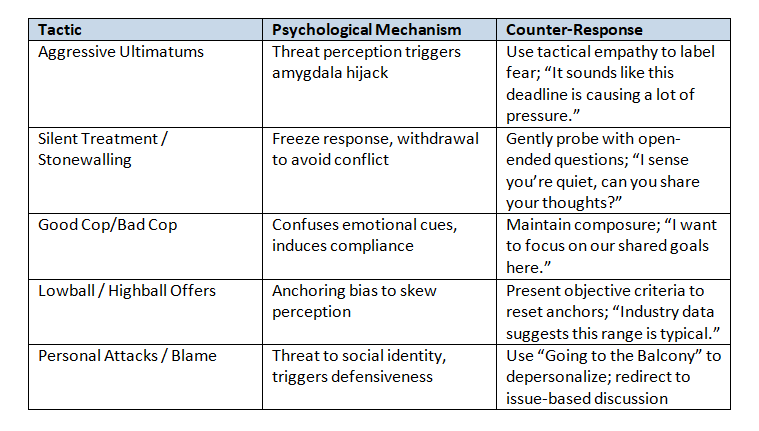
Recognizing these tactics early and responding with calibrated psychological tools neutralizes manipulation and de-escalates conflict.
Advanced Techniques
For senior negotiators facing the toughest deadlocks, consider these expert-level approaches:
- Emotional Labeling Combined with Micro-Expression Reading (Paul Ekman): Detect subtle facial cues to identify hidden emotions and address unspoken concerns immediately.
- The “Third Side” Perspective (William Ury): Engage neutral stakeholders or mediators who represent the broader community interest to add pressure and legitimacy.
- Presence Under Pressure (Amy Cuddy’s Power Poses): Employ physiological techniques pre-negotiation to boost confidence and reduce stress responses.
- Moral Reframing (Jonathan Haidt): Recast the negotiation in terms aligned with the counterpart’s moral values to overcome ideological divides.
- Strategic Silence: Use well-timed pauses after proposals to compel the other side to fill the void, often leading to concessions.
These advanced methods require skillful application but can decisively shift deadlocks in your favor.
Scripts and Templates
Here are exact word-for-word scripts for common deadlock scenarios:
1. [De-escalating Aggression]
“It seems like this issue is really important to you, and I want to understand your concerns better. Can you help me see what’s driving your position?”
2. [Breaking Silence]
“I notice it’s been quiet for a while. What’s on your mind? I’m here to listen.”
3. [Reframing]
“Instead of focusing on the price alone, let’s talk about what outcomes are most critical for each of us.”
4. [Conditional Concession]
“If you can agree to a delivery timeline of X, then I’m willing to discuss adjusting the payment terms.”
5. [Invoking Objective Criteria]
“Based on the recent industry report, the standard practice is to allocate resources this way. How can we align with that?”
Using these scripts verbatim in appropriate contexts helps maintain control and progress negotiations productively.
Frequently Asked Questions
Q1: How can I remain calm when the other party is hostile and threatening?
A1: Employ the “Going to the Balcony” technique. Focus on deep breathing to engage System 2 thinking and use tactical empathy to acknowledge their emotions without reciprocating aggression.
Q2: What if the counterpart refuses to negotiate or stonewalls?
A2: Gently probe with open-ended questions to encourage dialogue. Use calibrated questions like “What would it take for you to feel comfortable moving forward?” Also, consider bringing in a neutral third party.
Q3: Can deadlocks be prevented altogether?
A3: While some are inevitable, preparing with frameworks like TKI to understand conflict styles and setting ground rules for respectful communication reduces likelihood of impasse.
Q4: How do I handle a negotiator who uses manipulative tactics like lowball offers?
A4: Do not respond emotionally. Instead, reset the conversation with objective criteria and calmly explain why the offer is unrealistic.
Q5: When is it appropriate to walk away from a deadlocked negotiation?
A5: If all attempts at resolution fail and costs outweigh benefits, walking away may protect your interests. However, ensure you have explored all steps including mediation and reassessment.
Conclusion
Breaking deadlocks in negotiation is as much a psychological battle as it is a strategic one. By understanding the emotional undercurrents — from amygdala hijack to social identity threats — and applying proven frameworks like tactical empathy and “Going to the Balcony,” negotiators can transform impasses into breakthroughs. The six-step process and real-world case studies equip you with practical tools to manage even the most stubborn conflicts.
Whether you are a corporate executive, legal counsel, or sales leader, mastering these techniques will elevate your negotiation effectiveness and safeguard critical deals. Start integrating these strategies today to convert deadlocks into decisive wins. For deeper personalized guidance, consider advanced training or coaching tailored to your negotiation challenges.
References
1. Kahneman, D. (2011). Thinking, Fast and Slow. Farrar, Straus and Giroux.
2. Voss, C., & Raz, T. (2016). Never Split the Difference: Negotiating As If Your Life Depended On It. Harper Business.
3. Ury, W. (1991). Getting Past No: Negotiating in Difficult Situations. Bantam Books.
4. Gottman, J. M. (1994). What Predicts Divorce? The Relationship Between Marital Processes and Marital Outcomes. Lawrence Erlbaum Associates.
5. Cialdini, R. B. (2006). Influence: The Psychology of Persuasion. Harper Business.
6. Ekman, P. (2003). Emotions Revealed: Recognizing Faces and Feelings to Improve Communication and Emotional Life. Times Books.
7. Haidt, J. (2012). The Righteous Mind: Why Good People Are Divided by Politics and Religion. Pantheon Books.
8. Thomas, K. W., & Kilmann, R. H. (1974). Thomas-Kilmann Conflict Mode Instrument. CPP, Inc.
9. Amy Cuddy (2015). Presence: Bringing Your Boldest Self to Your Biggest Challenges. Little, Brown and Company.