Handling Ultimatums in Negotiation: How to Respond Without Caving

Negotiation tables have witnessed countless moments where one party slams down an ultimatum — “Take it or leave it,” “Agree now or lose everything,” or “This is our final offer.” Imagine a corporate CEO facing a hostile board pushing for an immediate merger under threat of removal. Or a labor union leader confronted with a “no compromise” stance that could trigger a strike. In international diplomacy, ultimatums can escalate tensions to the brink of conflict, as seen in historical crises like the Cuban Missile Crisis. These moments are fraught with pressure, high stakes, and emotional volatility, demanding the negotiator’s utmost skill and psychological acuity.
The core challenge is that ultimatums often trigger instinctual, emotional responses rather than thoughtful decision-making. Behavioral science shows that under pressure, the brain’s amygdala hijacks our System 2 rational thinking (as Daniel Kahneman explains), leading to reactive concessions or rigid refusals. Meanwhile, negotiators unfamiliar with tactical empathy (Chris Voss), emotional flooding (John Gottman), and trust dynamics risk escalating conflict or losing leverage. The psychological interplay can trap negotiators in a lose-lose scenario, where yielding feels like surrender and resisting feels like risking collapse.
This comprehensive guide will equip you to master ultimatums with confidence and composure. You will learn the neuroscience behind emotional hijacking, the psychology of ultimatums, and why typical responses fail. We will explore proven frameworks such as Voss’s FBI method, William Ury’s “Going to the Balcony,” and the Thomas-Kilmann Conflict Model to map your approach. You’ll follow a detailed, step-by-step process for responding to ultimatums, infused with exact psychological techniques and word-for-word scripts. Real-world examples from FBI hostage crises to multinational M&A breakdowns will illustrate practical lessons. Finally, advanced strategies and countermeasures will prepare you for even the most difficult dynamics, ensuring you respond without caving and emerge with trust and leverage intact.
· Table of Contents
· The Psychology Behind This Challenge
· Key Frameworks and Models
· Step-by-Step Process for Handling Ultimatums
· Real-World Case Studies
· Recognizing and Countering Difficult Negotiation Dynamics
· Advanced Techniques
· Scripts and Templates
· Frequently Asked Questions
· Conclusion
· References
The Psychology Behind This Challenge
At the heart of ultimatum negotiations lies a profound psychological battleground. Understanding this terrain is critical to responding effectively rather than reacting impulsively.
When faced with an ultimatum, the brain’s **amygdala**—the emotional processing center—can trigger an “amygdala hijack,” a term coined by Daniel Goleman. This results in an immediate fight-flight-freeze reaction, shutting down the more deliberative and analytical **System 2** thinking described by Nobel laureate Daniel Kahneman in *Thinking, Fast and Slow*. The urgent emotional reflex (System 1) often leads negotiators to either concede prematurely (flight) or dig in rigidly (fight), both of which can undermine outcomes.
Chris Voss, former FBI hostage negotiator and author of *Never Split the Difference*, emphasizes the power of **tactical empathy** to counterbalance emotional flooding. Tactical empathy is the deliberate effort to understand and vocalize the other party’s perspective without agreeing, a critical tool to de-escalate tension and re-engage rational dialogue. John Gottman’s research on emotional flooding in couples therapy reveals how overwhelming emotions impair communication and trust, a dynamic equally relevant in negotiation contexts.
Behavioral economics experiments, particularly the **Ultimatum Game**, show that people frequently reject unfair offers even at a personal cost, driven by perceptions of fairness and emotional insult rather than pure rational gain. This reinforces that ultimatums are not only strategic tools but emotional leverage points.
Finally, trust repair theories remind us that ultimatums often erode relational capital. Successful negotiators recognize that navigating ultimatums involves both managing immediate conflict and preserving or rebuilding trust for future collaboration.
This psychological framework sets the stage for a nuanced, effective approach to ultimatums—one that harnesses emotional regulation, empathy, and strategic thinking together.
Key Frameworks and Models
Several influential frameworks from negotiation and conflict resolution literature offer structured approaches to handle ultimatums. Below is a comparison of three essential models:
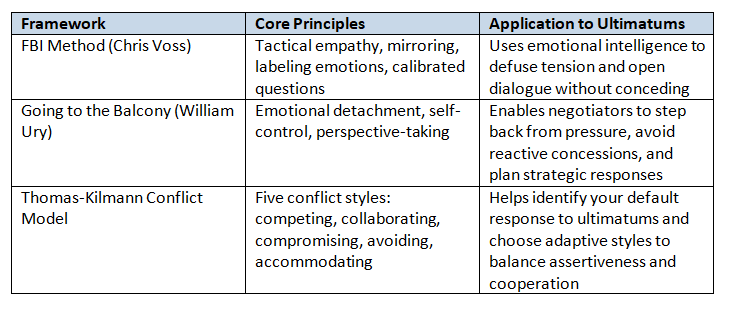
Each framework offers unique strengths. Voss’s FBI method excels at managing emotional intensity in real time, Ury’s balcony technique supports cognitive regulation under pressure, and Thomas-Kilmann provides a diagnostic lens to guide style adaptation. Integrating these frameworks creates a robust toolkit for ultimatum mastery.
Step-by-Step Process for Handling Ultimatums
Mastering ultimatums requires a methodical approach combining psychological insight and tactical moves. Below is a detailed six-step process incorporating proven techniques.
Step 1: Pause and Regulate Emotion
When presented with an ultimatum, resist the urge to react immediately. Use **Amy Cuddy’s power pose** or breathing exercises to calm your amygdala response and engage System 2 thinking. This “going to the balcony” moment prevents emotional flooding and impulsive concessions.
Step 2: Label and Mirror to Validate Emotions
Apply Voss’s **labeling** technique to acknowledge the other party’s feelings—“It seems like you feel this is a make-or-break moment.” Use **mirroring** by repeating key words to encourage them to elaborate. This demonstrates tactical empathy and lowers hostility without agreeing.
Step 3: Ask Calibrated Questions
Shift from confrontation to collaboration by posing open-ended, non-threatening questions such as: “What’s driving this deadline? What would happen if we explore alternatives?” This redirects the conversation from ultimatum to problem-solving.
Step 4: Reframe the Ultimatum
Use reframing to challenge the binary nature of the ultimatum. For example, “I hear this is presented as a final offer, but let’s explore what success looks like for both of us.” This expands the negotiation space and reduces pressure.
Step 5: Anchor with Your BATNA and Set Clear Boundaries
Know your **Best Alternative to a Negotiated Agreement (BATNA)** and communicate it calmly. For instance, “While I value working together, if we cannot find common ground, we have alternative paths we are prepared to pursue.” Setting boundaries signals strength without aggression.
Step 6: Build Trust and Plan Follow-Up
Ultimatums often damage trust. Use Gottman’s trust repair principles: express appreciation, acknowledge the strain, and propose next steps to rebuild rapport. Schedule a follow-up meeting to keep dialogue open.
This process blends emotional regulation, tactical empathy, strategic questioning, and trust repair to respond to ultimatums with confidence and control.
Real-World Case Studies
FBI Hostage Negotiation: The 1993 Waco Siege
During the Waco standoff, negotiators faced ultimatums from David Koresh’s group demanding no assault. Initial failure to use tactical empathy led to escalation and tragedy. Later, negotiators applied Voss’s techniques—labeling emotions, calibrated questions—to re-engage the group. Although the outcome remained difficult, this case underscores the power of emotional intelligence in ultimatums.
Corporate Boardroom: The AOL-Time Warner Merger Breakdown (2000)
Ultimatums surfaced when AOL executives pressured Time Warner’s board with “accept now or walk away” deadlines. Lack of effective reframing and trust repair led to rigid positions and eventual fallout. Analysts cite failure to manage psychological dynamics and emotional responses as key reasons for the deal’s collapse.
Diplomatic Crisis: Cuban Missile Crisis (1962)
President Kennedy faced Khrushchev’s ultimatum to withdraw missiles from Turkey. Instead of caving or retaliating immediately, Kennedy applied “going to the balcony” detachment and indirect calibrated messaging through backchannels. This strategic patience and reframing averted nuclear war, illustrating the power of measured, thoughtful responses to ultimatums.
Recognizing and Countering Difficult Dynamics
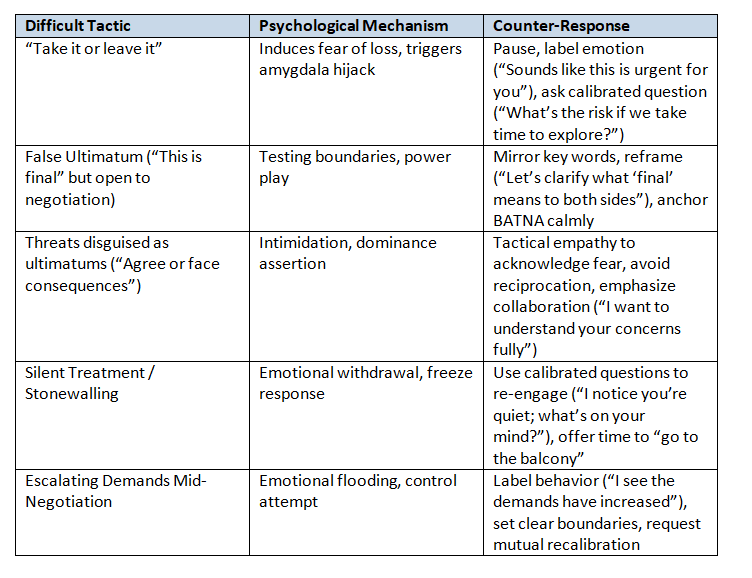
Negotiators encounter various difficult tactics that often masquerade as ultimatums but serve distinct psychological functions. The table below maps common tactics, their psychological mechanism, and exact counter-responses.
Advanced Techniques
For seasoned negotiators, the following advanced strategies deepen your capacity to handle ultimatums with finesse:
- **Emotional Contagion Awareness:** Study Paul Ekman’s microexpressions to detect subtle emotional tells signaling bluff or genuine urgency. Respond with calibrated empathy to mirror or counter emotional states.
- **Tactical Silence:** Deliberately use silence after an ultimatum to provoke discomfort and encourage the other side to fill the gap, often revealing new information or softening their stance.
- **Reciprocal Concession Sequencing:** Employ Robert Cialdini’s principles of influence by making small, conditional concessions that invite reciprocal movement rather than capitulation.
- **Third Side Engagement (William Ury):** Bring in a neutral mediator or third-party perspective to reframe the ultimatum as a shared problem, reducing zero-sum framing.
- **Presence Under Pressure (Amy Cuddy):** Use body language and mindset shifts to project confidence and calm, influencing both your own and the counterpart’s emotional regulation.
These techniques require practice and situational awareness but dramatically increase your negotiation resilience.
Scripts and Templates
Below are precise scripts tailored for common ultimatum scenarios. Use these verbatim or adapt to your style.
1. Responding to a “Take it or leave it” Offer
“I hear that this feels like a final decision point for you. Help me understand what’s driving that urgency, so we can find a solution that works for both of us.”
2. Deflecting a Threat Disguised as an Ultimatum
“I understand you’re concerned about the consequences. Let’s explore those concerns together—what are the underlying priorities we need to address?”
3. Reframing a “No Further Concessions” Ultimatum
“I appreciate you emphasizing the limits. What would success look like if we think beyond these boundaries? Are there areas we haven’t yet considered?”
4. Managing Silent Treatment or Stonewalling
“I notice it’s quiet on your end. I want to make sure we’re aligned—please share any thoughts or concerns when you’re ready.”
5. Anchoring Your BATNA Calmly
“We value working with you, but if we’re unable to reach agreement, we have alternatives that support our objectives. Let’s focus on finding a path that benefits us both.”
Frequently Asked Questions
Q1: How do I avoid appearing weak when I don’t immediately accept an ultimatum?
A1: Strength lies in emotional regulation and strategic responses. Use “going to the balcony” to pause, then respond with tactical empathy and calibrated questions. This shows control and confidence rather than weakness.
Q2: Can ultimatums ever be effective negotiation tools?
A2: Ultimatums can create urgency but often damage trust and reduce flexibility. They should be used sparingly and strategically, ideally accompanied by openness to dialogue to avoid deadlocks.
Q3: How can I rebuild trust after issuing or receiving an ultimatum?
A3: Apply John Gottman’s trust repair framework: express regret for harm caused, communicate appreciation, make concrete reparations, and commit to future transparency. Scheduling follow-ups helps sustain repair.
Q4: What if the other party refuses to move past the ultimatum?
A4: Recognize when to invoke your BATNA and be prepared to walk away if necessary. Sometimes disengagement preserves your interests better than protracted conflict.
Q5: How do cultural differences impact handling ultimatums?
A5: Cultural norms influence perceptions of directness, face-saving, and power distance. Research counterpart culture in advance and adjust your tone, phrasing, and emotional cues to maintain respect and effectiveness.
Conclusion
Ultimatums represent some of the most challenging moments in negotiation, where emotional intensity, strategic stakes, and relational dynamics collide. The key to handling them without caving lies in mastering the interplay between emotional regulation, tactical empathy, and strategic communication. By understanding the underlying psychology—from amygdala hijack to behavioral economics—you can anticipate reactions and craft responses that preserve leverage and trust.
Integrating proven frameworks like Voss’s FBI method, Ury’s balcony technique, and the Thomas-Kilmann Conflict Model, combined with a structured step-by-step process, allows you to transform ultimatums from threats into opportunities for creative problem-solving. Armed with real-world case insights, advanced techniques, and exact scripts, negotiators can approach ultimatums with presence and power rather than panic. Start applying these methods today to navigate your toughest negotiations with confidence and emerge stronger.
For personalized coaching on handling ultimatums and high-conflict negotiations, reach out to expert advisors who specialize in psychological strategy and conflict resolution. Your next negotiation could be your best yet.
References
1. Kahneman, D. (2011). *Thinking, Fast and Slow*. Farrar, Straus and Giroux.
2. Voss, C., & Raz, T. (2016). *Never Split the Difference: Negotiating As If Your Life Depended On It*. Harper Business.
3. Ury, W. (1991). *Getting Past No: Negotiating with Difficult People*. Bantam Books.
4. Gottman, J. M. (1999). *The Seven Principles for Making Marriage Work*. Crown Publishers.
5. Cialdini, R. B. (2006). *Influence: The Psychology of Persuasion*. Harper Business.
6. Ekman, P. (2003). *Emotions Revealed: Recognizing Faces and Feelings to Improve Communication and Emotional Life*. Times Books.