Handling Unfair Tactics in Negotiation: Mastering High-Conflict Situations with Psychological Precision

Negotiations often unfold in high-stakes settings where trust is fragile, stakes are immense, and opponents sometimes deploy unfair tactics that threaten to derail the process entirely. Imagine a tense corporate boardroom where one side blindsides the other with misinformation, ultimatums, and emotional manipulation—pressuring executives to capitulate or risk collapse. Or picture a labor strike negotiation where union leaders use deliberate misinformation and orchestrated emotional appeals to force management concessions under duress. In these moments, negotiators face not only the challenge of deal-making but the psychological minefield of managing their own reactions and outmaneuvering unfair maneuvers designed to exploit cognitive and emotional vulnerabilities.
What most negotiators get wrong is underestimating how these unfair tactics trigger automatic, emotional responses—what neuroscientists call the amygdala hijack—leading to reactive, System 1 thinking instead of calm, rational System 2 processing, a distinction Daniel Kahneman famously elucidated. Chris Voss’s concept of tactical empathy reveals the power of understanding and labeling the other party’s emotional state to defuse conflict, while John Gottman’s research on emotional flooding and trust repair offers critical insights on maintaining composure and rebuilding fractured relationships after deception or aggression. Behavioral economics, including the ultimatum game, further shows how perceived unfairness can harden positions and lead to impasse.
This comprehensive guide will equip you with actionable, evidence-based techniques to recognize and counter unfair tactics, drawing on proven frameworks such as Voss’s FBI negotiation method, William Ury’s “Going to the Balcony," and the Thomas-Kilmann Conflict Mode Instrument. You’ll learn a step-by-step process integrating psychological tools to regulate your emotional responses, build tactical empathy, and strategically redirect negotiations toward resolution. Real-world case studies from FBI hostage crises, multinational M&A breakdowns, and labor disputes will illustrate these principles in action. Additionally, the guide includes expert-level strategies, exact word-for-word scripts for handling ultimatums, deception, and emotional manipulation, and a detailed FAQ addressing common challenges faced by senior negotiators and managers.
· Table of Contents
· The Psychology Behind This Challenge
· Key Frameworks and Models
· Step-by-Step Process for Handling Unfair Tactics
· Real-World Case Studies
· Recognizing and Countering Difficult Dynamics
· Advanced Techniques
· Scripts and Templates
· Frequently Asked Questions
· Conclusion
· References
The Psychology Behind This Challenge
Negotiation under pressure is fundamentally a battle of minds and emotions. At the neurological core lies the amygdala, the brain’s fear and threat detector. When unfair tactics such as deception, ultimatums, or emotional manipulation are detected, the amygdala can trigger a rapid, involuntary response—commonly known as the amygdala hijack—where reason shuts down and primal fight-flight-freeze mechanisms take over. This automatic response often undermines a negotiator’s ability to stay composed and think strategically.
Daniel Kahneman’s seminal work distinguishes between System 1 and System 2 thinking. System 1 is fast, intuitive, and emotional; it governs the immediate reactions during negotiation crises. System 2 is slow, deliberate, and logical, enabling considered judgment and problem-solving. Unfair tactics are designed to provoke System 1 dominance, which can trap negotiators in reactive, emotionally charged exchanges, increasing the likelihood of concessions or impasses.
Chris Voss, former FBI hostage negotiator, introduced tactical empathy—an advanced technique that involves deeply understanding and verbally labeling the other party’s emotions to reduce hostility and build rapport. This approach leverages the brain’s social wiring to shift emotional states and open avenues for cooperation, even in confrontational contexts.
John Gottman’s research on emotional flooding—where overwhelming emotions inhibit constructive communication—parallels the amygdala hijack concept. Gottman’s trust repair theory further outlines how to restore damaged relationships after betrayals or unfair tactics, focusing on transparency, apology, and rebuilding predictability.
Behavioral economics offers additional insight through the ultimatum game, where individuals frequently reject offers perceived as unfair, even at personal cost. This illustrates how perceptions of fairness fundamentally shape negotiation outcomes and why unfair tactics can harden positions and escalate conflict.
Together, these psychological concepts form a foundation for understanding why unfair tactics are effective and how negotiators can counteract their impact by controlling emotional responses, practicing tactical empathy, and repairing trust when needed.
Key Frameworks and Models
Successful negotiators rely on structured frameworks to navigate complexities introduced by unfair tactics in problematic negotiations. Below are three foundational models frequently referenced in high-conflict negotiation literature:
1. FBI’s Behavioral Change Stairway Model (BCSM) — Developed by Chris Voss, this model emphasizes five sequential stages: active listening, empathy, rapport, influence, and behavioral change. Tactical empathy is the cornerstone, enabling negotiators to de-escalate and guide the other party toward collaboration.
2. William Ury’s “Going to the Balcony” — From his book “Getting Past No,” Ury proposes the metaphor of stepping back mentally (“going to the balcony”) to gain emotional distance, regulate responses, and avoid reactive engagement with provocations. This method facilitates maintaining presence and strategy under pressure.
3. Thomas-Kilmann Conflict Mode Instrument (TKI) — This framework identifies five conflict-handling modes (competing, collaborating, compromising, avoiding, accommodating), helping negotiators adapt their style based on context and the nature of unfair tactics encountered.
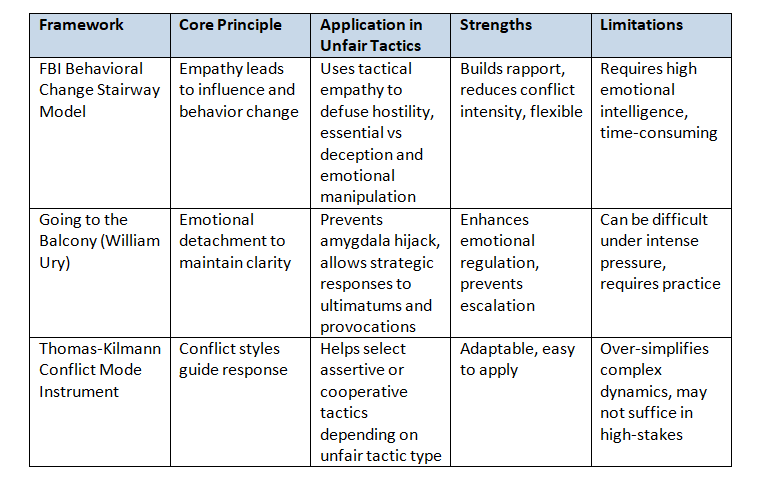
These frameworks complement each other and provide negotiators with psychological and strategic tools to recognize, manage, and counteract unfair tactics effectively.
Step-by-Step Process
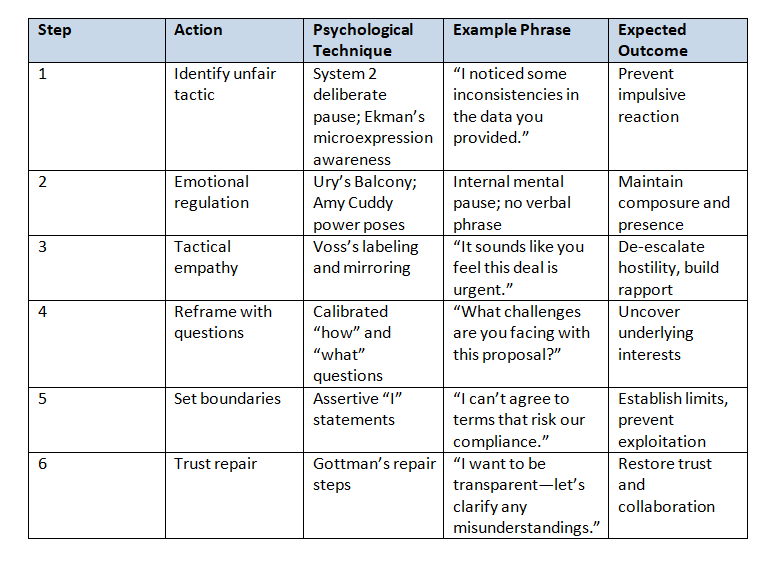
This section details a robust, six-step process for handling unfair tactics, integrating psychological techniques with practical negotiation actions.
Step 1: Recognize the Unfair Tactic Early
Awareness is your first defense. Unfair tactics include deception, misinformation, emotional coercion, ultimatums, false deadlines, and silent treatment. Use Paul Ekman’s research on microexpressions and behavioral cues to detect deceit or emotional manipulation early. Pay attention to inconsistencies in language, evasions, and emotional incongruence.
Psychological tool: Engage System 2 thinking deliberately by mentally pausing before reacting—counteracting the rush of System 1.
Step 2: Control Your Emotional State (Going to the Balcony)
Once a tactic is identified, activate Ury’s “Going to the Balcony” technique. Imagine stepping mentally outside the negotiation to observe it objectively. Use deep breathing, grounding techniques, or a brief mental pause to prevent amygdala hijack and emotional flooding.
Psychological tool: Amy Cuddy’s power poses can help restore presence and confidence before re-engaging.
Step 3: Employ Tactical Empathy and Labeling
Use Voss’s tactical empathy by acknowledging the underlying emotion driving the unfair tactic. Label it explicitly with calibrated phrases such as: “It seems like you feel pressured,” or “It sounds like you’re frustrated with the current terms.”
This disarms hostility and conveys understanding without conceding ground.
Psychological tool: Mirror the other party’s language and tone subtly to build subconscious rapport.
Step 4: Reframe the Conversation with Neutral Questions
Shift the dialogue away from confrontation by asking open-ended, neutral questions designed to clarify motives and interests, e.g., “Can you help me understand what’s most important to you here?” Avoid reacting to ultimatums directly; instead, probe for underlying needs.
Psychological tool: Use calibrated “How” and “What” questions from FBI negotiation training to encourage problem-solving.
Step 5: Set Clear Boundaries and Consequences
If the unfair tactic persists, calmly set limits by stating your boundaries and consequences without aggression. For example: “I want to find a solution that works for both of us, but I cannot agree to terms that compromise our core objectives.”
Psychological tool: Use “I” statements and assertive communication to maintain control without escalating conflict.
Step 6: Repair Trust and Reset the Negotiation
If trust has been damaged by deception or manipulation, apply Gottman’s trust repair model:
- Acknowledge the breach transparently
- Express a sincere apology if appropriate
- Ask for the other party’s perspective
- Commit to predictable, consistent behavior moving forward
By repairing trust, you restore the foundation necessary for productive negotiation.
Real-World Case Studies
FBI Hostage Negotiation: The 1993 Waco Siege
During the Waco siege, FBI negotiators faced David Koresh’s use of ultimatums and misinformation to control the standoff. The negotiators applied tactical empathy and labeling to acknowledge Koresh’s fears, avoiding direct confrontation initially. However, failure to fully repair trust and control emotional flooding contributed to escalation and tragedy. The lesson underscores the necessity of emotional regulation and trust repair in high-stakes unfair tactic environments.
Corporate M&A Breakdown: The AOL-Time Warner Merger
In the early 2000s, the AOL-Time Warner merger negotiations collapsed partly due to aggressive ultimatums and misinformation regarding valuations and synergies. Executives failed to recognize the emotional manipulation underlying the overly aggressive deadlines, leading to rushed decisions and mistrust. This case highlights the importance of “Going to the Balcony” to prevent system 1 impulsiveness and the strategic use of calibrated questions to clarify motives.
Labor Strike Negotiations: 2019 General Motors UAW Strike
The United Auto Workers (UAW) employed emotional appeals and misinformation about management’s intentions to rally support for a strike. GM negotiators countered by applying tactical empathy to acknowledge worker concerns while setting clear boundaries on feasibility. They used transparent communication to repair trust and ultimately reach a compromise. This example demonstrates effective application of trust repair and assertive boundary-setting in labor disputes.
Recognizing and Countering Difficult Dynamics
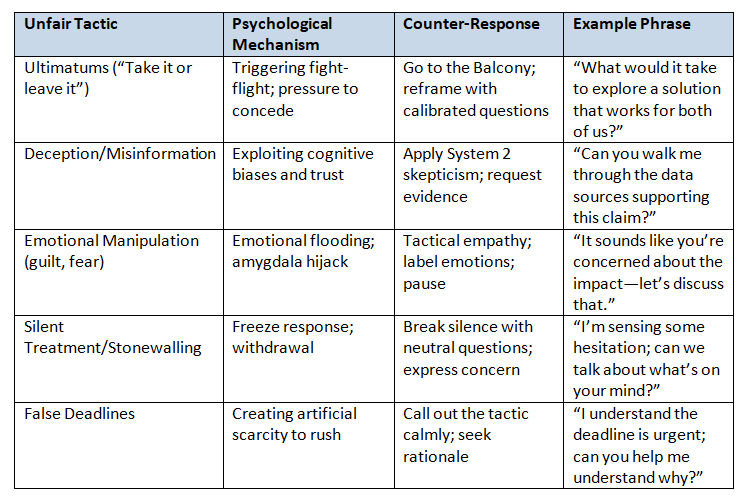
Negotiators often face specific unfair tactics linked to identifiable psychological mechanisms. The following table maps these dynamics with precise counter-responses.
Advanced Techniques
For seasoned negotiators facing entrenched unfair tactics, advanced strategies include:
- The “Accusation Audit” (Voss): Preemptively naming the negative assumptions or accusations the other party may hold to defuse their impact.
- Strategic Silence: Using well-timed silence after an unfair statement to compel the other party to fill the void, often revealing more information.
- Anchoring with Counter Offers: Presenting an initial counter-anchor to shift negotiation reference points away from unfair demands.
- Third-Side Mediation (William Ury’s “The Third Side”): Invoking community, organizational, or neutral stakeholder interests to reframe the negotiation context and reduce zero-sum dynamics.
- Emotional Containment Circles: Briefly involving trusted colleagues or advisors off-line to process emotional flooding and recalibrate approach mid-negotiation.
These techniques require practiced skill and situational awareness to deploy effectively but can neutralize the most sophisticated unfair tactics.
Scripts and Templates
The following exact scripts provide ready-to-use language for common unfair tactic scenarios.
1. Handling an Ultimatum
“I hear that this is important and urgent for you. Let’s work together to understand what success looks like for both of us. What would it take to reach an agreement that addresses your key concerns?”
2. Responding to Deception or Misinformation
“I want to make sure we’re on the same page. Could you help me understand how you arrived at that figure? Having clarity will help us move forward confidently.”
3. Countering Emotional Manipulation
“It sounds like this situation is causing you a lot of stress. I want to acknowledge that and find a solution that eases those concerns for both sides.”
4. Breaking the Silent Treatment
“I notice we haven’t heard from you in a bit. I want to make sure your perspective is included—what are your thoughts on the current proposal?”
5. Addressing False Deadlines
“I appreciate the urgency you’re expressing. Could you share more about the timeline requirements so we can prioritize effectively?”
Frequently Asked Questions
Q1: How can I stay calm when the other party uses aggressive or unfair tactics?
A1: Use emotional regulation techniques such as Ury’s “Going to the Balcony,” deep breathing, and Amy Cuddy’s power poses to maintain presence. Mental pausing activates System 2 thinking, preventing reactive decisions under pressure.
Q2: What are the best ways to identify deception during negotiation?
A2: Pay attention to behavioral cues and microexpressions studied by Paul Ekman, inconsistencies in verbal and nonverbal communication, and avoid overreliance on gut feeling alone. Ask clarifying questions to verify information.
Q3: When is it appropriate to call out unfair tactics openly?
A3: When trust allows, calmly naming the tactic can disrupt it without escalating conflict. Use neutral language and combine this with tactical empathy to avoid triggering defensiveness. If relationships are fragile, prioritize emotional regulation first.
Q4: How do I repair trust after unfair tactics have damaged the relationship?
A4: Follow Gottman’s trust repair steps: acknowledge the breach, apologize sincerely if warranted, listen actively to the other party’s perspective, and commit to consistent, transparent behavior moving forward.
Q5: Can unfair tactics ever be used ethically in negotiation?
A5: Ethical negotiation requires transparency and respect. While strategic framing and persuasion are acceptable, deliberate deception or coercion violates trust and typically leads to long-term harm. The best negotiators seek win-win outcomes without resorting to unfair maneuvers.
Conclusion
Handling unfair tactics in negotiation requires more than just tactical savvy; it demands deep psychological insight, emotional resilience, and principled strategy. By understanding the neuroscience behind emotional reactions, applying frameworks like the FBI Behavioral Change Stairway and Ury’s “Going to the Balcony,” and mastering tactical empathy and trust repair, negotiators can not only withstand but neutralize the most challenging unfair tactics. This mastery transforms high-conflict scenarios into opportunities for durable, mutually beneficial agreements.
To advance your negotiation skills further, commit to practicing these techniques in real-world settings, study the scripts and frameworks provided, and reflect regularly on your emotional responses. Join professional negotiation forums or training programs to continually refine your ability to handle unfair tactics with confidence and grace. Your success in these complex negotiations depends on not just what you negotiate, but how well you manage the psychological dynamics at play.
References
1. Kahneman, D. (2011). Thinking, Fast and Slow. Farrar, Straus and Giroux.
2. Voss, C., & Raz, T. (2016). Never Split the Difference: Negotiating As If Your Life Depended On It. HarperBusiness.
3. Ury, W. L. (1991). Getting Past No: Negotiating in Difficult Situations. Bantam Books.
4. Gottman, J. M. (1994). What Predicts Divorce? The Relationship Between Marital Processes and Outcomes. Lawrence Erlbaum Associates.
5. Ekman, P. (2009). Telling Lies: Clues to Deceit in the Marketplace, Politics, and Marriage. W. W. Norton & Company.
6. Cialdini, R. B. (2006). Influence: The Psychology of Persuasion. Harper Business.