Hard vs Soft Negotiation Tactics: When to Use Each for Maximum Impact

In 2012, during a tense contract negotiation between the National Football League (NFL) and its players’ union, the stakes could not have been higher. The NFL owners employed hard negotiation tactics, including ultimatums and rigid deadlines, while the players’ union largely adopted a softer, relationship-focused approach. The deadlock lasted for months, resulting in a lockout that caused major financial losses and fan alienation. This real-world example underscores how deploying hard or soft negotiation tactics—rightly or wrongly—can dramatically shape outcomes, either fostering agreement or escalating conflict.
At the neurological level, hard tactics activate threat responses in the brain, triggering defensive behaviors and loss aversion, as described in Kahneman’s Prospect Theory. Soft tactics, conversely, engage social bonding circuits and evoke reciprocity, trust, and cooperation, as Robert Cialdini’s principles of influence and Adam Grant’s research on giving demonstrate. Understanding these fundamental psychological mechanisms equips negotiators to choose and time tactics that leverage human behavior for optimal results.
This comprehensive guide will enable you to master the art of toggling between hard and soft negotiation tactics with precision. You will learn how to deploy each tactic effectively, recognize when the other side uses them against you, and counter with scientifically grounded scripts. Through detailed step-by-step processes, real-world case studies, and actionable frameworks, you will gain the expertise to navigate complex negotiations like a seasoned pro.
· Table of Contents
· The Science Behind Hard and Soft Negotiation Tactics
· How These Tactics Work in Practice: Spectrum and Outcomes
· Step-by-Step Deployment of Hard and Soft Tactics
· Recognizing and Countering Hard and Soft Tactics
· Real-World Case Studies: Lessons from High-Stakes Negotiations
· Common Mistakes and How to Fix Them
· Scripts and Templates for Hard and Soft Negotiations
· Frequently Asked Questions
· Conclusion: Synthesizing Insights and Next Steps
· References
The Science Behind This Tactic
Negotiation tactics do not operate in a behavioral vacuum; they hinge on deeply rooted psychological, neurological, and economic principles. The distinction between hard and soft negotiation tactics can be understood through lenses of behavioral economics, game theory, and social psychology.
Hard negotiation tactics—characterized by assertiveness, threats, and rigid demands—exploit human loss aversion as elaborated by Daniel Kahneman and Amos Tversky in Prospect Theory (1979). This theory posits that losses loom larger than equivalent gains in human cognition, making threats to withdraw or impose costs potent motivators. Neuroscientific studies reveal that such tactics stimulate the amygdala, the brain’s threat detector, inducing stress and defensive postures, which can either lead to capitulation or hardened resistance.
Soft negotiation tactics, emphasizing collaboration, empathy, and relationship-building, draw heavily on Robert Cialdini’s principles of influence, particularly reciprocity and liking. Adam Grant’s “Give and Take” (2013) further explains how generosity and trust foster cooperation and long-term value creation in negotiations. Chris Voss’s tactical empathy and labeling techniques (“Never Split the Difference”) activate mirror neurons and social bonding circuits, reducing perceived threats and encouraging openness.
Game theory, particularly the Nash equilibrium and the Prisoner’s Dilemma frameworks, illuminates the strategic interplay of hard and soft tactics. Hard tactics can push the other party into a zero-sum mindset, risking a Nash equilibrium of mutual defection, while soft tactics aim to create win-win outcomes, aligning incentives and trust for cooperative equilibria.
Behavioral economics research also emphasizes framing effects (Tversky & Kahneman, 1981). Hard tactics often frame offers as take-it-or-leave-it, invoking scarcity and urgency, whereas soft tactics frame deals as mutual gains opportunities, appealing to fairness and commitment.
Thus, the science reveals the dual-edged nature of these tactics: hard methods leverage loss aversion and power asymmetries but risk escalating conflict; soft methods harness social psychology and trust but can be exploited without safeguards. Mastery requires understanding when and how to toggle between approaches according to context and counterpart behavior.
How This Tactic Works in Practice
Hard and soft negotiation tactics exist on a spectrum from subtle influence to overt confrontation. To clarify their deployment, consider the following matrix outlining typical scenarios, tactical variations, and expected outcomes:
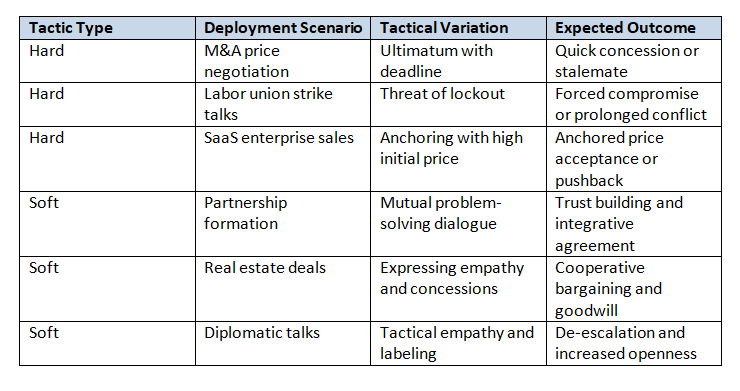
In practice, negotiators often blend hard and soft tactics dynamically. For example, Apple’s patent licensing talks with Samsung involved initial hard anchoring and threat of litigation, followed by soft relationship management to reach settlements. The effectiveness depends on timing, counterpart personality, and stakes.
Hard tactics are best deployed when you have clear leverage, deadlines, or when the counterpart is prone to risk-aversion. Soft tactics excel in long-term relationships, complex value creation, or when trust is fragile. Excessive hardness may provoke retaliation; excessive softness may invite exploitation.
Understanding this tactical continuum allows negotiators to calibrate intensity and approach for maximum efficacy.
Step-by-Step: How to Deploy This Tactic
Deploying hard and soft negotiation tactics effectively requires procedural discipline combined with psychological insight. Below is a detailed walkthrough for each, with six critical steps supported by scripts and timing considerations.
Step 1: Assess Your BATNA and Leverage
Hard: Clearly define your Best Alternative to a Negotiated Agreement (BATNA). The stronger your BATNA, the more credible your hard tactics.
Soft: Understand mutual BATNAs to identify shared interests and zones of possible agreement.
Script (hard): “Given our position and alternatives, we are prepared to walk away if terms are not met by Friday.”
Script (soft): “I want to understand your constraints so we can find a solution beneficial for both sides.”
Timing: Begin with fact-finding to inform tactic choice.
Step 2: Frame the Negotiation Context
Hard: Use scarcity and loss framing to increase pressure.
Soft: Frame the negotiation as a joint problem-solving exercise.
Script (hard): “This is a final offer; delays will reduce available options.”
Script (soft): “Let’s explore ways to address both our priorities effectively.”
Timing: Early; sets tone.
Step 3: Deploy Tactical Language and Non-Verbal Cues
Hard: Use assertive language, firm tone, and controlled body language.
Soft: Use open body posture, mirroring, and labeling emotions.
Script (hard): “We cannot accept anything less than X.”
Script (soft): “It sounds like this proposal concerns you; can you tell me more?”
Timing: Throughout interaction.
Step 4: Monitor Counterpart Reactions and Adapt
Hard: Watch for signs of resistance or capitulation.
Soft: Look for engagement levels and emotional cues.
Script (hard): “I notice hesitation; are there hidden concerns?”
Script (soft): “I appreciate your honesty; let’s address those concerns together.”
Timing: Continuous.
Step 5: Escalate or De-escalate Tactics
Hard: Increase pressure if soft tactics fail, e.g., introduce deadlines or consequences.
Soft: Introduce concessions or collaborative brainstorming.
Script (hard): “If we cannot agree today, we will need to explore other options.”
Script (soft): “What if we adjusted this term to better meet your needs?”
Timing: Mid-negotiation.
Step 6: Close with Clear Agreement or Plan for Next Steps
Hard: Secure commitment to final terms or walk away decisively.
Soft: Confirm mutual understanding and outline follow-up.
Script (hard): “Do I have your agreement to these terms now?”
Script (soft): “Let’s summarize what we’ve agreed and plan next steps.”
Timing: End phase.
How to Recognize and Counter This Tactic
Successful negotiators must identify when counterparts use hard or soft tactics and counter effectively to preserve leverage and avoid manipulation. The following table maps signals to counter-responses with exact wording.
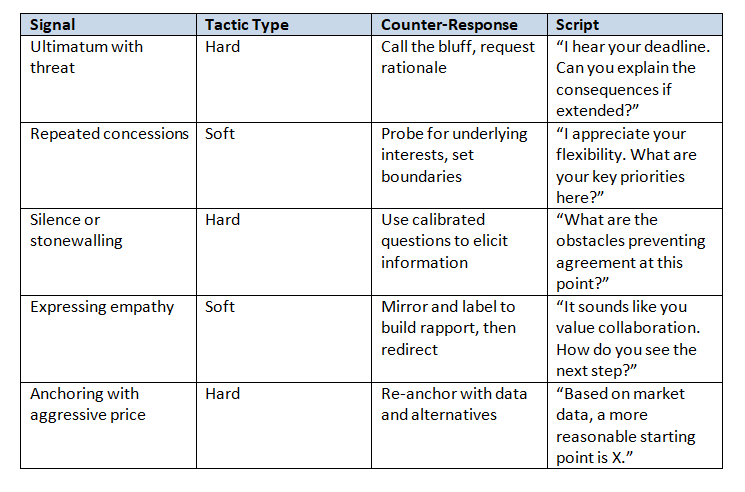
Counter-tactics blend tactical empathy from Chris Voss’s playbook with assertiveness from bargaining advantage frameworks. Timing and tone are critical to avoid escalation or appearing weak.
Real-World Case Studies
Case Study 1: Apple vs Samsung Patent Negotiations
Apple initially employed hard tactics including aggressive litigation and high royalty demands, leveraging strong patent portfolios (hard anchoring, threat of injunctions). Samsung responded with a blend of hard and soft tactics, pushing back on fees but opening channels for licensing agreements. The eventual settlement balanced hard pressure with soft collaboration, illustrating tactical blending.
Lesson: Hard tactics establish boundaries; soft tactics enable deal closure.
Case Study 2: NFL 2011 Collective Bargaining Agreement Talks
NFL owners adopted hard negotiation tactics including lockouts and ultimatums, activating players’ loss aversion and generating defensive resistance. The players’ union began soft tactics to preserve relationships but ultimately escalated to hard strikes. The protracted conflict resulted in financial losses and damaged reputations.
Lesson: Misjudging when to switch between hard and soft leads to stalemate.
Case Study 3: 2015 Iran Nuclear Deal Diplomatic Negotiations
Diplomatic teams oscillated between hard demands (red lines, sanctions threats) and soft diplomacy (tactical empathy, labeling concerns). U.S. negotiators under Chris Voss’s guidance applied calibrated questions and mirroring to understand Iranian fears, enabling a breakthrough.
Lesson: Soft tactics combined with strategic hardness yield breakthroughs in complex diplomacy.
Common Mistakes When Using This Tactic
· Overusing hard tactics too early can provoke retaliation and deadlock. Fix: Begin with soft tactics to build rapport, escalate selectively.
· Excessive softness can be perceived as weakness, inviting exploitation. Fix: Set clear boundaries and use calibrated questions to probe interests.
· Failing to read counterpart signals leads to mistimed tactic shifts. Fix: Continuously monitor verbal and nonverbal cues.
· Poor timing of escalation or de-escalation undermines credibility. Fix: Follow phased approach with pre-defined triggers.
· Ignoring BATNA strength causes mismatched tactic intensity. Fix: Conduct thorough BATNA analysis pre-negotiation.
Scripts and Templates
Script 1: Hard Tactic Ultimatum Email (Enterprise SaaS Sale)
Subject: Final Offer and Contract Deadline
Dear [Name],
Following our recent discussions, this is our final offer for the [Product] contract. To proceed under these terms, we require your signed agreement by Friday, [Date]. Delays beyond this may necessitate revisiting pricing and availability.
Please let me know if you have any questions.
Best regards,
---
Script 2: Soft Tactic In-Person Opening (Partnership Discussion)
“I appreciate you taking the time today. Before we dive into numbers, I want to understand your key goals and any concerns. My aim is to find a path that benefits both our organizations.”
---
Script 3: Countering Hard Anchoring (Phone Call)
“I understand you’re proposing $1 million as the starting point. Based on recent market data and comparable deals, a more standard range is $700,000–$800,000. How flexible are you on this?”
---
Script 4: Using Tactical Empathy to Counter Ultimatum
“It seems the deadline is important for you. Can you share what risks you’re managing with this timeline? Maybe we can find some middle ground.”
---
Script 5: Email to De-escalate After Hard Bargaining
Subject: Continuing Our Positive Dialogue
Hi [Name],
I sense that there are some sticking points. I want to reiterate our commitment to working collaboratively. Let’s schedule a call to discuss how we can address concerns and move forward.
Best,
Frequently Asked Questions
Q1: When should I use hard negotiation tactics?
Use hard tactics when you have significant leverage, clear alternatives (strong BATNA), and face deadlines or non-negotiable terms. They are most effective in zero-sum scenarios where value creation is limited.
Q2: Can soft negotiation tactics work in high-stakes business deals?
Yes. Soft tactics foster trust, uncover interests, and enable integrative agreements. They are especially valuable when relationships matter or when multiple issues require creative solutions.
Q3: How do I avoid being exploited when using soft negotiation tactics?
Set clear boundaries and communicate red lines transparently. Use calibrated questions and tactical empathy to gauge counterpart intentions and detect potential exploitation.
Q4: What are some signs the other party is using hard tactics?
Watch for ultimatums, fixed deadlines, aggressive anchoring, threats of walking away, and stonewalling. These signals indicate they are leveraging pressure.
Q5: How do I shift from soft to hard tactics without damaging relationships?
Signal the shift clearly and respectfully. Use language like, “To be candid, we need to consider firm deadlines now,” while maintaining empathy and openness to dialogue.
Conclusion
Mastering the delicate balance between hard and soft negotiation tactics is essential for any seasoned professional navigating today’s complex dealmaking landscape. Understanding the underlying psychological mechanisms—loss aversion, reciprocity, framing—and deploying tactics with calibrated timing and precision significantly increases your odds of securing favorable outcomes. Equally important is the ability to recognize and counter these tactics when used against you, preserving leverage and steering negotiations back to productive channels.
This definitive guide has equipped you with the science, practical frameworks, real-world case studies, and exact scripts to become an agile negotiator able to adapt your approach dynamically. Now is the time to apply these insights in your next negotiation—begin by assessing your BATNA, framing the conversation, and choosing your tactics consciously. For ongoing mastery, integrate these strategies into your team’s training and negotiation playbooks to drive consistent success.
References
· Kahneman, D., & Tversky, A. (1979). Prospect Theory: An Analysis of Decision under Risk. Econometrica.
· Cialdini, R. B. (2006). Influence: The Psychology of Persuasion. Harper Business.
· Voss, C., & Raz, T. (2016). Never Split the Difference: Negotiating As If Your Life Depended On It. Harper Business.
· Grant, A. (2013). Give and Take: Why Helping Others Drives Our Success. Penguin Books.
· Fisher, R., Ury, W., & Patton, B. (1991). Getting to Yes: Negotiating Agreement Without Giving In. Penguin Books.
· Shell, R. (2006). Bargaining for Advantage: Negotiation Strategies for Reasonable People. Penguin Books.