Hierarchy in Different Cultures: How Power Distance Shapes Negotiation Dynamics

In 2018, a high-stakes joint venture negotiation between a German manufacturing giant and a Japanese technology firm nearly collapsed. The German team, accustomed to direct communication and egalitarian decision-making, bypassed the formal approval from the highest-ranking executives in the Japanese firm. Japanese negotiators, steeped in a culture valuing hierarchy and consensus, perceived this as a breach of protocol and disrespect towards senior leadership. The deal stalled for months, risking millions in investment and market opportunities. Only after the German team adapted their approach—engaging in nemawashi (informal consensus building) and deferring to senior decision-makers—did negotiations resume and eventually succeed.
This scenario illustrates the pivotal role hierarchy plays in cross-cultural negotiations. Power distance, the extent to which less powerful members accept unequal power distribution, directly impacts communication, decision-making, trust-building, and conflict resolution in negotiations. Misreading or ignoring hierarchy can lead to mistrust, offense, stalled deals, or outright failure. Yet many professionals underestimate how deeply embedded cultural attitudes toward hierarchy are in shaping negotiation dynamics, often applying one-size-fits-all tactics that backfire.
This definitive guide will equip international executives, diplomats, and sales leaders with comprehensive, actionable expertise on hierarchy’s influence in negotiation. You will master a deep understanding of cultural frameworks—Geert Hofstede’s power distance, Erin Meyer’s communication scales, Richard Lewis’s behavioral models, Edward Hall’s context and time dimensions, and more. You will explore country-specific profiles with scores, do’s and don’ts, and communication styles. Step-by-step strategies provide precise language and behavioral scripts tailored for high, medium, and low power distance cultures. Real-world case studies illustrate successes and failures. Advanced tactics help you navigate complex hierarchical dynamics in multilayered negotiations. By the end, you will confidently adapt your approach to honor hierarchy’s role and unlock smoother, more effective global negotiations.
· Table of Contents
· The Theoretical Foundation: Cultural Frameworks and Power Distance Dimensions
· Key Frameworks and Models: Comparative Analysis of Hierarchy Across Cultures
· Step-by-Step Strategy: Six Tactical Steps to Navigate Hierarchy in Negotiations
· Real-World Case Studies: Successes and Failures from Japan, India, Germany, and Brazil
· Country/Region-Specific Insights: Do’s and Don’ts, Communication, Trust, and Negotiation Styles
· Advanced Strategies: Expert Techniques for Complex Hierarchical Contexts
· Scripts and Templates: Exact Language and Tone Adaptations for Diverse Cultures
· Frequently Asked Questions: In-Depth Answers on Hierarchy and Negotiation
· Conclusion: Key Takeaways and Actionable Next Steps
· References: Authoritative Sources for Further Study
The Theoretical Foundation — deep dive into relevant cultural frameworks
Understanding hierarchy in cross-cultural negotiation requires mastery of multiple scholarly models that analyze cultural values, communication styles, power dynamics, and conflict approaches. Below is a deep dive into the most critical frameworks relevant to power distance and hierarchy.
Geert Hofstede’s Cultural Dimensions
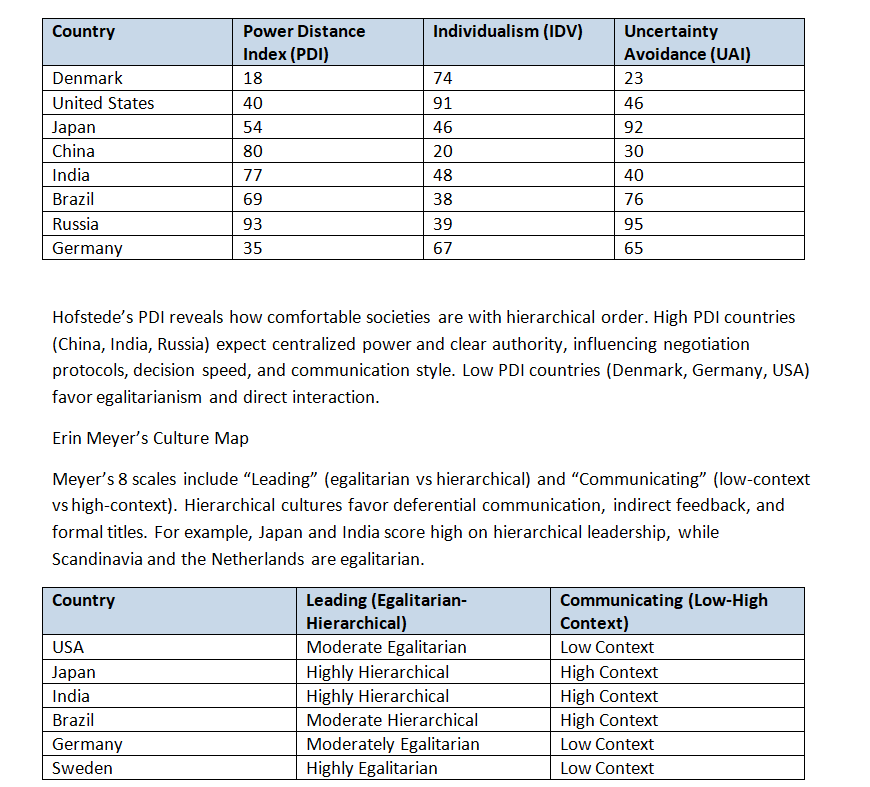
Hofstede’s pioneering work includes Power Distance Index (PDI), which measures acceptance of unequal power distribution. Scores range from low (egalitarian) to high (authoritarian). For example:
Richard Lewis’s Model
Lewis categorizes cultures into Linear-Active (task-focused, planned), Multi-Active (relationship-focused, flexible), and Reactive (listening, respectful) types, which intersect with hierarchy preferences. For example:
- Reactive cultures (Japan, China, Korea) show high respect for hierarchy and indirect communication.
- Multi-Active cultures (Brazil, India) emphasize relationships and hierarchical respect but are emotionally expressive.
- Linear-Active cultures (Germany, USA) prefer directness and low power distance but may struggle with hierarchical nuances.
Edward Hall’s Context and Time Dimensions
Hall’s high-context vs low-context communication aligns with hierarchical preferences. High-context cultures (Japan, China, Arab countries) rely on implicit cues, status signaling, and nonverbal respect to navigate hierarchy. Low-context cultures (USA, Germany) use explicit language and expect open dialogue.
Monochronic time cultures (Germany, USA) value schedules and punctuality, while polychronic cultures (India, Brazil, Middle East) are flexible, influencing hierarchical meeting protocols.
Richard Gesteland’s Negotiation Dimensions
Gesteland differentiates deal-focus vs relationship-focus and formal vs informal cultures. Hierarchical cultures tend to be relationship-focused and formal, requiring deference to rank and protocol (e.g., Middle East, Japan). Low power distance cultures lean deal-focused and informal (e.g., USA, Netherlands).
David Livermore’s Cultural Intelligence (CQ)
CQ comprises Drive, Knowledge, Strategy, and Action. High CQ Strategy and Action are critical to adapting negotiation style to hierarchical contexts—knowing when to defer, how to read status cues, and how to engage senior decision-makers appropriately.
Trompenaars & Hampden-Turner’s Dimensions
Their model highlights universalism vs particularism and achievement vs ascription. Hierarchical cultures often emphasize ascription—status derived from age, class, or connections (e.g., India, Middle East)—versus achievement-based status common in low PDI cultures.
Thomas-Kilmann Conflict Mode Instrument
Conflict handling varies by hierarchy. High power distance cultures often avoid open confrontation, preferring accommodation or avoidance, while low PDI cultures may engage in direct confrontation. Understanding these preferences is vital to conflict de-escalation.
Key Frameworks and Models — 2-3 named frameworks with a comparison table
To operationalize hierarchy in negotiation, three frameworks offer the most actionable insights: Hofstede’s Power Distance Index, Erin Meyer’s Culture Map Leading Scale, and Richard Lewis’s Behavioral Model.
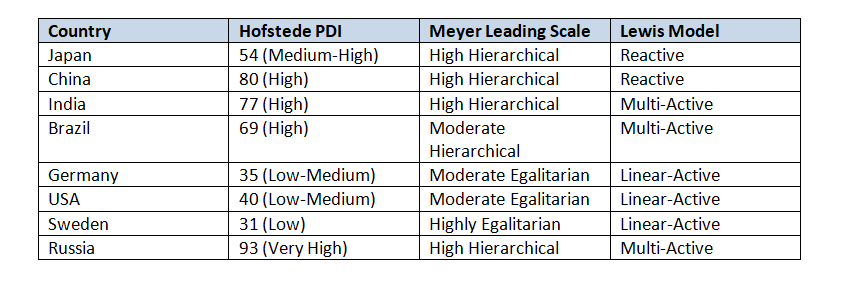
This table shows cluster patterns: East Asian and South Asian countries have high PDI and hierarchical leadership, matching reactive or multi-active behavior. Western countries tend to have lower PDI and egalitarian leadership with linear-active behavior.
Understanding these distinctions allows negotiators to anticipate decision-making speed, communication style, and protocol related to hierarchy, enabling tailored approaches.
Step-by-Step Strategy
Step 1: Conduct a Hierarchy Assessment Pre-Negotiation
Gather detailed cultural intelligence on your counterpart’s power distance level using Hofstede, Meyer, and Lewis data. Confirm with local experts and previous deal experience. Ask: Who holds decision power? How formal is the hierarchy? What titles or honorifics matter?
Step 2: Adapt Communication Style to Hierarchical Norms
In high PDI cultures, use formal titles, indirect language, and show deference. For example, in Japan, open meetings with respectful greetings to senior members, and avoid public disagreement.
In low PDI cultures, be direct and egalitarian but remain polite.
Step 3: Engage Senior Decision-Makers Early and Respectfully
In high hierarchy cultures (China, India, Russia), secure buy-in from senior executives through private briefings or nemawashi (Japan). Avoid bypassing authority layers.
Step 4: Build Relationships with Gatekeepers and Influencers
Recognize the role of intermediaries (guanxi in China, wasta in Middle East) who control access to decision-makers. Invest time in trust-building with them.
Step 5: Manage Decision-Making Pace According to Hierarchy
High PDI cultures typically require consensus or top-level approval, leading to slower decisions. Plan for multiple meetings, ringi circulation (Japan), or hierarchical endorsements.
Step 6: Handle Conflict and Disagreement with Hierarchical Sensitivity
Avoid public criticism of senior figures in hierarchical cultures. Use private feedback channels. In low PDI cultures, encourage open debate but remain respectful.
Step 7: Confirm Agreements with Hierarchical Protocols
Use formal written contracts and ceremonial signings in high PDI cultures to honor status and commitment. In egalitarian cultures, simpler verbal agreements may suffice.
Real-World Case Studies
Case Study 1: Japanese Nemawashi and German Directness
A German energy firm negotiating with a Japanese partner faltered by pushing for immediate contract approval. The Japanese side expected nemawashi—informal consensus-building among executives before formal meetings. The Germans’ bypassing of this protocol was seen as disrespectful. After adopting a stepwise approach, involving informal discussions and deferring publicly to senior Japanese managers, the deal closed successfully.
Lesson: Respect hierarchical consensus processes to build trust.
Case Study 2: Indian Hierarchical Dynamics in Pharmaceutical Licensing
A Western pharmaceutical company underestimated the power of hierarchical relationships in India, dealing only with middle managers. Senior executives were bypassed and felt sidelined, causing delays. By investing in relationship-building with senior leaders and acknowledging hierarchical seniority through respectful language and gifts, negotiations accelerated.
Lesson: In India, hierarchical respect and relationship primacy are paramount.
Case Study 3: Brazilian Jeitinho and Positional Bargaining
In Brazil, a negotiation between a U.S. tech firm and a Brazilian distributor highlighted hierarchical nuances combined with warmth and flexibility. The Brazilian approach used jeitinho (creative problem-solving with relational flexibility) but simultaneously respected positional authority. The Americans’ rigid, transactional style caused friction until they adapted to a more relational and hierarchy-aware approach.
Lesson: Combine warmth with hierarchical respect in Brazil for effective negotiation.
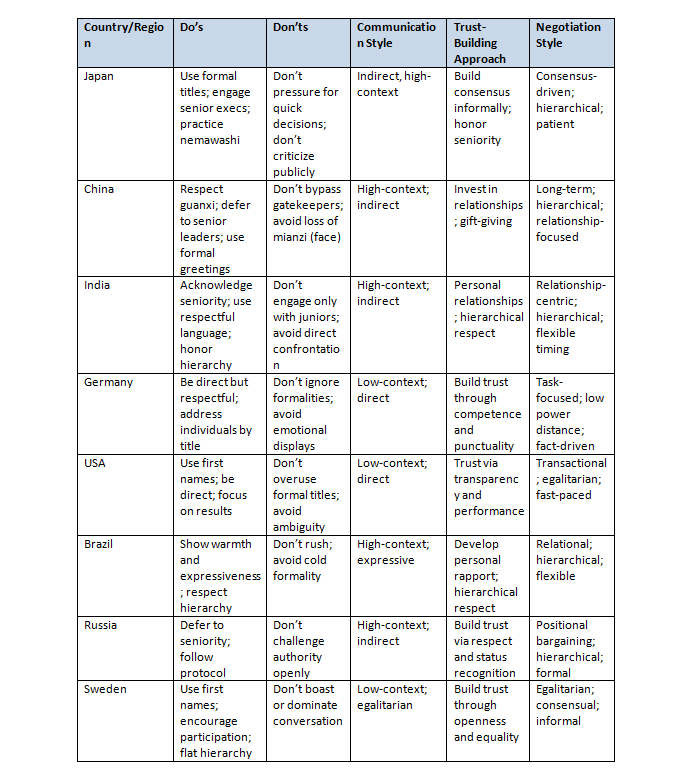
Country/Region-Specific Insights
Advanced Strategies
1. Multi-layered Influence Mapping: Identify formal and informal power holders, gatekeepers, and influencers beyond organizational charts in hierarchical cultures.
2. Hierarchical Signaling: Use nonverbal cues such as seating arrangements, gift selection, and speaking order to honor status.
3. Adaptive Feedback Delivery: Employ indirect feedback and private channels in high PDI cultures; use direct, transparent feedback in low PDI.
4. Cross-Hierarchy Coalitions: Build alliances at multiple hierarchical levels to create momentum and reduce blockage risks.
5. Time Flexibility: Anticipate slower decision cycles in high PDI contexts and build buffer time into negotiation timelines.
6. Emotional Intelligence Calibration: Read subtle signs of respect or dissatisfaction, especially in high-context cultures where hierarchy governs communication.
7. Leverage Cultural Intelligence (CQ) Strategy and Action components to continuously monitor and adjust hierarchical adaptation based on evolving signals.
8. Hybrid Negotiation Teams: Include members with hierarchical cultural expertise and local status to bridge gaps.
Scripts and Templates
Script 1: Addressing Senior Executives in Japan (High Power Distance, High Context)
“Good morning, esteemed Chairman Tanaka-san and honored guests. It is with the utmost respect that we present our proposal today. We look forward to your valued guidance and feedback as we proceed together. Please forgive any oversight as we aim to contribute positively to our shared goals.”
Script 2: Engaging Middle Management in Germany (Low Power Distance, Low Context)
“Hello Mr. Müller, thank you for taking the time today. We believe this proposal offers clear benefits and look forward to your direct feedback and any suggestions you may have. We value open and straightforward dialogue to reach the best outcomes.”
Script 3: Building Guanxi in China (High Power Distance, High Context)
“Dear Director Li, it is a privilege to meet you. We have heard much about your leadership and expertise. We hope to build a strong partnership based on mutual respect and shared success. May I also express our gratitude with this small token of appreciation.”
Script 4: Managing Conflict in India (High Power Distance, Indirect Communication)
“Respected Mr. Singh, thank you for sharing your insights. We greatly value your perspective and would appreciate your continued guidance as we refine our approach. We remain committed to working harmoniously for the benefit of all parties involved.”
Script 5: Fast-Paced Direct Negotiation in USA (Low Power Distance, Low Context)
“Hi John, thanks for meeting on short notice. Here’s a straightforward proposal we believe will advance our objectives quickly. Let’s discuss any concerns openly to finalize the deal promptly.”
Frequently Asked Questions
Q1: How does power distance affect negotiation decision-making speed?
High power distance cultures tend to have centralized decision-making requiring approvals from top executives, which slows the process. Low power distance cultures empower individuals to decide faster.
Q2: What are common mistakes negotiators make regarding hierarchy?
Ignoring formal titles, bypassing senior leaders, being too direct or informal in high PDI cultures, and failing to build relationships with gatekeepers are common errors.
Q3: How can I identify hierarchy cues in foreign cultures?
Observe language usage (titles, honorifics), seating arrangements, who speaks first, body language, and response patterns. Consult local cultural experts to confirm.
Q4: How do hierarchical differences influence conflict resolution?
High PDI cultures use avoidance or accommodation to preserve harmony and respect authority; low PDI cultures prefer direct confrontation and problem-solving.
Q5: Can a negotiation succeed without adapting to hierarchy?
It is possible but rare. Ignoring hierarchy often leads to misunderstandings, mistrust, and delays. Adaptation improves rapport, trust, and deal outcomes.
Conclusion
Hierarchy and power distance profoundly shape negotiation dynamics across cultures. Understanding and respecting these dimensions is not optional but essential for global success. By mastering cultural frameworks, country-specific protocols, and adaptive strategies outlined in this guide, negotiators can avoid costly missteps, foster trust, and accelerate deal closure. Hierarchy is not a barrier but a cultural reality to navigate skillfully.
International executives who invest in cultural intelligence and practice the step-by-step tactics and scripts presented here will unlock smoother dialogues, deeper relationships, and more sustainable agreements. Embrace hierarchy’s complexity as an opportunity to differentiate your negotiation approach and deliver superior results in a globalized world.
References
Hofstede, G. (2001). Culture’s Consequences: Comparing Values, Behaviors, Institutions and Organizations Across Nations. Sage Publications.
Meyer, E. (2014). The Culture Map: Breaking Through the Invisible Boundaries of Global Business. PublicAffairs.
Lewis, R. D. (2006). When Cultures Collide: Leading Across Cultures. Nicholas Brealey Publishing.
Hall, E. T. (1976). Beyond Culture. Anchor Books.
Livermore, D. (2015). Leading with Cultural Intelligence: The Real Secret to Success. AMACOM.
Trompenaars, F., & Hampden-Turner, C. (1998). Riding the Waves of Culture: Understanding Diversity in Global Business. McGraw-Hill.