High-Context vs Low-Context Communication in Negotiation: A Complete Guide

In 2018, a major Sino-European joint venture collapsed on the brink of signing due to a fundamental misreading of communication styles. The European executives, accustomed to direct, explicit exchanges, pressed for immediate clarity and rapid agreement. Meanwhile, their Chinese counterparts, operating in a high-context communication culture, relied heavily on implicit cues, long-term relationship-building, and indirect signals. The Europeans took silence and indirect answers as evasiveness or lack of commitment, while the Chinese perceived the Europeans’ push for rapid clarity as rude and disrespectful. The result was a deal worth over $500 million unraveling, costing both sides dearly. This scenario vividly illustrates how high-context and low-context communication styles can make or break negotiations.
Cross-cultural negotiation is fundamentally different from domestic negotiation precisely because of these invisible cultural scripts. We bring assumptions about how communication works that we rarely question. Many executives do not realize that what they interpret as straightforwardness or politeness may be seen as aggressive or evasive elsewhere. Signals such as silence, tone, gesture, and even the choice of words carry weight far beyond their face value. Trust, which is the currency of successful negotiation, is fragile and built differently across cultures. Misreading these cues leads to missed opportunities and costly misunderstandings.
In this definitive guide, you will master the science of cultural differences in communication during negotiation. We will navigate seminal cultural frameworks from Geert Hofstede’s dimensions to Erin Meyer’s Culture Map, Richard Lewis’s communication typologies, and Edward Hall’s contextual communication theory. You will gain country-specific insights — from Japan’s subtle nemawashi consensus-building to Brazil’s expressive warmth. Beyond theory, you will receive actionable, step-by-step cultural preparation strategies, exact word-for-word scripts tailored to cultural contexts, and advanced techniques to manage interpreters, hierarchy, and non-verbal cues. This guide is your essential resource for negotiating with cultural intelligence and winning across borders.
· Table of Contents
· The Science of Cultural Differences in Negotiation
· Key Cultural Frameworks and Comparative Analysis
· Step-by-Step Cultural Preparation Strategy
· Real-World Case Studies in High- and Low-Context Negotiations
· Country/Region-Specific Insights: Do’s and Don’ts
· Advanced Strategies for Expert Cross-Cultural Negotiators
· Scripts and Templates for Different Cultural Contexts
· Frequently Asked Questions
· Conclusion and Call to Action
· References
The Science of Cultural Differences in Negotiation
Understanding high-context versus low-context communication requires an appreciation of foundational cultural research that quantifies and qualifies cultural contrasts affecting negotiation.
Geert Hofstede’s 6 cultural dimensions provide a quantitative lens. His dimension of Individualism vs Collectivism is critical: collectivist societies such as China (score 20) and Japan (46) rely on group harmony and implicit communication, aligning with high-context styles. In contrast, individualistic societies like the United States (91) and Germany (67) favor explicit, direct communication, reflecting low-context tendencies. Power Distance scores further influence communication; high power distance nations like India (77) and Russia (93) embed hierarchical respect, often communicating indirectly upward, while low power distance countries like Denmark (18) prefer egalitarian, straightforward dialogue.
Erin Meyer’s Culture Map elaborates with eight dimensions that impact communication style, such as Communicating (low-context vs high-context) and Disagreeing (confrontational vs avoid confrontation). For example, Japan scores as highly high-context and avoids open disagreement, while the United States is low-context and more confrontational. Meyer’s research emphasizes how these dimensions impact not only what is said but how it is said and received.
Richard Lewis’s cultural typology divides cultures into Linear-Active (Germany, Switzerland), Multi-Active (Brazil, Mexico), and Reactive (Japan, China). Linear-Active cultures prefer direct, fact-based communication. Multi-Active cultures combine expressiveness with emotional communication and relationship-focus, while Reactive cultures prioritize listening and harmony, often communicating indirectly.
Edward Hall’s seminal work on high-context and low-context communication remains foundational. High-context cultures, such as Japan and Arab countries, embed meaning in non-verbal cues, context, and shared understanding, while low-context cultures like the U.S. and Germany rely heavily on explicit verbal messages. Hall also differentiates time orientations: monochronic (linear, scheduled) in low-context cultures versus polychronic (flexible, relationship-prioritized) in high-context cultures.
Richard Gesteland’s dimensions of deal-focused vs relationship-focused and expressive vs reserved communication further clarify how culture shapes negotiation dynamics. Relationship-focused cultures (Middle East, Latin America) demand time invested in rapport, often communicated through warmth and expressiveness, whereas deal-focused cultures (U.S., Germany) prioritize efficiency and facts.
David Livermore’s Cultural Intelligence (CQ) model offers a behavioral perspective emphasizing CQ Drive (motivation), CQ Knowledge (cultural understanding), CQ Strategy (planning), and CQ Action (behavioral adaptation). High CQ is essential to decode and adapt to high- or low-context communication during negotiation.
Trompenaars and Hampden-Turner’s seven dimensions, including Universalism vs Particularism and Specific vs Diffuse, explain how universal rules or personal relationships determine communication’s content and style. For example, Japan’s diffuse culture integrates business and personal life, necessitating indirect communication, unlike the U.S.’s specific and universalist style that favors explicit contracts and directness.
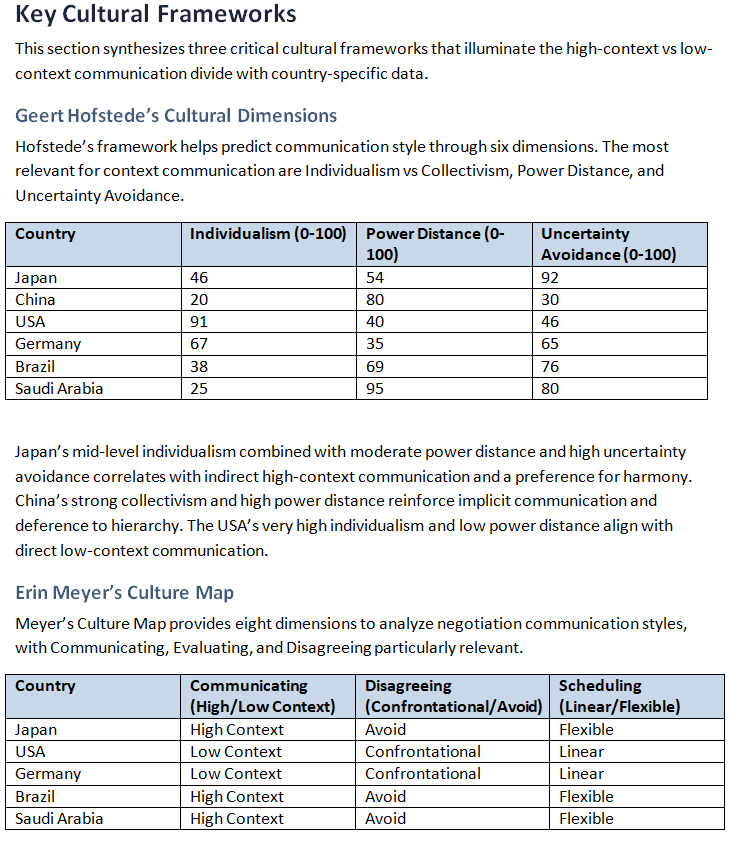
Japan and Saudi Arabia’s preference for avoiding direct disagreement aligns with high-context communication, while Germany and the USA’s confrontational and direct disagreement style reflect low-context communication.
Richard Lewis’s Model
Lewis categorizes cultures into Linear-Active, Multi-Active, and Reactive, which correspond broadly to low-, mid-, and high-context communication styles.
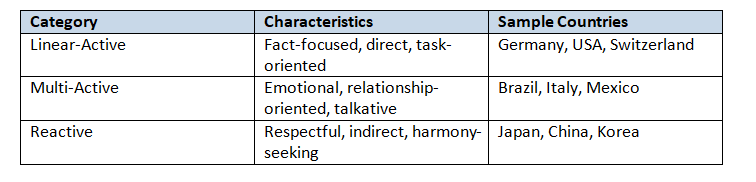
Understanding these categories helps negotiators anticipate communication flow and style, adjusting approach accordingly.
Step-by-Step Cultural Preparation Strategy
Mastering negotiation across high- and low-context cultures requires deliberate preparation. This six-step strategy ensures cultural intelligence in every phase.
Step 1: Conduct Deep Cultural Research
Begin by researching the counterpart’s cultural profiles using Hofstede, Meyer, Lewis, and Hall’s frameworks. Identify their communication style, time orientation, hierarchy, and relational preferences. For instance, if negotiating with South Korea, prepare for indirect communication, polychronic time, and hierarchical respect.
Step 2: Build Relationships Before Business
In high-context cultures such as Saudi Arabia or Brazil, invest time in relationship-building through informal meetings, social events, and personalized gestures. This builds trust and understanding, key to decoding implicit messages later.
Step 3: Adapt Communication Style
Modify your verbal and non-verbal communication to align with the counterpart’s style. Use indirect language, silence, and active listening in high-context cultures; be explicit, structured, and direct in low-context ones. Avoid interrupting in reactive cultures; be succinct in linear-active environments.
Step 4: Implement Trust-Building Protocols
Trust-building varies: in China, cultivate guanxi through multiple meetings and gift exchanges; in Scandinavia, demonstrate competence and consistency; in the Middle East, rely on wasta (influence) and personal introductions.
Step 5: Navigate Face-Saving and Hierarchy
Anticipate face concerns especially in East Asia and the Middle East. Avoid public criticism or direct contradiction. Use nemawashi (informal consensus-building) in Japan or defer to elders in India. Tailor conflict management to save face and preserve harmony.
Step 6: Close with Cultural Sensitivity
In low-context cultures, document agreements explicitly and confirm verbally. In high-context cultures, recognize that written contracts may be less binding than relationships and ongoing trust. Use subtle signals to confirm closure and plan follow-up accordingly.
Real-World Case Studies
Case Study 1: Japan’s Nemawashi Saves a Delicate Tech Merger
A U.S. tech firm negotiating a joint venture in Japan initially pushed for quick executive meetings. The Japanese side withdrew, feeling ignored. After adopting nemawashi—the informal consensus-seeking process involving multiple stakeholders behind the scenes—the Americans gained trust, and the deal proceeded smoothly. Lesson: patience in high-context, relationship-centric decision-making pays dividends.
Case Study 2: Brazilian Warmth vs German Directness in Automotive Deal
German executives frustrated by Brazilian partners’ flexible scheduling and indirect communication almost canceled a contract. Understanding Brazil’s multi-active style and emphasis on warmth, Germans adjusted to more informal interactions and flexible timelines. This cultural adaptation saved a $200 million deal.
Case Study 3: Middle Eastern Wasta and U.S. Transactional Style Clash
A U.S. company failed to close a contract in Saudi Arabia because they ignored the need for wasta—relationship networks and personal introductions. The heavily relationship-focused Saudi negotiators saw the Americans as transactional and disrespectful. After hiring a local intermediary and investing in relationship-building, the deal closed successfully. Lesson: prioritize relationships and social capital in high-context Middle Eastern contexts.
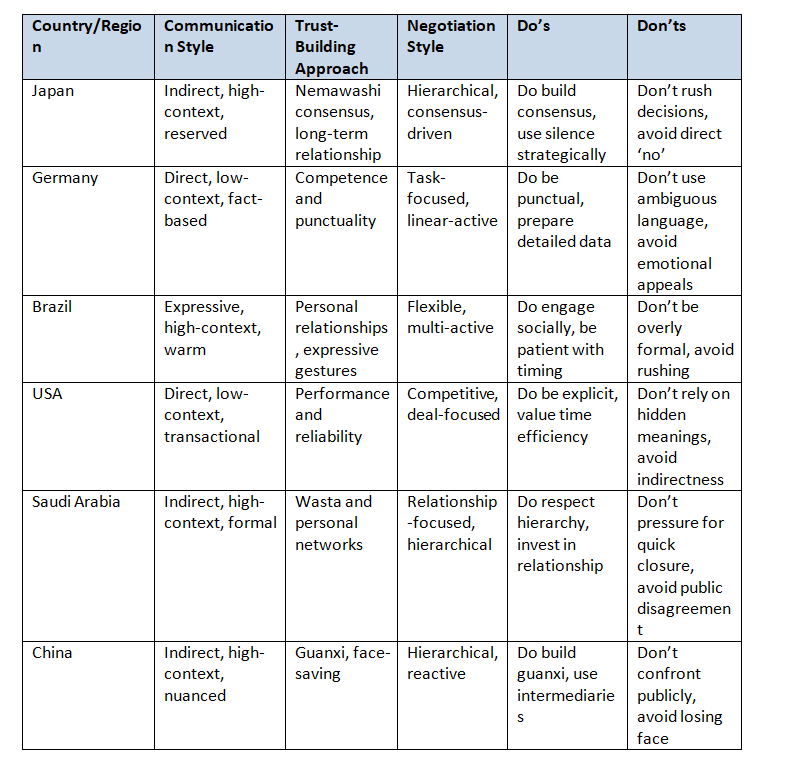
Country/Region-Specific Insights
Advanced Strategies
Expert negotiators employ nuanced techniques to bridge high- and low-context divides.
Managing interpreters: Ensure interpreters understand cultural subtleties, not just language. Brief them on context, hierarchy, and indirectness to preserve meaning.
Building guanxi/wasta: Engage trusted intermediaries respected by the counterpart to facilitate introductions and trust-building.
Navigating hierarchy and face: Use deferential language, avoid direct criticism, and recognize implicit status cues such as seating arrangements and honorifics.
Adapting persuasion styles: High-context cultures favor inductive, story-based persuasion emphasizing harmony; low-context prefer deductive, fact-based logic.
Reading non-verbal signals: In Japan, silence is communication; in Brazil, expressive gestures convey honesty; in the Middle East, proxemics signal respect or dominance.
Scripts and Templates
Below are word-for-word negotiation opening statements tailored to different cultural communication contexts, all conveying the same core message: a willingness to collaborate on a new project.
German (Low-Context, Direct)
“Good morning. I appreciate the opportunity to discuss this project. Our team has prepared detailed data and a clear timeline. We aim to finalize the agreement efficiently based on these facts. Please let me know your questions.”
Japanese (High-Context, Indirect)
“Thank you for meeting with us today. We hope to continue building our strong partnership through this project. We look forward to hearing your valued thoughts and working together to achieve mutual understanding.”
Brazilian (High-Context, Expressive)
“Olá! It’s great to see you again. We’re very excited about this opportunity and believe that together we can create something wonderful. Let’s take our time to ensure everyone feels comfortable and aligned.”
American (Low-Context, Transactional)
“Hi, thanks for joining. We’re ready to move forward quickly and believe this project will benefit both sides. Let’s get straight to the key points and work out the details today.”
Frequently Asked Questions
1. What defines high-context vs low-context communication in negotiation?
High-context communication relies on implicit messages, shared background, and non-verbal cues, common in collectivist and hierarchical cultures. Low-context communication emphasizes explicit, direct verbal messages typical in individualistic and egalitarian societies.
2. How can I identify if my negotiation partner uses high- or low-context communication?
Observe verbal directness, use of silence, reliance on non-verbal cues, decision-making speed, and whether relationship-building precedes business. High-context partners often avoid direct “no” and expect reading between the lines.
3. What mistakes do Western negotiators often make with high-context cultures?
Common errors include pushing for rapid decisions, ignoring relationship-building rituals, misinterpreting silence as hesitance, and failing to respect hierarchy and face, which leads to distrust.
4. How do I adapt my communication style for a high-context negotiation?
Use more indirect language, practice active listening, be patient with timing, invest in relationships, and read non-verbal signals carefully. Avoid blunt refusals and public disagreements.
5. Are contracts equally important in high- and low-context cultures?
No. Low-context cultures treat contracts as final and binding. High-context cultures view contracts as frameworks within ongoing relationships, where trust and reputation often override written terms.
Conclusion
High-context and low-context communication styles profoundly shape international negotiation dynamics. Understanding these differences is not merely academic but a practical necessity to avoid costly misunderstandings, build trust, and close deals effectively. By integrating cultural frameworks, country-specific insights, and expert strategies, negotiators can decode implicit messages, adapt their approaches, and navigate the complex web of cross-cultural signals with confidence.
This guide arms you with the tools to transform cultural challenges into competitive advantages. Embrace cultural intelligence, apply the step-by-step preparation, leverage tailored scripts, and deepen your understanding through real-world examples. The next time you enter a negotiation with a partner from a different cultural context, you will not only communicate—you will connect, influence, and succeed. Start mastering high-context and low-context communication today to elevate your global negotiation capability.