How Buyers Negotiate with Suppliers: Inside the Procurement Playbook

In 2019, a mid-sized electronics component supplier lost a billion-dollar contract with a global automotive giant after a six-month negotiation stalemate. The buyer, leveraging deep category insights and a sophisticated should-cost model, pushed relentlessly on price and delivery terms. The supplier, unable to counter with differentiated value or strategic alternatives, conceded the contract to a lower-cost competitor. This procurement showdown illustrated the brutal reality facing suppliers in today’s high-stakes negotiation environment—where buyers wield advanced analytical tools and strategic frameworks to maximize savings and minimize risk.
Behind every headline-grabbing procurement standoff lies a complex interplay of strategy, psychology, and power. Buyers operate under intense pressure to attain cost reductions while maintaining quality and supplier reliability. They navigate asymmetrical information gaps, armed with category management expertise, Kraljic supplier segmentation, and total cost of ownership (TCO) analyses. Sellers, often caught off-guard, struggle to protect margins without alienating customers or losing strategic footholds. What many miss is that procurement negotiation is not a zero-sum battle but a nuanced dance requiring preparation, transparency, and tactical flexibility.
This definitive guide will arm procurement and sales professionals with everything needed to excel in supplier negotiations. You will master critical frameworks such as the Kraljic Matrix and BATNA (Best Alternative to a Negotiated Agreement), learn step-by-step negotiation strategies tailored for both buyers and sellers, analyze real-world cases from Toyota, Apple, and Amazon, and gain access to exact word-for-word scripts proven in high-pressure discussions. Whether you are a CPO aligning cross-functional stakeholders or a sales director defending margins, this playbook will elevate your negotiation acumen to the highest level.
· Table of Contents
· The Strategic Landscape: How Procurement Really Works
· Key Frameworks and Models
· Step-by-Step Strategy for Buyer and Seller Negotiations
· Real-World Case Studies
· Tactics and Counter-Tactics
· Advanced Strategies in Procurement Negotiation
· Scripts and Templates
· Frequently Asked Questions
· Conclusion
· References
The Strategic Landscape: How Procurement Really Works
Procurement is far more than price haggling. It is a structured, strategic discipline designed to optimize value across cost, quality, service, and innovation dimensions. Understanding the procurement process, buyer incentives, and psychological drivers is essential to decoding negotiation dynamics.
The procurement lifecycle begins with category management—segmenting spend into manageable groups based on supplier markets and business needs. Professional buyers operate under KPIs focusing on cost savings, supplier risk reduction, and service levels. Within categories, they apply the Kraljic Matrix to classify suppliers by supply risk and buying impact into four quadrants: strategic, bottleneck, leverage, and non-critical. This segmentation dictates negotiation approach and level of collaboration or competition.
A key tool is total cost of ownership (TCO) analysis, which moves beyond unit price to consider acquisition, operating, logistics, and end-of-life costs. Buyers use should-cost models to estimate what a supplier’s product or service should cost based on input costs, overhead, and profit margins. This provides a rational basis for challenging supplier prices.
Professional buyers are also influenced by behavioral economics—loss aversion means they often prefer avoiding supplier failure over marginal cost reductions. They aim to build collaborative relationships with strategic suppliers while squeezing leverage on commoditized categories. The asymmetry of information favors buyers who invest in market intelligence and supplier performance data.
For suppliers, understanding these incentives and mental models is critical to positioning value propositions effectively and resisting margin erosion.
Key Frameworks and Models
This section explores foundational frameworks that shape procurement negotiations and supplier engagement. Understanding these models enables buyers and sellers to anticipate moves and optimize their strategies.
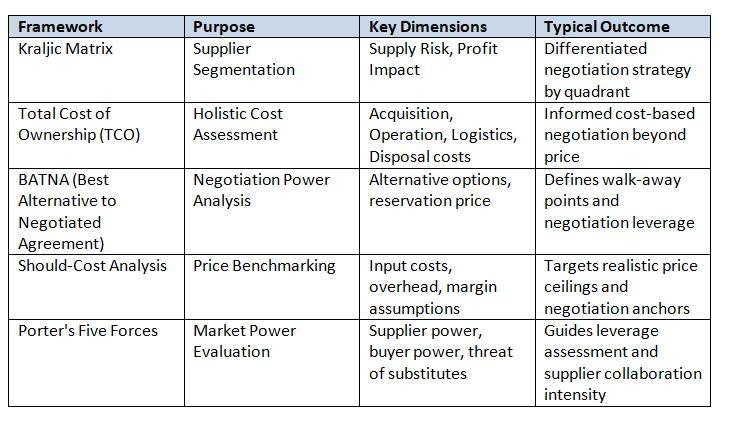
The Kraljic Matrix remains a cornerstone for supplier segmentation. Strategic suppliers—high supply risk and high profit impact—require partnership and joint value creation. Leverage suppliers offer purchasing power advantages, ideal for cost negotiation. Bottleneck suppliers command complex risk management. Non-critical suppliers are transactional.
TCO analysis prevents buyers from focusing on sticker price alone, incorporating hidden costs like downtime, quality defects, and transportation. Should-cost analysis, pioneered by automotive leaders like Toyota, equips buyers with a grounded price expectation based on engineering data and market conditions.
BATNA identification is fundamental to negotiation: buyers must know their alternatives if talks fail, whether substitute suppliers or insourcing. Sellers must likewise understand their fallback options and assess how much margin compression is sustainable.
Step-by-Step Strategy
Mastering procurement negotiation requires a phased, methodical approach. Below are six essential steps, with tactics and language from both buyer and seller perspectives.
Step 1: Preparation and Intelligence Gathering
Buyer: Conduct category analysis, segment suppliers with Kraljic, build TCO and should-cost models, benchmark market pricing. Identify BATNA and internal stakeholder needs. Prepare negotiation objectives balancing cost, quality, and risk.
Seller: Analyze buyer’s business drivers and procurement KPIs, assess competitive landscape, and quantify unique value contributions. Determine walk-away price based on cost structure and strategic importance to buyer.
Language Tip (Buyer): “Based on our category spend data and should-cost analysis, we see room for efficiency gains while maintaining quality standards.”
Language Tip (Seller): “Our solution is tailored specifically to reduce your total cost of ownership across the product lifecycle.”
Step 2: Initial Engagement and Setting the Agenda
Buyer: Open negotiations with clear agenda emphasizing mutual value, timeline, and decision criteria. Use open-ended questions to understand supplier priorities.
Seller: Confirm agenda, express flexibility, and signal willingness to collaborate on value creation.
Language Tip (Buyer): “We’d like to align on key areas including pricing, delivery, and innovation opportunities.”
Language Tip (Seller): “We’re keen to explore how we can support your cost and risk objectives.”
Step 3: Information Exchange and Validation
Buyer: Share relevant data to test supplier pricing and capabilities. Challenge assumptions using should-cost models. Probe on risk mitigation and contingency plans.
Seller: Provide transparent cost breakdowns where possible. Highlight unique differentiators. Address buyer concerns proactively.
Language Tip (Buyer): “Can you walk us through your cost drivers and how you manage supply chain risks?”
Language Tip (Seller): “Our costs reflect premium materials and robust quality assurance processes critical to your product reliability.”
Step 4: Proposal and Counter-Proposal
Buyer: Present initial offer grounded in TCO and BATNA analysis. Use anchoring tactics to set negotiation baseline.
Seller: Respond with counter-offer balancing margin protection and competitive positioning. Propose value-added services or volume discounts.
Language Tip (Buyer): “Given our analysis, we propose a price adjustment of 8% to reflect market realities.”
Language Tip (Seller): “We can offer a 5% discount with extended lead times and joint process improvements.”
Step 5: Handling Objections and Building Consensus
Buyer: Address supplier pushback by reinforcing value drivers and portfolio strategy. Use concession sequencing strategically.
Seller: Present alternative scenarios and reinforce long-term partnership value. Escalate internally if needed.
Language Tip (Buyer): “We recognize your concerns; however, total cost savings are imperative for our budget compliance.”
Language Tip (Seller): “Let’s explore phased implementation to balance your cost targets with our operational constraints.”
Step 6: Closing and Contract Finalization
Buyer: Summarize agreed terms, confirm mutual commitments, and clarify escalation procedures. Prepare for contract execution.
Seller: Ensure clarity on deliverables, payment terms, and service levels. Propose performance metrics.
Language Tip (Buyer): “We appreciate your collaboration and look forward to formalizing our agreement.”
Language Tip (Seller): “We are committed to delivering on these terms and supporting your strategic goals.”
Real-World Case Studies
Examining concrete examples sharpens understanding of theory in practice.
Case 1: Toyota’s Supplier Partnership Model
Toyota revolutionized supplier negotiations by embedding suppliers in product development and sharing cost data transparently. Using should-cost models and mutual problem-solving, Toyota achieved high quality at reduced costs. This long-term relational approach contrasts with adversarial price battles, illustrating the power of collaboration.
Case 2: Apple’s Procurement Leverage
Apple leverages immense buying power and product ecosystem dominance to negotiate favorable terms. It employs rigorous supplier segmentation, demanding innovation, and volume discounts. Despite tough negotiations, Apple invests in supplier development to ensure supply resilience and quality, balancing leverage with partnership.
Case 3: Walmart’s Supplier Squeeze Tactics
Walmart is famous for squeezing suppliers on price using category management and BATNA leverage. Its aggressive negotiations often pressure suppliers to cut costs drastically, sometimes causing supplier consolidation. Walmart’s approach exemplifies transactional procurement and the risks of overleveraging supplier relationships.
Tactics and Counter-Tactics
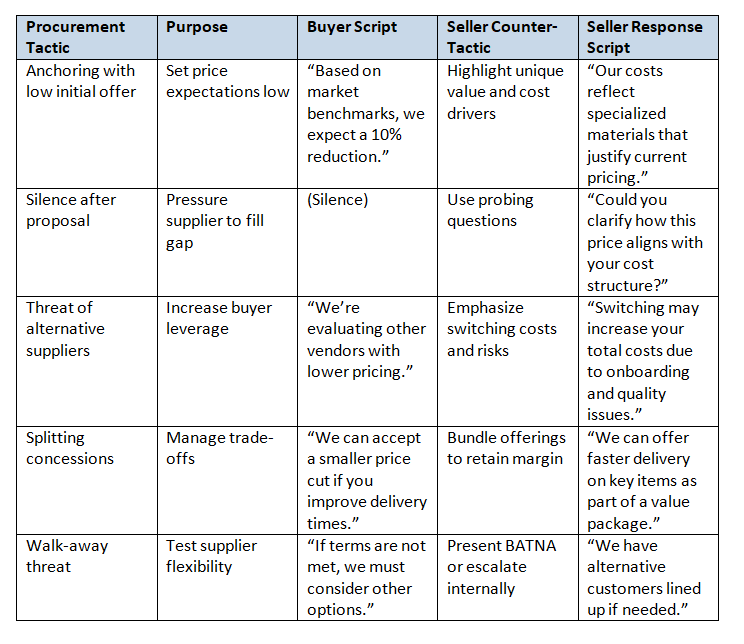
Understanding these tactics and scripted counters equips negotiators to maintain control and avoid common pitfalls.
Advanced Strategies
Beyond basics, expert negotiators apply advanced methods to maximize outcomes.
Relationship Leverage: Building trusted, long-term relationships enables buyers to negotiate collaboratively, reducing transaction costs (Williamson’s transaction cost economics) and unlocking innovation. Suppliers gain preferred status and growth opportunities.
Multi-Year Deal Structuring: Locking in agreements over multiple years stabilizes pricing and supply, allowing suppliers to invest in efficiency. Buyers can leverage volume commitments for better terms. Contractual flexibility through performance clauses manages risk.
Value-Based Positioning: Instead of competing solely on price, suppliers quantify and communicate economic value delivered—such as reduced downtime, improved product features, or sustainability benefits—shifting buyer focus to total value.
Lean Procurement: Applying lean principles to procurement eliminates waste, streamlines processes, and reduces lead times, enabling more agile negotiations and faster contract cycles.
Psychological Tactics: Skilled negotiators use framing, reciprocity, and calibrated questions to influence buyer or seller mindset, managing loss aversion and anchoring bias (Kahneman’s behavioral insights).
Scripts and Templates
Below are exact scripts for common procurement negotiation scenarios.
Script 1: Initial Buyer Outreach Email
Subject: Exploring Partnership Opportunities in [Category]
Dear [Supplier Name],
We are currently reviewing our [category] spend and would like to initiate discussions around potential collaboration. Our goal is to identify cost savings and innovation opportunities while maintaining high quality and service levels.
Could we schedule a meeting next week to explore how your offerings align with our strategic priorities?
Best regards,
Script 2: Buyer Counter-Proposal Email
Subject: Revised Proposal for [Product/Service]
Dear [Supplier Name],
Thank you for your detailed proposal. After thorough analysis, we would like to propose an adjusted pricing structure reflecting market benchmarks and total cost considerations.
Specifically, we are targeting an 8% price reduction, contingent on maintaining current delivery and quality terms.
Please let us know your thoughts.
Best,
Script 3: Seller Response to Price Pressure
Subject: Re: Revised Proposal for [Product/Service]
Dear [Buyer Name],
We appreciate your feedback. Our pricing reflects the premium materials and quality assurance that ensure your product reliability. However, we are willing to discuss volume discounts and value-added services to meet your cost objectives.
Looking forward to continued collaboration.
Best,
Script 4: Closing Confirmation Email
Subject: Confirmation of Agreement Terms
Dear [Supplier/Buyer Name],
We are pleased to confirm the agreed terms as follows: [Key terms summarized]. We look forward to successful execution and a productive partnership.
Please advise on next steps for contract finalization.
Regards,
Frequently Asked Questions
Q1: How do buyers determine their BATNA in supplier negotiations?
A1: Buyers assess alternative suppliers’ capabilities, pricing, and risk profiles. This includes evaluating in-house production feasibility or postponing purchases. Understanding BATNA sets the reservation price and informs walk-away decisions.
Q2: What role does total cost of ownership play versus simply negotiating price?
A2: TCO considers all costs over the product lifecycle, including acquisition, operation, maintenance, and disposal. Focusing solely on price can lead to suboptimal supplier selection and hidden costs, undermining long-term value.
Q3: How can suppliers effectively push back against aggressive buyer tactics?
A3: Suppliers should provide transparent cost breakdowns, emphasize unique value, propose alternative trade-offs, and highlight risks of switching. Maintaining professionalism and seeking collaborative solutions preserves relationships.
Q4: What negotiation frameworks are most relevant for managing strategic suppliers?
A4: The Kraljic Matrix guides differentiated approaches—strategic suppliers require partnership-oriented frameworks emphasizing joint value creation, risk sharing, and innovation collaboration rather than price battles.
Q5: How important are multi-year contracts in procurement negotiations?
A5: Multi-year contracts provide stability, enable volume discounts, and justify supplier investments in process improvements. However, they require built-in flexibility and performance metrics to manage market changes and mitigate risks.
Conclusion
Procurement negotiation is a sophisticated discipline that transcends traditional price haggling. By leveraging strategic frameworks like the Kraljic Matrix and TCO analysis, preparing meticulously, and applying proven negotiation scripts and tactics, buyers and sellers can unlock mutual value, mitigate risks, and build enduring partnerships. Understanding psychological drivers, adopting advanced strategies, and learning from benchmark companies such as Toyota and Apple further elevate negotiation outcomes.
Whether you represent procurement leadership seeking to deliver breakthrough savings or suppliers aiming to protect margins without sacrificing relationships, this playbook equips you with actionable insights and practical tools. Begin applying these techniques today to transform your negotiation approach and secure winning agreements that deliver sustained competitive advantage.
References
1. Kraljic, P. (1983). Purchasing Must Become Supply Management. Harvard Business Review.
2. Kahneman, D. (2011). Thinking, Fast and Slow. Farrar, Straus and Giroux.
3. Porter, M. E. (1979). How Competitive Forces Shape Strategy. Harvard Business Review.
4. Williamson, O. E. (1985). The Economic Institutions of Capitalism. Free Press.
5. Monczka, R. M., Handfield, R. B., Giunipero, L. C., & Patterson, J. L. (2015). Purchasing and Supply Chain Management. Cengage Learning.
6. Liker, J. K. (2004). The Toyota Way: 14 Management Principles from the World's Greatest Manufacturer. McGraw-Hill.