How Culture Affects Negotiation Outcomes: Research, Evidence, and Practical Implications

Negotiations are seldom just about numbers and terms. Consider the 2011 failed merger talks between a major American tech firm and a Japanese conglomerate. Despite attractive financial terms, the deal collapsed when American negotiators pushed for rapid decisions, dismissing the Japanese practice of nemawashi — the essential informal consensus-building that ensures group harmony. This cultural misstep cost both sides millions in lost opportunities, highlighting how hidden cultural expectations can derail even the most promising deals. In contrast, a 2018 Middle Eastern-European infrastructure partnership succeeded spectacularly because European executives invested months cultivating wasta-style relationships, respecting the Arab emphasis on trust before contracts.
Cross-cultural negotiation differs fundamentally from domestic deals because it involves navigating invisible cultural scripts and assumptions we often don’t realize we hold. Signals such as tone, timing, and deference, which may seem subtle or unspoken, profoundly affect trust and rapport. Misreading these cues or undervaluing relational dynamics can stymie progress or lead to costly misunderstandings. Successful negotiators cultivate cultural intelligence — the capability to interpret and adapt to these unseen cultural layers — transforming potential barriers into bridges of mutual gain.
This comprehensive guide will equip you with a deep understanding of the leading cultural frameworks — including Geert Hofstede’s dimensions, Erin Meyer’s Culture Map, Richard Lewis’s model, Edward Hall’s context theory, Richard Gesteland’s deal vs relationship-focus, David Livermore’s CQ model, and Trompenaars & Hampden-Turner’s cultural typologies. You will gain country-specific insights, actionable preparation strategies, real-world case studies, advanced negotiation techniques, and exact scripts tailored for diverse cultural contexts. Prepare to master the art and science of cross-cultural negotiation for superior outcomes worldwide.
· Table of Contents
· The Science of Cultural Differences in Negotiation
· Key Cultural Frameworks and Comparative Analysis
· Step-by-Step Cultural Preparation Strategy
· Real-World Case Studies
· Country/Region-Specific Insights and Best Practices
· Advanced Cross-Cultural Negotiation Strategies
· Scripts and Language Templates for Different Cultures
· Frequently Asked Questions
· Conclusion and Call to Action
· References
The Science of Cultural Differences in Negotiation
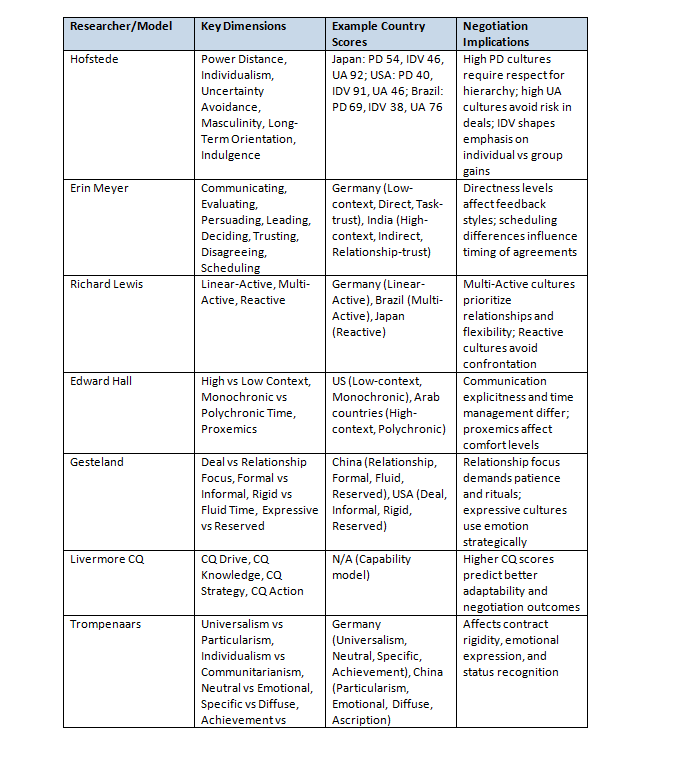
Understanding how culture shapes negotiation requires a multi-theoretical lens. Seven seminal researchers and frameworks contribute vital perspectives. Each offers unique dimensions and empirical country scores that reveal predictable patterns in negotiation behavior.
Geert Hofstede’s six cultural dimensions (2010) remain foundational. For example, Japan scores high on Uncertainty Avoidance (92) and Collectivism (46), favoring risk-averse, consensus-driven negotiations, whereas the U.S. scores low on Uncertainty Avoidance (46) and high on Individualism (91), resulting in more direct and transactional dealings. Brazil’s high Power Distance (69) reflects hierarchical respect, influencing who speaks and decides at the table.
Erin Meyer (2014) expands on communication and decision-making with her Culture Map’s eight dimensions, such as Communicating (low-context vs high-context) and Scheduling (linear-time vs flexible-time). For instance, Germans are low-context and rigid-time, preferring explicit information and punctuality, while Indians are high-context and polychronic, where indirect communication and flexible timing prevail.
Richard Lewis’s triadic model classifies cultures as Linear-Active (e.g., Germans, Americans), Multi-Active (e.g., Brazilians, Italians), or Reactive (e.g., Japanese, Chinese). Linear-Active negotiators prioritize facts and schedules, Multi-Active emphasize relationships and emotional expressiveness, and Reactive focus on harmony and listening. This explains why a Brazilian negotiator’s warmth and digressions may frustrate a German counterpart expecting directness.
Edward Hall’s theory contrasts High-Context cultures (e.g., Japan, Arab countries) that rely heavily on implicit communication and shared context, with Low-Context cultures (e.g., U.S., Scandinavia) that prefer explicit messages. Hall also distinguishes Monochronic time cultures (e.g., U.S., Germany) that value strict schedules from Polychronic ones (e.g., Latin America, Middle East) where multitasking and flexible timing dominate. Proxemics — comfortable interpersonal distances — also vary widely, affecting rapport building.
Richard Gesteland’s framework further clarifies negotiation styles by distinguishing Deal-Focus versus Relationship-Focus, Formal versus Informal, Rigid-Time versus Fluid-Time, and Expressive versus Reserved cultures. Chinese negotiators exhibit relationship-focus and formality, emphasizing mianzi (face) preservation, while Americans lean toward deal-focus and informality, prioritizing efficiency over ceremony.
David Livermore’s Cultural Intelligence (CQ) model offers a practical lens with four capabilities: CQ Drive (motivation), CQ Knowledge (understanding cultural systems), CQ Strategy (planning and awareness), and CQ Action (adaptability in behavior). High CQ negotiators anticipate cultural obstacles and adapt strategies dynamically, increasing success rates.
Lastly, Trompenaars & Hampden-Turner’s seven dimensions (1997) such as Universalism vs Particularism and Achievement vs Ascription enrich the understanding of how cultures apply rules and assign status. Germany’s universalism contrasts with China’s particularism, influencing contract rigidity and negotiation flexibility.
Key Cultural Frameworks
To navigate cultural complexity in negotiation, mastering a few frameworks is essential. Below is a comparative summary of Hofstede, Meyer, and Trompenaars frameworks across selected countries known for active global negotiating roles.
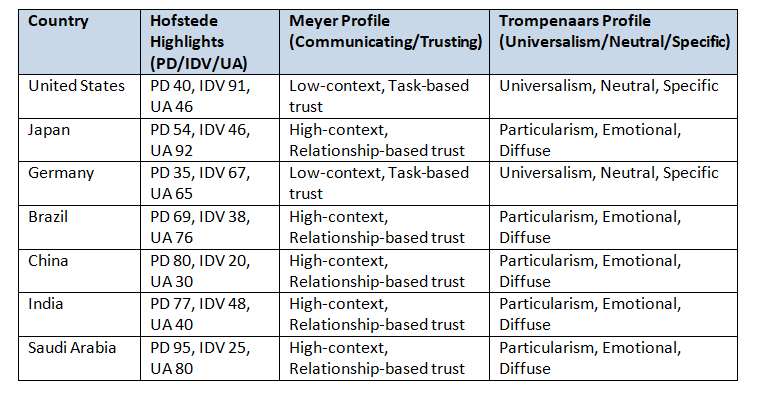
This table illustrates how cultures scoring high on Power Distance and Collectivism, such as China and Saudi Arabia, emphasize relationship-building and indirect communication. Western cultures like the U.S. and Germany lean toward direct communication and rules-based negotiations. Understanding these contrasts is vital for adapting negotiation style, tone, and pacing.
Step-by-Step Cultural Preparation Strategy
A systematic approach to cross-cultural negotiation preparation reduces risk and enhances outcomes. Follow these six essential steps:
Step 1: Conduct Deep Cultural Research
Before the negotiation, analyze the counterpart’s cultural dimensions using multiple frameworks. Identify their communication style, decision-making process, and time orientation. For example, researching Japan’s nemawashi process signals the need for prolonged informal consensus-building before formal meetings. Use resources such as Hofstede Insights or Erin Meyer’s Culture Map assessments.
Step 2: Understand Relationship-Building Norms
Differentiate whether the culture emphasizes relationship or deal focus (Gesteland). In Middle Eastern or Indian contexts, invest time in wasta or personal rapport before discussing terms. In contrast, Scandinavian cultures value egalitarianism and may prefer straight-to-business interactions.
Step 3: Adapt Communication Style
Tailor verbal and nonverbal communication to suit high- or low-context cultures. For example, in Germany, use explicit, fact-based language; in China, employ more indirect expressions and pay attention to silence as a communication cue. Avoid interrupting reactive cultures like Japan, where harmony is prized.
Step 4: Build Trust Through Culturally Appropriate Behaviors
Trust-building varies: Americans rely on competence trust (task-based), while Indians and Arabs emphasize affective trust (relationship-based). Delivering on small promises early can build credibility. In cultures valuing face (China, Korea), avoid public criticism and use private, diplomatic language.
Step 5: Manage Face and Save Dignity
Understand the concept of face (mianzi in China, wasta in Middle East) and develop strategies to prevent loss of face. Use indirect disagreement, ask questions instead of blunt statements, and provide multiple options to allow counterparts to choose without embarrassment.
Step 6: Close with Respect for Cultural Protocols
Negotiation closure differs: Japanese may expect extended post-negotiation rituals or gift exchanges; Americans prefer clear final agreements and immediate signatures. Confirm mutual understanding using culturally appropriate summaries and ensure all stakeholders’ consensus in collectivist cultures before finalizing.
Real-World Case Studies
Case Study 1: The American-Japanese Automotive Joint Venture (2008)
In 2008, a U.S. automotive company attempted a joint venture with a Japanese manufacturer. The Americans pushed for fast, decisive contract signing, disregarding Japan’s ringi system — a bottom-up consensus approach involving multiple layers of approval. The Americans interpreted delays as indecisiveness; the Japanese partners saw haste as disrespect. The deal stalled for six months before a cultural mediator helped educate both sides on the other's processes. Lesson: Respect consensus-building rituals to avoid perceived disrespect and mistrust.
Case Study 2: European-Middle Eastern Energy Contract (2018)
A European energy firm sought investment in a Middle Eastern country. European executives initially approached negotiations with a deal-focus and rigid timelines. The Middle Eastern partners expected relational buildup consistent with wasta. By shifting to relationship-building dinners, informal meetings, and flexible schedules, Europeans successfully established trust. The final contract reflected mutual respect rather than just terms. Lesson: Prioritize relationship development in high-context, relationship-oriented cultures for deal success.
Case Study 3: German-Brazilian Construction Project (2015)
A German engineering firm experienced repeated frustration negotiating with Brazilian partners who frequently changed meeting times and introduced new stakeholders. Germans viewed this as unprofessional; Brazilians operated in a polychronic time framework valuing warmth and personal bonds over schedules. After German negotiators adjusted expectations, integrated informal socializing, and adopted a flexible approach, collaboration improved. Lesson: Adapt to polychronic time and multi-active communication styles to maintain harmony and progress.
Country/Region-Specific Insights
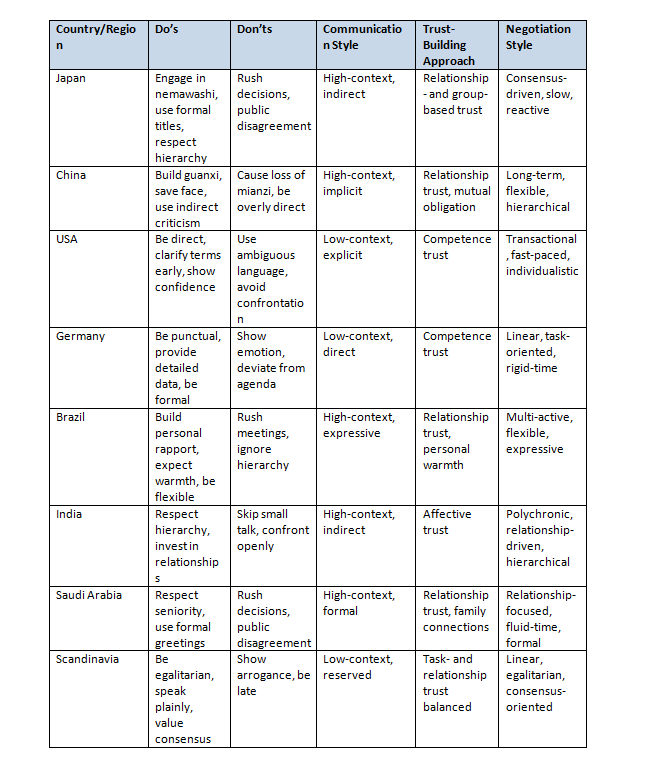
Below is a summary table presenting cultural do’s and don’ts, communication style, trust-building approach, and negotiation style for key countries and regions.
Advanced Strategies
Expert negotiators leverage nuanced techniques to manage complex cultural dynamics:
- Managing Interpreters: Use interpreters not just for language but as cultural brokers. Brief them on negotiation goals and cultural sensitivities. Pause frequently to ensure accurate, context-aware translation. Avoid overloading interpreters with jargon or idioms.
- Building Guanxi, Wasta, and Other Relationship Capital: Understand that in China, guanxi involves reciprocal favors and long-term connections; in the Middle East, wasta leverages family or tribal networks. Allocate time and resources to cultivate these networks before formal negotiations.
- Navigating Hierarchy and Face: Defer to senior decision-makers in high Power Distance cultures. Publicly acknowledging their authority enhances respect. Use indirect language to disagree or correct to preserve face. In Korea, reading nunchi (emotional intelligence) about status cues and moods is vital.
- Adapting Persuasion Styles: Americans prefer principles-first (deductive) logic; French value theoretical argumentation; Asians often use applications-first (inductive) reasoning. Tailor your persuasion approach accordingly.
- Reading Non-Verbal Signals: High-context cultures use subtle facial expressions, silences, and gestures as communication. In Japan, a slight nod signifies agreement, while in Brazil, expressive hand gestures support enthusiasm. Train to recognize and interpret these cues accurately.
Scripts and Templates
Below are example word-for-word negotiation opening statements adapted for four cultures reflecting their communication norms and cultural protocols.
German Negotiation Opening Script
“Good morning, Mr. Schmidt. Thank you for meeting promptly. We have prepared a detailed agenda and supporting data for today’s discussion. Our objective is to review the proposed contract line by line to ensure clarity and mutual understanding. Please feel free to raise any questions as we proceed.”
Japanese Negotiation Opening Script
“Thank you very much for granting us this opportunity, esteemed Mr. Tanaka. We sincerely appreciate your time. Before we begin, we would like to express our respect for your company’s traditions and the careful consideration you give to all partners. We hope to engage in open dialogue and work together harmoniously to reach a consensus.”
Brazilian Negotiation Opening Script
“Olá, Senhor Silva! It’s great to finally meet you in person. We’ve heard wonderful things about your team. Please, let’s take some time to get to know each other before diving into business — building a strong relationship is very important to us. We’re excited about the possibilities and look forward to a warm, productive conversation.”
American Negotiation Opening Script
“Hi, John, thanks for joining the call. Let me start by outlining the key points we want to cover today. We aim to reach an agreement efficiently and move forward with implementation quickly. Please feel free to speak frankly — transparency will help us get the best outcome for both sides.”
Frequently Asked Questions
Q1: How can I quickly assess a counterpart’s cultural negotiation style?
A1: Use preliminary research tools like Hofstede Insights or Erin Meyer’s Culture Map to identify their country’s dominant cultural traits. Observe behaviors during initial meetings — note communication directness, decision speed, and formality. Asking respectful, open-ended questions about their process can also reveal preferences.
Q2: What are effective ways to build trust in high-context cultures?
A2: Prioritize relationship-building activities such as informal meetings, shared meals, and personalized gestures. Demonstrate respect for hierarchy and cultural norms. Avoid rushing or pressing for immediate decisions. Consistently follow through on small commitments to reinforce reliability.
Q3: How should I handle disagreements in cultures that avoid open conflict?
A3: Use indirect methods such as asking clarifying questions, proposing hypothetical scenarios, or offering options rather than blunt rejections. Maintain a calm tone and avoid public criticism. Employ a mediator or trusted third party if necessary to facilitate dialogue.
Q4: Can cultural intelligence (CQ) be developed quickly?
A4: While deep cultural knowledge takes time, CQ can be enhanced rapidly through focused training, real-world exposure, self-reflection, and coaching. Practicing active listening, perspective-taking, and behavioral adaptation improves CQ Strategy and Action especially.
Q5: How important is hierarchy in cross-cultural negotiations?
A5: Very important in high Power Distance cultures such as China, India, and Middle Eastern countries. Always identify key decision-makers and show appropriate deference. In low Power Distance cultures like Scandinavia, egalitarian interaction is expected. Misjudging hierarchy risks offending counterparts or stalling decisions.
Conclusion
Cross-cultural negotiation is a sophisticated interplay of tangible terms and intangible cultural scripts. Mastery demands more than language fluency or technical expertise — it requires deep cultural intelligence, empathy, and strategic adaptation. By integrating the insights of Hofstede, Meyer, Lewis, Hall, Gesteland, Livermore, and Trompenaars, negotiators decode the unseen forces that shape outcomes, transforming potential pitfalls into pathways for partnership.
Executives and global professionals who invest in cultural preparation, relationship-building, and nuanced communication unlock superior deal value, trust, and long-term collaboration. Use the frameworks, case studies, strategies, and scripts in this guide as your strategic toolkit. Commit to continuous cultural learning and flexibility — your negotiation success depends on it. Begin today by applying these principles to your next international engagement and witness transformative results.
References
- Hofstede, G. (2010). Cultures and Organizations: Software of the Mind. McGraw-Hill.
- Meyer, E. (2014). The Culture Map: Breaking Through the Invisible Boundaries of Global Business. PublicAffairs.
- Lewis, R. D. (2006). When Cultures Collide: Leading Across Cultures. Nicholas Brealey Publishing.
- Hall, E.T. (1976). Beyond Culture. Anchor Books.
- Gesteland, R.R. (2012). Cross-Cultural Business Behavior: Marketing, Negotiating, Sourcing and Managing Across Cultures. Copenhagen Business School Press.
- Livermore, D. (2015). Leading with Cultural Intelligence: The Real Secret to Success. AMACOM.
- Trompenaars, F., & Hampden-Turner, C. (1997). Riding the Waves of Culture: Understanding Diversity in Global Business. McGraw-Hill.
- Graham, J.L., Mintu, A.T., & Rodgers, W. (1994). Explorations of Negotiation Behaviors in Ten Foreign Cultures Using a Model Developed in the United States. Management Science, 40(1), 72-95.
- Brett, J. (2001). Negotiating Globally: How to Negotiate Deals, Resolve Disputes, and Make Decisions Across Cultural Boundaries. Jossey-Bass.