How Procurement Teams Create Leverage: Tactics Every Supplier Should Know

In the sprawling procurement offices of a global automotive giant like Toyota, a complex negotiation unfolds. Toyota’s procurement team, armed with deep category insights and a finely calibrated should-cost model, leverages their strategic position to negotiate not merely on price but on innovation, quality, and delivery reliability. Across the table, suppliers are not just vendors; they are critical partners whose margins and operational strategies hinge on understanding the subtle but powerful ways procurement creates leverage.
The stakes are immense. Procurement teams that master leverage can drastically reduce total cost of ownership, minimize supply chain risks, and drive continuous improvement. Suppliers unaware or unprepared for these tactics risk losing contracts or eroding profitability. Conversely, those who grasp procurement’s strategic levers can engage more effectively, secure better terms, and foster collaborative partnerships.
This comprehensive guide will take you through the foundational frameworks—like the Kraljic Matrix and Porter's Five Forces—that procurement professionals employ. You will learn the step-by-step processes they follow, see real-world case studies from industry leaders such as Apple and Boeing, and gain actionable scripts and tactics to counter procurement moves. Whether you are a supplier account manager or a sales director, mastering these insights will elevate your negotiation game and strengthen your market position.
· Table of Contents
· The Strategic Foundation: Procurement Leverage Psychology and Frameworks
· Key Frameworks and Models: Kraljic Matrix, Porter's Five Forces, TCO Analysis
· Step-by-Step Process: From Spend Analysis to Contract Finalization
· Real-World Case Studies: Toyota, Apple, Boeing
· Tactics and Counter-Tactics: Negotiation Scripts and Responses
· Advanced Strategies: Collaborative Negotiation, Value Engineering, BATNA Optimization
· Scripts and Templates: Word-for-Word Buyer and Seller Dialogues
· Frequently Asked Questions: Procurement Leverage Demystified
· Conclusion and Next Steps
· References
The Strategic Foundation
Leverage in procurement is no accident; it is the result of deliberate strategy grounded in rigorous frameworks, behavioral economics, and competitive analysis. At its core, leverage means the buyer’s ability to influence supplier behavior and terms favorably by controlling key variables—information, alternatives, timing, and power dynamics.
Foundational research in negotiation theory by Harvard’s Deepak Malhotra and Max Bazerman has shown that leverage arises when one party can shape the Zone of Possible Agreement (ZOPA) and optimize their Best Alternative to a Negotiated Agreement (BATNA). Procurement teams cultivate leverage by systematically increasing their BATNA—through supplier segmentation, alternate sourcing, and demand shaping.
Another key psychological insight is the concept of the "anchoring effect," where initial offers set negotiation reference points. Procurement professionals intentionally use should-cost models to anchor supplier expectations downward, often backed by data analytics and total cost of ownership (TCO) assessments.
Strategic frameworks like the Kraljic Matrix reinforce how suppliers are segmented based on risk and profit impact, guiding the leverage tactics employed. For example, critical suppliers with high supply risk and high financial impact are managed collaboratively but with tight performance controls, whereas leverage items invite aggressive price competition.
Finally, category management principles underpin how procurement organizes spend into manageable segments, enabling focused leverage-building actions. By aligning procurement strategy with organizational goals, these teams ensure leverage translates into sustained business value rather than short-term gains.
Key Frameworks and Models
Procurement leverage is best understood through multiple analytical lenses. Below are three pivotal frameworks that procurement teams rely on to create and exercise leverage effectively.
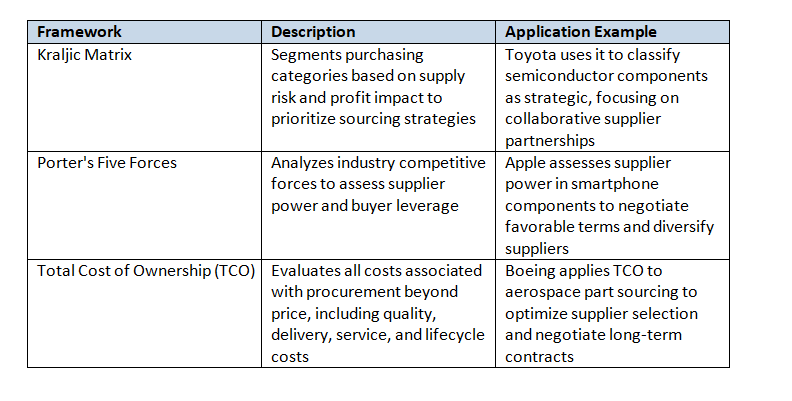
These models guide procurement to identify where leverage exists and how it can be maximized. For instance, in categories identified as 'strategic' in the Kraljic Matrix, procurement shifts from adversarial price-cutting to joint value creation and risk-sharing. Conversely, in 'leverage' categories, price and terms become the main battleground.
Porter's Five Forces analysis helps procurement understand supplier concentration, switching costs, and threat of substitutes, which directly affect their bargaining power. This insight informs sourcing strategies such as dual sourcing or supplier development.
TCO modeling shifts the negotiation focus from unit price to holistic cost, enabling procurement to argue for concessions on price by highlighting downstream savings in inventory carrying costs, warranty, or obsolescence.
Step-by-Step Process
Procurement teams follow a disciplined, iterative process to create leverage. Below is a detailed exploration of each step with specific tactics and language that suppliers must recognize.
Step 1: Spend and Market Analysis
Procurement begins by segmenting spend data to identify high-value categories and potential leverage points. Market intelligence is gathered on supplier landscape, pricing trends, and technological innovations.
Tactic: Deploy should-cost models and benchmark prices.
Supplier Awareness: Expect buyers to question current pricing assumptions and benchmark against industry standards.
Step 2: Supplier Segmentation and Risk Assessment
Using frameworks like the Kraljic Matrix, buyers categorize suppliers by criticality and risk.
Tactic: Classify suppliers into strategic, bottleneck, leverage, or routine to tailor negotiation approach.
Supplier Awareness: Your classification dictates buyer’s flexibility and negotiation style.
Step 3: Develop Sourcing Strategy and BATNA
Procurement designs sourcing strategies—single vs. multiple sourcing, partnerships vs. competitive bidding—while strengthening BATNA by cultivating alternative suppliers.
Tactic: Establish credible alternatives to increase negotiation leverage.
Supplier Awareness: Buyers with strong BATNA will push for more concessions; demonstrate your unique value to mitigate.
Step 4: Initiate Negotiation with Anchoring and Data
Buyers open negotiations anchored by data-backed price targets from should-cost and TCO analyses.
Tactic: Present well-prepared cost models and benchmarking data early to set price expectations.
Supplier Awareness: Be prepared to defend your costs and avoid conceding prematurely.
Step 5: Apply Value Engineering and Collaborative Problem Solving
Procurement seeks cost reduction by redesigning products/processes with suppliers.
Tactic: Use joint workshops to identify cost drivers and innovation opportunities.
Supplier Awareness: Engage proactively to co-create value rather than resist change.
Step 6: Finalize Contract with Performance Metrics and Flexibility Clauses
Leverage extends into contract terms emphasizing KPIs, penalty clauses, and options for volume flexibility.
Tactic: Embed service level agreements, continuous improvement incentives.
Supplier Awareness: Understand contract terms fully and negotiate balanced risk-sharing.
Real-World Case Studies
The theory of procurement leverage is best illustrated through practical examples from industry leaders.
Case 1: Toyota’s Supplier Collaboration and Risk Mitigation
Toyota’s procurement team leverages the Kraljic Matrix to classify key automotive parts as strategic. By fostering close supplier relationships and sharing forecasts, Toyota reduces supply risks and cost volatility. They use should-cost modeling extensively to benchmark prices, enabling them to negotiate tough but fair terms.
Lesson: Leverage is not just about hard negotiation but about creating mutual dependency that strengthens bargaining positions.
Case 2: Apple’s Multi-Tiered Supplier Strategy
Apple employs a dual approach: aggressive price negotiations with leverage suppliers using Porter's Five Forces insights, while investing in strategic partnerships with critical suppliers for innovation. Its procurement teams orchestrate multiple global suppliers to maintain BATNA and avoid single-source risk.
Lesson: Leveraging alternatives while nurturing innovation partnerships balances power and collaboration.
Case 3: Boeing’s TCO-Driven Aerospace Sourcing
Boeing’s procurement leverages total cost of ownership analysis to evaluate suppliers beyond price, including quality, reliability, and lifecycle support. By integrating value engineering during negotiations, Boeing secures supplier commitments that optimize long-term cost and risk.
Lesson: Effective leverage combines rigorous data analysis with supplier engagement to achieve sustainable cost savings.
Tactics and Counter-Tactics
Procurement teams deploy various leverage tactics, and savvy suppliers must be prepared with counter-tactics. The following table summarizes common buyer tactics and effective seller responses with sample language.
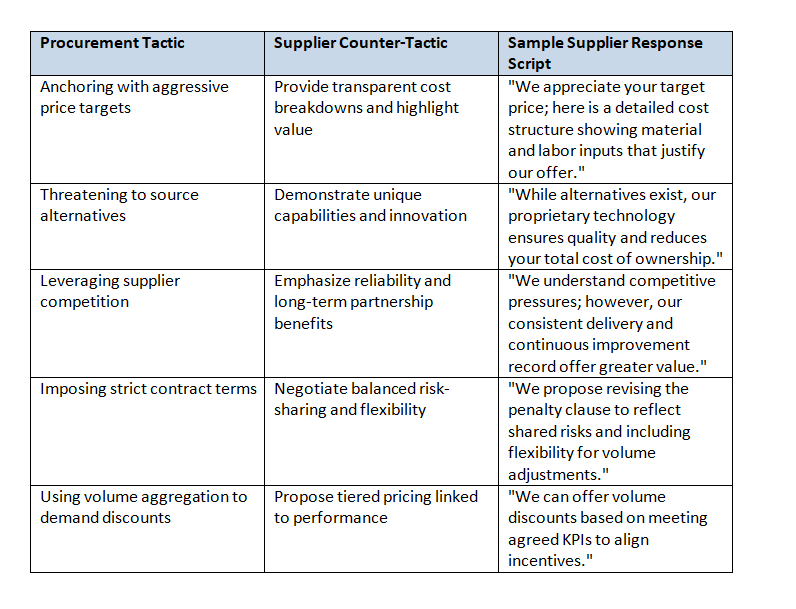
Recognizing these tactics allows suppliers to engage proactively rather than reactively, maintaining profitable relationships while addressing buyer leverage.
Advanced Strategies
Leading procurement teams employ advanced leverage-building strategies beyond basic negotiation:
· Collaborative Negotiation: Leveraging joint problem-solving workshops to align interests and unlock innovation savings.
· Value Engineering: Working with suppliers to redesign products/processes to lower costs without sacrificing quality.
· Dynamic BATNA Management: Continuously monitoring market conditions and supplier developments to maintain strong alternatives.
· Digital Procurement Tools: Using AI-driven analytics for spend visibility, supplier risk assessment, and predictive negotiation scenarios.
· Supplier Relationship Management (SRM): Segmenting suppliers and tailoring engagement to optimize long-term value and mitigate risks.
Suppliers who understand and anticipate these evolving methods can better position themselves as indispensable partners rather than mere vendors.
Scripts and Templates
Below are practical word-for-word scripts suppliers can use to manage procurement leverage dynamics effectively.
1. Responding to Aggressive Price Anchoring:
"Thank you for sharing your target pricing. To ensure transparency, I’d like to walk you through our detailed cost structure, highlighting areas where quality and service add significant value beyond raw cost."
2. Countering Threats of Alternative Sourcing:
"We recognize the importance of competitive pricing. However, our unique capabilities and commitment to continuous improvement reduce your long-term risk and overall costs, which alternatives may not match."
3. Negotiating Contract Terms:
"We are committed to meeting your KPIs. To make this sustainable, could we discuss revising penalty clauses to reflect shared risks and introduce flexibility for volume fluctuations?"
4. Proposing Value Engineering Collaboration:
"We would value the opportunity to collaborate on value engineering workshops aimed at identifying cost-saving innovations without compromising quality or delivery."
5. Addressing Volume Discount Requests:
"We can work on a tiered pricing model where discounts increase based on performance metrics, ensuring alignment of incentives and shared success."
Frequently Asked Questions
Q1: How do procurement teams use the Kraljic Matrix to gain leverage?
A1: The Kraljic Matrix segments suppliers based on risk and impact, enabling procurement to focus aggressive leverage tactics on ‘leverage’ items where alternatives exist, while fostering partnerships for ‘strategic’ items. This segmentation informs negotiation style, sourcing strategies, and risk management.
Q2: What role does total cost of ownership (TCO) play in procurement leverage?
A2: TCO expands focus beyond price to include quality, delivery, warranty, and lifecycle costs. Procurement uses TCO to anchor negotiations on holistic value, pressuring suppliers to reduce not just price but also costs embedded in other areas, enhancing leverage.
Q3: How can suppliers improve their BATNA against procurement leverage?
A3: Suppliers can improve their BATNA by differentiating through innovation, reliability, and service excellence, entering alternative markets, or forming partnerships to reduce buyer dependency on substitutes, balancing negotiation power.
Q4: What psychological tactics do procurement teams use during negotiations?
A4: Besides anchoring, procurement uses framing, selective information sharing, and timing to influence supplier perceptions. For example, postponing concessions to late stages or emphasizing benchmark comparisons can pressure suppliers.
Q5: How do digital tools enhance procurement leverage?
A5: Digital tools provide real-time spend analytics, supplier performance data, and market intelligence, enabling procurement to identify cost-saving opportunities, monitor supplier risks, and simulate negotiation scenarios, thereby strengthening leverage.
Conclusion
Procurement leverage is a sophisticated, multi-dimensional construct rooted in strategic frameworks, data-driven analytics, and behavioral insight. For suppliers, understanding these levers is not optional but essential to navigate increasingly complex and competitive B2B negotiations. By recognizing procurement’s structured approach—from spend segmentation and BATNA development to advanced collaboration and contract design—suppliers can anticipate tactics and respond with confidence and value-added propositions.
Mastering the interplay of procurement leverage tactics and counter-strategies empowers suppliers to move from reactive concession-making to proactive partnership development. This transformation not only preserves margins but fosters innovation, resilience, and mutual growth. Engage with these principles and tools to elevate your negotiation approach and thrive in today’s demanding procurement landscape.
For suppliers looking to deepen their skills or procurement leaders aiming to refine leverage, connect with our expert consulting services to tailor strategies that win.
Need more knowedge? Visit:
https://www.michalchmielecki.com/procurement-negotiation
References
· Malhotra, D., & Bazerman, M. (2007). Negotiation Genius: How to Overcome Obstacles and Achieve Brilliant Results at the Bargaining Table and Beyond. Bantam.
· Kraljic, P. (1983). Purchasing must become supply management. Harvard Business Review.
· Porter, M. E. (1979). How competitive forces shape strategy. Harvard Business Review.
· NHS Supply Chain. (2020). Category Management Framework. NHS England.
· Handfield, R., & Nichols, E. (1999). Introduction to Supply Chain Management. Prentice Hall.
· Boeing. (2022). Supplier Engagement and Total Cost of Ownership Best Practices. Boeing Procurement Publications.