How to Anchor Price in Negotiation: The Definitive Guide for Sales Professionals and Business Owners

Imagine you are about to close a critical enterprise SaaS deal worth millions. The client flinches at your price proposal, hinting at budget constraints. Your ability to set the initial price anchor decisively will determine whether you secure the deal at a premium or bleed margin in costly concessions. Studies show that negotiators who establish the first price anchor capture up to 85% of the final agreement value (Galinsky & Mussweiler, 2001). Yet, many sales professionals struggle to apply anchoring strategically, losing billions in avoidable discounting every year.
This guide unlocks the psychology and science behind price anchoring — a cornerstone tactic rooted in behavioral economics and cognitive biases. Poor pricing not only erodes profit but signals weak value perception, impacting long-term brand equity. Understanding how prospects mentally frame your offer’s value relative to your anchor is essential for protecting margins and closing premium deals. Whether you sell SaaS, professional services, manufacturing, or luxury goods, mastering price anchoring is non-negotiable.
You will learn proven frameworks, step-by-step processes, real-world case studies from leaders like Apple and McKinsey, and advanced tactics to outsmart buyers’ counteranchoring. This guide also provides exact scripts and templates for immediate use, plus common pitfalls with corrective actions. By the end, you will wield price anchoring as your most powerful negotiating weapon.
· Table of Contents
· The Psychology and Science Behind Price Anchoring
· Key Frameworks and Models for Effective Anchoring
· Step-by-Step Process to Anchor Price in Negotiation
· Real-World Case Studies: Apple, McKinsey, Amazon
· Common Mistakes and How to Avoid Them
· Advanced Tactics for Expert Price Anchoring
· Scripts and Templates for Anchoring Price
· Frequently Asked Questions
· Conclusion and Next Steps
· References
The Psychology and Science Behind This Topic
Price anchoring is a cognitive bias where the first number offered sets a mental benchmark, influencing all subsequent judgments and decisions. Kahneman and Tversky’s seminal work on prospect theory (1979) revealed how people evaluate gains and losses relative to a reference point rather than in absolute terms. The initial price anchor becomes this reference point, skewing perception of value and acceptability.
In his book "Predictably Irrational," Dan Ariely documented experiments where arbitrary anchors—like spinning a wheel—dramatically shifted participants’ willingness to pay, demonstrating anchoring’s subconscious power. Ariely’s findings explain why the initial price offer in negotiation disproportionately impacts final outcomes, even if unrelated to actual value.
Anchoring works in conjunction with the price-quality heuristic, where buyers infer quality from price—higher anchors imply premium quality and exclusivity (Veblen goods theory). The decoy effect also leverages anchoring by introducing an asymmetrically dominated option to steer choice toward a preferred price point. Reference pricing tactics, common in retail and B2B, set external anchors by displaying competitor prices or MSRP to frame your price favorably.
Robert Cialdini’s principles of influence—particularly scarcity and authority—amplify anchoring’s effectiveness. Scarcity (limited availability) makes a high anchor more acceptable by creating urgency, while authority (expertise or brand prestige) justifies premium pricing. Integrating these psychological levers with anchoring creates a potent negotiation strategy rooted in deep behavioral science.
Key Frameworks and Models
Several frameworks codify the steps and considerations for effective price anchoring. The following three are widely used in sales and pricing strategy:
1. The Negotiation Anchoring Ladder (NAL) — sequences anchor setting from initial offer, midpoint adjustment, to final concession.
2. The Value-Based Anchor Model (VBAM) — aligns anchor price explicitly with quantified client value to justify premium.
3. The Dual Anchor Strategy (DAS) — combines high price anchor with a lower decoy option to nudge buyers toward target price.
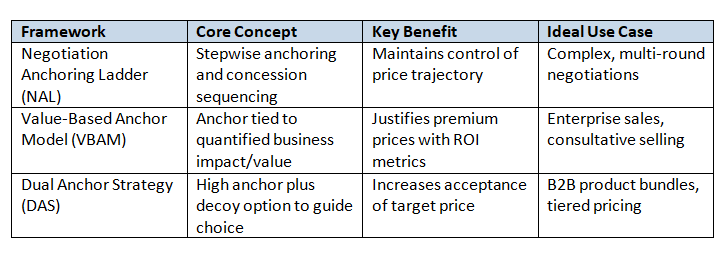
These models provide mental maps for systematically deploying anchoring tactics tailored to your sales context.
Step-by-Step Process
Step 1: Research and Prepare Your Anchor
Deeply understand your prospect’s needs, budget, and alternatives. Analyze market pricing, competitor offers, and your product’s differentiated value. Prepare an anchor price above your target final price, incorporating a buffer for concessions. This upfront preparation increases confidence and credibility.
Step 2: Establish Authority and Set Context
Open the negotiation by establishing your authority through brand prestige, expertise, or proven ROI. Frame the discussion around value rather than cost. For example: “Based on our track record with similar clients delivering a 30% productivity boost, our premium package starts at $X.”
Step 3: Deliver the Initial Anchor with Confidence
Present your anchor assertively and without hesitation. Use precise numbers rather than rounded figures to convey rigor (e.g., $97,500 vs. $100,000). Avoid tentative language like “around” or “maybe.” Silence after the offer is powerful.
Step 4: Use Reference Anchors to Reinforce
Show competitive pricing data, MSRP, or historical pricing trends to establish external anchors validating your price. This can include benchmarking studies or competitor quotes that position your anchor as fair or advantageous.
Step 5: Introduce Scarcity or Decoy Options
If appropriate, highlight scarcity (“Only 3 slots left at this price”) or present a decoy option priced higher but offering less value to nudge the buyer toward the preferred anchor.
Step 6: Prepare for Counteranchors and Objections
Anticipate buyer attempts to reset the anchor lower. Use objection-handling frameworks such as “Feel-Felt-Found” or “Price-Value Exchange” to reiterate your anchor’s validity and shift focus back to value.
Step 7: Gradually Concede with Strategic Concessions
If concessions are necessary, make them small, conditional, and time-limited to maintain anchor integrity. Never concede on price without extracting equivalent value concessions.
Real-World Case Studies
Apple’s Premium Product Launches
Apple consistently uses price anchoring by launching new products at premium prices well above competitors. Their initial anchor frames the product as a luxury, high-quality good, activating the price-quality heuristic. Consumers then perceive competitor prices as bargains or lower-tier. This strategy preserves Apple’s brand equity and gross margins even in price-sensitive markets.
McKinsey’s Value-Based Fees
McKinsey anchors fees based on quantified client impact — often charging a percentage of identified cost savings or revenue gains. This value-based anchor justifies fees significantly higher than standard hourly rates. Clients accept these anchors as they align directly with measurable business outcomes, reducing price pushback.
Amazon’s Procurement Negotiations
Amazon leverages dual anchoring in supplier negotiations by presenting a high internal cost benchmark alongside a lower preferred price. This anchors suppliers’ expectations and narrows the negotiation zone. Amazon’s deep data analytics inform reference pricing, creating a science-driven anchor difficult for suppliers to counter.
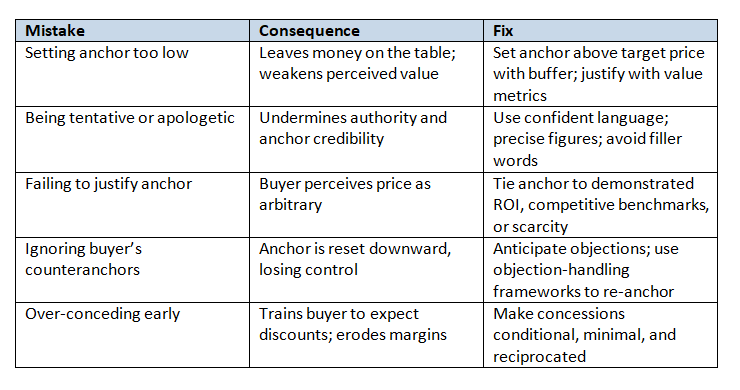
Common Mistakes and How to Avoid Them
Advanced Tactics
- Layered Anchoring: Introduce multiple anchors at different points—product features, implementation costs, service levels—to create complex mental reference points that increase final price acceptance.
- Anchoring Through Stories: Use narrative selling to embed price anchors within success stories or case studies, making the price feel justified emotionally and rationally.
- Time-Limited Anchors: Create urgency by making the anchor valid only temporarily, leveraging scarcity to pressure decision-making.
- Cognitive Reframing: Shift the frame from price to total cost of ownership or lifetime value to reset buyer mental benchmarks.
- Reverse Anchoring: In settings with empowered buyers, anchor by asking buyers for their budget first, then anchoring your offer just above it to create a contrast effect.
Scripts and Templates
Script 1: Initial Anchor Presentation
“Based on our extensive experience with companies in your sector achieving 25% cost reduction, our comprehensive solution is priced at $120,000 annually. This reflects the measurable value you can expect.”
Script 2: Handling Price Pushback
“I understand $120,000 is a significant investment. Many clients I’ve worked with initially felt the same way, but after seeing the impact on their bottom line, they found that the ROI justified the price. Can I share some examples?”
Script 3: Introducing Decoy Option
“We offer three packages: Basic at $85,000, Standard at $120,000, and Premium at $150,000. Most clients choose Standard because it balances features and investment optimally.”
Email Template: Post-Meeting Price Anchor Reinforcement
Subject: Following up on our proposal and pricing
Dear [Name],
Thank you for the productive discussion today. As we reviewed, the $120,000 investment aligns with the substantial business outcomes we anticipate delivering, including [specific metrics]. Please let me know if you have any questions or would like to explore customized options.
Best regards,
Frequently Asked Questions
Q1: Why is anchoring price so effective in negotiations?
Anchoring exploits cognitive biases where the first number presented sets a mental reference point, heavily influencing subsequent judgments. This effect is subconscious and robust, affecting even experienced negotiators.
Q2: How do I decide what price to anchor at?
Anchor at a price above your target final price but justified by value or market data. Consider your walk-away price, competitive landscape, and client’s perception of value. Preparation and research are critical.
Q3: Can anchoring backfire and alienate buyers?
Yes, if the anchor is unrealistically high without justification, it can damage credibility. Always back your anchor with data, ROI, or competitive benchmarks and deliver it confidently.
Q4: How do I respond if buyers present a lower counter-anchor?
Acknowledge their figure, then re-anchor by reiterating your value justification, using objection frameworks like Feel-Felt-Found, or introducing reference pricing and scarcity cues.
Q5: Is it better to anchor first or let the buyer start?
Generally, anchoring first gives you control over the negotiation range. However, in some cases where buyers have strong budget constraints, asking for their range first and then anchoring slightly above can be strategic (reverse anchoring).
Conclusion
Mastering price anchoring is the single most impactful skill a sales professional or business owner can develop to protect margins and close premium deals. Anchoring shapes buyer perceptions through well-documented psychological biases, allowing you to set favorable negotiation reference points that anchor value firmly in your favor. By combining rigorous preparation, confident delivery, and strategic use of behavioral economics, you create a powerful framework for pricing that withstands buyer pushback and drives profitable outcomes.
Start implementing the step-by-step processes, adopt the proven frameworks, and leverage the scripts in this guide to transform your price negotiations. Embrace advanced tactics to outmaneuver even the savviest buyers. Your next deal’s margin depends on the strength of your anchor—set it thoughtfully, confidently, and strategically. For personalized coaching or tailored pricing strategy consultations, contact our team to elevate your negotiation mastery today.
References
- Kahneman, D., & Tversky, A. (1979). Prospect Theory: An Analysis of Decision under Risk. Econometrica.
- Ariely, D. (2008). Predictably Irrational: The Hidden Forces That Shape Our Decisions. HarperCollins.
- Galinsky, A.D., & Mussweiler, T. (2001). First Offers as Anchors: The Role of Perspective-Taking and Negotiator Focus. Journal of Personality and Social Psychology.
- Cialdini, R.B. (2006). Influence: The Psychology of Persuasion. Harper Business.
- Thaler, R.H. (1985). Mental Accounting and Consumer Choice. Marketing Science.
- HBR Article: "The Science of Price Anchoring in Negotiations," Harvard Business Review, 2019.