How to Avoid Giving Discounts Without Losing the Deal: The Definitive Guide for Sales Professionals

Imagine a senior account executive on a critical call with a Fortune 500 prospect. The buyer leans in and bluntly states, "Your price is too high compared to your competitor. Can you do better on the price, or we’ll have to look elsewhere?" The deal, worth millions, teeters on the edge. The instinct to immediately concede a discount to save the sale is powerful, yet the cost of one unnecessary discount can ripple through the company’s margin for years. This scenario is all too familiar in sales environments inundated with discount expectations and commoditized offerings.
Understanding how to navigate these price objections without lowering your price is one of the most critical competencies senior sales professionals and business owners must master. Discounting is often seen as the quickest path to closing a deal, but excessive discounting erodes profit, damages brand perception, and trains buyers to expect lower prices. Behavioral economics teaches us that price perception is deeply psychological — buyers interpret price signals in complex ways that go beyond sticker numbers. Mismanaging this can lead to leaving money on the table or losing deals unnecessarily.
This comprehensive guide will equip you with the scientific psychology behind price perception, proven frameworks for value communication, a detailed step-by-step process to resist discounting pressure, real-world corporate examples, and tested scripts for objection handling. You’ll also gain advanced tactics and ready-to-use dialogue templates designed to keep your price intact while closing deals. Whether you are a SaaS sales leader, a professional services partner, or a manufacturing business owner, this pillar page will transform how you defend your price and win without discounts.
· Table of Contents
· The Psychology of Price: Behavioral Economics Behind Buyer Price Perception
· Key Frameworks: Value Ladder, Price-Value Matrix, BATNA for Pricing
· Step-by-Step Process to Avoid Giving Discounts
· Real-World Examples: Apple, McKinsey & Company, Salesforce
· Objection Handling: Price Objections and Exact Responses
· Advanced Tactics: Anchoring, Decoy Pricing, Scarcity, Reciprocity
· Scripts and Templates: Dialogue and Email Examples
· Frequently Asked Questions
· Conclusion and Call to Action
· References
The Psychology of Price
Buyers’ perception of price is rarely linear or purely rational. Nobel Laureate Daniel Kahneman’s prospect theory illuminates how buyers weigh potential losses more heavily than equivalent gains—meaning a price increase triggers disproportionately negative reactions, while a price discount does not produce equivalent positive feelings. This loss aversion makes price conversations psychologically charged.
Ariely’s research in "Predictably Irrational" highlights the anchoring effect—a cognitive bias where the first number a buyer hears sets a mental reference point influencing all subsequent price judgments. If you start the conversation with a strong premium price anchored to value, buyers will evaluate discounts relative to that, not just the sticker price.
The price-quality heuristic is another crucial concept: buyers often infer quality based on price. Lowering price can inadvertently signal lower quality or diminished value, undermining brand positioning. This is why companies like Apple maintain premium pricing to reinforce their product’s aspirational status as a Veblen good—where higher prices actually increase demand because they confer exclusivity and status.
The decoy effect also plays a role. Presenting a third, less attractive pricing option can steer buyers toward the premium choice, making it seem more reasonable by comparison. Understanding these psychological levers equips sales professionals to shape price discussions that protect margins without triggering buyer resistance.
Key Frameworks
Leveraging structured frameworks helps sales teams consistently resist discounting while reinforcing value. Below are three foundational pricing frameworks widely used by top-performing organizations:
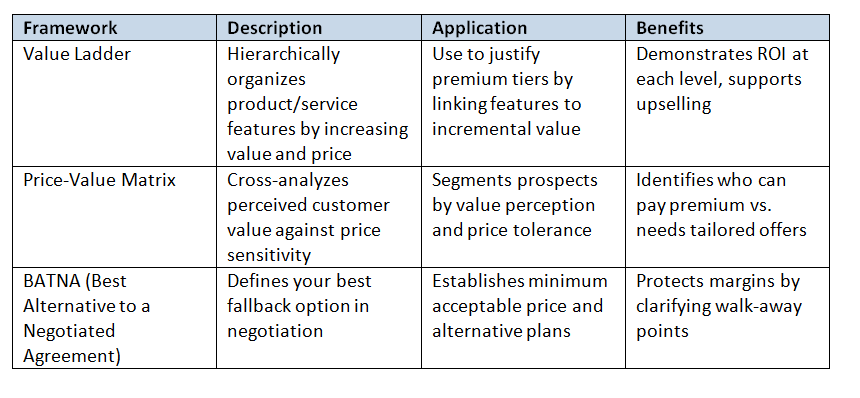
These frameworks unify sales and pricing strategy. For example, a Value Ladder guides reps to show clients how each incremental price step unlocks tangible benefits, reducing price resistance. The Price-Value Matrix enables tailored messaging based on the customer’s price elasticity. BATNA ensures reps never concede price below a profitable threshold.
Step-by-Step Process
Avoiding discounting requires a disciplined, consultative sales approach. Follow these six steps to navigate price objections without giving in:
Step 1: Prepare and Anchor Early
Before quoting, research the customer’s business challenges and budget context. Open with a confident, high-value price anchored to outcomes, e.g., “Based on your scale, we recommend our Enterprise package at $X, which delivers Y% improvement in KPIs.” This sets the mental reference point.
Step 2: Diagnose the True Objection
When price pushback arises, ask diagnostic questions: “Can you help me understand how you arrived at that budget constraint?” or “What factors besides price are important in your decision?” This uncovers underlying concerns like risk, timing, or competing priorities.
Step 3: Reframe Price as Investment, Not Cost
Use storytelling and data to shift the conversation from expense to ROI. For example, “Our solution reduces churn by 15%, which translates to $X in revenue retention annually.” This leverages the price-quality heuristic positively.
Step 4: Employ the Decoy or Tiered Options
Present multiple pricing tiers to create choice architecture. Highlight the mid-tier as the best value. For example, “Our Professional plan offers these features at $X, but the Enterprise plan adds Y and Z for $Y — most clients choose Enterprise for the additional ROI.”
Step 5: Introduce Non-Monetary Concessions
If pressure remains, offer value-added options that do not cut price, such as extended implementation support, training, or faster delivery. This demonstrates goodwill without eroding margin.
Step 6: Use BATNA and Be Ready to Walk Away
Know your minimum acceptable price and communicate confidence. “We want to partner long-term, but $X is the lowest we can go to maintain quality. If this doesn’t meet your budget, I’d be happy to revisit when priorities shift.” Willingness to walk away increases perceived value.
Real-World Examples
Apple maintains some of the highest price points in consumer electronics. Rather than discounting, Apple invests heavily in brand equity and product innovation. Customers perceive Apple products as superior quality and status symbols (Veblen goods), making them less price sensitive. Apple rarely offers discounts, instead driving upgrades and loyalty through ecosystem lock-in, allowing them to protect margins and profitability.
McKinsey eschews hourly billing in favor of value-based fees tied to client outcomes. Their pricing conversations focus on measurable impact—cost savings, revenue growth—not just time input. This repositions price as a fair investment, reducing discount pressure. McKinsey’s disciplined pricing framework supports premium fees and long-term client relationships.
Salesforce uses a tiered pricing model anchored around features and company size. The presence of multiple subscription levels creates decoy effects, steering customers towards higher-value plans. Salesforce sales teams are trained to resist discounting by demonstrating incremental value at each tier, and by offering non-price concessions like dedicated support.
Objection Handling
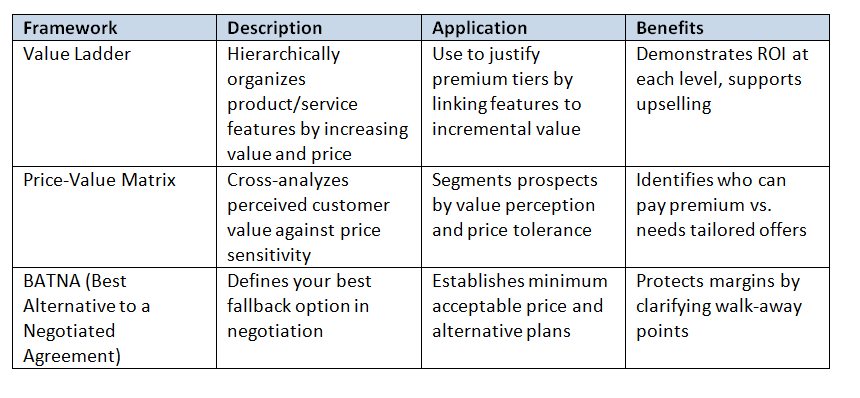
Price objections are inevitable. Below is a table matching common objections with exact, proven responses to maintain price integrity:
Advanced Tactics
Experienced sales leaders use these expert-level tactics to further safeguard price:
· Price Anchoring with High-Value Packages: Start conversations with a premium-priced option to create a favorable comparison for core offerings.
· Decoy Pricing: Introduce a deliberately less attractive option to make the preferred package appear more reasonable.
· Scarcity and Urgency: Use limited-time offers or capacity constraints to encourage timely decision-making without lowering price.
· Reciprocity Without Discount: Offer free consultations, workshops, or add-ons to trigger buyer reciprocation psychologically without reducing price.
· Collaborative Pricing Workshops: Engage buyers in joint value-creation sessions to co-develop solutions and justify price.
Scripts and Templates
Below are ready-to-use scripts proven to navigate price negotiations without discounting:
“Based on our analysis, the Enterprise package at $X is the best fit for your goals, delivering Y% efficiency gains. Many clients find that the ROI justifies the investment quickly.”
“I appreciate your concern about price. Could you share more about your budget parameters? Often, when we look at the total cost of ownership and benefits, the premium is offset by measurable savings.”
“While we’re unable to adjust the price, we can include additional onboarding support to accelerate your team’s adoption and maximize value.”
“We want to ensure this is a win-win partnership. If the pricing doesn’t align with your current priorities, I’d be happy to stay in touch and revisit when circumstances change.”
Frequently Asked Questions
Q1: How can I justify premium pricing to a skeptical buyer?
A1: Focus on quantifiable outcomes, use case studies, and leverage the price-quality heuristic by reinforcing your brand’s value and differentiation. Provide ROI calculations that align with the buyer’s business goals.
Q2: When is it appropriate to offer discounts without damaging margins?
A2: Discounts should be strategic, such as for multi-year contracts, volume commitments, or to accelerate payment terms—not as a reaction to initial objections. Always tie discounts to reciprocal commitments.
Q3: How does anchoring influence discount negotiations?
A3: The first price presented sets the buyer’s reference point, making subsequent concessions seem more significant. Anchor high to increase perceived value and create room to negotiate on other terms besides price.
Q4: What non-price concessions can I offer instead of discounts?
A4: Additional training, extended support, faster delivery, or extra features at no cost can add perceived value without reducing price.
Q5: How can I train my sales team to avoid discounting?
A5: Use role-playing, objection-handling frameworks, and emphasize value communication. Establish clear BATNA thresholds and empower reps to say no confidently.
Conclusion
Mastering the art of avoiding discounts without losing deals is a transformative skill that preserves margin, strengthens brand equity, and elevates sales performance. By understanding the deep psychology behind price perception and applying structured frameworks, you can confidently navigate pricing conversations that others might succumb to discount pressure. The step-by-step process, real-world examples, objection responses, and advanced tactics provided here equip you to shift from reactive discounting to proactive value-driven selling.
Take control of your pricing destiny today. Implement these strategies with your team, refine your scripts, and commit to defending your value. The difference is not just in closing deals but closing deals that deliver sustainable profit and long-term client partnerships. Start transforming your pricing conversations now — your margins and reputation depend on it.
References
· Kahneman, D., & Tversky, A. (1979). Prospect Theory: An Analysis of Decision under Risk. Econometrica.
· Ariely, D. (2008). Predictably Irrational: The Hidden Forces That Shape Our Decisions. HarperCollins.
· Cialdini, R. B. (2006). Influence: The Psychology of Persuasion. Harper Business.
· Hinterhuber, A., & Liozu, S. M. (2014). Is It Time to Rethink Your Pricing Strategy? MIT Sloan Management Review.
· Nagle, T., Hogan, J., & Zale, J. (2016). The Strategy and Tactics of Pricing: A Guide to Growing More Profitably. Routledge.
· Harvard Business Review. (2015). Stop Giving Away the Store: How to Protect Your Pricing Power. HBR Articles.